370 Chrome Vulnerabilities Patched: 13-Year-Old Sandbox Escape (CVSS 9.6) Finally Fixed by Google's AI
TL;DR
- CVE-2026-18556 & 18577: Unauthenticated RCE Swarm Hits Arista VCO. Your VCO patched? Because May called, and it wants its zero-day back.
- 83% Detection Gap: Three Cybersecurity Hubs Coordinate While 14 Critical CVEs Go Live. Your security team still debating while 14 critical exploits drop — how long before you're the incident report?
- 370 Chrome Vulns Fixed in One Go — One Hidden Since 2013 (CVSS 9.6). When was the last time you actually checked your browser for critical unpatched exploits?
🏴☠️ Arista VCO: The Door Wasn't Just Unlocked, It Was Demolished
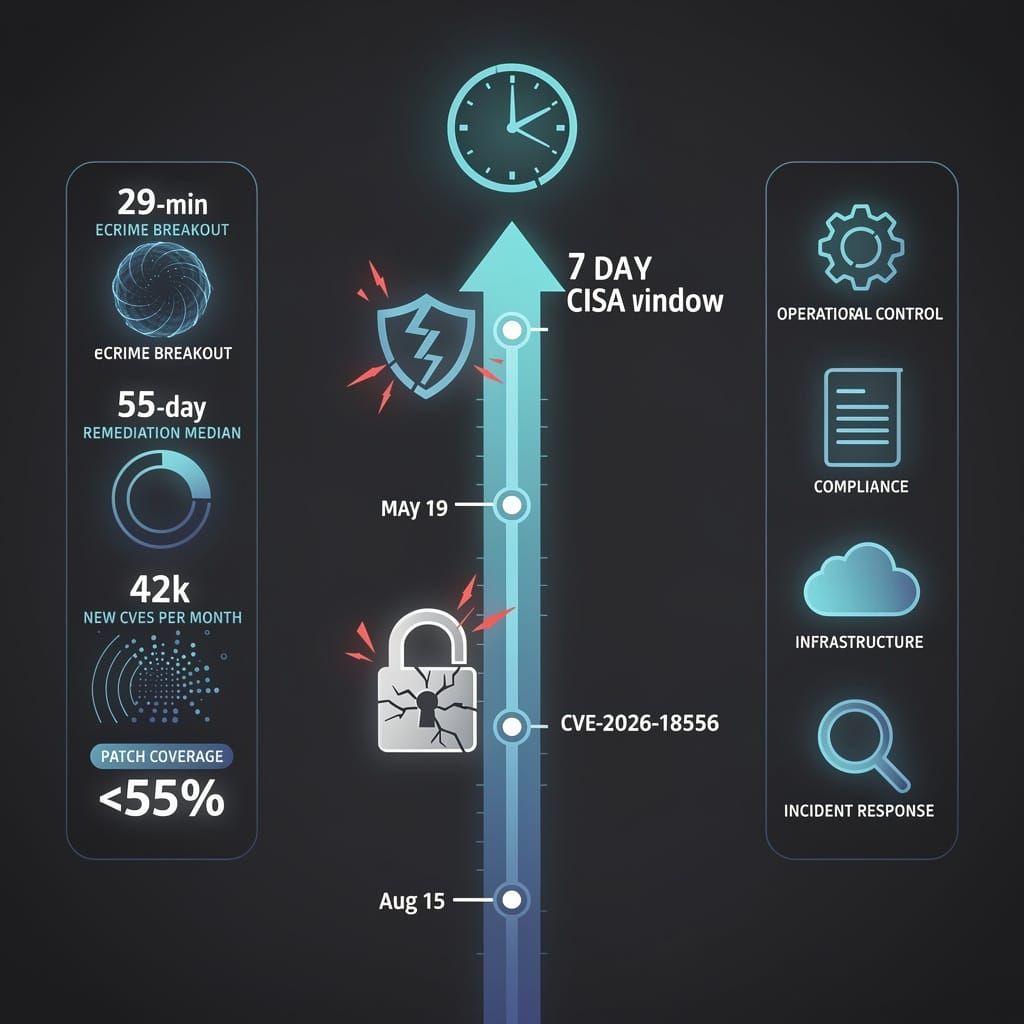
CVE-2026-18556: auth was optional. Arista VCO shelled with zero creds, zero clicks, just a malicious HTTP fart. 🏴☠️ Patch was so shit CISA dropped CVE-2026-18577 4 days later. Less than 55% of systems fixed. eCrime breakout hits 29 minutes, enterprises run 55-day remediation. Good luck with that board slide. — You're 9 weeks past the first exploit. Patch today or enjoy explaining to your CISO why "we were waiting" was your strategy?
Some engineer is staring at a Slack channel right now muttering "well shit" for the 48th time this year. Arista's VeloCloud Orchestrator spent July telling the internet authentication was merely a suggestion.
The Zero-Day That Didn't Even Ask for a Password
- CVE-2026-18556 — confirmed by N‑able on August 15, actively exploited since May 19. Unauthenticated command injection through the web UI. No credentials. No user interaction. Send a malicious HTTP request and you own the orchestrator, all edge devices, and probably your CISO's weekend. The patch? It was so incomplete that CISA had to add CVE-2026-18577 on August 4 — a CVSS 8.2 authenticated server takeover via that same "fixed" path. Attackers weaponized N-Central's 'Take Control' function to persist remotely. Less than 55% of systems patched.
CISA's Double Feature: Admin Nightmares, Now in Theaters
Two CVEs hit the Known Exploited Vulnerabilities catalog this week. Both enable full admin takeover via paths your vendor forgot to document. Real exploitation? Already live. Target? Cloud infrastructure, obviously. Meanwhile, 42,000 new CVE submissions flood NIST's triage queue monthly — NIST halted automated severity scoring in April, shifting enrichment to manual review. Good luck getting a CVSS baseline before your board asks why you're still vulnerable.
Impact breakdown:
- Operational: Attackers gain full administrative control over all linked edge devices via exposed API paths classified as "internal" until someone actually checked. RMM platform breaches confirmed.
- Compliance: Undocumented API paths + active exploitation since May 19 + BOD 26-04 deadline = your SOC 2 audit just got a lot more interesting. Regulators want attestations linking technical findings to strategic decisions.
- The CISA clock: Seven days. Patch or explain to your board why "we were waiting for the official advisory" was your strategy.
The Forecast (Sardonic, but Accurate)
Fully mitigated by August 7 if hardening completes immediately. That's Arista's optimistic scenario. The realistic one involves credential rotation across every managed device, forensics on configuration file integrity, and several all-nighters. Average eCrime breakout hits 29 minutes — enterprises still sit on 55-day median remediation delays. Good luck threading that needle.
Sectoral Implications
- Enterprise security: If your VCO isn't patched, assume compromise. Not "consider it"—assume it. Exploitation predates disclosure by three months. Mythos-generated CVEs are accelerating exposure windows daily.
- Cloud infrastructure: These exploits target the orchestration layer. Everything below it is now suspect, including active Cloudflare tunnels observed in the CVE-2026-18577 attack chain. Anomalous svchost.exe files and specific IP flows are your detection breadcrumbs.
- Incident response: Forensics teams should prioritize configuration file integrity. Exfiltration vectors were confirmed operational during May's initial exploitation wave. Limited customer exposure reported, but that's cold comfort when you're the one doing the postmortem.
The Bottom Line (No, Seriously, Patch Now)
N‑able disclosed this on August 15. Zero-days don't respect patch schedules. Active exploitation was spotted in May, and CISA is now breathing down your neck with BOD 26-04 deadlines. One vendor promise and a CISA deadline don't change physics. Patch today to v2026.3.1.7. Confirm tomorrow. Audit next week. Or enjoy that conversation with your CISO. 🏴☠️
🔥 Oh Great, Anthony Spadafora Is "Coordinating" From His Home Office. What Could Possibly Go Wrong?
83% of vulnerabilities remain invisible to conventional screening — while a "continuous cybersecurity coordination" unit with three hubs argues across time zones about who pushes the button 🔥 That's the gap between Anthony's home office Zoom calls and the 14 critical CVEs (CVSS 9.0–10.0) disclosed in just 6 weeks. AI-driven attacks already surpassed defenses on July 20. Your invoicing system goes down for 6 hours while the steering committee debates acronyms. Small businesses absorb the latency tax — you're still RDPing over port 3389 while three hubs "coordinate." Ready to bet your recovery cost on another committee meeting?
Three hubs — Houston, Texas, South Korea, Hawaii. A "continuous cybersecurity coordination" unit. One guy named Anthony running vulnerability assessments with test protocols. And the big reveal? A June 30 Reuters State of Cybersecurity report confirms systemic gaps in response coordination — and Harfang Lab's August webinar plans suggest more talking than fixing.
Brilliant. 🔥
The Punch Line Nobody's Laughing At
Let's trace the causal chain:
- May 28, 2026: HHS shuts down the Office of Long COVID Research, NIH funding terminates — national research capacity evaporates. Meanwhile Cogent Research's Detection Gap Report reveals 83% coverage hole in conventional vulnerability screening. Wiz launches an Exposure Management Dashboard that can map entire attack trees daily. Detection improves, but who pushes the button?
- Same week: Palo Alto Networks, IBM, and Red Hat launch Project Lightwell — virtual patching for small businesses. Still waiting on Anthony's team to approve the rollout.
- Result: Encrypted remote access tool adoption rises "slightly" among verified users only. The other 80% of people working from home are still exposed — a pattern confirmed since CyberArk's June 2020 survey showed 77% of remote workers using personal devices for corporate systems, with 40% of organizations failing to increase security protocols. Forward Email's v0.11.26 with AES-256 at-rest encryption dropped July 7 — but nobody told the coordination hubs.
The mechanics here are tragically simple: distributed workforce + centralized security theater = lag. BeyondTrust disclosed four critical CVEs (CVSS up to 9.2) on July 7 enabling remote takeover. UniFi OS had CVE-2026-34908 on June 23 — root-level RCE confirmed by Bishop Fox on June 8 across five CVSS-10.0 vulnerabilities (CVE-2026-34908 through -34911). OpenRemote's IDOR bug on July 31 lets attackers register fake consoles under legitimate IDs. And Ubiquiti rolled out v5.1.19 patches on July 8 for two more critical flaws (CVSS 9.9 and 9.0) — but who's coordinating that rollout across three time zones?
Three hubs debating patch Tuesday while the exploit window widens.
The Real Game
| What They Said | What It Means |
|---|---|
| "Continuous coordination" | More Zoom calls across three time zones |
| "Core collaboration hubs" | Jensen Huang's HBM deals in South Korea, while your router gets owned |
| "Response times may lag" | July 20 confirms AI-generated attacks surpass projections. You're still waiting on committee approval. |
Who Pays?
Small business owners absorb the latency tax. Simply Business launched Risk Radar on July 13 because SMEs bleed recovery costs exceeding 9 months revenue per incident — while long-COVID economic impact alone exceeds $8 billion by late 2027, and healthcare systems already fail to capture multi-morbidity trajectories. AI-generated legal exposure from inaccurate outputs. Inflation-adjusted insurance gaps. Delayed patches from coordination hubs mean your invoicing system is down for 6 hours. Meanwhile Bishop Fox demonstrated that those unpatched UniFi OS endpoints enable multi-stage attack chains for lateral movement across enterprise networks.
Adoption of encrypted remote tools rises slightly among verified users. That means everybody else is still RDPing over port 3389 with "Password123" — exactly the behavior the 2020 Pulse Secure VPN credential leak exposed across 617 still-vulnerable servers.
South Korea is building its own sovereign AI cybersecurity model by year-end — because even they know US "coordination" is theater. SK Telecom and SK Hynix are partnering with Nvidia on secure supply chains. Meanwhile Anthony is probably patching his own router right now while the steering committee debates acronyms.
IBM posted a -7% infrastructure revenue dip on July 14, stock down 26%. Their big announcement? Lightwell going GA for open-source vulnerability management. The same Lightwell Anthony's team is "reviewing."
Outlook
- Near-term: July 20 prediction confirmed — AI-driven attacks outpace defenses. Vulnerability reporting up 20%, remote-code-execution up 39%. The lag between detection and response widens. Expect at least one medium-severity incident to slip through before Q4.
- Medium-term: Either they strip the coordination hubs down to one actual decision-maker, or the whole "continuous" thing becomes a euphemism for "we saw it coming but couldn't agree on who pushes the button." Red Hat, IBM, and Palo Alto are already doing the work.
- Recommendation: Ditch the three-hub NATO cosplay. Give Anthony a terminal, a budget, and a direct line. No committees. No time zones.
Cheeky bastard's probably deploying Lightwell patches while five directors debate the fiscal implications. 🌴
🗑️🔓 Google Finally Admits Chrome Was Held Together With Tape, Fixes 370 Vulns
370 vulns patched in one Chrome update. One of them — a sandbox escape (CVSS 9.6) — had been hiding since 2013. That's 13 years of someone holding keys to your browser castle 🗑️🔓 Google's AI found it. Then Google frantically fixed it outside the normal cycle. Chrome runs on 3.4 billion devices. Every one of those 370 holes was a pre-staged invasion route. Backup software punches its own privilege escalation. Arch Linux can't trust its package repo. NVD hit 46,872 flaws in half a year. Your threat model is fine though, right? 😏
Oh, now you patch. After 370 gaping holes—including one ancient sandbox escape (CVE-2026-3545, CVSS 9.6) that Gemini AI detected lurking since 2013—Google ships a Chrome emergency fix that screams "we lost the keys to the castle for thirteen years and found them under the server rack." 🗑️🔓
July 30, 2026: 370 vulnerabilities closed in a single browser update. But that's just the teaser—Google also disclosed that AI-driven audits had uncovered 1,072 total bugs across Chrome 149–151, more than the browser's entire prior decade of patches. Not a patch. That's an archaeological excavation of technical debt.
The Sandbox That Was Never A Box
The crown jewel? A remote code execution flaw—a sandbox escape that had been hiding in plain sight since Chrome's early days. Google skipped the quarterly release cycle entirely, pushing an out-of-band fix after Gemini traced the CVE through 13 years of unpatched Git history. The discovery chain: AI detection → internal "oh shit" meeting → emergency release. Earlier in July, Google had already pushed Chrome 150.0.7871.46 fixing over 400 bugs and 150.0.7871.114 fixing 27 more—meaning the year's total actually crosses 1,499 vulnerabilities across Chrome 148–151 alone.
Meanwhile, In Dystopia Corner
- Arch Linux (June 11): Attackers injected malicious shell commands into AUR PKGBUILD files that execute during system upgrades, slipping RAT payloads and credential harvesters into normal-looking updates. Users now need
diffmenuandeditmenuflags just to survive package installs. The hobbyist distro's package ecosystem runs on the honor system. It is not being honored. - Veeam (July 22): Privilege escalation vulnerability discovered in backup software. The irony of your backup tool being the attack vector writes itself.
- Redis (June 8): Critical RCE via SLAVEOF command (CVE-2026-23631) patched across versions 7.2.x–8.6.x. AI-driven hacking tools like FlameScript already weaponizing memory handling flaws.
The Real Scoreboard
| Impact | Figure |
|---|---|
| Chrome vulns fixed July 30 | 370 |
| Total Chrome vulns fixed in 2026 (148–151) | 1,499+ |
| Sandbox escape CVE-2026-3545 severity | CVSS 9.6 (hidden since ~2013) |
| NVD global flaws, early 2026 | 46,872 |
Why This Actually Hurts
Chrome runs on 3.4 billion devices. Each of those 370 vulnerabilities was a pre-staged invasion route. The math is simple:
- Attack surface: 3.4B endpoints
- Unpatched window for CVE-2026-3545: ~13 years
- Lateral movement potential: Everything connected to everything
🎯 The Cheeky Bit
We're now in a world where the NVD hit 46,872 flaws in a single half-year, Arch Linux can't trust its own package repo, enterprise backup software punches its own privilege escalation, and the world's most-used browser needed a sandbox escape that went unnoticed for 13 years to be found by its own AI.
But sure, keep telling me your threat model is fine.
The real takeaway: patch your Chrome (v151.0.7922.71+), stop using AUR for production deploys, and maybe—just maybe—test your backup software before the ransomware does it for you. 😏
Full disclosure: This article was typed on a Tails-booted machine. You should too.


Comments ()