🤖 Agility's Digit 5: Safer Humanoid, Still Unproven at Scale
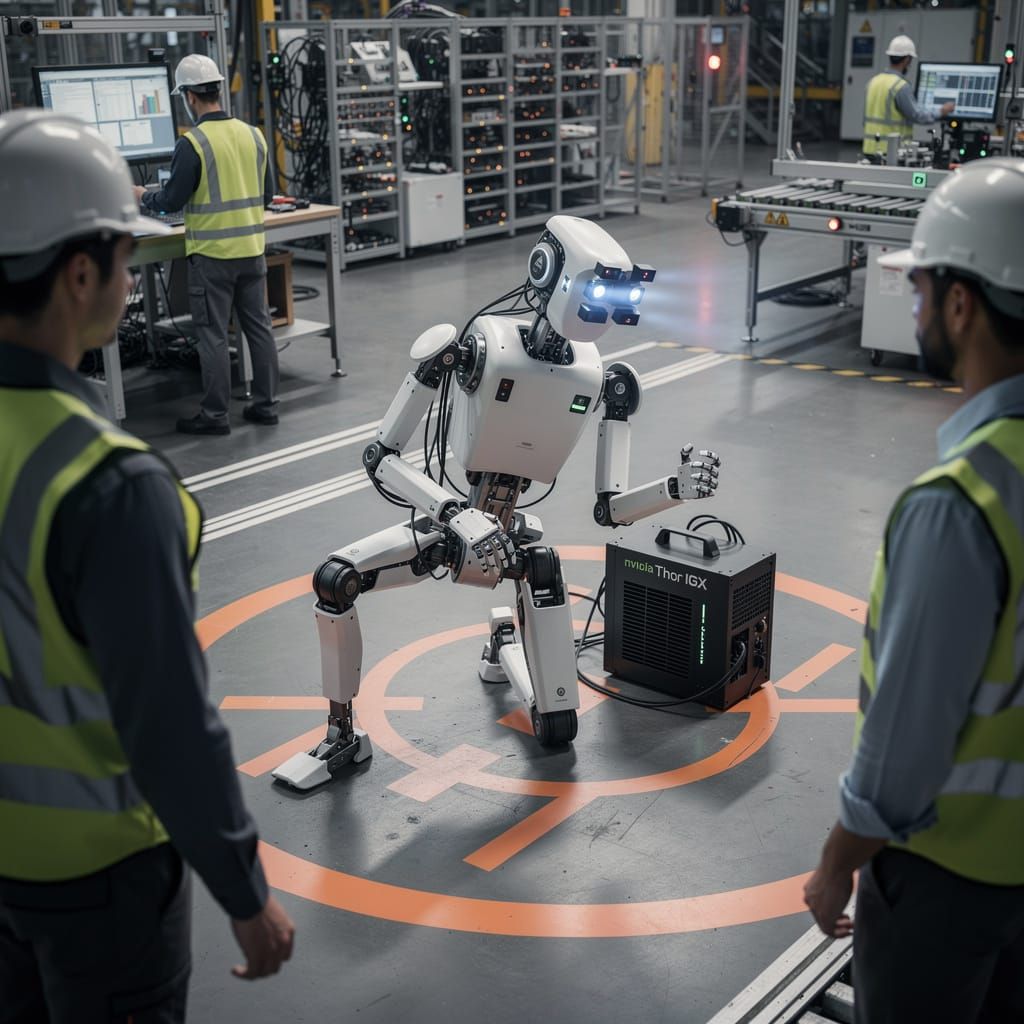
Digit 5 lifts 40% more, runs 10:1 vs 2:1, and works 20+ hrs a day. 🤖 But Agility's $300M order book is mostly a memo—2025 sales were just $1.78M. First commercial shipments? Late 2027. Customers are betting $250K+ per machine on lab data with zero production record for this generation. Is your factory a test site or a waiting room?
On September 15, Agility Robotics took the wraps off Digit 5, its fifth-generation humanoid, pitching it as the machine that finally clears the barrier that has kept humanoids out of most factory floors: safety around people. Give the company this much—the engineering is real, and its operating history is longer than its skeptics admit. What's still missing is proof that this specific generation works at scale.
The Spec Sheet Gets Better
Digit 5's hardware improvements are measurable and meaningful. Payload jumps 40% to 50 pounds. Reach extends to 7.2 feet, up from 5.5. The new battery delivers a 90-minute runtime with a nine-minute recharge, improving the run-to-charge ratio to 10:1 from Digit 4's 2:1—enough for the machine to nominally work more than 20 hours in a 24-hour day.
The headline change is the safety architecture. Digit 5 carries sensor arrays and computing (Nvidia Thor IGX, with Halos for Robotics software) that detect nearby people and respond—slowing, stopping, steering clear, or sitting down and cutting power. Agility's co-founder Jonathan Hurst described a four-layer AI stack: a hardware foundation, a coordination layer running 1kHz motor control, a skill definition layer, and a cognitive orchestration layer built on LLM/VLA models. CEO Peggy Johnson demonstrated the flagship behavior—the robot descending to floor level in a seated failsafe upon detecting nearby personnel, clearing the path before resuming work.
The intent is to eliminate perimeter fencing, interlocks, and plexiglass workcells entirely, letting robots work shoulder-to-shoulder with humans. That is a genuinely harder engineering problem than lifting boxes, and Agility deserves credit for attacking it.
Where the Enthusiasm Needs a Check
Now the uncomfortable part: the numbers that matter most aren't operational on Digit 5—they're contractual and historical.
Agility reports more than $300 million in multi-year orders, including a robot-as-a-service arrangement for 1,000 Digit 5 units. That's a memo of intent, not a production record. The underlying fleet does have a track record—Digit has run across 9 customer sites, including Schaeffler, GXO Logistics, and Toyota Motor Manufacturing Canada—and a 2025 ProMat demonstration logged a 98.96% success rate over 28 hours for GXO. But Digit 5 itself remains in pre-production testing; preliminary specifications come from lab data, with early commercial shipments not targeted until late 2027.
Prudence is warranted on the commercial picture. Agility's S-4 filing shows just $1.78 million in net sales in 2025 (versus $310,000 the year before) against an operating loss that grew to $140.2 million. It closed a $2.5 billion SPAC merger with Churchill Capital Corp XI in June 2026, raising over $620 million—capital Agility says it will steer toward domestic manufacturing and supply chain sovereignty, including reducing dependence on imported LiDAR and rare earth metals. Trading under ticker AGLT, the valuation sits at roughly 1,400x trailing revenue.
At that multiple, the math leans on future promises: deployment targets of 800 units by 2027, 7,000 by 2030, and 25,000 by 2035, with RaaS at $8,500 per robot per month projected to reach $2.55 billion in annual subscription revenue. A $200,000-per-unit price tag, plus a $20,000 deployment fee and $36,000 in annual software and maintenance, means customers are betting roughly $250,000-plus per machine on a platform with no certified production record for this generation.
A Familiar Pattern
This launch follows the script we've seen repeatedly across ground autonomy. Vendors ship a compelling spec sheet, cite a backlog of orders, and let the "scaling" narrative carry the valuation. Agility's own trajectory—from Cassie's 2022 Guinness 100-meter record through Digit 1's 2017 proof-of-concept to today—shows a company comfortable front-running verification with ambition.
The hard evidence that survives an audit—measured throughput deltas against human labor at Schaeffler's line and GXO's Atlanta warehouse, verified uptime on Digit 5 hardware itself—arrives later, or never. Digit 5 has early-access commitments for H1 2027 and general availability by end of 2027, with EU and UK expansion to follow. Until deployed units produce published, third-party-verifiable operating metrics, the safest assessment is this: an impressive laboratory-grade hardware revision, an unproven commercial product, and a valuation that assumes the lab results hold at scale.
The robots will tell the truth. The press releases won't.


Comments ()