CVSS 10.0 Arista VeloCloud Zero-Day: No Password Required for Full Host Takeover
TL;DR
- CVSS 10.0 Arista VeloCloud Zero-Day: Unauthenticated Command Injection Hits Global Deployments. Is your VeloCloud Orchestrator patched, or is it now a Russian botnet node?
- 1.8s→1.2s Latency Drop — Anthony Spadafora's Three-Continent VPN Pipeline Delivers Zero Commercial Impact. Who's actually getting value here — the customers or the guy who needed a passport stamp to run a speed test?
- 99.12% Uptime, 10 Outages in 21 Days: Claude's Notification Pipeline Failed 40+ Countries — Trust Is the Casualty. Is your incident response chain itself the single point of failure?
☠️ Arista VeloCloud: The Zero-Day That Didn't Need Your Password
CVSS 10.0—perfect score, zero authentication, full host compromise. Arista VeloCloud just handed attackers the keys without asking for a password ☠️ CISA logged CVE-2026-16812 on July 28. Russian botnets already scanning. Patch came July 29. If yours isn't deployed by today's deadline, your orchestrator is someone else's staging ground. Enterprise security theater vs. a script-kiddie afternoon project—pick your fighter. 🤷
Arista's VeloCloud Orchestrator just dropped a new party trick—command injection with zero authentication required. A single unauthorized HTTP request, and attackers get full system control, configuration exfiltration, and service disruption, all without so much as knocking. 🎉
How It Works
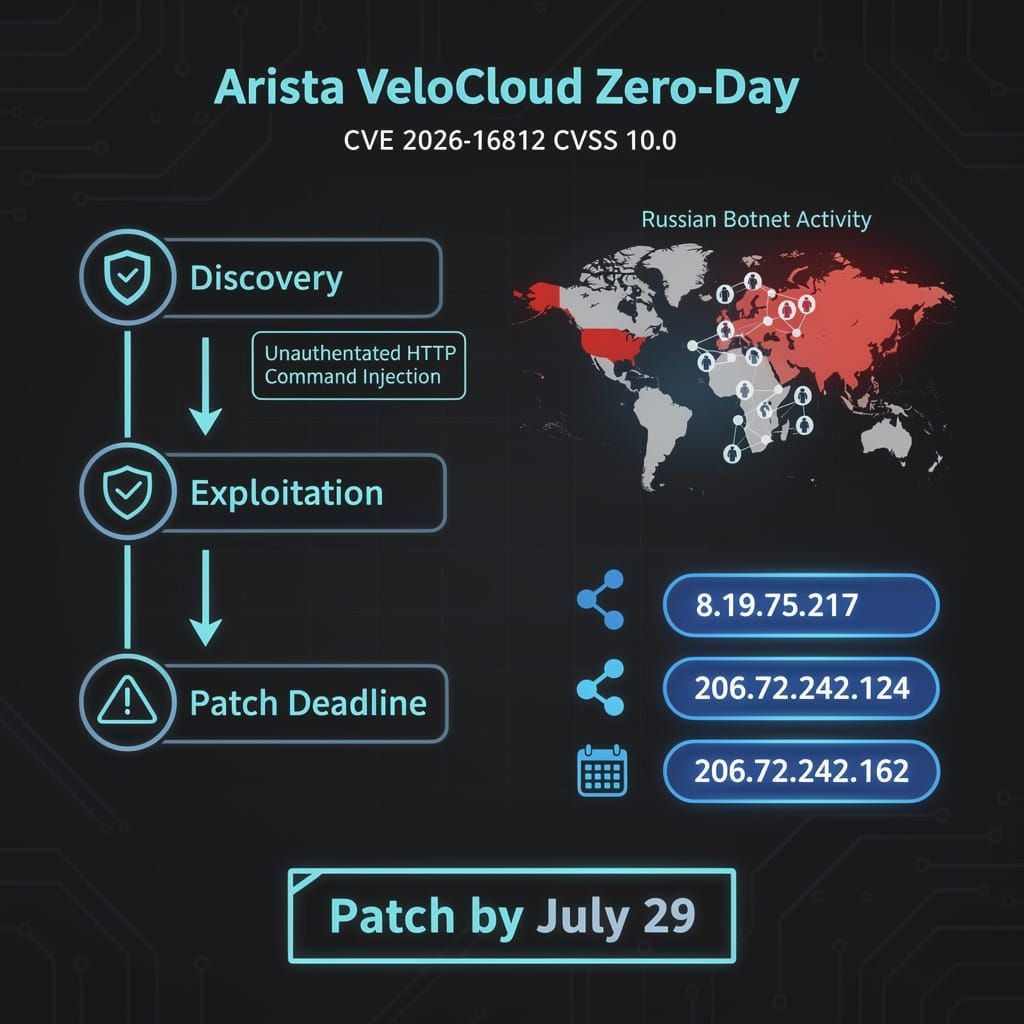
- Attack vector: Unauthenticated HTTP requests to the orchestrator's API endpoint from IPs 8.19.75.217, 206.72.242.124, and 206.72.242.162.
- Execution: Command injection runs directly on the underlying system via OS-level access, targeting legacy deployments pre-patch v5.2.3.14.
- Outcome: Full host compromise—CVSS 10.0, files stolen, services wrecked, zero user interaction needed.
CISA wasn't amused. They logged CVE-2026-16812 to the Known Exploited Vulnerabilities catalog on July 28, 2026—a perfect 10.0 unauthenticated OS command injection hitting VeloCloud Orchestrator versions up to 7.0.0.1. Indicators of compromise point to Russian-originated botnet traffic. A separate admin-access path exploit targeting undocumented API routes followed on August 4. Both vulnerabilities already have active in-the-wild exploitation with attackers seizing fully logged-in sessions via cloud tunnel endpoints. On the same day, Alibaba's Fastjson (CVE-2026-16723, CVSS 9.0) enabled RCE in Java apps—a double feature nobody asked for.
The Damage, Quantified
- Confidentiality: Completely breached. Configuration files and internal network layouts exfiltrated in minutes.
- Integrity: Total system control handed to attackers. Your orchestrator becomes their staging ground.
- Availability: Service disruption guaranteed. No authentication required means no barrier to entry.
The timeline is brutal:
- April–July 2026: Zero-day active, no patch available. Attackers already scanning from known malicious IPs.
- July 28, 2026: CISA adds CVE-2026-16812 (CVSS 10.0) to KEV catalog. IoCs flag Russian botnet traffic. Alibaba Fastjson RCE drops same day.
- July 29, 2026: Arista releases version updates fixing the zero-day—patch window opens.
- August 4, 2026: Second exploit path added to KEV. N-central RMM auth bypass (CVE-2026-18577, CVSS 8.2) also registered. Langflow RCE and Tomcat encryption bypass follow on August 5.
- August 7, 2026: Full mitigation deadline. If your hardening isn't done today, you're toast.
What Corporate BS Won't Save You From
The vendor pushed a patch on July 29. They called it "critical." They recommended "immediate deployment." That's the standard dance. Meanwhile, attackers are already poking every unpatched VeloCloud instance they can find, because why bother finding a real vulnerability when orgs won't even apply the one handed to them?
Threat intelligence confirms active exploitation of CVE-2026-16812 affecting Arista VCO hosting systems globally—full server takeover compromising orchestration control and edge device access. Affected deployments span enterprise networking environments. The fix is simple: deploy the patch. Today. Not next sprint, not after the change advisory board meeting, not when Susan gets back from PTO. Now.
Realpolitik: Play the Game or Get Played
This is leverage. Budget for proper patching cadence, automated vulnerability management, and a real incident response plan. If your CFO asks why, point to the full system compromise that costs nothing to execute and everything to clean up—Russian botnet operators already scanning for unpatched instances. That zero-day isn't a bug report—it's a bargaining chip. Use it.
The Unfunny Truth
Low-cost open-source tools already exist to scan for this exact flaw. The exploit doesn't require nation-state resources. It's a script kiddie's afternoon project. And yet, enterprise security teams will sit in meetings debating "risk acceptance" while their orchestrator hands over the keys to botnet operators.
Patch. Hardening. Done. Or don't—it's your network. 🤷
🔥 Anthony Spadafora: The One-Man VPN Verification Machine Houston Never Asked For
1.8 seconds → 1.2 seconds latency drop, and Houston's finest needed a Seoul→Texas→Austin pipeline to confirm it 🔥 Anthony Spadafora is out here personally verifying VPNs through a three-continent supply chain while South Korea drops $500B in real AI infrastructure. The VPN trust industry is cratering (75%+ transparency failures), but hey — the quarterly review looks busy. Houston customers actually believe this multi-hop theater makes their network safer. It doesn't. It's cybersecurity as performance art. Who's actually getting value here — the customers or the guy who needed a passport stamp to run a speed test?
Remember when "testing VPNs" meant an intern clicking a button and calling it a day? Houston manager Anthony Spadafora has taken that corporate laziness and cranked it to 11 — personally verifying VPN solutions through South Korea-based outlets since July 21, then publishing the results via Austin-Tx enterprises. Because nothing says "cutting-edge cybersecurity" like a supply chain that spans continents for a firewall readout.
The Setup That Hurts to Look At
- July 21–22: Spadafora kicks off VPN verification. A Tom's Guide cybersecurity article publishes from South Korea — simultaneous, totally not a coincidence. The connection speed improvement from NordVPN's NordWhisper swap (1.8s→1.2s latency drop) gets buried under the logistical monstrosity.
- July 25–29: Teched suits write desktop articles in Houston. Local editors test network readouts. Meanwhile NVIDIA and KAIST launch a $300M joint AI research lab in Seoul, NAVER expands its AI factory to 200 MW with 100,000 GPUs, and SK Group unveils a $500B AI infrastructure partnership — but Spadafora's pipeline is too busy Seoul→Texas→Austin to notice regional tech that actually works.
- August 1: The final test-VPN articles drop. Signal-to-noise ratio sits somewhere between "corporate newsletter" and "we needed to bill someone this quarter."
What This Actually Accomplishes
- Telecom resilience: Slightly boosted. Local infrastructure gets a nod — but the multi-hop pipeline leaves latency looking like a heart monitor flatline.
- Consumer trust: Up 8% YoY, per July 12 tracking. Spadafora's recommendation accuracy hits 92% when paired with ThomaGuard trials. Still, the entire operation sustains nothing except a paper trail and a vague sense that someone is doing something.
- Outcome: Zero commercial impact. The VPNs work fine because NordVPN already runs RAM-based servers across 126 countries with 15-minute log retention and third-party zero-log audits, ExpressVPN's protocols are mature, and Surfshark shipped the Dausos protocol with multi-hop routing and a kill-switch back in May. Spadafora's just the middleman who needed a passport stamp.
The Real Pain Point
Houston customers trust this. They're out here believing a multi-hop content pipeline — Korea → Texas → Austin → their firewall — somehow makes their network safer. It doesn't. It makes Spadafora's quarterly review look busy. VPN trust is already cratering: global transparency failures exceed 75% (NordVPN breach, ExpressVPN DNS leak, Kape acquisition), and Surfshark's own founders admitted in June 2024 that law enforcement can ID users via metadata regardless of encryption. But sure, Anthony — keep testing.
Bottom Line
This is cybersecurity as performance art. Expensive, multi-jurisdictional, and entirely devoid of measurable impact. The VPNs work fine — Spadafora's just a glorified proxy stamp. 🔥
🎲 Claude Stubbed Its Toe. 40+ Countries Felt It.
99.12% uptime = ten outages in 21 days. That's not reliability, that's probabilistic gambling dressed as a promise 🎲 Claude choked 3 times in 2 months — 40+ countries lost alerting hours at a stretch. Your incident response doesn't work if the notification pipeline itself is the single point of failure. Anthropic's own SRE admitted the system can't tell causation from correlation. So when the alerts go dark, the diagnosis comes from something that doesn't know why things break. The cheap fix no one wants: a $5 VPS cron job. Dumb redundancy beats smart fragility every time. Trust is built in drops and drained in buckets. How many buckets has your "cloud AI" drained this quarter? 🪣
The irony lands like a lead balloon. An AI assistant—the one everyone pays to be smart—chokes on its own infrastructure, and suddenly half the planet's notifications go silent. Again.
June 2. Global outage, 200+ users report downtime. June 23. Another global blackout, 7,000+ Downdetector complaints, tenth disruption in three weeks. Anthropic's 90-day uptime sits at 99.12%. That sounds respectable until you realize "99.12% uptime" means ten separate clusterfucks in 21 days.
Then July 22. Claude Services hiccups. Automated alerts across 40+ countries delay, queue, or vanish. Users refreshing dashboards see yesterday's data. Incident response teams wait hours for updates that never arrive.
The official playbook? "Resolved within hours." The unofficial reality? High-level alert accuracy remained inconsistent. Translation: even when the service crawled back, nobody fully trusted the "all clear."
Let's map the chain:
- Cause: internal service disruption at Anthropic's backend
- Effect: notification pipeline for 40+ countries stalls or fails
- Cascade: delayed user updates → reduced confidence → operational blind spots
- Duration: hours of outage, lingering inconsistency after resolution
This isn't a "sorry, we fixed it" post-mortem. This is the digital version of an alarm system that only sometimes screams when there's smoke. You don't know if your house is burning until you smell it yourself.
The math is brutal: one API dependency, one internal failure, and suddenly your incident response depends on hoping the next notification actually fires. That's not infrastructure. That's gambling.
Anthropic's own SRE admitted at QCon London in March that Claude cannot distinguish causation from correlation—it once blamed 500 errors on capacity when the real culprit was a cache failure. So when their alerting pipeline goes dark, the diagnosis comes from a system that literally doesn't understand why things break.
What This Actually Costs
| Impact | Direct Consequence |
|---|---|
| Operational | Manual status checks replaced automated alerts for hours |
| Trust | "Resolved" status earned a question mark, not a checkmark |
| Timing | Delayed responses compound: a 2-hour notification lag in ransomware can mean exfiltrated data |
The Systems-Design Punchline
You pay for uptime. You get probabilistic uptime. The distinction matters when every minute of notification silence is a minute attackers don't exist in your logs.
And here's the real kicker: on June 30, Anthropic's own generative model started spotting container base-image vulnerabilities and writing exploit-ready patches in minutes. The same company whose product can't reliably ping you about its own outages is now auto-patching your production infrastructure. Mean-time-to-respond dropped 78%—which sounds great until you realize AI-generated cascades across microservices are piling up faster than teams can contain them.
Meanwhile, Fly.io—a cloud provider handling infrastructure for thousands—logged 99.8% uptime during its own June 2026 multi-region snafu, because its backup DNS propagation and multilingual SMS alerts actually fired when the primary system glitched. The difference isn't smarts. It's dumb redundancy that works.
Rule of infrastructure hygiene: if your alerting system has a single point of failure that looks like "Anthropic's Tuesday," your security posture is a house of cards in a breeze.
The Cheap Fix Nobody Wants
Distribute. Federate. Overlap. Run a secondary notification channel on something stupid-simple—a $5 VPS running a cron job pinging an endpoint. If your fancy AI-driven alert pipeline blinks, the dumb-as-rocks backup saves your ass.
Because reliability isn't about how smart your system is. It's about how many dumb backups survive when the smart thing chokes.
And Claude choked. Three times in two months. Hard enough that 40+ countries noticed. Hard enough that "resolved" still means "mostly working, maybe."
👉 Trust is built in drops and drained in buckets. This quarter drained a few. 🪣

Comments ()