🚖⚡🤖 Bolt–Lucid robotaxi deal undercuts by EU approval caps
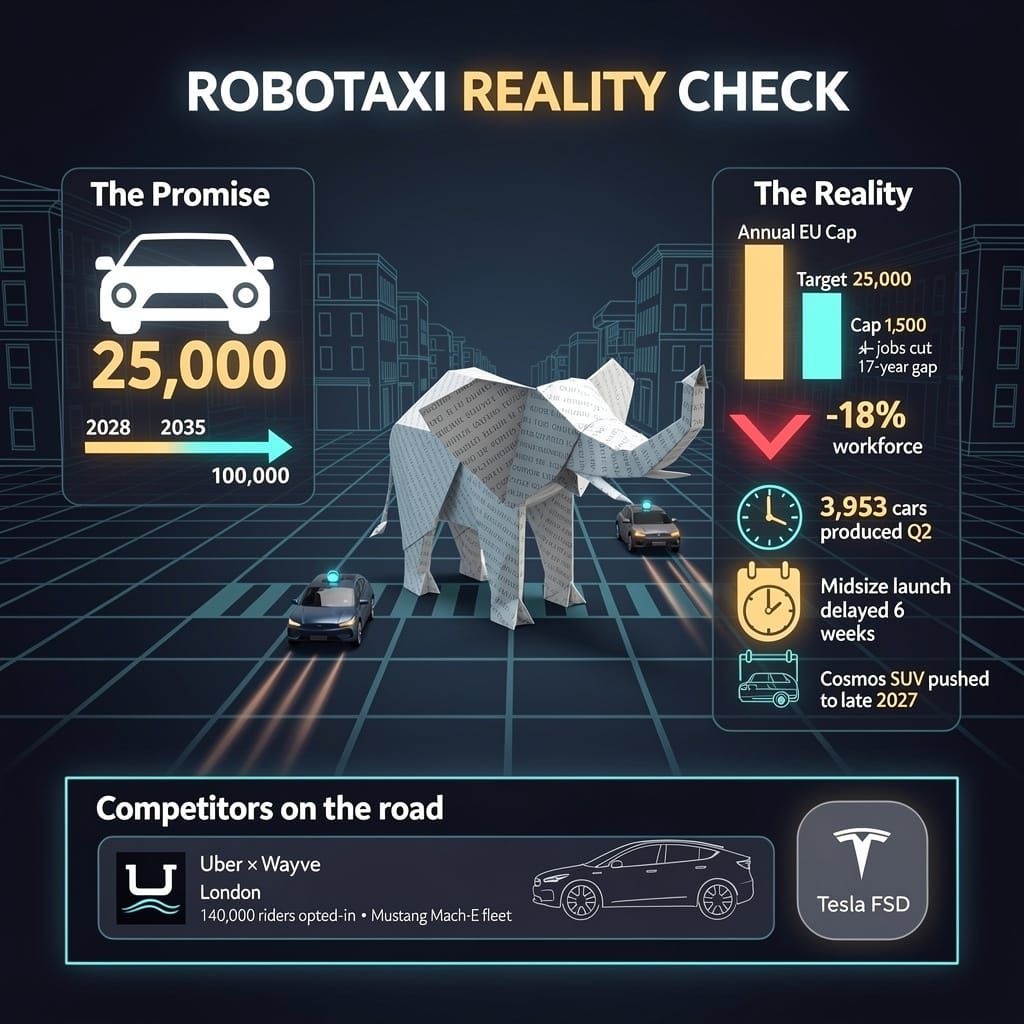
25,000 robotaxis is the headline — but the fine print says zero vehicles ordered, zero euro committed, no binding deal. 🚖 EU type approval caps automated vehicles at 1,500 per type per year — making 25,000 a 17-year slog, not a 2028 rollout. Meanwhile Uber already has Londoners inside Wayve-driven Mustang Mach-Es, and Tesla awaits an EU vote on October 6 for continental FSD validity. Lucid's own Midsize delivery slipped six weeks; a mainstream SUV delayed nearly a year; ~18% of staff cut. Is this a roadmap or just a press release doing the work of engineering? Where does your city stand on robotaxi-ready roads? ⚡
On September 17, Bolt and Lucid Motors unveiled a grand vision: at least 25,000 fully autonomous robotaxis threading through European cities, powered by Lucid's Midsize platform and NVIDIA's Hyperion hardware. First wave, 2028. Ultimate ambition, 100,000 vehicles by 2035.
Strip away the polish, though, and the announcement looks less like a roadmap and more like a press release doing the work of engineering.
What Was Actually Committed?
Start with the fine print that any operations analyst will flag first. This is a non-binding partnership agreement. Not one vehicle has been ordered. Not a single euro has been committed. No deployment date exists beyond a loose "2028" reference that appears in none of the parties' hard statements. Lucid's own disclosures make the "at least 25,000" framing contingent on "potential" fleet growth—language that gives either side an exit ramp whenever convenient.
The gap between ambition and hardware is measurable. Lucid has never deployed a commercial robotaxi version of any existing vehicle. Its first Midsize platform delivery has already slipped six weeks, pushing to the second half of 2027—a timeline that strains the 2028 first-wave target even before autonomy validation begins. That slippage follows a summer already defined by turbulence: on August 5, Lucid postponed its budget-friendly Cosmos crossover SUV by nearly a year, citing quality failures and executive churn, and the delivery date now sits unlikely before the end of 2027. Meanwhile, under new CEO Silvio Napoli, the company has cut roughly 18% of its workforce. That retrenchment is not theoretical—production ran at just 3,953 cars in Q2, down sharply despite a 19% year-on-year rise in orders. A company that shed a fifth of its staff and delayed a mainstream SUV now proposes to out-engineer the most complex consumer safety product ever regulatory-approved.
The Regulatory Arithmetic That Doesn't Work
Here's the number that should puncture the press cycle: EU type approval currently caps fully automated vehicles at 1,500 units per type per year. At that pace, reaching 25,000 vehicles takes roughly 17 years, not the seven years to 2035 promised. And that's before national border approvals—each country adds its own layer beyond EU-wide certification.
Nor is EU harmonization moving toward looser autonomy rules on any reliable schedule. The bloc's regulatory energy is currently flowing in a very different direction. In June 2026, the European Parliament passed a binding rule mandating 15% recycled plastic in new cars by 2030 and 25% by 2040. Days before that, on June 10, 2026, the EU's End-of-Life Vehicles Regulation entered into force, imposing stricter design, collection and treatment standards on the 10–12 million units reaching retirement each year. And on July 8, regulators doubled down on safety hardware rather than autonomy: the European Commission expanded General Safety Regulations to mandate advanced emergency braking and closed-loop driver-monitoring cameras across all newly registered vehicles. None of this is deregulation. Regulators are tightening materials, safety and monitoring rules while Bolt and Lucid bet on them rewriting deployment caps on demand.
The only way the 2035 target becomes plausible is if regulators rewrite the rules on schedule, which is precisely the assumption that has burned every autonomous-vehicle proponent from Phoenix to San Francisco. Counting on regulatory reform you don't control is not a deployment strategy; it's a hope dressed in a partnership logo.
What the Competition Actually Shows
Set Bolt and Lucid's timeline beside the operators with working deployments. Uber already launched London's first public robotaxi service in partnership with Wayve on September 3, running electric Mustang Mach-E vehicles through the Uber app. Roughly 140,000 Londoners have already opted in, the fleet covers all of London except airports, and Wayve—a British firm with London road data since 2020—is expanding to Tokyo with Nissan Leafs. These are not abstract partnerships; they are operating systems with vehicles on the road and regulators in conversation. And they are not alone: on September 1, Tesla confirmed its Full Self-Driving Supervised system active across five EU nations with 70,000+ users logging over a million kilometers daily, submitting Article 39 exemptions to an EU Technical Committee vote on October 6 that could grant continental validity.
Bolt's own advantage is real—200 million customers, 4.5 million drivers and couriers across 850 cities—but a ride-hailing network is not an autonomous-vehicle program. Fleet operation competence transfers; safety-critical autonomy does not.
The Bottom Line
The deal reads as an attempt to hold a position in a race where the leaders are already lapping the field. Lucid needs the scale to validate Level 4 autonomy and justify a fleet-based revenue pivot—yet its own platform deliveries slip while an SUV launch collapses by nearly a year; Bolt needs to appear ahead of Uber in European autonomy, only to watch Uber put Londoners inside Wayve-driven Mustang Mach-Es today—and wait for a European Commission vote that may hand continental approval to Tesla's rival system outright. Both needs are served by a headline, even with zero orders on the books.
European road autonomy is coming. It's just coming from operators with vehicles on the pavement, regulators engaged, and timelines that survive contact with reality—not from a press release counting cars before they're built.

Comments ()