✈️ Faster Than the Budget: Inside the 1,000-Drone Promise
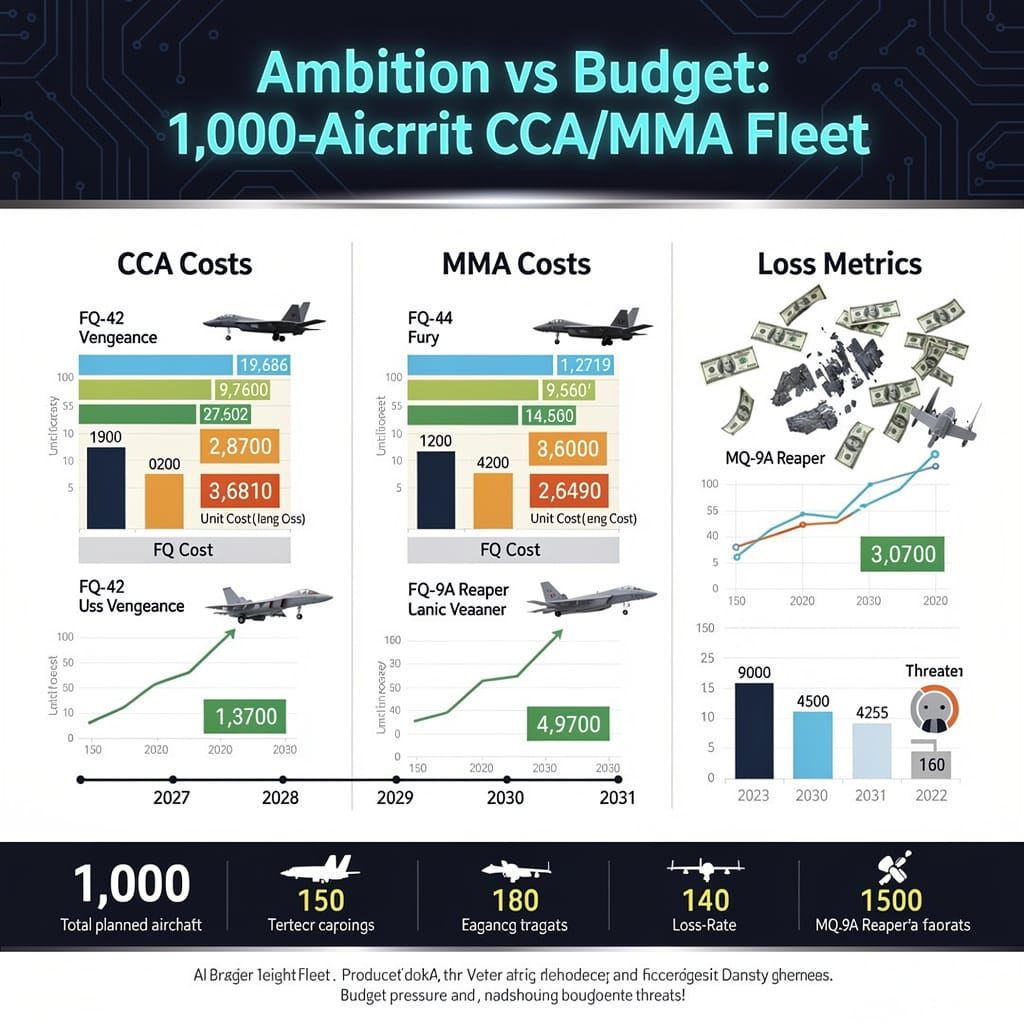
The Air Force wants 1,000 combat drones by 2032 — at ~$20M each, that's a $20B promise. ✈️ Yet its own secretary admits the budget "was not designed for the current tempo of conflict." Iran has downed ~45 Reapers (a quarter of the fleet) at a ~$1.3B tab fueling the urgency. But scaling from 150 to 1,000 battle-ready systems needs more than factory ramps — it needs certs, sustainment, and multi-year funding. Can the ambition outpace the ledger?
On Sept. 14, during a keynote at the Air, Space and Cyber Conference, Secretary of the Air Force Troy Meink stood in front of a room of officers and industry executives and did something more unusual than it may have sounded: he named two aircraft that don't fully exist yet.
The FQ-42 Vengeance and FQ-44 Fury are uncrewed Collaborative Combat Aircraft (CCAs), part of a program the Department of the Air Force insists will field 500 combat-ready systems by 2032 and ultimately a fleet of 1,000. The framing leaned on a compelling contrast between past ingenuity and future capability — the service must "outpace AI-enabled threats" evolving faster than its own procurement machinery can respond. But the closer you pull on that thread, the more the timeline and the ledger start to disagree.
The Numbers Behind the Ambition
Setting aside the rhetoric, the stated milestones are worth putting in order:
- 150 aircraft in Initial Batch 1, with production reportedly begun in June
- 500 combat-ready systems targeted by 2032 — the same figure repeated across separate Sept. 14 briefings
- 1,000 total fleet as the eventual goal, revised down from an earlier target of 1,000 by decade's end
- 100 Mass Modular Aircraft (MMA) by 2029, priced at half the cost of a CCA and one-tenth that of a fifth-generation fighter
There is real hardware behind the slideware. The program won its procurement line — $996.5 million in 2027 for CCA Increment 1 — and paired General Atomics (FQ-42A) with Anduril (FQ-44A), with Collins Aerospace and Shield AI handling mission autonomy. Since June, additional contracts have landed for aircraft and autonomy software, and testing runs through the Experimental Operations Unit at Nellis AFB.
The Cost Math That Undercuts the Enthusiasm
Here is where the skepticism attaches itself to the momentum. Meink cited an MMA price tag around $10 million and a CCA figure near $20 million per aircraft — cheap relative to a fifth-generation fighter, but the fleet targets multiply fast. The newest pitch pushes 500+ CCAs and 500+ MMAs by 2032, doubling what was previously framed as a single 1,000-aircraft program.
The urgency has a body count behind it. Iran's IRGC has been methodically attritioning American unmanned fleets over the Strait of Hormoz: the August 3 shoot-down followed an earlier loss, with about 45 MQ-9A Reapers — roughly a quarter of the fleet — gone through late summer, a tab approaching $1.3 billion given each airframe runs $30–$50 million. That loss rate justifies mass.
But it does not answer Meink's own admission that the budgeting system was "not designed for the current tempo of conflict." Affordability and resourcing remain flagged as "critical risks." The plan has grown from 150 initial airframes to a 1,000-plus total inside a funding architecture Meink concedes is out of step with his own timeline — while the same August report warned the Reaper losses themselves may have exposed MALE platforms as obsolete against Iranian air defenses.
What Fast Prototyping Conceals
The broader CCA project — manned-unmanned teaming with the F-35 and MQ-20, tested live through May and June — validated the core software chain from sensor fusion to terminal engagement under pre-approved envelopes. It did not resolve the harder question of scale. Producing 100-plus aircraft in months is not the same as fielding 1,000 battle-ready systems with certifications, sustainment pipelines, and multi-year appropriations to keep them flying. The June production contracts and factory ramps are real industrial achievements; they also occur precisely where past programs hit their downward revisions.
The ambition is coherent. The funding path is not. That gap — not the naming ceremony, and not the test shots — is the story worth watching between now and 2032.

Comments ()