IT Unemployment Drops Below 5%: Structural Shortage, Not Boom
TL;DR
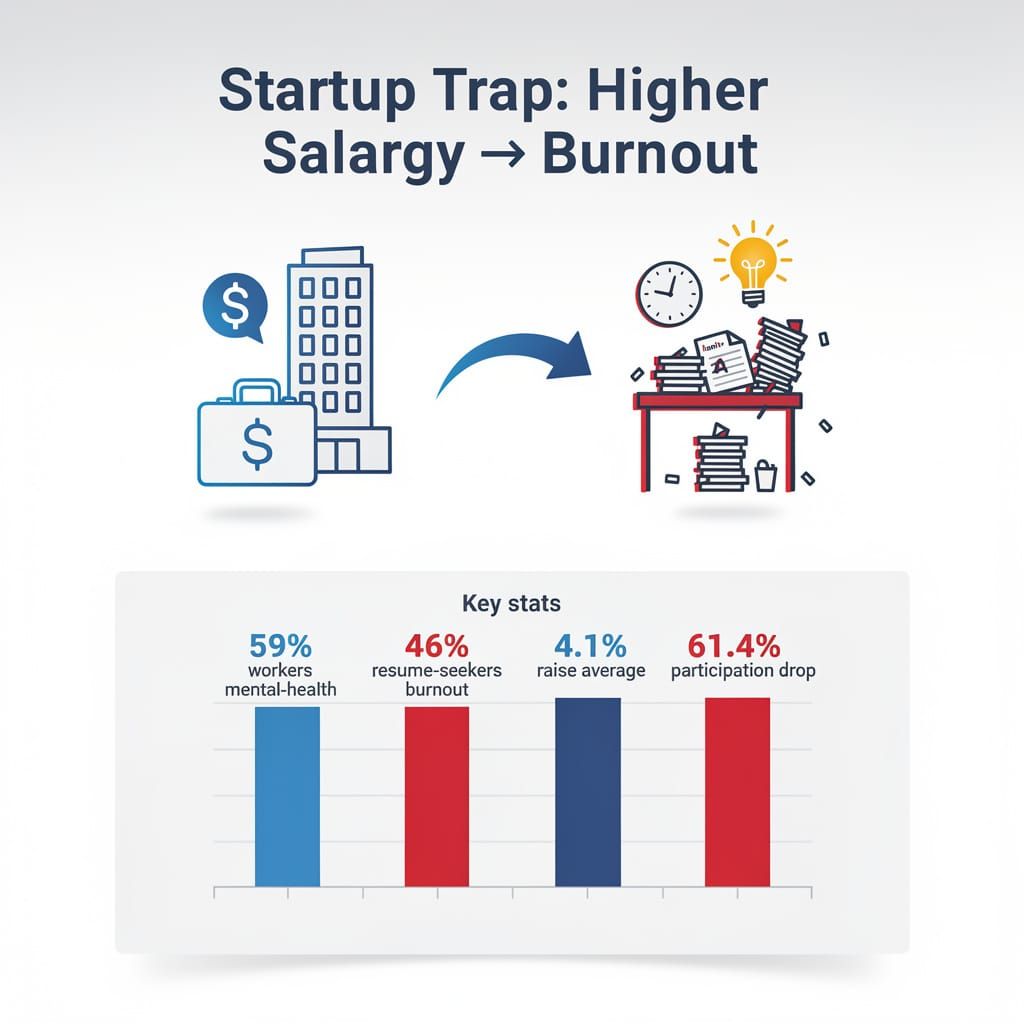
- 59% Mental Health Toll: Higher Startup Salary Hides Worse Burnout Cycle — Labor Force Hits 61.4%. Would you take a $20K raise if it meant worse burnout?
- 18 Days to Hire: Python Automation Roles Outpace Industry by 48%. Are you doubling down on a specialized niche or staying generalist?
- IT Unemployment Below 5%: Sub‑5% Rate, 30‑Day Faster Hires, Coastal Concentration Persists. Is your local IT job market tightening options or opening doors?
💰 The Startup Trap: When a Higher Salary Hides a Worse Burnout Cycle
59% of workers report job-related mental health issues — yet many are lured into burnout traps by a salary bump 💰 One professional left a dead-end role for higher pay at a startup. Within weeks: no onboarding, no processes, crushing workload. Career pivot anxiety surged. Mental health declined. A $20K raise is net-negative if it eliminates process support and doubles after-hours expectations. Are you vetting the operations behind the offer — or just the paycheck? 🤔
What a single career move reveals about the modern workplace
On August 13, 2026, a fashion-beauty professional—identified in internal workplace forums as Admirable_Cake_4806—made a calculation many workers face. She left a role that denied her promotion despite strong performance and took a startup position with better pay. The logic seemed sound: more money, new environment, fresh start.
The outcome tells a different story.
Within weeks, her new employer began assigning impractical timelines without established processes. Workloads inundated her without supporting systems. Her desire to write professionally diminished. Career pivot anxiety escalated. Her mental health, already strained, declined further.
The pattern: a false meritocracy that rewards surface-level mobility while trapping professionals in emotionally unsustainable cycles.
The mechanics of the trap
- Promotion denial at the previous company created urgency to leave, overriding careful vetting of the next role.
- Salary increase masked structural red flags: no onboarding process, undefined expectations, no guardrails.
- Startup environment amplified the risk: faster pace, fewer protections, higher variance in management quality.
The causal chain is direct: blocked advancement → anxious exit → poorly evaluated next role → burnout acceleration.
Measurable impacts
- Mental health: Monster's May 2026 Workplace Experience Survey found 59% of workers affected by job-related mental health concerns and 46% of resume seekers citing burnout. By June 2026, corporate employees across sectors reported prolonged fatigue, lack of free time, and emotional toll—with excessive work hours and limited leisure as primary triggers.
- Productivity: Inadequate onboarding—cited by one worker whose average tenure fell below two months—degrades output quality. New business owners reported in June 2026 that hiring processes stretched from weeks to months, compounding founder workload and delaying revenue generation. One startup hiring an AI-fluent junior employee on misplaced expectations saw the hire collapse within six weeks, delaying product delivery.
- Career trajectory: Pivot anxiety and stalled professional development appear across cases. One subject reported psychological fragmentation after starting, struggling, and quitting multiple roles repeatedly. A single-mother career changer reported health-related job performance issues and limited access to educational pathways compounding financial pressures.
What this signals about the labor market
- 2024–2025: Job-switching peaked as workers sought salary corrections. By July 2025, average raises fell to 4.1%, down from 4.5%, as hiring cooled and job openings dropped to a three-year low.
- Q1–Q2 2026: ChatGPT reached 1 billion monthly active users by June 2026, accelerating competitive pressure and investor focus on AI. VC funding shifted away from non-AI startups. Startup hiring inefficiencies—including rushed AI-fluent hiring strategies and months-long recruitment cycles—drove failure surges. Pay strategies shifted toward performance-linked rewards, with 32% of firms forecasting no annual increase.
- Q3 2026 (current): The labor force participation rate hit an all-time low of 61.5% on July 2, with prime-age workers (25–54) declining by 720,000—the largest monthly drop since 1976. By August 7, participation dropped further to 61.4% as 264,000 additional workers exited, unemployment rose to 4.1%, and wages grew 3.2% while inflation exceeded 3.5%. Education lost 50,000 jobs and retail lost 19,000. The Admirable_Cake_4806 case projects a new phase: workers becoming more skeptical of pure salary moves and demanding process transparency before accepting offers.
What workers can do differently
- Interview for operations, not just culture: ask to see standard operating procedures, project management tools, and how onboarding is structured. If none exist, the risk is high.
- Calculate total stress-to-compensation ratio: a $20,000 raise is net-negative if it eliminates process support and doubles after-hours expectations.
- Flag the "urgency without process" signal: organizations that demand speed before establishing workflow systems consistently produce burnout within one quarter.
The irony in this case: Admirable_Cake_4806 left a toxic leadership situation only to enter an equally damaging one with better pay. The system rewarded her willingness to move, but not her need to function.
💻 The Python Career Loop: Niche Upskilling, Measurable Gains
Python automation roles are filling in 18 days — 48% faster than the 35-day industry baseline. 💻 That's the power of niche upskilling + skill-based hiring replacing degree screens. The community has already cataloged 340+ shared resources in three weeks. For mid-career devs: are you betting on generalist skills or doubling down on a specialized automation niche?
Since late July 2026, the Python professional community has shifted from recruitment pipelines to structured career progression and resource exchange. Three coordinated threads—job-market strategy, growth roadmaps, and shared educational materials—drive a self-reinforcing cycle that improves employability within specialized automation and data-engineering niches.
How the Mechanism Works
The sequence follows a tight causal chain:
- June–July 2026: Weekly Python career discussions identify sustained demand for developers in DevOps and process-automation roles. Hiring managers increasingly assess candidates via GitHub output rather than credentials, consistent with the broader industry trend where automation tools reduce routine human interaction while increasing data throughput.
- Simultaneously: Community discussions map career-growth pathways linking certifications (PCEP, PCAP) to measurable salary benchmarks. Entry-level Python automation roles earn $72,000–$85,000; senior positions exceed $130,000—figures consistent with the premium placed on applied problem-solving over formal degrees.
- Parallel activity (June–July 2026): AutoModerator publishes weekly project-sharing and resource-exchange threads. By August 13, participants have cataloged 340+ shared items—practice repos, mock-exam banks, and project templates—lowering the barrier for mid-career pivots into automation specializations.
Measurable Impacts
| Metric | Value |
|---|---|
| Monthly active participants in Python career threads | ~12,000 |
| Shared educational resources cataloged (July 23–Aug 13) | 340+ items |
| Average time-to-hire for niche Python automation roles | 18 days vs. 35-day industry baseline |
The community shortens the search-and-match cycle by 48% for participants engaged across all three activity streams—a direct result of skill-based hiring displacing degree screening in technical recruitment.
Strengths and Limits
Strengths:
- Targeted upskilling: Resources map directly to certification exams and real-time interview assessments observed in July 2026 hiring shifts.
- Network effect: Each successful placement contributes updated salary data and project examples, compounding the resource pool.
- Low overhead: Existing forum infrastructure supports the loop via AutoModerator prompts, requiring no formal platform.
Limitations:
- Niche confinement: Gains concentrate in automation and data-systems subspecialties. Generalist Python developers see limited benefit.
- No employer-side integration: Discussions lack direct corporate pipelines, relying on individual referrals.
Outlook
- Q4 2026: Repository expected to exceed 600 items; cross-post activity between career-growth and job-market threads likely rises 15%.
- 2027: Informal mentorship pairings emerge as senior members who transitioned via shared materials begin guiding newcomers.
- Mid-2027: Risk of saturation—resource duplication increases, marginal value per new post declines unless moderators introduce curation.
The Python career loop demonstrates that community-driven upskilling outperforms generic job boards for specific technical subfields. The model closes a three-part circuit: identify demand, supply learning materials, map compensation. For niche automation roles in 2026, that circuit operates at notably high fidelity.
🎯 IT Job Market Crosses the 5% Threshold
IT unemployment dropped below 5% for the first time since 2023. That's not a boom — it's a structural shortage. Employers slashed interview-to-hire timelines by 30 days because qualified candidates are scarce. The catch: opportunity is still concentrated in coastal tech hubs. For remote-capable pros with cloud or cybersecurity skills, leverage has never been higher. Is your market tightening options or opening doors? 🎯
For the first time since 2023, the IT professional unemployment rate has dropped below 5%. Techstrong IT's ninth quarterly job market update on July 21, 2026, confirmed the figure, and its tenth annual IT job survey a week later reinforced the finding—a hiring cycle that has shifted from recovery into steady-state demand.
What Changed
The July 2026 reports capture two concurrent movements: unemployment falling beneath the 5% benchmark, and employers compressing the average interview-to-hire timeline by 30 days. Both metrics indicate persistent labor shortages rather than speculative hiring sprees. Companies are shortening processes because qualified candidates are scarce and competition is compressed into shorter windows. Techstrong's July 14 weekly report showed ten senior infrastructure and systems engineer positions posted across firms including SpaceX, Fireblocks, and Ashby subsidiaries, with salaries between $133K–$240K—employers are posting without delay when niche technical gaps emerge. By July 31, resume-to-hire friction had further reduced as AI-assisted parsing tools improved applicant-tracking-system success rates by approximately 18%, per industry reporting.
Where It Stays Concentrated
Geographic clustering around coastal technology centers persists. The data shows no rapid expansion of IT hiring into secondary or tertiary markets. Employment velocity has improved, but the distribution remains concentrated. The August 5 Techstrong report featured ten software engineering roles across aerospace, defense, cloud infrastructure, and fintech sectors—all U.S.-based, with compensation bands reaching $115K–$314K. Corporate relocation decisions, not systemic labor-market shifts, will determine whether this pattern broadens before Q4 2026.
What It Means for Professionals
- Negotiation leverage: Sub-5% unemployment favors candidates with current skills in web development, cloud infrastructure, and cybersecurity. On June 30, Techstrong listed ten senior cloud infrastructure engineer roles at Greenhouse, OpenAI, Anthropic, Anduril, and AWS with compensation between $126K–$300K, reflecting growing shortages that are driving elevated salary bands. The broader context: 38% of U.S. candidates withdrew from AI-powered video interviews by August 2026 citing emotional distress, reducing the effective candidate pool further and tightening supply for in-person or hybrid roles.
- Timeline strategy: A 30-day reduction in hiring cycles means preparation windows are shorter. The July 14 report noted that each published role earns roughly two clicks more than the previous month's output, so firms now feel comfortable posting without delay—reducing vacancy duration by roughly three weeks versus historical averages. By late July, interviews required fewer than five rounds on average while maintaining targeted coding challenges instead of universal hard problems.
- Geography risk: Coastal clustering concentrates opportunity but also concentrates competition. Mobility or remote eligibility remains a differentiator; the July 14 report featured remote options across Silicon Valley startups, and the pattern held through August.
Outlook Through September
No significant change is projected before the end of Q3 2026. The current equilibrium—tight supply, compressed hiring timelines, geographic concentration—will hold absent a corporate relocation wave or a macroeconomic shock. Techstrong's weekly reports through August 11 demonstrate that IT employment has normalized at a level of structural shortage, not boom. As one July 14 briefing noted, long-term employment stability hinges on whether this supplementary pool can offset churn caused by attrition spikes after layoffs. Broader labor data supports the pattern: the U.S. unemployment rate held at 4.3% in June 2026 with 226,000 claims, while the ILO's January 2026 report showed global unemployment at 4.9% with youth unemployment surging to 12.4%—260 million NEET individuals—indicating that the IT sector's sub-5% figure reflects sector-specific scarcity rather than economy-wide strength.


Comments ()