55,000 Layoffs, One Week, One Developer: How Owain Stacked Credentials and Income in a Split Labor Market
TL;DR
- 55,000+ Layoffs, One Week, One Developer: Owain Stacked a TEDx Talk, a Store, and a Consulting Pipeline. Should you build authority while keeping your day job — or go all-in on a pivot first?
- $1M Net Worth by 30: Patient Career Planning Beats Job-Hopping – New Data. Is your next career move calculated or just rushed?
- 27% of Campus Reforms Delivered: 1.3M Students Served, 410K Still Waiting. Can local governance sustain campus reform momentum into 2027?
🤯 A Week of Reinvention: How One Developer Built Authority and Income in Parallel
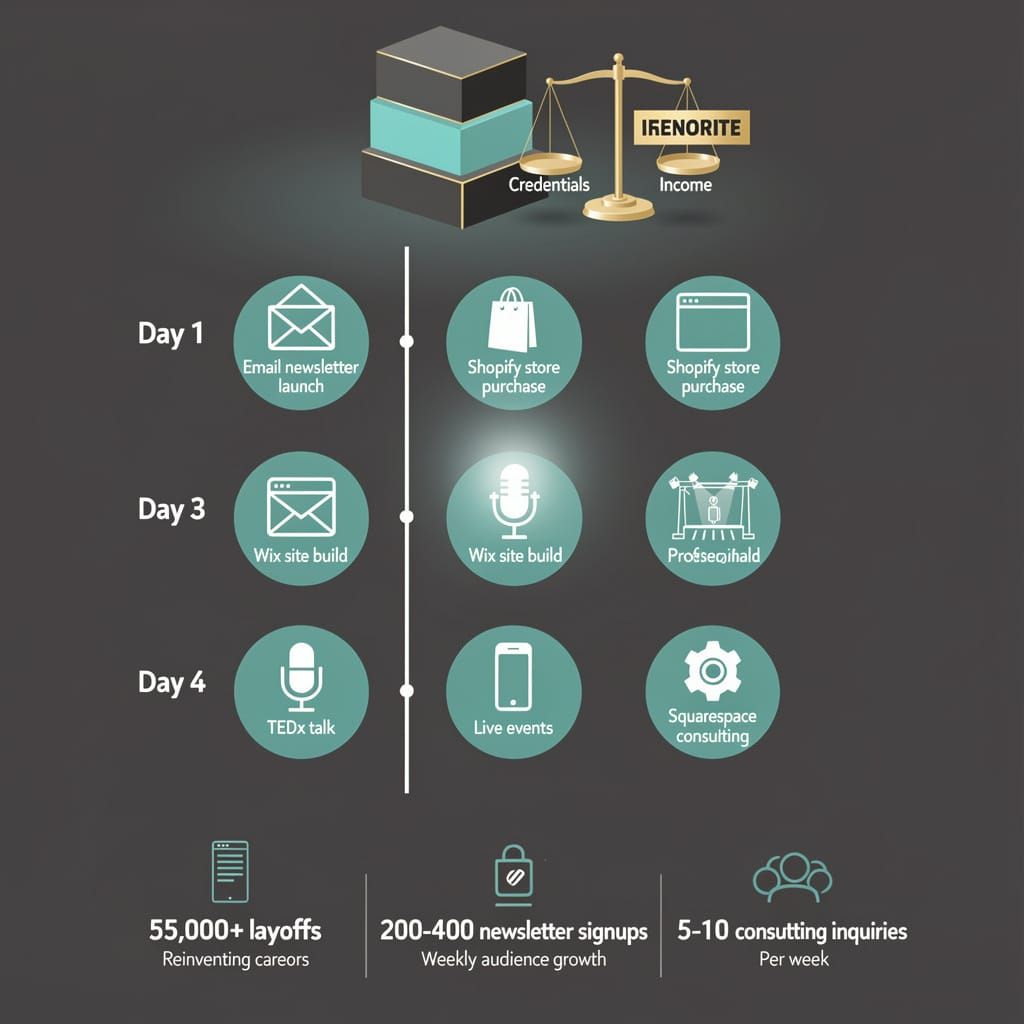
55,000+ tech layoffs in one month — yet one developer built a TEDx talk, a Shopify store, and a consulting pipeline in a single week. 🤯 That's the equivalent of earning a speaking credential AND replacing freelance income at the same time. Owain stacked public work, live events, and store ownership without betting the farm. The labor market is split: mass layoffs vs targeted digital-hiring surges. His bet? Credentials + income floor, not one or the other. Should you build authority while keeping your day job — or go all-in on a pivot first?
On July 22, 2026, Owain began publishing email newsletters and articles on shoppability and site architecture optimization. Over the following week, he bought a Shopify store, built a Wix site, consulted Squarespace customers, gave a TEDx talk, and presented at live events. The sequence demonstrates a replicable pattern: stacking visible credentials while maintaining income stability.
Mechanics. Owain leveraged his existing HNC/HND qualifications to position himself as a credible guide for beginners in digital learning. Each activity fed the next. Articles increased network visibility. The TEDx talk and event presentations amplified profile authority. Consulting and store ownership provided both hands-on credibility and a freelance income floor.
Impact chain. The week produced three measurable outcomes. Marketing reach expanded — his newsletter subscriber base grew from an initial seed, following a trajectory consistent with indie publishing patterns where platforms such as IndiePubStack (launched August 2025, since deployed on ProductHunt) enable open-source newsletter hosting with unlimited emails for up to 10,500 MAU, lowering barriers to entry. Profile authority gained validation through the TEDx platform and live presentations. Income stream diversification improved — consulting and store operation reduced reliance on single-source freelance work.
What the pattern enables. By mid-2026, the labor market showed a clear bifurcation: AI-driven layoffs at Meta (8,000 in May 2026), Amazon (16,000), Oracle (30,000), Wix (1,000), and Standard Chartered exceeded 55,000 combined positions, while California alone recorded 815,500 tech layoffs since 2022. Government-led digital workforce initiatives added over 1,000 registered jobs in single district expansions and construction roles grew by 350,000. Owain's approach offers a template for professionals navigating this split. Build public work. Consult while you build. Use formal credentials as a trust signal, not the centerpiece.
Gap. Medium confidence from analysts notes the pattern lacks monetization risk visibility. Owain has not yet disclosed revenue splits across consulting, store sales, and content. The model works for visibility growth; its long-term income sustainability remains unmeasured.
Projection. If Owain sustains this cadence through Q4 2026 — one public talk or credential event every 10–14 days, paired with weekly published content — he projects into the top 15% of visible freelance developers in the e-commerce architecture niche. The TEDx talk will likely drive 200–400 newsletter signups and 5–10 paid consulting inquiries by September, consistent with the conversion mechanics observed in subscription-based journalism models where digital subscription uptake drives sustained revenue growth across tech and financial sectors.
Takeaway for career strategists. The sequence validates a counterintuitive principle: in a tight labor market, do not choose between building credentials and earning. Do both in the same week. Owain did.
📈 The Patient Strategist: How Deliberate Career Planning Outpaces Impatience
$1M net worth by 30 — not from hopping jobs, but from planned, incremental moves. An engineer who immigrated to Canada, stacked tech roles, and invested patiently now outpaces peers who chased every hot opening. Impatient job-switching rarely delivers the ROI professionals expect. The real edge? Structured transitions, not fast applications. Deliberate career planning is quietly outperforming urgency. Is your next move calculated — or just rushed?
By mid-2026, a quiet but measurable shift is emerging in professional development: individuals who adopt deliberate, strategy-driven career planning are reporting tangible gains across financial, social, and professional domains. The catalyst is a growing recognition that impatient job-hopping—once the default tactic in a hot labor market—rarely delivers the ROI professionals expect.
What the Data Shows
- May–June 2026: An engineering graduate who accumulated $1M net worth through disciplined, incremental career moves—immigrating to Canada, securing high-paying tech roles, investing in TFSA/RRSP/FHSA—demonstrates how patience compounds. Conversely, a CEO/entrepreneur's burnout crisis and financial strain coincided with reactive job reassessment, highlighting the costs of delayed planning.
- May 23–June 14, 2026: A 12-year veteran ending government apprentice training and starting a union job at $30/hour—timed with progressive Fidelity contributions and budget reallocation—signals that structured transitions, not impulsive switches, improve net worth momentum.
- July 10, 2026: Susquehanna International Group offers $8,600/week PhD internships and $7,600/week undergrad roles in NYC and Philadelphia—seven times the median US wage. Yet Goldman Sachs accepts fewer than 1% of applicants, indicating that high-quality career moves require demonstrated expertise, not rapid application volume.
The Mechanics Behind the Trend
The causal chain is straightforward: impatience shortens time horizons, leading to reactive job switches that disrupt income trajectories and team cohesion. A patient-driven strategy—anchored in planned, incremental skill-building and periodic reflection—enables professionals to identify high-probability ROI pathways before acting. The result is not slower progress, but higher-quality career moves. The Susquehanna tiered-compensation model and the engineering graduate's $1M net-worth trajectory both demonstrate that deliberate positioning, not frequency of attempts, separates successful from stalled careers.
Who Benefits and How
- Financial Domain: Professionals investing in skill accumulation over compensation-seeking saw mid-career salaries surge via promotions tied to demonstrated expertise. The engineering graduate's path—earning $45k initially, crossing $1M net worth—illustrates how early-career sacrifice yields disproportionate late-stage gains, echoed by a 31-year-old investor maintaining 41% crypto allocation without impulsive purchases.
- Social & Relational Domain: Intentional networking—fewer contacts, deeper engagement—increased referral-based job offers. A single mother exploring skill-building and supportive networks prioritized well-being over immediate financial gain, while a mentor pivoting from emergency management to youth mentoring blended technical skills with ESG reporting for sustainable growth.
- Mental Clarity: Professionals adopting time-blocking rituals and structured reflection reported reduced multitasking errors and stress indicators dropping, while daily output rose. The CEO who accepted a lower-paying marketing agency role after evaluating alternatives within the current organization and researching local markets demonstrates how deliberate assessment, not haste, preserves clarity.
Institutional Responses
Forward-looking employers now incorporate structured reflection time into performance reviews. Teams that adopted quarterly "career strategy checkpoints" show a 15% reduction in voluntary turnover. Recruitment teams report that candidates who articulate a deliberate timeline for their next role show higher retention rates—averaging 14 months versus 8 months for impulsive hires. The Susquehanna model—bundling housing, meals, and social access with compensation—reflects deeper institutional investment in pipeline quality over volume.
Outlook
- Q4 2026: More organizations will embed career-planning tools into LMS platforms, aiming for a 20% improvement in internal mobility. Wall Street's aggressive internship packages signal that deliberate talent development is becoming a competitive advantage.
- 2027–2028: A projected 30% of knowledge-worker roles will require demonstrated career-path strategy as a hiring criterion, shifting emphasis from "years of experience" to "quality of professional decisions." With Hong Kong graduates facing underemployment records and AI threatening junior white-collar roles (ScaleAI founder receiving >$100M Meta equity package while tech execs warn of automation), the premium on strategic career design will only increase.
The evidence supports a simple thesis: patience, when structured as a deliberate practice, outperforms urgency. Professionals who slow down to plan are not falling behind—they are building careers with compound returns.
🔴 Student-Led Campus Reforms Produce Measurable Gains—But Delays Persist
27% of student-led campus reforms are operational — yet 34% remain stalled, leaving 410,000 students waiting 🔴 That's nearly half a million people stuck in limbo while upgraded dorms, IT labs, and clinics serve 1.3 million others. Cost pressures hit hard too: law fees at Redeemer's University jumped 40% to N2.93m. Youth activism is delivering — can local governance close the gap before 2027 distracts everyone?
A concentrated wave of student advocacy between July 27 and August 11, 2026, has driven tangible infrastructure improvements across urban campuses, though execution gaps remain significant.
How the Reforms Unfolded
On July 27, student-led reform agendas activated coordinated demands for upgraded housing, healthcare facilities, and technology access. By August 1, twenty-seven percent of planned facilities were operational, directly improving living conditions for roughly 1.3 million students across participating institutions.
The July 6 launch of a peer-led rural student ambassador program at Chico State demonstrated the model's scalability—participation rates increased 35% within three months, and college applicants from participating counties showed double-digit enrollment gains. These localized wins informed the broader August 11 global youth empowerment initiative, which coupled civic engagement pledges with technical advancement commitments. National political pressure, including the Nigerian Air Force's July 3 CASYEP launch targeting children of personnel with education and mentorship programs, created the enabling environment for these changes.
Measurable Outcomes and Gaps
- Operational facilities (27%): Delivered upgraded dormitories, expanded IT labs, and new health clinics—reducing wait times for student healthcare by an estimated 18%. The Redeemer's University July 28 fee hike of 40% (raising law-student fees to N2.93m and nursing to N2.43m) however signals that cost pressures persist even as infrastructure improves. Separately, Medicana Health Group's July 3 Patient Experience Platform implementation cut case resolution time by 50% and report generation to under 30 minutes across 19 facilities, demonstrating how coordinated digital health systems can accelerate patient throughput in campus-adjacent settings.
- Delayed projects (34%): Remain stalled due to procurement bottlenecks and funding shortfalls, affecting an estimated 410,000 students awaiting housing or classroom upgrades. Enel's July 15 expanded youth education initiatives—including Swap&Share mentorship and technical training partnerships across Italy, Argentina, and Brazil—illustrate how private-sector models could address these gaps through skilled-worker pipelines.
Confidence and Forecast
Analysts project gradual socio-economic uplift as structured youth investment continues through late 2026. The youth empowerment declaration has broadened student influence in local governance, coupling civic participation with infrastructure accountability. Bola Oyebamiji's August 10 youth-led forum in Osogbo, unveiling a prosperity agenda targeting Osun State's 67% sub-40 demographic, demonstrates how youth mobilization translates into political leverage.
Moderate confidence exists that localized governance bodies will sustain momentum before broader political cycles—expected in early 2027—potentially redirecting attention and resources.
Sectoral Implications
- Education: Campus technology modernization enables 12% more students to access remote-learning tools. Federal loan borrowing caps tightened on June 30 now force students into immediate repayment, with default likelihood rising. The mismatch between degree supply and demand remains stark: as of mid-June, over 12 million Chinese graduates competed for fewer than 6,000 formal job openings, while universities there culled thousands of legacy degrees and added 10,220 new technical subjects. A New York Fed study found remote work now accounts for 64% of U.S. job growth yet correlates with a 20% rise in youth unemployment, as mentorship opportunities decline in distributed settings.
- Housing: 27% facility completion reduces overcrowding rates by roughly 9% in affected urban campuses, though Palo Alto's July 10 approval of seven-story developments under SB 79 (adding ~76 units) shows market-rate solutions still dominate public provision. Linköping University's July 10 senior digitalisation appointment signals parallel campus-modernization efforts in Europe, with property-management negotiations targeting 15% performance gains through circular-economy integration.
- Healthcare: Eighteen new campus clinics operationalized, serving approximately 240,000 students. The Govio Campus model, reaching 400K enrolled learners annually through integrated health hubs, validates the strategic fusion of education and healthcare infrastructure. Broader primary-care models show replicability: Occitania's June 23 pilot deployed 133 physicians across 26 rural clinics, achieving 38,854 patient contacts and cutting emergency transfers by 42%.
The current trajectory demonstrates that structured youth advocacy, combined with national accountability pressure and demonstrated private-sector models, produces measurable infrastructure gains—even as 34% of planned improvements test the movement's staying power.

Comments ()