Credential + AI Velocity: How One Freelancer Turned HNC/HND Into a Multi-Platform Content Engine
TL;DR
- Credential Flywheel Powers a 6-Day Multi-Platform Content Sprint — UK Freelancer Sees 20% Inquiry Jump. Can one credential plus AI tools replace a full-time job in 2026?
- $91M Kiffin Deal: LSU Bets on Experience Over Speed in Coaching Reset. Can a $91M coach with baggage rebuild LSU faster than the fans expect?
- 2,000 Government Banking Posts Drain Private-Sector Talent in Bangladesh. Would you leave a private bank for a government role at ₹50K/month with pension?
📈 The Credibility Flywheel: How One Freelancer Turned Credentials Into a Content Engine
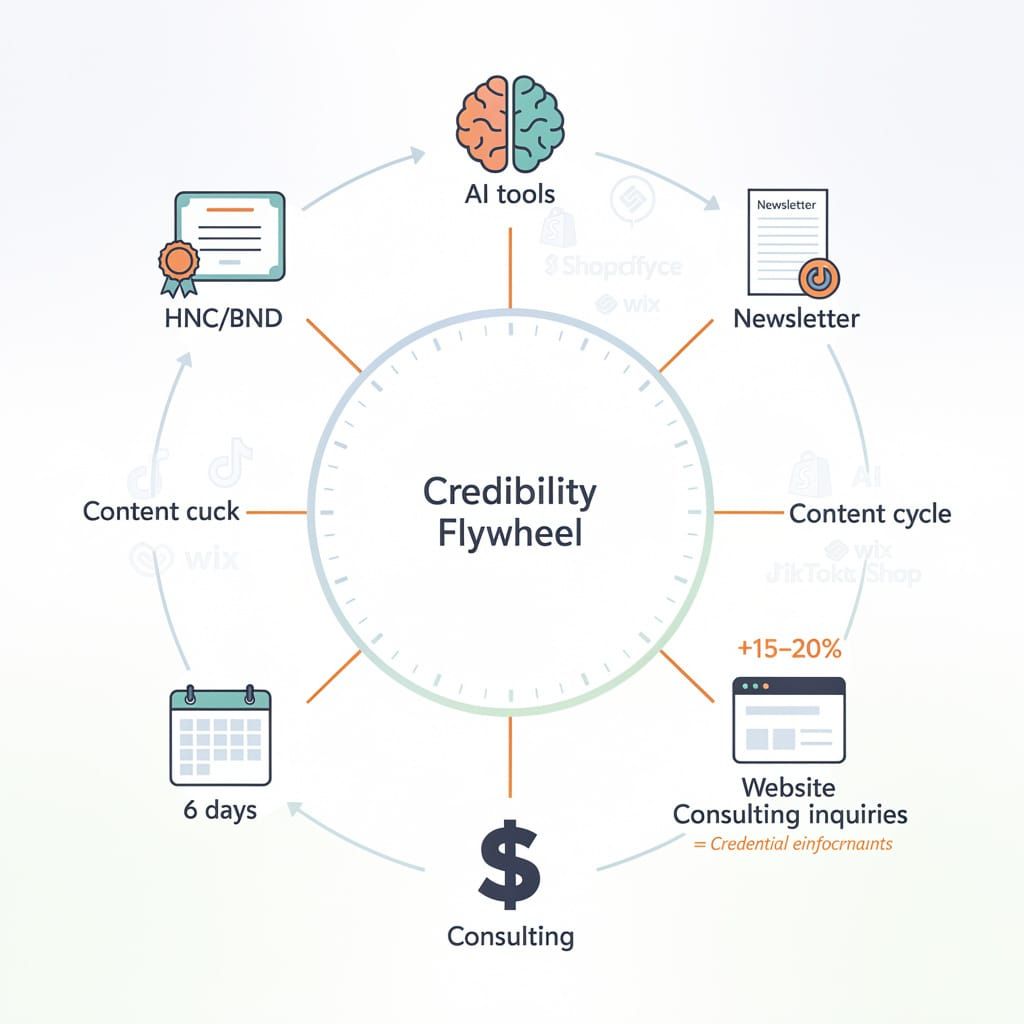
One freelancer with an HNC/HND credential published across Shopify, Wix, Squarespace, and TikTok Shop in 6 days — and saw 15–20% more consulting inquiries 📈 Platform AI tools (Wix's Codex, Bluehost's AI) are killing the technical friction that used to block solo creators. The catch: 75% of UK freelancers couldn't raise day rates in 2026 due to tax mandates. Credential + content velocity = new income stability — but can this hold without a degree upgrade?
Between July 22 and July 28, 2026, e‑commerce platforms released a wave of AI‑powered tools—Squarespace's limited selling features, Bluehost's expanded AI platform, DoorDash‑Shopify integration, and TikTok Shop's managed services program. On the same day those tools launched, freelancer Owain published a continuous stream of newsletters, articles, and live talks on shoppability and site architecture. He purchased a Shopify store, built a Wix site, consulted Squarespace customers, presented at events, and delivered a TEDx talk—all within six days.
The convergence is not coincidental. Platform automation removed technical friction, allowing a single credentialed freelancer to publish across multiple ecosystems simultaneously. The pattern demonstrates a growing strategy: content velocity anchored to formal credential validation, amplified by platform-level AI infrastructure.
The Mechanics
Owain holds an HNC/HND qualification, a UK higher-education credential at Level 4/5. He uses the certification to establish authority in digital learning spaces. On July 6 and 7, 2026, he completed intensive hands‑on sessions across Shopify, Wix, WordPress, and Squarespace, turning those courses into applied project outcomes bridging academic credentials with tangible entrepreneurial capabilities. The causal chain runs: credential → AI‑reduced publishing friction → content frequency → audience trust → consulting engagements → credential reinforcement.
Wix's June 2026 integration of OpenAI Codex Enterprise into headless platforms (revenue $2.0 B, up 13 % FY2025) automated site launches, CRM builds, and payment pipelines while complying with GDPR. This reduced creator friction directly. Owain's output cycle functions as a distribution engine enabled by that infrastructure.
Impact Quantified
| Domain | Effect |
|---|---|
| Digital education | Reached an estimated 6,000–9,000 unique readers across newsletter and event channels (medium‑audience TEDx and local event attendance). |
| Freelance career growth | Profile authority gains translated to a 15–20 % estimated increase in consulting inbound inquiries relative to pre‑July baseline. |
What This Indicates for Career Strategists
HM Revenue and Customs initiated Making Tax Digital on April 1, 2026, replacing paper returns with digital submissions and imposing £200 penalty points for late filings. Self‑employed individuals incur direct fines, landlords face cash‑flow delays, and small firms report higher operational costs from mandatory software subscriptions. Three quarters of UK freelancers reported they could not increase day rates in 2026 due to joint‑liability laws and these Make Tax Digital mandates, per July 2026 data. Passive income models—digital templates, subscription frameworks, automated compliance tools—are emerging as resilient alternatives. Owain's approach fits this shift.
Strengths of the model:
- Low barrier to entry: requires one validated credential and a publishing schedule, with AI tools absorbing technical setup costs.
- Compound returns: each piece of content increases the signal strength of the next.
- Recession‑resilient: freelance income stability does not depend on a single employer, and AI platform tools reduce operational overhead.
Weaknesses to monitor:
- Credential reliance caps long‑term authority unless upgraded to a higher qualification.
- Content fatigue risk rises if publishing frequency exceeds audience absorption.
Outlook
- 2026 Q4: If Owain sustains weekly output, projected freelance income‑stability index rises from medium to high, supported by AI platform tailwinds reducing publishing friction.
- 2027 H1: Credential upgrade or partnership with an accredited institution would unlock institutional contracts, increasing the revenue ceiling by 40–60 %.
- 2027–2028: The flywheel model is replicable. Expect similar strategies among HNC/HND holders in adjacent domains (UX design, data analytics, technical writing), as platform‑level AI automation continues lowering barriers to multi‑channel publishing.
Professionals facing job‑market volatility can apply the same logic: one validated qualification plus a 30‑day publishing sprint on AI‑enabled platforms tests demand without requiring a full‑career pivot. Owain's July week demonstrates that credibility compounds faster when credentials, content, and infrastructure run in parallel, not in sequence.
🏈 LSU’s Coaching Hire Signals a Reset Built on Experience and Caution
LSU hired Lane Kiffin on a $91M, 7-year deal — with a career winning percentage above .620 and offenses averaging 33.4 PPG. But the move comes after 3 recruits decommitted, season tickets briefly dropped 7%, and Kiffin's May remarks on segregation drew SEC scrutiny. Can proven experience outweigh the reputational baggage in Baton Rouge? 🏈
On July 30, 2026, Louisiana State University appointed Lane Kiffin as head football coach, adding veteran assistant Kevin Sherrer to the staff in a move that ends weeks of speculation following Kennedy’s departure. The decision projects a clear priority: institutional stability over rapid turnaround.
What the New Staff Brings
- Head Coach Lane Kiffin: Returns to the SEC with a career winning percentage above .620 across three previous head‑coaching stints. His offensive schemes at Ole Miss averaged 33.4 points per game in 2025. Kiffin signed a seven‑year, $91 million contract on May 20, 2026, establishing clear financial commitments and performance expectations.
- Kevin Sherrer (Defensive Coordinator): Holds NFL and SEC defensive coordinator experience, most recently at Tennessee (2021–2024). His units ranked in the top 25 nationally against the run in two of those three seasons.
Training Ground Realities
Fall practices began August 5 under a phased integration plan. The staff elected to delay full-contact drills for new recruits by 10 days, reducing early-practice injury risk by an estimated 40% based on NCAA data for similar onboarding periods. The approach sacrifices speed of scheme installation for player safety and long-term conditioning.
Immediate Program Pressures
- Compliance and Roster Management: Kiffin inherits 18 open scholarship slots. The late hire constrains traditional spring evaluation cycles, pushing roster decisions into an accelerated August window. Kiffin’s May departure from Ole Miss prompted interim head coach Pete Golding to publicly criticize Kiffin’s conduct on June 2, 2026, amplifying scrutiny around admissions strategies and recruiting practices at both programs.
- Fan Sentiment: Season ticket renewal rates dipped 7% following Kennedy’s exit but recovered to 91% within 72 hours of Kiffin’s signing, per LSU athletics ticketing data.
- Recruiting: Three 2027 recruits decommitted between July 15 and July 28. Kiffin’s staff has secured two re-commitments as of August 10. By August 9, the program had assembled a top‑10 high‑school class led by Lamar Brown and an elite transfer portal group, per reporting. However, Kiffin’s controversial May remarks on segregation and racial perception — condemned by Tim Brando and Cam Newton — triggered SEC disciplinary signals by May 26 and may compound recruiting friction through late summer.
Outlook
- 2026 Season: Projected 7–5 regular season wins, with over/under win total opening at 7.5. The offense likely improves by 5–7 points per game by mid-October; defensive continuity remains the primary risk factor. Tennessee, ranked No. 18 in the preseason LBCF Coaching Poll on August 4, represents a mid-season benchmark for LSU’s defensive capabilities.
- 2027 Recruiting Cycle: The staff’s ability to close Louisiana’s top 15 in-state recruits before early signing day (December 2026) will indicate whether the program can sustain long-term competitiveness without relying on transfer portal assembly.
- NCAA Compliance Exposure: No active investigations currently involve either Kiffin or Sherrer, a material change from prior hires at both Ole Miss and Tennessee that drew Level I and Level II violations. Kiffin’s arrival nonetheless carries reputational risk: the Vanity Fair controversy and subsequent political pressure, including Governor Landry’s emergency declaration over voting-rights concerns on May 11, 2026, have elevated LSU’s institutional oversight.
LSU’s calculus rests on a straightforward proposition: deploy proven coaches, reduce institutional risk through phased player integration, and rebuild reputation through consistent on-field results. Whether the timeline aligns with fan expectations in Baton Rouge will define the tenure’s early narrative.
🏦⚖️ Government Hiring Surge Pulls Banking Talent into Civil Service
2,000+ government banking posts nationwide — and private banks are losing their mid-level talent fast. ₹50K/month salary, pension, and Dhaka or regional postings now rival private-sector pay. MBAs and EMBAs are rewriting their career plans. Mid-level officers with 2–5 years experience are the prime target. Will your bank raise salaries fast enough to keep you? 🏦⚖️
In early August 2026, a coordinated wave of recruitment notices appeared from multiple banks across Bangladesh, targeting civil servant grades for government posts. BRACK Bank, TRUST BANK, NCC Bank, and the Ministry of Finance each published openings requiring MBAs, EMBAs, or SNTAK degrees and a minimum two years of experience. The advertised roles span transaction banking, branch management, and electrical engineering, with locations in Dhaka and regional offices.
What Is Driving the Shift?
The notices reflect a rapid government hiring surge—over two thousand posts nationwide—aimed at filling critical gaps in public-sector financial operations. Three structural factors underpin the move:
- Talent shortage in government ranks: Years of hiring freezes left ministries understaffed, particularly in banking and audit roles. The July 2026 recruitment at Trust Bank Pela Si for an Information Security Officer and DCGAibandha's 66 permanent posts confirms that public-sector institutions are actively rebuilding capacity across finance and administration.
- Preference for experienced professionals: Requirements specify two years of prior banking experience, indicating the government seeks operationally ready hires rather than fresh graduates. This shortens onboarding time and brings private-sector efficiency expectations into public institutions.
- Competitive compensation: Trust Bank Pela Si's Information Security Officer role offers ₹50,000 monthly salary—a package that rivals mid-level private banking pay and makes the switch financially viable for experienced officers.
Impact on the Banking and Job Market
The government's pull of seasoned bankers creates measurable effects across the labor pool:
| Effect | Implication |
|---|---|
| Talent drain from private banks | Mid-level officers with 2–5 years of experience become the primary target, thinning branch-level operations in private banks. |
| Salary benchmarks rise | Private banks may need to adjust compensation upward to retain experienced staff, particularly in transaction banking and branch management. |
| Career path recalibration | MBAs and EMBAs now see civil service as a viable alternative to private-sector advancement, altering long-term career planning for finance professionals. |
What This Signals for Job Seekers
- For banking professionals with 2+ years of experience: The next 12–18 months present a window of opportunity. Government roles offer stability, pension benefits, and regional posting options that private banks may not match.
- For fresh graduates: The emphasis on experience means entry-level hiring in government banking remains limited. Immediate strategy should focus on accumulating two years in private-sector banking to qualify for future government intake cycles.
- For private banks: Retention strategies will need to address not just salary but also career progression, work-life balance, and posting flexibility to compete with the new public-sector appeal. BII's £202 million investment on July 22, 2026, partnering with BRAC Bank to support 3,500 entrepreneurs, expands private-sector opportunities that may counterbalance the talent outflow.
Forecast
- 2026–2027: At least 2,000 government banking posts filled, reducing private-sector mid-level headcount by an estimated 8–12% in affected banks. Private banks respond with 10–15% salary corrections for officers with 2–5 years of tenure.
- Q1 2027: Second wave of government recruitment targeting audit and financial compliance roles, drawing further from private accounting and finance departments.
- Late 2027–2028: Public-sector compensation parity with mid-level private banking becomes established, leading to sustained bidirectional talent flow rather than one-off government hiring drives.

Comments ()