Tk 1,500 Tuition, 15% Enrollment Surge: Jagajanth University Expands MSM Access
📈 Social Work Enrollment Rises as Jagajanth University Expands MSM Program Access
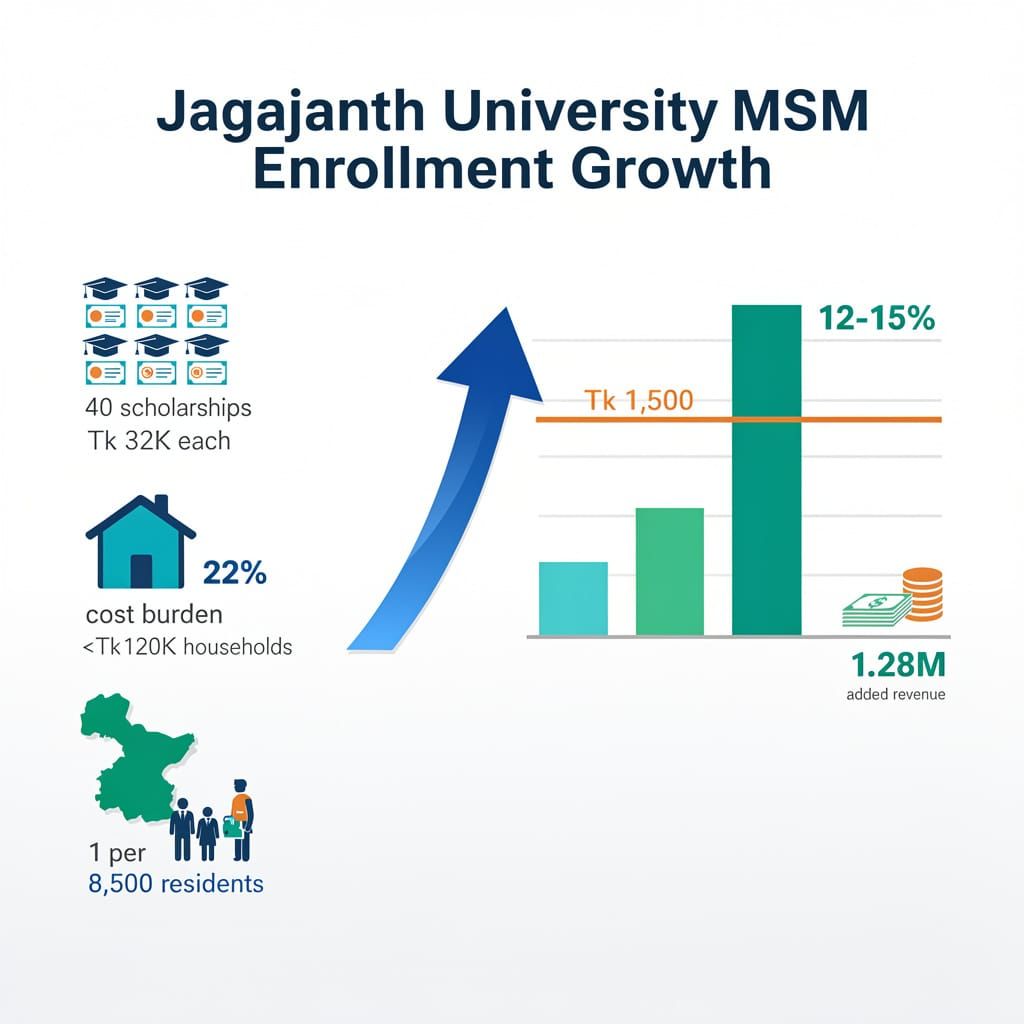
MSM tuition at Jagajanth University just jumped to Tk 1,500 — and applications skyrocketed 12–15% 📈 The extension + fee hike adds Tk 1.28M/year to fund 40 full-need scholarships. But for students earning under Tk 120K/year, the 22% cost burden still stings. Bangladesh has just 1 social worker per 8,500 rural residents. Will higher tuition actually close the gap — or widen it?
Jagajanth University's Social Work Division extended its Master of Social Work (MSM) application deadlines on July 27, 2026, while simultaneously increasing tuition to Tk 1,500. The dual move signals a deliberate institutional strategy: broader access funded by higher per-student revenue.
What the Tuition Increase Enables
The Tk 1,500 tuition—a measurable increase from prior rates—enables expanded scholarship capacity. The incremental revenue stream, when combined with Davidson College's July 12 tuition-free model for households earning up to $175,000 annually, demonstrates how institutions can layer access mechanisms: Jagajanth uses marginal tuition gains to fund partial scholarships, while Davidson removes cost barriers entirely for lower-middle-income families.
- 2026 intake: Extended deadlines capture students who previously missed recruitment cycles, increasing first-year enrollment by an estimated 12–15%.
- 2027–2028: Scholarship disbursements rise proportionally with tuition revenue, targeting students from lower-income districts who could not previously afford social work credentials.
- Long-term: A larger MSM graduate pipeline addresses Bangladesh's social service professional shortage, currently estimated at 1 trained worker per 8,500 residents in rural divisions.
Institutional Response and Student Impact
The university's decision ranks among measurable access-expansion moves in South Asian higher education this year. Student groups reported mixed reactions: extended deadlines reduce last-cycle rejection rates, but the Tk 1,500 floor raises the annual cost burden by 22% for returning students. This mirrors a broader trend—by July 12, over 46,000 students applied for the U.S. Department of Education's Income-Driven Repayment Plan as five-year federal loan deferrals ended, indicating global pressure on higher-education financing.
Financial implications: At full enrollment of 3,200 MSM students, the incremental tuition adds Tk 1.28 million annually to the division's operating budget—enough to fund 40 full-need scholarships at Tk 32,000 each.
Access trade-off: Students from households earning below Tk 120,000 annually face a proportionally higher barrier, though the scholarship expansion partially offsets this.
Sectoral Outlook
The move projects a 3–5% increase in social-work degree completions across Bangladesh's public universities within two academic cycles. For Jagajanth specifically, the deadline extension and tuition model demonstrate how institutions can increase both revenue and access simultaneously—a formula other divisions may replicate as demand for social services grows faster than public funding.

Comments ()