🚀 Isar Aerospace reaches orbit after four failures — but the math on strategic autonomy doesn't add up
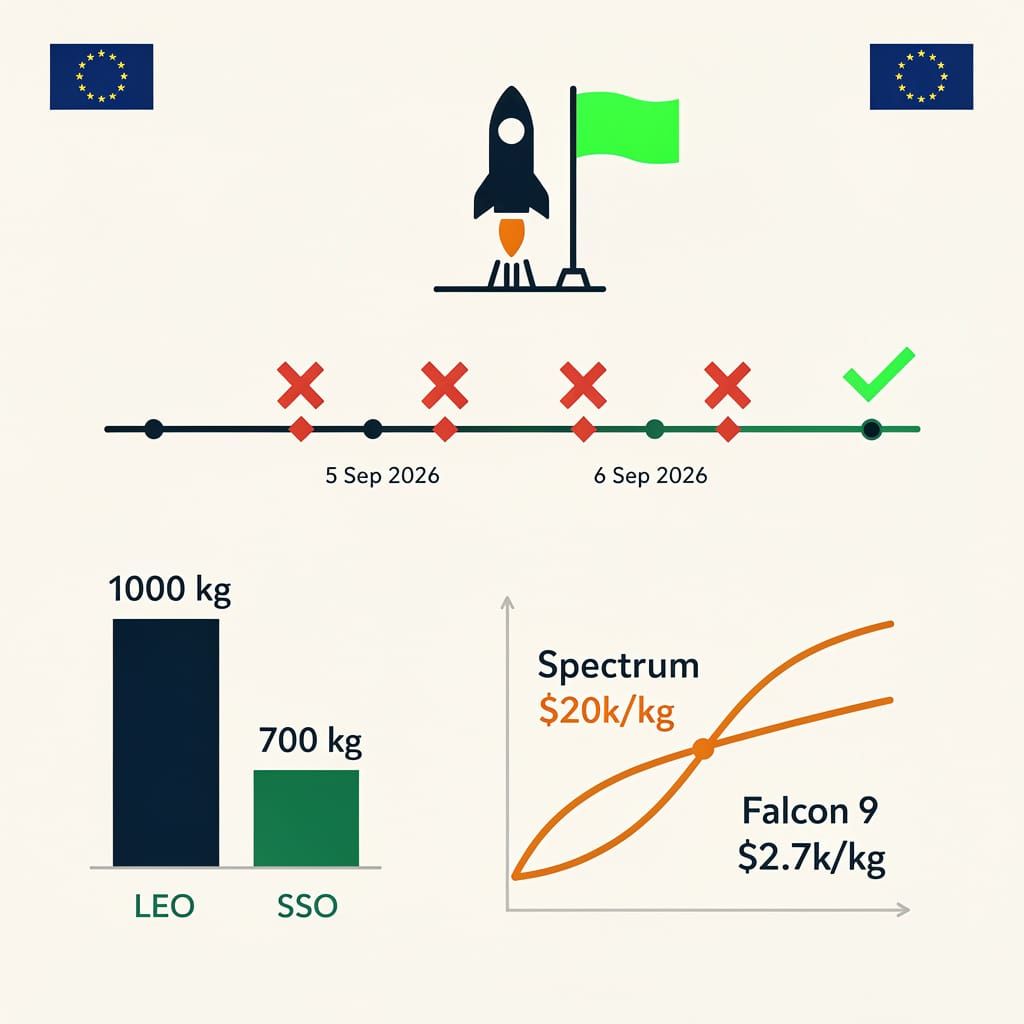
4 failures in 5 test flights. $1B in private financing burned. Spectrum reaches orbit — but at $18k–$22k/kg vs. Falcon 9's ~$2,700/kg. 🚀 Europe now has a fragile, expensive small launcher that can't serve the commercial rideshare market (needs 4,000–6,000 kg; Spectrum lifts 1,000 kg to LEO). The "strategic autonomy" narrative requires ignoring that every prior failure was propulsion-based and required external corrective action. Production target of 40/yr by 2030 would be 5x the continent's current total launch cadence — funded only through Q3 2028. SpaceX delivered 6 Starship Starlink launches in July 2026 alone. Does a 6–8x sovereignty premium on launch costs make sense for European satellite operators when LEO costs are projected to fall 93% by 2040?
On September 5–6, 2026, Isar Aerospace launched its Spectrum rocket from Norway's Andøya Spaceport, inserting a payload into Earth orbit using a vehicle built by a German startup. The event is being framed as Europe's first fully commercial orbital launch from Western European soil.
The headline numbers demand scrutiny. The four previous failures—March 2025 (vent-valve failure 30 seconds after liftoff), January 2026 (pressurisation valve), April 2026 (leak), June 2026 (fluid system issues)—had already erased years of schedule gains and consumed approximately $1 billion in private financing. Calling the September flight a sovereign capability requires ignoring that every prior failure stemmed from propulsion and fluid-system problems Isar Aerospace had not solved until external corrective action was implemented.
What the Success Actually Demonstrates
The Spectrum vehicle did achieve orbit, a genuine engineering milestone. The second flight, named "Onward and Upward," carried five CubeSats and one DLR scientific experiment, demonstrating pitch-over maneuver and second-stage in-flight restart. But the causal chain reads less like mastery and more like a crash program that finally cleared the minimum bar after the March 2025 vent-valve root cause was identified and rectified. The narrative of full independence collapses against the fact that the vehicle's 1,000 kg LEO payload capacity (700 kg to SSO from Andøya) places it squarely in the small-launcher niche—comparable to Firefly Alpha (630 kg SSO, 1,030 kg LEO), not in the class of vehicles serving the primary commercial market, which requires 4,000–6,000 kg per rideshare mission.
The $8 Billion Defense Export Projection
The claim that this launch will generate $8 billion in additional defense exports over the next decade relies on three assumptions: that production can scale to 40 missions annually by 2030, that European satellite manufacturers will shift procurement away from US providers, and that no further failures interrupt the ramp.
- Production reality: Series manufacturing begins late 2030, after a third test flight scheduled for early February 2027. Current launchpad infrastructure at Andøya supports one mission per quarter. A ten-year contract with Maritime Launch Services for Spaceport Nova Scotia ($3.75 million per quarter) was signed July 7, 2026—but that site is not operational. Isar Aerospace states that Spectrum launch vehicles 3–7 are already in production, but achieving the "annual capacity of up to 40 launch vehicles" depends on a new facility not yet funded.
- Market dynamics: SpaceX executed six Starlink V3 satellite launches via Starship in July 2026 alone, each delivering ~61,000 Gbps capacity. The cost per kilogram on Spectrum is projected at $18,000–$22,000; Falcon 9 runs at approximately $2,700/kg. Cambridge-led research published July 15, 2026 projects LEO launch costs falling to ~$1,569/kg by 2030 and ~$273/kg by 2040—a 93% reduction from 2025's $3,868/kg. No commercial satellite operator will pay sovereignty premiums of 6–8x when the floor is dropping beneath them. SKYROOT's Vikram-1 benchmark ($43k–$57k/kg) and Firefly Alpha ($14,500/kg) demonstrate the spread is real.
- Failure risk: Four failures from four test attempts before the September success yields a 100% failure rate through the first campaign. One success does not establish reliability. A single in-flight failure during the 2027 test sequence resets the schedule by 18–24 months.
What the Eurocosmos Agenda Actually Delivers
The "strategic autonomy" framing enables EU institutions to redirect Horizon Europe funds toward domestic launch infrastructure—the European Space Agency added €197.8 million ($230 million) via the European Launcher Challenge. This generates political capital and procurement budgets but does not fix the fundamental physics: European launch costs remain structurally higher than US and Chinese systems, and the development timeline for reusable stages (needed to compete on price) begins no earlier than 2035 under current roadmaps. The EU's May 2026 decision to allocate 2 GHz of mobile satellite spectrum exclusively to European operators—while simultaneously approving the IRIS² secure government broadband constellation as a countermeasure to Starlink—demonstrates the priority is market control, not cost competitiveness.
Gaps That the Narrative Omits
- Guidance systems: No public documentation confirms the star-tracker and IMU sources. The 2025 failure investigation identified vent-valve opening and attitude-control loss as root cause—attitude control depends on guidance subsystems. Whether those subsystems were domestic or imported remains undisclosed.
- Payload capacity: Spectrum lifts 1,000 kg to LEO. The average commercial rideshare mission requires 4,000–6,000 kg. Isar Aerospace cannot serve the primary commercial market segment. Its secured contracts—Planet's Pelican satellite and the ESA Flight Ticket Initiative—are smallsat and government payloads.
- Launch license: The Norwegian Civil Aviation Authority granted a restricted license valid for one flight. Recertification requires full documentation of the anomaly resolution from all four prior failures. That process is ongoing.
The Outlook, Stripped of Hype
- 2027: Third test flight scheduled. If successful, production planning accelerates. If not, the program enters restructuring. Cash runway extends through Q3 2028.
- 2028–2029: Limited commercial availability at 4–6 launches per year, constrained by range availability and stage production rates. Payloads will be government and institutional only. Launch service agreements with SEOPS are planned for 2028.
- 2030: Target of 40 annual missions requires an entirely new launch site (French Guiana or Sardinia) and a second-stage production facility not yet funded. Current cash runway extends through Q3 2028. Even if the facility materializes, Europe managed only 8 orbital launches in total the previous year—the production target is 5x the continent's entire current launch cadence.
The Spectrum launch is not nothing. It is a functional orbital vehicle built in Europe. But calling it the dawn of strategic autonomy confuses a single successful flight with a competitive industry. The numbers, the costs, and the failure history point to a different conclusion: Europe now has a fragile, expensive, low-capacity launcher that cannot meaningfully reduce dependence on US providers for at least another decade—and may never survive the cost curve SpaceX and Starship are driving toward $273/kg.
Comments ()