🇨🇦✈️ Gripen E scores 33% vs F-35's 95% in Canada's own suitability test
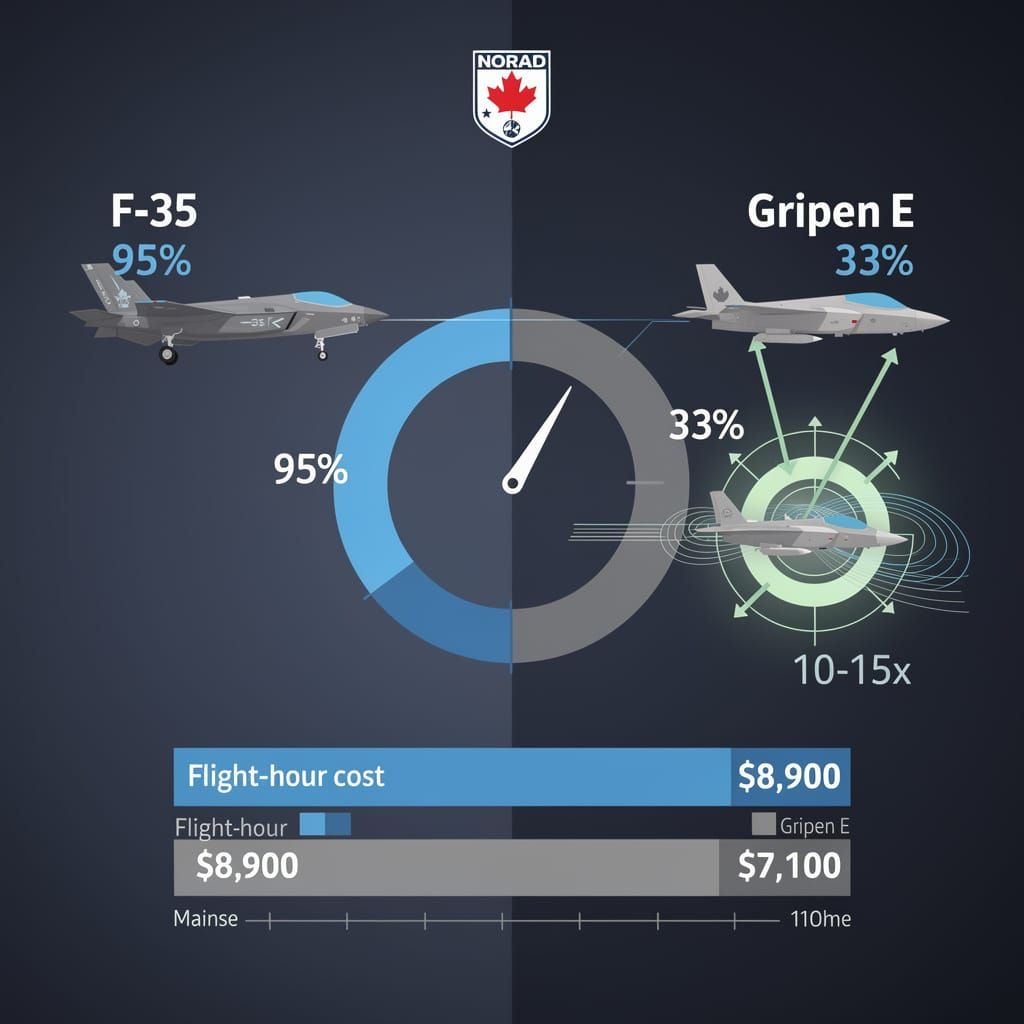
Canada's internal assessment gives the F-35A a 95% suitability rating. The Gripen E scores 33% on the same evaluation — a 3× survivability gap in radar signature against modern air-defence systems. 🇨🇦✈️ Proponents say Gripen cuts U.S. leverage. But swapping one foreign supplier for a smaller one with no combat-proven logistics chain at scale is not sovereignty. Ottawa can save upfront and inherit a cheaper, older, less capable fleet — or pay full price for a fighter that survives first contact. Which bet does Canada's Arctic posture justify?
On paper, Canada’s flirtation with the JAS 39 Gripen E looks like a logical hedge against U.S. export leverage. SAAB submitted its “fourth‑gen” offer on August 10, 2026, and Ottawa is now openly weighing an exit from the F‑35 pipeline. The question nobody wants to answer: is trading fifth‑gen stealth for a cheaper price tag actually a net gain?
The Numbers That Don’t Add Up
The Royal Canadian Air Force’s own internal assessment, released August 22, awarded the F‑35A a 95 % suitability rating. The Gripen E, by contrast, scored 33 % on the same Canada Security Initiative evaluation. That is not a rounding error. That is a structural gap in survivability, interoperability, and long‑term combat relevance.
Proponents, including former National Defence deputy Andrew Latham, argue that the Gripen’s lower unit cost and domestic maintenance ecosystem free Canada from Washington’s political strings. The logic holds only if you ignore what Canada actually needs to do with the aircraft.
- Stealth: The Gripen E is a fourth‑generation platform with partial low‑observability features. Against modern Russian S‑400 and future S‑500 air‑defence systems, it generates a radar signature roughly 10 to 15 times larger than an F‑35. That difference translates directly into mission kill probability. On July 31, 2026, the United States removed Turkey from its F‑35 program specifically because Russia deployed two S‑400 triple‑threat units adjacent to the Anatolian coast—confirming Washington’s assessment that fifth‑gen stealth is the only credible countermeasure against those systems.
- Interoperability: NORAD is an integrated U.S.–Canadian command. Operating a non‑stealth, non‑American fighter inside a network built around F‑35, F‑22, and next‑generation sensors forces costly gateway adaptations. Every link downgrades the alliance’s shared picture.
- Cost trajectory: SAAB’s proposal promises “four‑generator” savings, but Sweden’s own projected per‑flight‑hour cost for the Gripen E is $7,100 versus the F‑35A’s $8,900. The 20 % difference evaporates when you factor in the additional support infrastructure Canada must build from scratch.
The Timing Problem
Canada joined the GCAP (Global Combat Air Programme) Observer programme on July 21, signalling interest in a sixth‑generation platform beyond 2040. That is a sensible hedge. But replacing the CF‑18 fleet with Gripen E now, then pivoting to GCAP in fifteen years, creates a mid‑life capability valley exactly when Arctic sovereignty demands grow.
Meanwhile, the United States showcased an F‑35A prototype in Alaska on August 8, reinforcing that Washington is not de‑commissioning the platform. The U.S. Air Force plans to operate F‑35s through at least 2070. A Canadian fleet that cannot integrate fully with that force by 2035 guarantees diminished operational standing inside NORAD.
What Ottawa Actually Risks
The cost argument hinges on near‑term budget relief. But Canada’s defence budget grew 7 % year‑over‑year, reducing the fiscal pressure that once justified CF‑18 life extensions. The real risk is not overspending on F‑35s—it is under‑investing in a fleet that cannot survive first contact.
Interoperability: A mixed fleet or a full Gripen transition degrades NORAD sensor fusion. Readiness: SAAB’s delivery schedule projects 12 aircraft per year; Lockheed Martin delivers 16 F‑35s annually to international partners. Sovereignty: Choosing Gripen does not eliminate foreign dependency—it swaps one supplier for another, with a smaller industrial base and no combat‑proven logistics chain at scale.
The Super‑Minister proposal pushed by former RCAF commander Stephen Fuhr on August 22 centralises buying power, but centralisation does not fix a flawed procurement target. Ottawa can buy the Gripen E, save a few hundred million upfront, and inherit a fleet that is cheaper, older, and less capable—or it can pay the full price for a fighter that still works when the radars light up.
Comments ()