✈️ B-52 Upgrades Cost Billions but Deliver Less Firepower Per Sortie
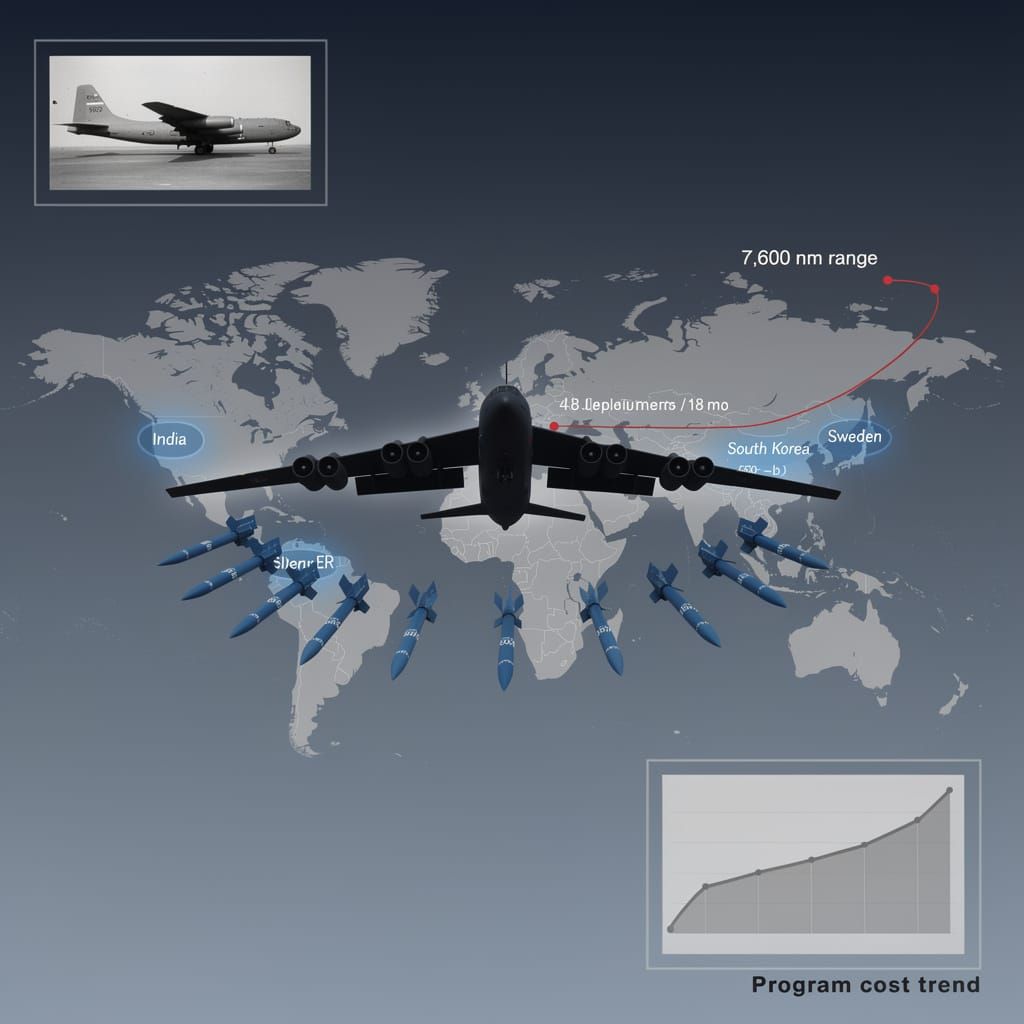
B-52 fleet: ~140 airframes remain from a peak of 550+. Each sortie now delivers less explosive mass than WWII-era ordnance. ✈️ Engine upgrades are $3B+ over budget and 3 years behind schedule. The Air Force is spending billions to keep a 70-year-old bomber flying through 2050 while next-gen programs get deferred. Can a Cold War relic really sustain air dominance against peer competitors — or is this a costly stopgap the Pentagon can't afford to retire and can't afford to keep flying?
The U.S. Air Force’s B-52 Stratofortress debuted in 1955. By August 2026, the fleet has shrunk from over 500 airframes to roughly 140. Rather than retire the type, the USAF is doubling down. Engine upgrades and long-range JDAM integration now push each sortie beyond 7,600 nautical miles—while delivering significantly less explosive payload per bomb than WWII-era ordnance.
What the Numbers Actually Show
- Fleet size: ~140 active B-52F and B-52H variants remaining, down from ~550 at peak deployment. Bomber Task Force deployments have increased to 48 times in 18 months across India, South Korea, and Sweden—a tempo the 140-frame fleet cannot sustain indefinitely.
- Range improvement: Upgraded engines and JDAM-ER enable 7,600+ nm missions versus the original ~8,800 nm unrefueled range—a marginal net gain when factoring in heavier munitions. Boeing delivered the first B-52J prototype on August 3, 2026, equipped with Rolls-Royce F130 engines, but the GAO reports the program is already three years behind schedule and more than $3 billion over budget.
- Explosive yield shift: JDAMs carry ~500 lb or 1,000 lb warheads, compared to the B-52’s historical capacity for 20,000–70,000 lb of conventional bombs. Each sortie now delivers less total explosive mass per strike, offset by precision.
General Thomas Bussiere framed the upgrade as "sustaining air dominance under depleted-fleet conditions," during an August 28 briefing, noting BTFs now operate worldwide on short notice. The math does not support the framing.
The Hidden Costs of Prolonging a 70-Year-Old Platform
Maintaining a fleet designed in the early 1950s incurs compounding technical debt:
- Engine reliability: The B-52H uses eight TF33-P-3 turbofans, first certified in 1962. The Rolls-Royce F130 upgrade projects a 30% fuel-efficiency improvement, but the GAO audit published August 1, 2026 reveals the engine rollout alone has exceeded design budgets by 30–38%, with schedules lagging beyond three years. Retrofitting 70+ aircraft requires $11.3 billion through 2035—before accounting for the $3 billion already overspent.
- Structural fatigue: Airframes average 30,000+ flight hours. The USAF estimates wing-replacement costs at $4.2 million per aircraft, with mandatory depot maintenance cycles doubling from every 8 years to every 4 years. By September 2026, stress fractures have emerged across multiple airframes, and the Air Force lacks viable mitigation—concurrent retrofit initiatives have already left eight airframes missing their modification window.
- Avionics gap: No stealth coating, limited electronic-warfare self-protection, and no passive sensor fusion. In contested airspace, the B-52 remains dependent on fighter escort and standoff weapons to survive.
What Sustained Air Control Actually Looks Like
The August 2026 Operation Epic Fury exercise demonstrated the upgraded B-52’s role: continuous 28-hour sorties from Barksdale AFB (Louisiana) to the Philippine Sea and back, with aerial refueling—a single triple-bomber sortie first conducted in 2016 and now executed at higher frequency. The mission profile projects:
- Per sortie: 12 JDAM-ER missiles, delivering precision strikes against simulated coastal defense sites.
- Per month: ~45 sorties across the fleet, limited by aircrew availability and airframe service hours. BTF missions have increased to 48 deployments in 18 months, stressing the 140-frame inventory.
- Regional strike capacity: Covers targets within a 3,500 nm radius from Guam, but cannot penetrate integrated air-defense systems beyond standoff range.
The Unconvincing Case for Mid-Century Service
The USAF’s stated goal—keeping B-52 variants active through at least 2050—rests on three questionable assumptions:
- Engine upgrades solve obsolescence: The F130 is a commercial-derivative turbofan, not a next-generation powerplant. It extends loiter time but does nothing for survivability. The B-52J prototype delivered August 3, 2026 integrates new radar and communications suites, yet the $21 billion program faces integration bottlenecks that raise "failure probability across propulsion, communications and sensor suites," per the GAO.
- JDAM-ER coverage compensates for fleet shrinkage: 140 aircraft firing 12 precision weapons each cannot replicate the volume of fire from 500 aircraft carrying 70,000 lb loads.
- Cost discipline will hold: The B-52 modernization program currently carries a $56 billion lifecycle price tag through 2050. Historical USAF procurement overruns average 47%. The 2026-2031 USAF budget adjustment reallocates $2.1 billion from next-generation programs to B-52 sustainment.
The Reality Under the Retrofit
Maintenance costs are rising at 6.2% annually (inflation-adjusted). Every dollar spent on TF33-to-F130 retrofits is a dollar not spent on the B-21, NGAD, or Loyal Wingman drones. The B-21 Raider fleet is planned for 100–200 aircraft, but will not reach operational squadron strength until at least 2032—leaving a six-year gap where 70-year-old airframes are the only option.
The B-52 remains operationally effective in permissive airspace against low-tech adversaries. It is not a strategic deterrent against peer competitors. It is a highly expensive stopgap—one that the U.S. Air Force cannot afford to retire and cannot afford to keep flying.
Comments ()