Volotea's Insolvency Is a Retreat, Not a Rescue
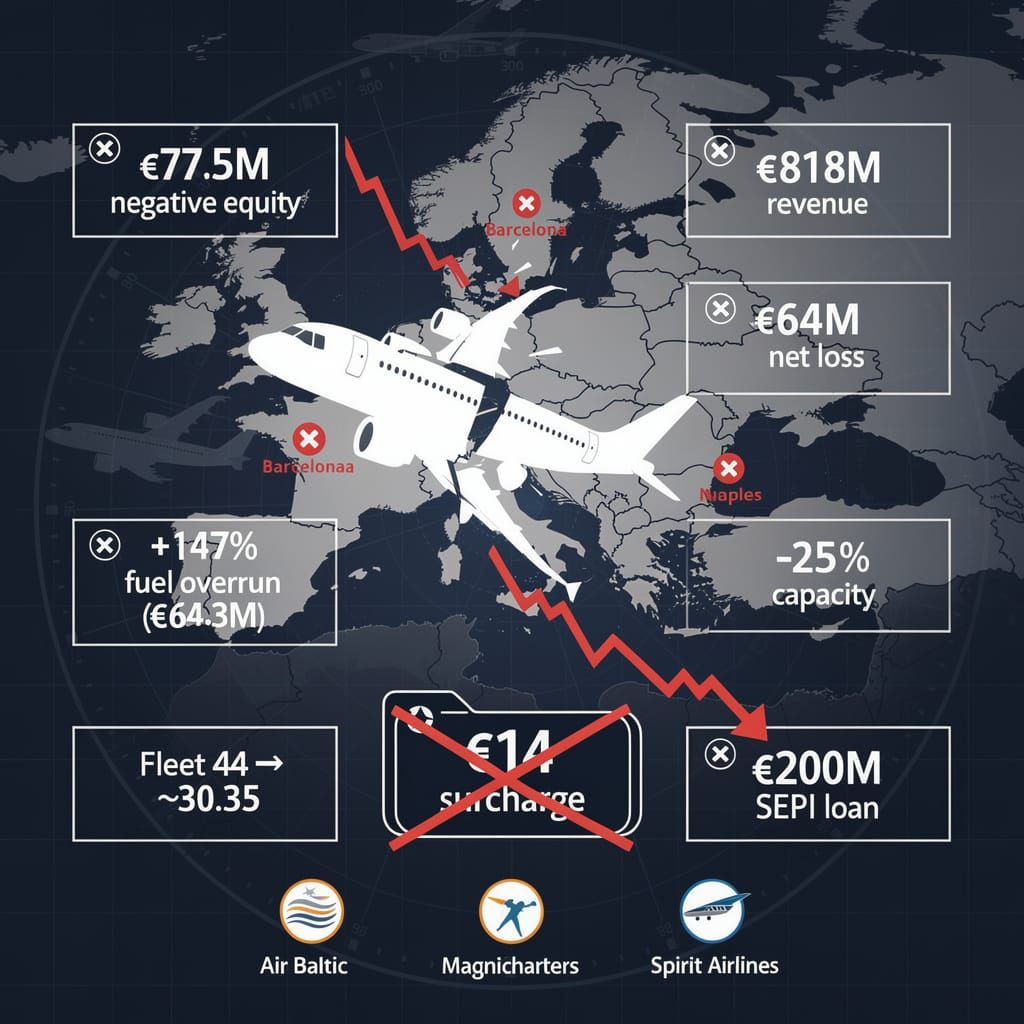
Volotea's insolvency filing is a confession, not a rescue. The numbers are stark: negative equity of €77.5M on €818M revenue, a €64M net loss, and fuel costs running 147% over budget after the Strait of Hormuz closure spiked prices. The restructuring plan is really a retreat — roughly a third of the fleet goes, German network cuts, Naples and Florence bases at risk. Even more telling: co-founder Carlos Muñoz filed the same day to block the procedure he'd rather not admit is real. The low-cost regional model is breaking across carriers. Spirit shut down in May; Air Baltic and Magnicharters are also navigating insolvency. Relief requests are not relief — December will test whether Volotea exits as a viable airline or just a legal entity.
When Volotea announced that it was entering a self-administered insolvency procedure, the company's framing was almost defiant: flight operations "continue unaffected," a restructuring plan is due by December, and a capital increase will set things straight. The language is comforting. The math is not.
Here is what the numbers actually say. Volotea reported negative equity of €77.5 million for fiscal 2025 on annual revenue of €818 million, with a net loss of €64 million. Its debt burden, layered on top of three consecutive years of operating losses and roughly €150 million in additional fuel costs since March—when hostilities in the Near East began distorting global energy markets—did not break the company this week. It broke it months ago. The filing merely made it official, and the timing confirms the pattern: preliminary creditor protection was sought on September 29, after a year in which jet fuel price highs and a closed Strait of Hormuz left thin-margin operators with nowhere to hide.
Company disclosures quantify the damage with unusual specificity. Fuel overruns reached €64.3 million—147 percent above budgeted costs for the year—even as an operational result improved 41 percent to €47.3 million. That operational "improvement" is what happens when you strip away capacity rather than grow into demand. A previous fuel surcharge of up to €14 per flight per passenger, meant to claw back costs, was reversed after regulatory investigation, removing another tool management had hoped to use.
The restructuring plan is essentially a downsizing plan. Fleet count drops from 44 leased A319s and A320s to approximately 30 to 35, a reduction of roughly a third and up to 25 percent of capacity. Approximately 50 jobs are being eliminated in Barcelona. The German network—Berlin, Hamburg, Munich—faces real cuts, and the Naples and Florence bases are slated for possible closure by autumn. That is not a stabilization program. That is a retreat.
The more revealing detail is who is resisting the process. Carlos Muñoz, Volotea's co-founder, filed on the same day to restrict the insolvency filing, attacking its very premise—even as management under Muñoz and investment vehicle Alaeo sought new capital raises. A founder suing to block his own company's restructuring is not the behavior of someone confident the plan will succeed. It is the behavior of someone who understands the procedure may not end in recovery but in liquidation, and wants to control the narrative before creditors and the SEPI-administered state machinery set the terms. The company is renegotiating repayment of a €200 million SEPI loan due in 2029, a deadline that looks optimistic given current losses.
Even the supporting cast undermines the hopeful storyline. Volotea's distress is unfolding alongside insolvencies at Air Baltic and Magnicharters—peers that also ran into fuel volatility and debt with thin margins. The closures are not confined to Europe. Spirit Airlines permanently shut down all operations in May 2026, and Magnicharters filed for bankruptcy in the same cycle. When carriers in different corridors fail within months of one another, the industry line tends to be "cyclical pressures" or "external shocks." The simpler explanation is that the low-cost regional model stopped working under current input costs, and several operators had been papering over that fact with expansion and borrowed money.
Notice what is absent from Volotea's public statements: any concrete EU or national commitment. The solvency plan approved on September 28 includes "debt relief demands," but relief requests are not relief. Added regulatory penalties from delayed environmental compliance audits and a mounting maintenance backlog—which pushes out turnaround times and raises costs further—remain unaddressed. The company is betting that creditors, SEPI, and the EU will all cooperate by December.
That is a hope, not a plan.
The honest read: a carrier that was already operationally impaired is now contractually, financially, and fleet-wise smaller. Even if restructuring completes on schedule, Volotea exits December with a shrunken network, fewer aircraft, reduced capacity in Germany and Italy, and a balance sheet that will still carry foreign-currency and fuel exposure. The restructuring may preserve a legal entity. Whether it preserves a viable airline is a question the December deadline will answer—and the company's own founder, by fighting the process, seems to doubt the answer.

Comments ()