Vietnam Airlines 787-9 overruns Munich runway after brake-sensor defect
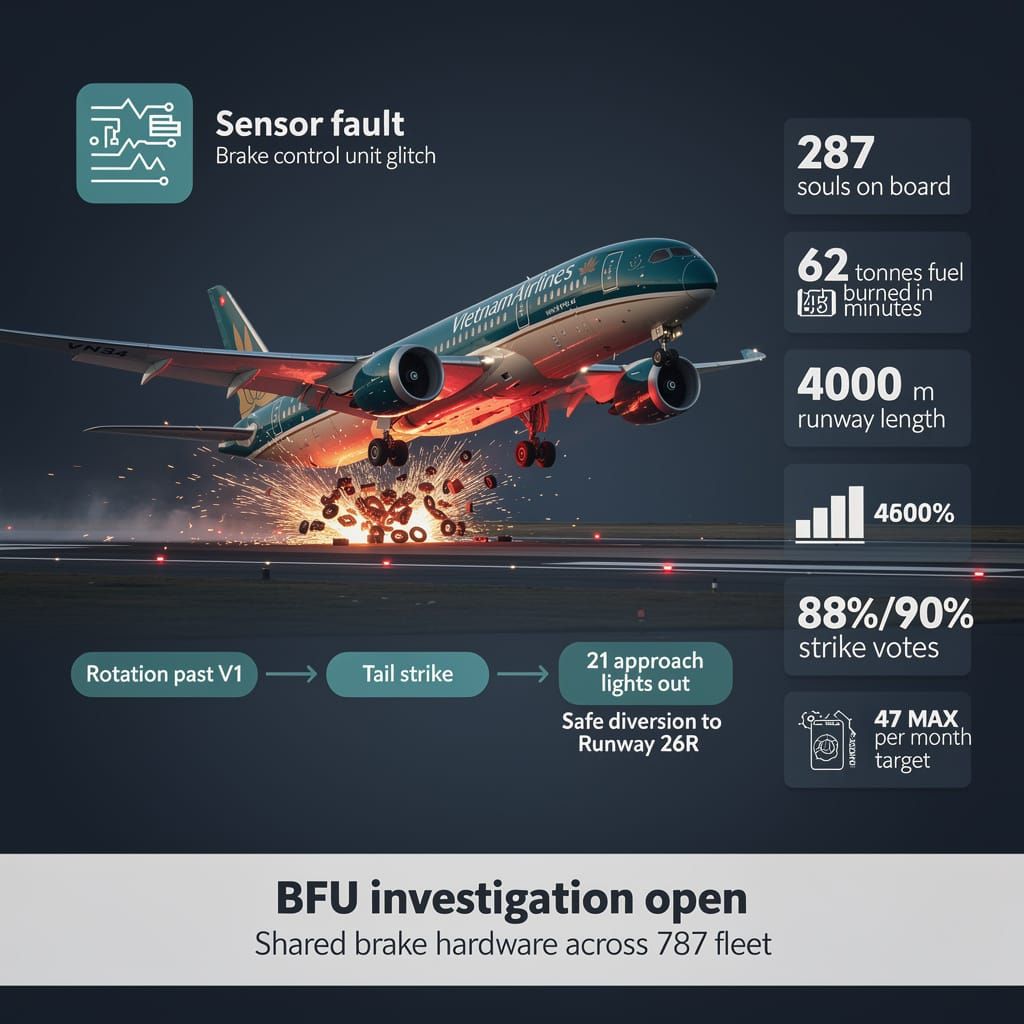
A Vietnam Airlines 787-9 overran Munich's Runway 00L on Sept 15, consuming ~62 tonnes of fuel as the crew handled a tail strike, four lost main-gear tires, and 21 failed approach lights. All 287 onboard walked away — a remarkable outcome, but one measured against thin margins. The trigger: defective brake-input sensors that stripped normal braking authority. The broader risk: those sensor control units are shared across the 787 fleet, yet the fix now routes through Boeing's centralized Common Core System and an FAA certification pipeline — while the company's own MAX production remains unstable and SPEEA engineers have authorized an Oct 7 strike. The BFU's report is still open. This is an unresolved question about 787 brake-integrity, not a closed case.
On September 15, 2026, a Vietnam Airlines Boeing 787-9 registered VN34 was cleared for takeoff from Munich Airport's Runway 00L, bound for Hanoi with 287 people aboard. What followed wasn't a textbook departure—it was a textbook lesson in how a single subsystem failure can cascade into a structural, procedural, and reputational test for an entire airline.
Let's be precise about what did and didn't happen, because the early reporting has been loose.
What the sensors show
The aircraft's extended departure distance traces to defective brake-input sensors in the wheel-brake system. The brake system control units received corrupted input, which effectively stripped the crew of the normal braking authority they'd expect during the takeoff roll. While the investigation is open, the BFU—Germany's federal accident authority—has not confirmed whether the pilots recognized the degradation in time or how decisively they responded.
What's documented: the 787 became airborne only after passing a point where a conventional V1 decision would have applied, then struck the runway surface at the far end. The tail strike deformed the aircraft's structure. Four left-main-gear tires tore off. The approach-lighting array at the runway end suffered twenty-one light failures, wiping out the visual reference for subsequent arrivals.
The aircraft diverted, landed safely on Runway 26R, and all 287 onboard walked away. That's the headline—and it matters. But it should not be the whole story.
Fuel, time, and risk
Here's a number worth sitting with: roughly 62 metric tonnes of jet fuel were consumed within roughly 45 minutes as the crew worked through the post-strike checklist and maneuvered for the diversion. This wasn't just a cost line. An aircraft that has just suffered structural deformation, lost gear components, and is carrying 60-plus tonnes of fuel is an aircraft managing simultaneous threats. That no fire ignited during the overrun, taxi, or landing is attributable to conditions—not to margins that were designed to be this thin.
Vietnam Airlines and the VFW inspectors dispatched to assess both ground and flight-deck damage are now in a delicate position. The carrier's aviation authority is involved, and Air India, Amazon Air, and others connected to 787 operations are watching closely—not because this was their aircraft, but because the brake-system control units in question are shared hardware across the fleet.
And here the timing gets uncomfortable. Since August 1, Boeing has been consolidating avionic functions into a unified Common Core System, replacing the isolated avionics units this aircraft's brake hardware belongs to. The mechanism matters: under the new architecture, defects are reported centrally, which routes fixes through a Boeing-led redesign-and-FAA-validation pipeline rather than a unilateral airline patch. That's a single-point dependency by design. For an operator pulling a 787 out of a runway overrun while the BFU examines a brake-input sensor defect, it means the fleet-wide remedy doesn't sit in their own engineering shop—it sits in a queue behind a type-design certification process that no airline can short-circuit.
Note that this consolidation is landing during a fragile production moment. On September 18, CEO Kelly Ortberg acknowledged at the Morgan Stanley Laguna Conference that 737 MAX production is not yet stable at the targeted 47 aircraft per month, with the company's own Renton wing-manufacturing operation the principal constraint. That admission signals a manufacturer stretched thin on engineering bandwidth and quality assurance—not a company positioned to rapidly stand up fresh fix pipelines for a brake-sensor fleet issue.
The uncomfortable part
It gets harder still to treat this as isolated. On September 8, SPEEA engineers and technical workers voted 88% and 90%—by unit—to reject contract offers and authorize a strike, with a potential start of October 7. At the Renton factory, the absence of Organization Designation Authorization personnel would halt the handling of non-conformance reports and airworthiness documentation, stalling production lines and MAX 10 and 777-9 certifications. A company losing the engineering staff who process airworthiness exceptions is not an organization with slack to prioritize a sensor-defect fix for a single fleet family, shared or not.
The BFU's investigation remains open as of October 1, with no decision made. Absent a final report, we are left with the facts we have: a sensor defect, an ambiguous pilot response, a 4,000-meter runway that proved insufficient, and an aircraft that kept rolling past the point of safe departure.
The inclination in aviation will be to call this a contained event because nobody died. That framing is convenient. It is also incomplete. The margin between "all occupants unharmed" and "fire, explosion, catastrophic loss" was measured in tire failures and fuel quantity, not in bureaucratic distance.
Until the BFU's final report settles what the pilots knew, when they knew it, and how the brake-input sensors passed their last inspection, this incident should be treated as an open question about 787 brake-system integrity—answered against a backdrop of production instability and a looming engineering strike—not a closed case about a lucky landing.
Comments ()