Sydney's five runway near-misses reveal a structural controller shortfall
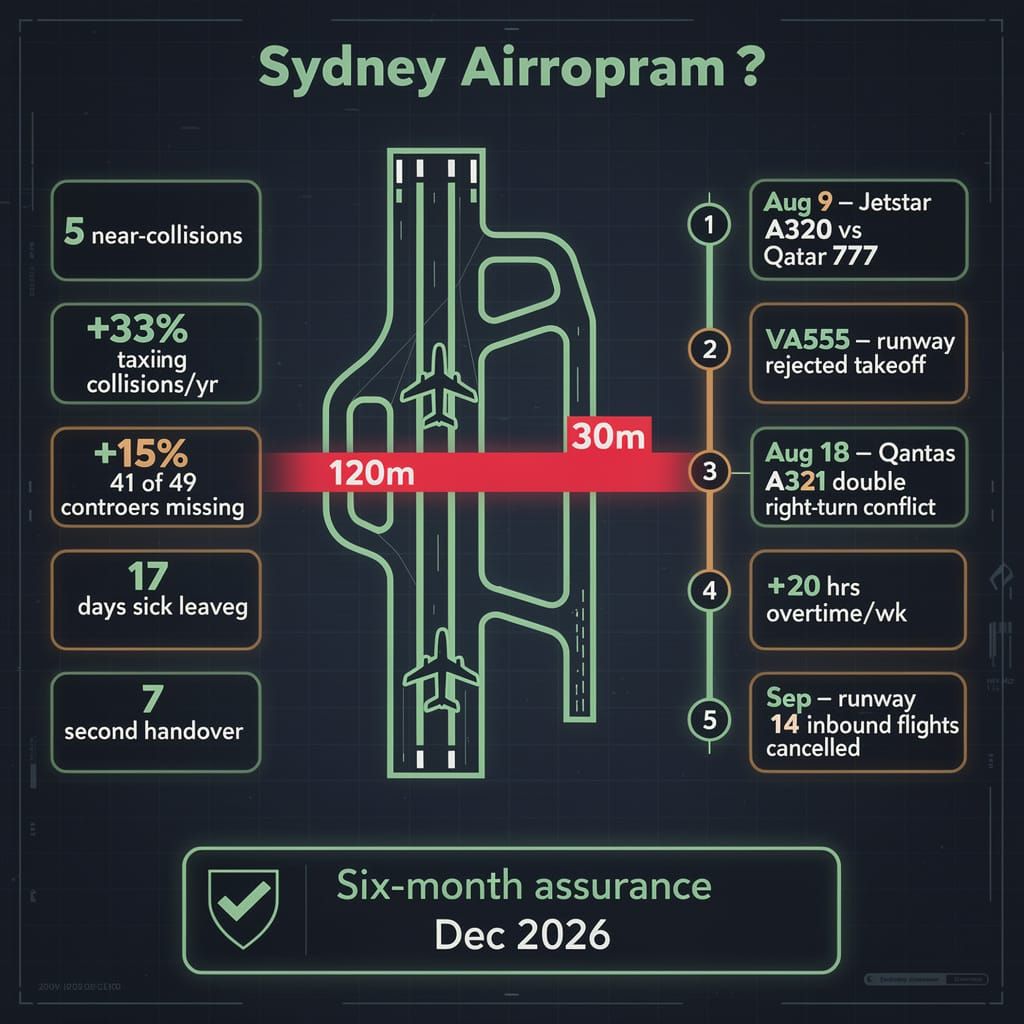
Sydney Airport has recorded at least five runway incursions and near-collisions since late July — including a Qantas taxiway conflict, a Jetstar–Qatar Airways near miss that delayed 150+ flights, and a rejected takeoff on VA555. The ATSB points to a structural driver: 41 of 49 contracted controller positions are unfilled, and staff logged 17 average sick days last year. When fatigue rules push controllers out, overtime pushes the rest closer to the same edge. The new federal review panel can't hire 41 controllers or shrink that shortfall — Airservices projects relief only by December. The near-misses are clustering, not isolated. The question isn't whether the airport is safe today; it's whether structural reform lands before the pattern repeats.
On September 30, Australian Transport Safety Bureau (ATSB) officials confirmed what had quietly been circulating through the aviation community for weeks: since late July 2026, Sydney Airport has recorded repeated runway incursions and taxiway conflicts involving commercial aircraft. In one instance, a flight attendant sustained a fractured wrist after an aircraft halted just 30 meters from a larger plane. In another, a controller on a break handed over responsibility only seven seconds before issuing an incorrect clearance, leaving two aircraft separated by just 120 meters.
The reaction from the federal government was swift, predictable, and carefully worded. Transport Minister Catherine King assured travelers that Sydney Airport "remains secure" and that the incidents, while serious, have not triggered an operational shutdown or a change in the airport's safety thresholds.
The Numbers Behind the Reassurance
Here is what the reassurance is anchored to:
- At least five documented near-collisions and incursions between late July and September 2026, including a conflict on August 18 where a Qantas Airbus A321 was cleared to turn right onto the same taxiway as another aircraft
- A near collision on August 9 between a Jetstar A320 and a Qatar Airways Boeing 777, which also sent more than 150 flights into delay
- A Virgin Australia flight, VA555, aborting takeoff on August 9 after a runway crossing conflict
- Air traffic controllers averaged 17 days of sick leave in the last financial year
- A shortfall of 41 out of 49 contracted controller positions as of September 11, triggering short-term flow management that cancelled at least 14 inbound flights
The ATSB identified staff resourcing as a recurring issue and has begun interviewing controllers and flight crews across the incidents, hunting for common operational factors. Airservices Australia models show elevated fatigue risk among tower staff during the incident windows—a concern echoed by its own reporting that controllers have been working more than 20 extra hours per week—though the bureau has stopped short of confirming fatigue as the cause of any single event.
The Pattern That Isn't Being Discussed
What is striking is not the incidents themselves—runway incursions are a known operational hazard—but the structural conditions that produced them, and their frequency. The four July–August incidents were counted as four. The evidence flatly contradicts that framing: the August 9 Jetstar–Qatar Airways near miss, the VA555 rejected takeoff, and the August 18 double-right-turn taxiway conflict form a chain the bureau is now actively investigating as potentially linked. The clustering is measurable: domestic taxiing collisions rose roughly 33% annually, and commercial runway incursions climbed about 15% per year, with four runway safety events at Sydney alone inside three weeks.
Controllers are legally barred from working while unwell or fatigued. That same legal protection inflates absenteeism, which then pushes remaining staff into overtime, which then erodes the very alertness the law is designed to protect. The system, in effect, manufactures its own shortage—and, per the evidence of a seven-second handover and a duplicated clearance, its own near-misses.
What an Assurance Panel Can and Cannot Do
The federal government has established an independent assurance panel, chaired by Retired Air Vice Marshal Ken Robinson, to operate for six months. Its mandate covers rostering, rest periods, the recruitment pipeline, and technology utilization. That is a reasonable scope. It is also, notably, a review—not a mandate.
The panel cannot hire 41 controllers. It cannot reduce sick leave. It cannot make Sydney's runway layout or traffic mix measurably safer. Airservices Australia, meanwhile, is recruiting and building a larger standby pool—credible incremental steps, but ones that take training cycles measured in months, not weeks. Its own projections indicate relief is unlikely to materialize before December 2026. The panel can produce recommendations, which will then need funding, legislative support, and the kind of sustained political attention that typically fades once the next news cycle arrives.
The Cautious Assessment
None of this is to claim Sydney Airport is unsafe today. The ATSB's position—no immediate safety risk to the traveling public—is technically defensible. Measurable accident rates have not shifted. Ground staff and pilots intervened effectively in the August 18 conflict, the aircraft braking normally, demonstrating that existing safeguards functioned under duress.
But the government's central claim—that the airport "remains secure"—strikes an unconvinced ear. The near-misses are not isolated; they are clustering. The airport did not close. The question is whether the structural reforms arrive before the pattern repeats.
Comments ()