Nigeria's airlines threaten nationwide shutdown over levy dispute
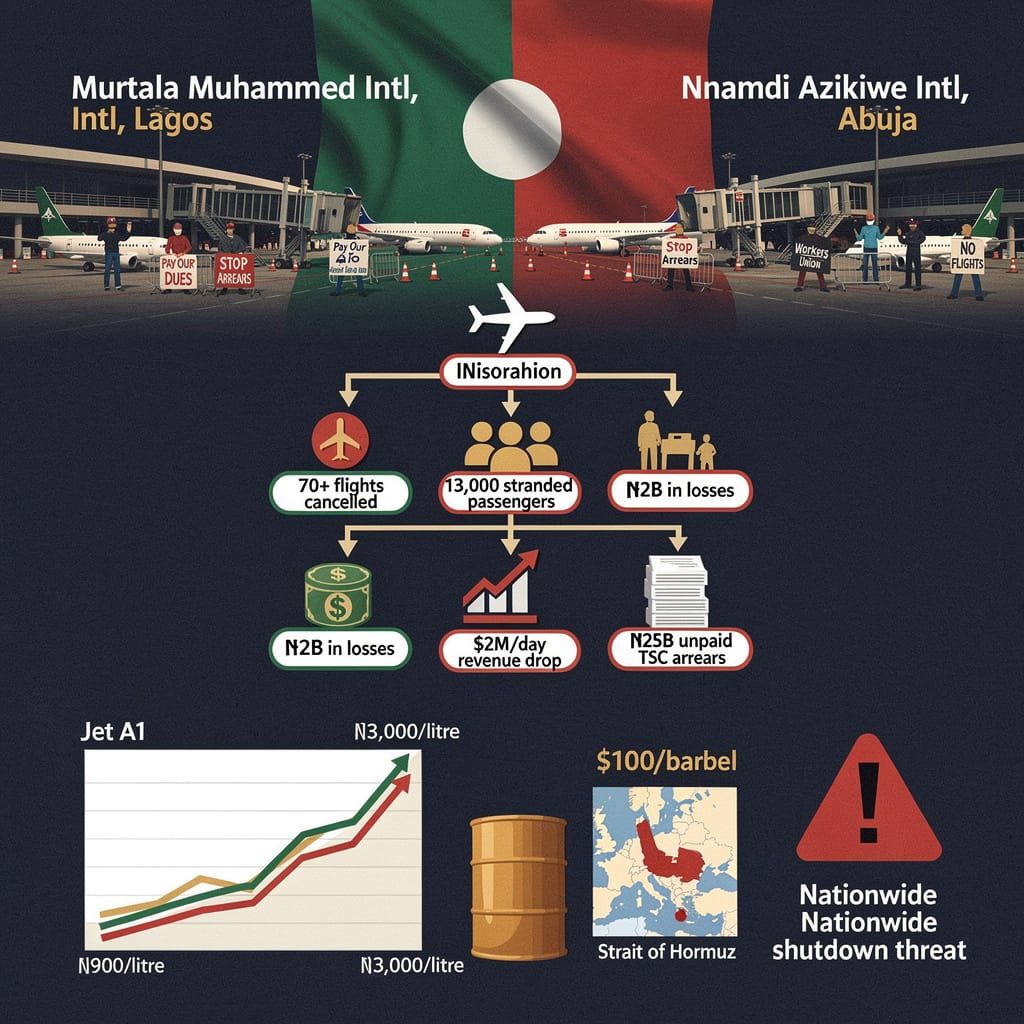
Nigeria's airlines have issued an ultimatum: strike again, and they ground every domestic flight. ✈️ One lost afternoon in August already hit 70+ flights and stranded ~13,000 passengers. But this isn't just union vs. employer. Airlines hold back ₦25bn+ in statutory levies — then call the 5% TSC abolition a fight for survival. Betraying the system last. Do passengers absorb this one too — or does the regulator step in before Q4?
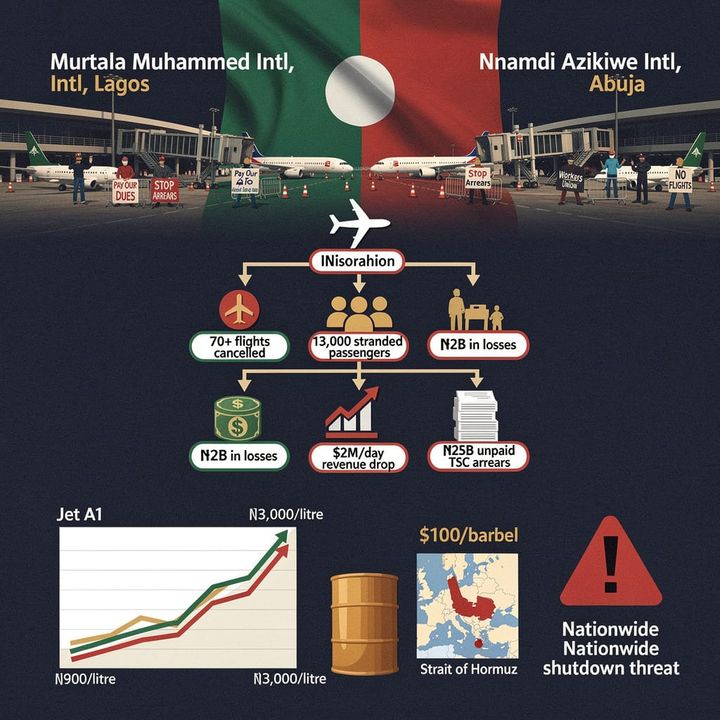
Earlier this month, on August 11, 2026, a coordinated picket at two of Nigeria's busiest airports — Murtala Muhammed International Airport in Lagos and Nnamdi Azikiwe International Airport in Abuja — ground domestic aviation to a halt. Union members barricaded terminals in Abuja, Lagos, and Enugu, producing delayed and suspended operations. Air Peace alone suspended its Lagos aerodrome, seeing more than 70 flights disrupted, with losses the airline puts above ₦2 billion. United Nigeria Airlines reported over 30 flights affected, stranding an estimated 13,000 passengers. Enugu Air temporarily paused at Nnamdi Azikiwe due to access restrictions, with an estimated revenue drop of US$2 million per day.
Now, the Airline Operators of Nigeria (AON) is firing back with an ultimatum: repeat the disruption, and operators will shutter domestic flight operations across the entire country.
On its face, this is a labor confrontation. But read the sequence of events, and a more uncomfortable picture emerges — one where the labels of "union aggression" and "airline noncompliance" both carry weight, and where neither side looks fully credible.
A dispute with both sides badly exposed
The unions frame their actions around two demands: a five percent Ticket Sales Charge (TSC) that airlines are said to be refusing to pay to government agencies, and what they describe as workforce protection — including claims that workers were improperly stopped from unionizing and that the dispute encompasses freedom-of-association enforcement via direct employee contact.
The airlines' response, via AON directors like Victor Enengedi, is blunt. They argue the picketing turned violent, with bodily injuries to staff, the blocking of check-in counters and departure terminals, and what AON terms a "serious security threat" exposing airport vulnerabilities.
Set aside the accusations for a moment and look at the mechanics. The August strike did not just inconvenience flyers. It triggered a cascading operational effect: crew repositioning, aircraft rescheduling, and stranded passengers requiring rebooking. That is precisely the kind of operating instability that spooks aircraft lessors — who are not known for patient capital — and that registers directly on investor confidence across the African aviation market. The unions' own reporting showed average wait times of five minutes as passengers were delayed entry at MMA1, while customer-service volumes spiked as carriers pushed alternative contact methods. One disruptive day does not look like the isolated temper tantrum AON implies, nor the righteous workers' action the unions describe. It looks like leverage deployed when statutory payments were withheld.
The uncomfortable question neither side wants to answer
What makes this hard to dismiss as a simple union-versus-employer feud is the sequence. AON's core accusation — that repeated picketing in Lagos and Abuja triggered the near-total halt of three international terminals — is not contested in the intelligence available. Neither is the scale of passenger harm, with roughly 13,000 travelers affected across member airlines.
But the unions' countercharge also withstands scrutiny: airlines' "arbitrary refusal" to pay the TSC is statutory noncompliance, and it predates the violence — the disputed arrears reportedly exceed ₦25 billion. In a sector already squeezed by high aviation fuel import costs — exacerbated by the Iran-America war on fuel prices — and forex-linked maintenance expenses, holding back mandated levies is a classic cash-preservation move — and a predictable provocation. Notably, at the September 10 League of Airports and Aviation Correspondents conference, AON went beyond resistance to propose outright abolition of both the 5% TSC and 5% Cargo Sales Charge, arguing they constitute unjustified government ownership of airlines under the Civil Aviation Act 2022.
That means the decisive variable is not who started it. It is that both parties chose escalation over the regulatory channel that supposedly exists for exactly these disputes.
A collapse that would ripple far beyond the tarmac
The credible worst case is not a strike — it is a coordinated shutdown of every domestic carrier at once. AON has signaled precisely that. If union action touches any member airline again, the network stops.
The fuel picture makes the stakes literal. Jet A1 prices have trebled from ₦900 to ₦3,000 per litre through 2026, and the Strait of Hormuz closure has doubled jet fuel prices globally — with global oil topping $100 per barrel in September. United Nigeria Airlines' chief commercial officer was already appealing at the AeroWest Africa Annual Summit on September 2 for tax relief, citing financing costs near 30% against profit margins below 5%. The war-induced fuel shock is not a background footnote; it is the pressure that makes the TSC standoff a survival move rather than a negotiating tactic. Against that export — dollar-denominated fuel and maintenance against naira-based revenue — every withheld naira of TSC is margin protection.
The downstream effects of a shutdown would be outsized for a sector this concentrated. Roughly 70-plus flights were lost in a single afternoon in August. A full shutdown would fracture the national transport chain, force a scramble for emergency regulatory intervention, and very likely push emergency state takeover of airway services — a scenario no one at the Ministry of Aviation appears to want.
The September 29 warnings from AON and from Chris Ona-Najomo's Trade Union Congress reflect, in their own way, acknowledgment that the situation has passed the point of routine negotiation. (Regulator Chris Najomo urged dialogue in August; it did not settle the matter.) Whether that acknowledgment produces a settlement before the fourth quarter — or a national grounding — is the question that now hangs over every domestic departure.
Neither the unions nor the operators emerge from this looking like transparent actors. Both have wielded power the system could not absorb. And the passenger, as usual with infrastructure politics in Nigeria, absorbs it last.
Comments ()