Four survive Wisconsin cornfield Cessna crash, but the heroics story may be premature
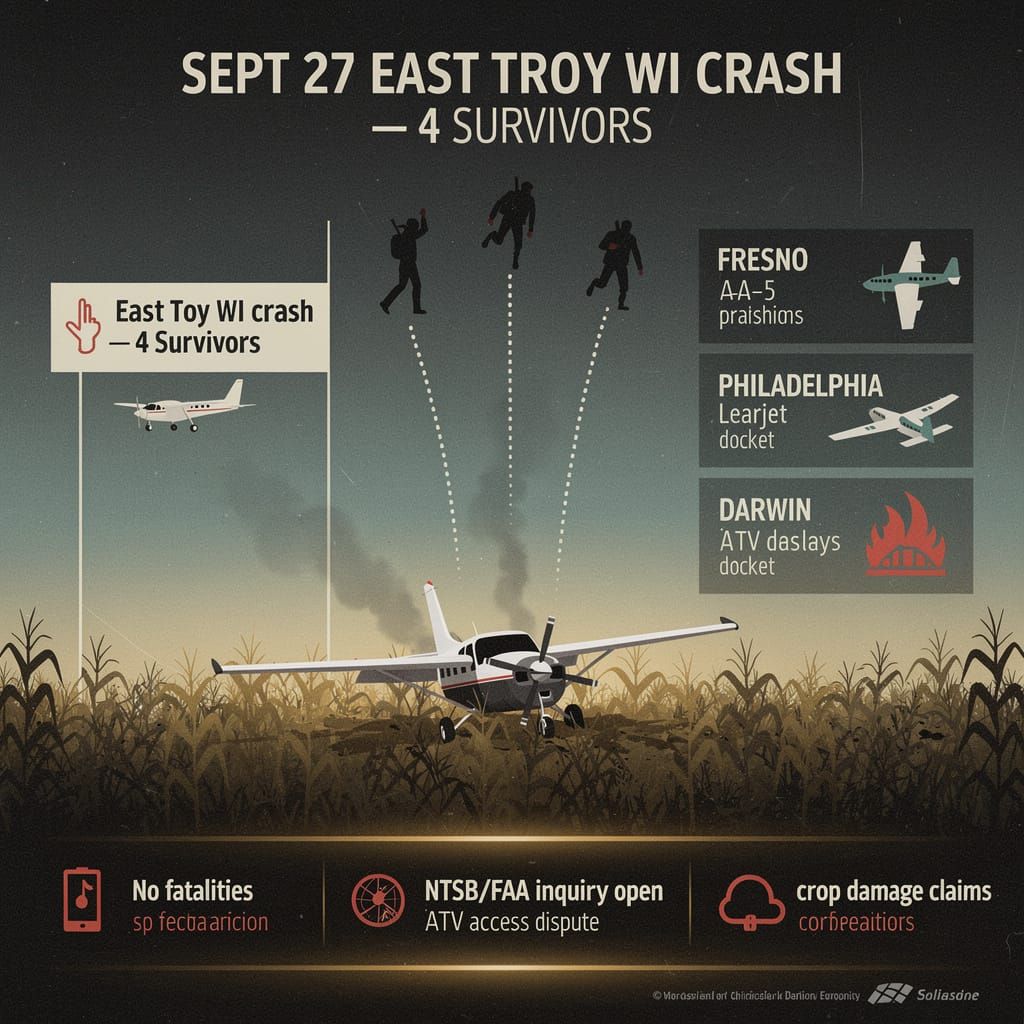
4 occupants walked away from a Cessna 206 crash into a Wisconsin cornfield, with skydivers among the first on scene. ✈️ Yet "no fatalities" is not proof of a well-functioning system. A comparable rescue delay in Darwin produced five deaths in a similar scenario. A working farm now faces real crop-contamination and damage concerns — coverage that's thin next to the heroics angle. The NTSB inquiry remains open, with no flight recorder to reconstruct what truly happened. Could the feel-good framing have outpaced the verified facts?
On a hazy Sunday afternoon, the first people to recognize a disaster unfolding near East Troy, Wisconsin, weren't pilots or ground crews—they were falling from the sky.
At roughly 1:30 p.m. on September 27, Skydive Milwaukee jumpers in freefall near Carvers School Road watched a single-engine Cessna 206 pitch nose-first into a cornfield outside East Troy Municipal Airport. The aircraft, operated by John Bechtel, carried four occupants when it clipped the crop rows and came to rest amid mature cornstalks.
What happened next depends on which account you credit, and that's part of the problem.
A Rescue That Fits the Story Too Well
The narrative that has dominated coverage is almost too clean: recreational skydivers spotted the wreck, a jump pilot dropped EMT-trained jumpers onto the site, and those same skydivers—one a former paramedic—provided medical aid before fire crews could fight through the terrain. Four occupants walked away. Three were hospitalized and released; the fourth was treated and released at the scene. No fatalities.
The "jumpers as first responders" angle is compelling. It also deserves skepticism. Skydive Milwaukee has explicitly confirmed it had no association with the crash itself, even as its crews assisted on the ground. That a tandem of coincidences produced both a plane crash and a cohort of pre-positioned, trauma-trained rescuers in the same cornfield is plausible—but it is a claim we should press, not applaud.
The Questions Nobody Is Answering
The FAA and National Transportation Safety Board have opened an inquiry. That's the standard protocol, not a signal of anything unusual. But the early reporting raises inconsistencies worth flagging—inconsistencies that this agency gets to a verdict slowly, if at all.
Consider the NTSB's recent track record. Eleven days in, on September 5, a Grumman American Avn. Corp. AA-5 in Northwest Fresno aborted takeoff over a radio problem, had a mechanic troubleshoot it, then crashed on the second attempt—killing all four aboard, with the pilot's husband dying two days later from severe burns. The NTSB's own reporting shows the nose gear severed and a roughly one-acre post-crash fire. That's what "routine inquiry and no fatalities" looks like when the outcome is worse. Yet in East Troy, an aircraft that came down with similar potential for fire damage produced four survivors—and that good fortune is being treated as if it explains the cause.
Even where findings are released, certainty is rare. The NTSB's August 18 docket on the January 2025 Learjet 55 crash in Philadelphia added 59 items of doorbell-camera video, drive-thru footage, and cockpit voice recorder data, and still produced no final cause determination—18 months after six passengers and two ground personnel died and at least 24 others were injured. The pattern is consistent: this board grounds its conclusions slowly and, where the record is thin, may never fully close the loop. A rural cornfield with no mandatory flight data recorder gives investigators far less to work with than a Philadelphia crash did.
And when rescue is the difference between life and fatality, the stakes of a flawed response are not hypothetical. Last month, on August 5 near Darwin's Stuart Highway, a Ford Ranger collided with a Toyota HiAce and five people died as rescue attempts were delayed by an uncontrollable blaze—a 2 km detour imposed on traffic while the fire burned. Northern Territory Police underlined the systemic limits of emergency response under extreme conditions. Put that beside East Troy and the lesson is uncomfortable: a fire that got no purchase in a cornfield produced four survivors and a feel-good headline; a fire that did win produced five deaths. The survival outcome hinged on the scene, not the system.
The Questions Nobody Is Answering
Still, there are specifics worth flagging. Witnesses describe the aircraft breaking off course amid "hazardous wind pushing" the plane away from the runway—an echo of a class of risks this fall has already exposed. In the Fresno crash, the initial abort was driven by a radio problem, and the second, fatal attempt proceeded with an engine described as sounding "weak." That suggests a small-aircraft failure chain of mechanical doubt plus a push to get airborne again—exactly the kind of decision-making that witnesses in East Troy hint at, and that an NTSB without a flight recorder must reconstruct from memory and tilework.
The terrain-access story shifted too. Early reports stressed that rescue delays justified the skydivers' intervention; a later account surfaced that the fire department's ATV "was too loaded with equipment" to carry passengers, so a Good Samaritan on a separate ATV did the job. That version undermines the "impassable terrain" framing and raises its own question: why was the responding ATV loaded such that it couldn't transport survivors?
The community impact is also being laundered into a feel-good tale. The cornfield belongs to a working farm, and residents have voiced concerns about crop contamination and field damage—a real economic and environmental consequence getting thin coverage relative to the heroics angle.
What "No Fatalities" Actually Buys Us
A four-occupant crash with zero deaths is fortunate. It is not evidence of a well-functioning system. Given how close other parts of this fall's record came to mass casualty—and how a comparable rescue delay in Darwin produced five deaths and not one survivor—the survival outcome speaks to low impact forces in soft terrain, not robust aviation or emergency practices.
The NTSB's Fresno and Philadelphia timelines show this agency moves on a scale of months, not the roughly two weeks being suggested here. Until a verified cause is published—and there's no guarantee one will be—the celebratory framing is premature. A plane crashed into a farmer's field. Four people got lucky. The rest of the details are, for now, claims under review.
Comments ()