Flydubai FZ1073: flight data undercuts 'under control' narrative
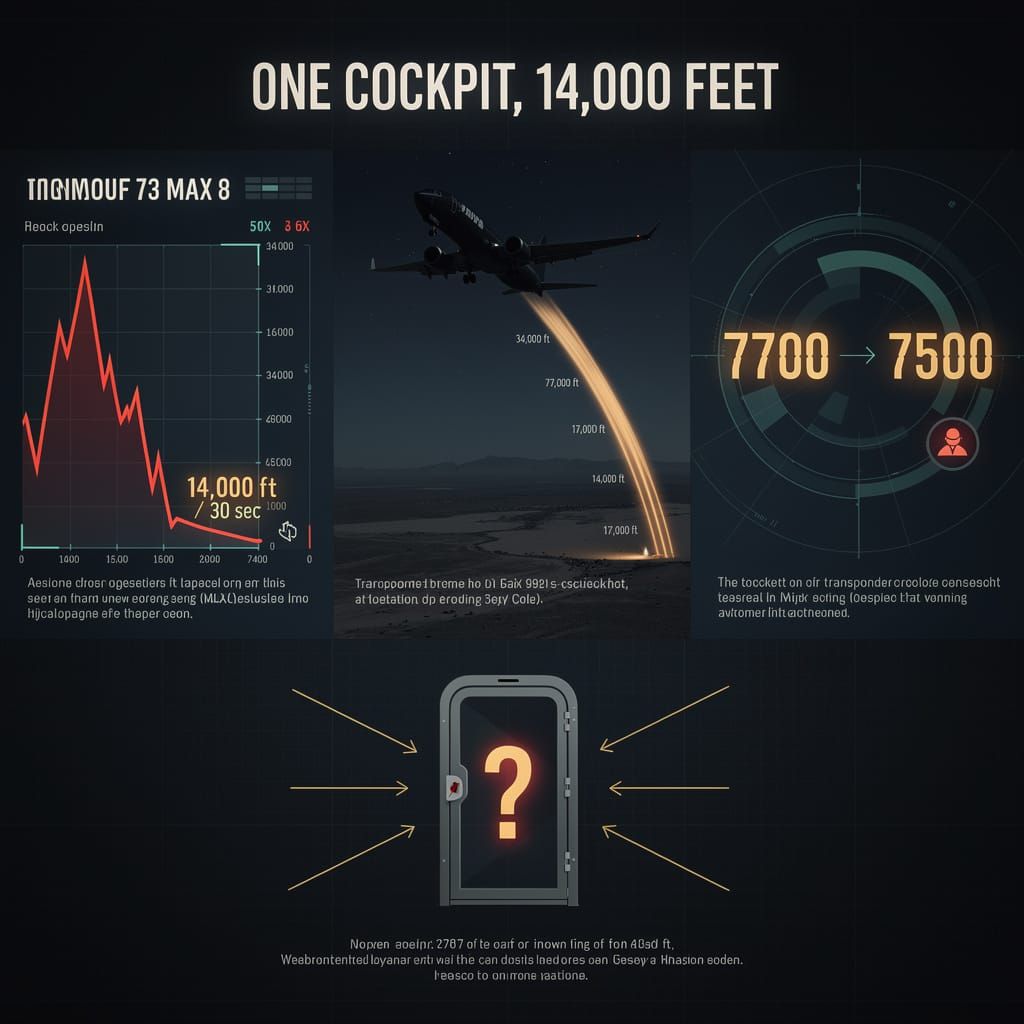
Flydubai FZ1073 was declared "under control" hours after its Tabuk emergency landing. The tracking data tells a harder story. The Boeing 737 MAX 8 dropped ~14,000 feet (34,000 to under 17,000) in under 30 seconds. Its transponder shifted from squawk 7700 to 7500 — the international code for unlawful interference. That is a cockpit struggle at cruise altitude with 174 people in the cabin, not a "crew disagreement." Then the contradictions: Who reasserted control? Accounts credit passengers, off-duty pilots, cabin crew — Reuters, AP, BBC, and Times of Israel haven't converged. Whoever it was had to break a door reinforced to keep attackers out. That itself warrants scrutiny, as does a route-specific flight suspension that says the carrier can't currently guarantee cockpit integrity. "Averted" is real. "Under control" is not yet a conclusion.
The Flydubai FZ1073 emergency landing in Tabuk on September 30 was declared "under control" by the Israeli Prime Minister's office within hours. All 174 passengers, including 27 children, were accounted for. A replacement aircraft flew them home. The official line is tidy, heroic, and reductive.
Let's slow the tape down, because the details do not support the story being sold.
Flight tracking data shows the Boeing 737 MAX 8 dropped roughly 14,000 feet—from about 34,000 to under 17,000 feet—in under 30 seconds before the first emergency transmission. That is not a pilot "losing his temper." That is a deliberate, violent, physical struggle over the flight controls at cruise altitude, at speed, with 174 people in the cabin behind a locked door.
The transponder history tells its own sequence: an initial general distress squawk (7700), then a shift to 7500, the internationally recognized code for unlawful interference. Whatever the final motive determination, the aircraft's own instruments were trying to tell air traffic control that this was a hijacking, not a crew disagreement.
Then there is the question of who was flying. The co-pilot is reported as Omani. The captain is reported as Emirati. But what was never convincingly addressed is how a lone first officer on the flight deck—with the captain incapacitated—was subdued, and by whom. Reports credit "passengers," "off-duty pilots traveling as passengers," "two additional pilots on board," and "cabin crew" entering the cockpit. Those are materially different claims from different outlets. Reuters, the AP, the Times of Israel, and the BBC have not converged on a single consistent account of who reasserted control, when, or under what authorization.
That matters. Cockpit doors on modern Boeing aircraft are reinforced and locked from inside precisely so that no one can enter during a security event. If passengers breached a flight deck door mid-crisis, that itself is a finding worth scrutiny. If they did not—if the door was opened from inside—then the entire "heroic passenger intervention" narrative is a comfortable fiction.
The rapid-fire official characterizations are also instructive. Within hours, the event went from "pilots fight" to "attempted hijacking" to "terrorist attack" to "9/11-style plot," attributed variously to a single Israeli cabinet minister, the defense minister, and the prime minister's office. Israeli officials described it as an attempted terror attack even as the motive remained unidentified. Some outlets reported the co-pilot was Omani and "Israeli"; others said Emirati. One version has the stabbing perpetrated by the captain against the co-pilot; most have it reversed. The reporting is not confused—it is actively contradictory in ways that agencies chasing a single coherent story would have resolved by now.
Flydubai has suspended flights on the route. That is a commercial decision, but it is also a signal: the carrier is telling its own customers it cannot currently guarantee cockpit integrity on that corridor. A replacement jet did fly, so the suspension is selective, which raises the question of what route-specific risk drove it.
None of this diminishes what was averted. A high-capacity jet did not go down; the passengers who were grabbed at and who watched a colleague bleed out in the aisle behaved with composure under abject fear. That is real. What is unwarranted is the speed with which every institution involved—the carrier, two governments, and a full security establishment—converged on a tidy narrative while the flight's own sensors contradicted it in real time.
The investigation is ongoing, and that is exactly the problem. The official line was finalized long before the forensics were. On evidence this thin and this conflicting, "under control" is not a conclusion. It is an aspiration.
Comments ()