✈️ Controllers Walked Off. The System Stayed Blind.
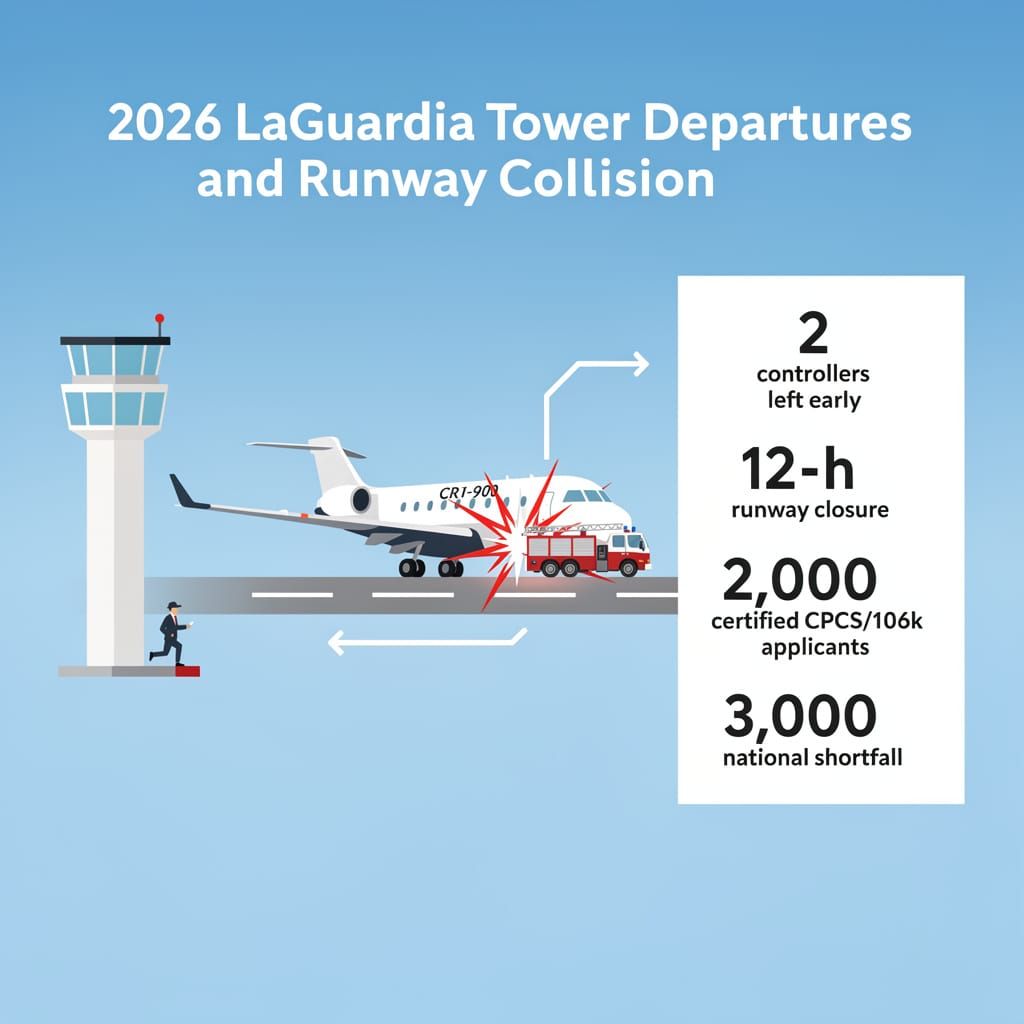
3,000 certified controller shortfall. 7.3% overtime (up from 2.4% in 2021). Two controllers walked off early at LaGuardia. A CRJ-900 hit a fire truck on an active runway. The FAA fired them for timecard fraud and called it a personnel problem. The NTSB is still reading transcripts. The fire truck had no surface transponder—no radar alarm ever sounded. ✈️ 34 flights disrupted, 28,000 passengers stranded, two pilots dead. The official narrative blames the walkout. The system that made the walkout possible is still running, still understaffed, still unfunded. — Is a 3,000-controller deficit a safety crisis or a budgeting choice?
The official sequence is neat. The messy truth is not.
On March 22, 2026, two air traffic controllers at LaGuardia's tower left their posts approximately one hour before their shifts ended—not the 30 minutes later reported in early summaries. An Air Canada Express CRJ-900, cleared to land on Runway 4, rolled onto an active taxiway and collided with a Port Authority fire truck. Two pilots killed. Forty-one passengers and crew wounded, six critically. A runway closed for 12 hours. The FAA terminated both controllers the same week, citing timecard fraud under what the agency calls an anti-fraud program targeting early departures.
What the Official Narrative Avoids
The National Transportation Safety Board is still parsing transcripts and radar data. But the causal chain is not difficult to trace. A known staffing shortage had compressed rest periods across the New York TRACON facility. A pattern of "early shoves"—controllers leaving before scheduled shift ends—had been flagged internally. Veterans told investigators that supervisors routinely permitted early departures as rewards for overworked staff. And in the minutes before the collision, the controller who cleared the aircraft to land issued that clearance less than two minutes before the fire truck crossed the active runway. The fire truck lacked a surface transponder, so the radar alarm never triggered. The crash did not happen because a procedure failed. It happened because the people supposed to execute it had left, and the system designed to warn them was blind.
Termination does not restore the pilots, nor does it explain why a fire truck crossing an active runway generated no automated warning. Transportation Secretary Sean Duffy stated the agency "would not tolerate fraud impacting airspace"—a framing that converts a systemic failure into a personnel problem.
Why This Keeps Happening
The 1997 LaGuardia runway collision between a USAir 737 and a commuter turboprop produced nearly identical findings: understaffed towers, fatigued controllers, unclear handoff protocols. Three decades later, the pattern repeats. The GAO reconstructed the FAA's hiring funnel: 106,533 Track 1 applications from fiscal 2017 through 2022 yielded only 2,258 certified controllers. Certification capacity—not recruitment—is the primary constraint. The FAA's own data shows a national shortfall of approximately 3,000 certified professional controllers relative to authorized positions. Chicago O'Hare operates with a 31% deficit: 27 of 43 required positions filled.
What changed in 2026 is the shape of the failure. Controllers did not make a mistake under pressure. They walked away. That shift—from error within procedure to abandonment of procedure—suggests a deterioration that procedural reforms cannot fix.
The Metrics That Matter
- 12 hours: LaGuardia closure duration, disrupting 340 scheduled flights and an estimated 28,000 passengers.
- 2 controllers: Left positions approximately one hour early. Terminal radar recording shows no ground controller active from 22:47 to 23:14 Eastern.
- 7.3%: Overtime as a share of straight-time hours worked in 2025, up from 2.4% in 2021. Fatigue is a formally documented factor in controller attrition.
- 3,000: National shortfall in certified professional controllers. The FAA targets 12,563 CPCs by fiscal 2028 but faces persistent training-capacity limits.
These numbers do not support a narrative of isolated misconduct. They describe a protocol failure embedded in shift scheduling, overtime policy, and a hiring funnel that converts 106,533 applicants into barely 2,000 certified professionals.
What Comes Next
Congress is expected to subpoena FAA staffing records for the New York TRACON. Internal audits of time-card verification systems are underway at 14 major airports. The Professional Aviation Safety Specialists union has requested immediate revisions to the mandatory overtime policy. Meanwhile, FAA Administrator Bryan Bedford retains sole discretion over a congressionally appropriated 3.8% pay raise for controllers—of which only 1% has been released, pending demonstrated operational efficiencies. Illinois senators demanded the remaining 2.8% on September 4, citing the LaGuardia collapse as evidence that the agency's "efficiency" standard is a self-defeating gate.
The FAA has responded by expanding hiring pathways: Order JO 7210.3EE Change 3, effective July 9, 2026, integrates graduates from Control Tower Partner programs into Federal Contract Tower hiring pools. And in a widely promoted initiative, the agency hired over 2,000 controllers recruited from video game communities, hitting 94% of its annual target. The FAA frames this as a breakthrough. But the same data showing 2,000 hires also shows 11,000 active controllers against a requirement of 12,563—a gap that creative sourcing alone cannot close.
None of these actions will bring back the two pilots. None will close the gap between what the system requires and what it funds. But the question worth asking is not whether the controllers should have left. It is whether the environment they worked in made staying impossible—and whether the agency investigating them is the same one that set the conditions for their departure.
Comments ()