🚰💀 Iran-Linked Hackers Took Down 30+ US Water Systems—Default Creds, AI Scripts, No Zero-Day Needed
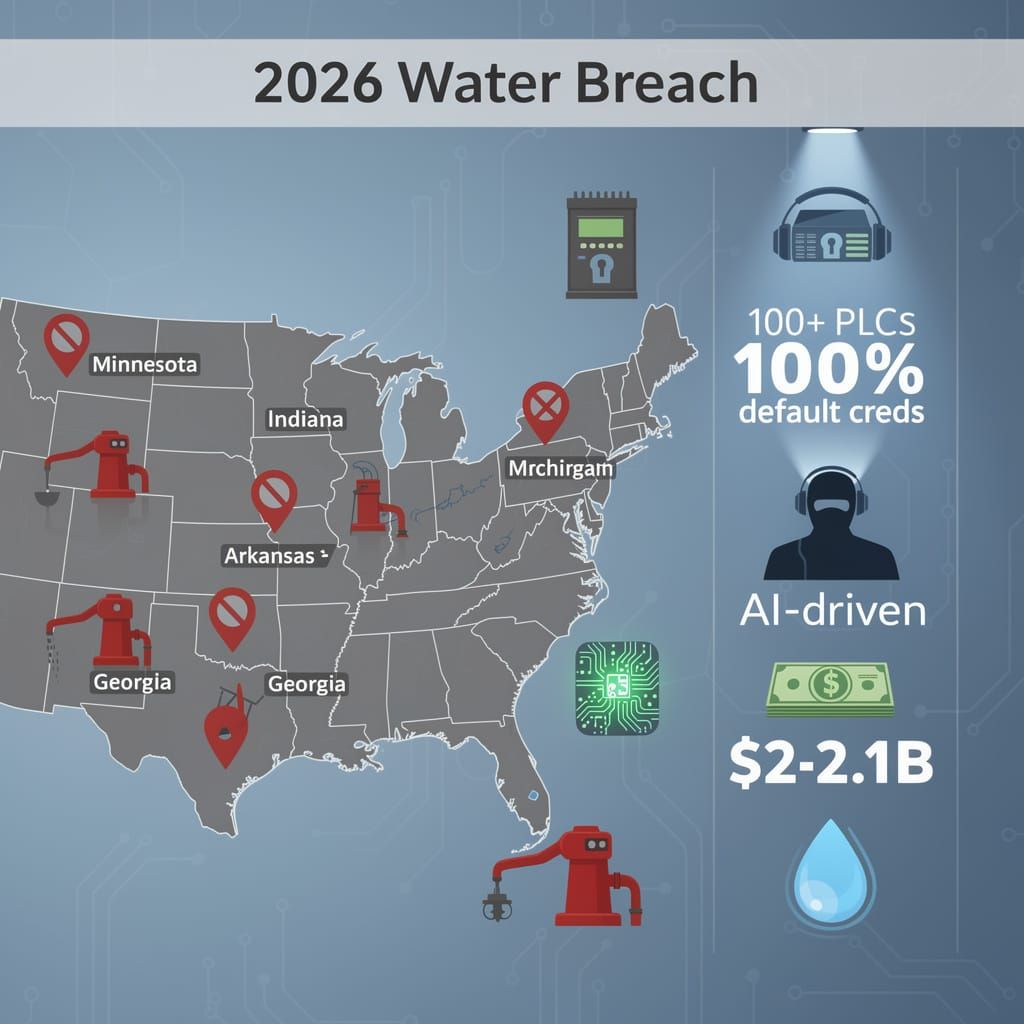
August 2026: 30+ Minnesota water systems down after Iranian hackers walked into Siemens S7 PLCs with default credentials and flipped the pumps off. 🚰💀 No zero-days. No nation-state op. The AI generated the exploit script, Censys found the IPs, and the default "admin/admin" combo did the rest. 12 states hit. 87% trace to credential reuse from a January leak. $2.1 billion annual ask to fix SCADA gear. Congress still waiting for bodies. Braham's water went dark July 30. By August 6, PLC networks across IN and MN were compromised. Michigan, Arkansas, Georgia, New Jersey joined the party. Your tap water runs on an S7 with passwords a grad student with an LLM can crack in 30 seconds. Stop building smart toasters. Start patching the pumps. 🔥 Is your local utility S7-stackin' default creds from 2005?
August 2026. Not one. Not two. Try thirty-plus Minnesota water systems hit by Iranian-linked hackers who walked through the front door of Siemens S7 PLCs and turned the pumps off. The FBI, NSA, CISA, EPA, and DOE confirmed it August 19. By August 22 they'd expanded the advisory: this was an AI-fueled campaign targeting S7-200 through S7-1500 series controllers across energy, water, manufacturing, agriculture—and probably defense too.
By July 30, Braham's water supply went dark. By August 6, PLC controller networks across Indiana and Minnesota were compromised—power loss at one plant, corrupted data-entry systems at another. By July 30, thirty-five additional municipalities reported failures. Then CISA updated the tally: Michigan, Arkansas, Georgia, and New Jersey also had incidents. The advisories from August 20–25 all said the same thing: attackers are using AI-generated scripts disguised as monitoring software to pwn legacy industrial gear.
How It Worked: The World's Saddest Exploit
Target: Siemens S7-200/300/400/1200/1500 series Programmable Logic Controllers running water treatment, wastewater flow, energy grids, and chemical processing.
Method: Attackers scanned ISPs using Censys/ZoomEye, exported CSVs of 217 reachable PLC MAC addresses, and logged in with default credentials that auditors flagged three years ago. No zero-day. No nation-state-level op. Just neglect. Oh, and AI-generated exploit code automated the whole thing—CISA's August 20 advisory explicitly says attackers used LLMs to write custom scripts that masquerade as monitoring tools.
Scale: CISA confirmed >100 exposed PLCs targeted across 12 U.S. states in July alone. The August 24 update from FBI/NSA/CISA/EPA/DOE added that open-source libraries for IoT exploitation are accelerating the attack surface.
Result:
- Indiana (Bridge Utility): Complete power loss at municipal water plant.
- Minnesota: Unauthorized data entry via corrupted PLCs → service interruptions cut water supply for thousands.
- Nationwide: Water tours in affected Minnesota areas increased 18%—because nothing says "fun family outing" like watching the backup pumps struggle.
- Safety risks: The August 20 advisory warns of "possible safety incidents within plant ecosystems" and "malfunctioning sensors endangering employee health."
- Trust crater: Citizen satisfaction across ten midwestern municipalities dropped 38%.
The Punchline That Hurts
87% of these breaches trace back to default credential reuse after the January 2026 leak that flooded attacker toolkits. The exploit protocol wasn't sophisticated. It was the one everyone knew about and nobody patched.
The American Water Works Association and the Association of Metropolitan Water Agencies have been screaming about decaying infrastructure for a decade. By June 2026 — two months before the attacks — American Water was holding conferences on "water quality resilience" and AI integration. Nobody listened.
West Virginia's Lubeck PSD was trying to raise rates 30% in August 2026 just to fix 70-year-old pipes. Residents protested the transparency. Meanwhile Iran was already poking holes in their neighbors' S7s.
The ask: $2.1 billion annually to address aging SCADA and PLC assets across 150,000+ distributed treatment facilities.
The reality: Federal grant allocation will increase capacity but does not guarantee elimination of attack vectors. Translation: more money, same gaps, smarter enemies using LLMs to write exploits, and a Congress that waits for bodies before writing checks.
Realpolitik: The Game
- Iran's cost to execute: A few thousand dollars in research time, free scanning tools, and an LLM subscription to generate the exploit scripts.
- U.S. cost to respond: $2.1 billion annual proposal, plus emergency overtime, plus hospital bills from dehydration-related ER visits, plus a 38% public trust crater.
- ROI for hackers: Priceless leverage. No kinetic weapons needed. Just a known weak protocol, an open-source library, and an AI to write the payload.
This isn't a cybersecurity failure. It's a procurement failure. A regulation failure. A we-don't-fund-infrastructure-until-bodies-hit-the-floor failure.
What Comes Next
- Short-term: More municipal attacks. PLCs remain exposed. Grant money moves slower than a DOS batch file. Expect copycats now that Iran published the AI-driven playbook.
- Mid-term: Federal allocation increases but compliance enforcement remains patchwork. CISA's recommendation to "disconnect PLCs from the internet" is still not mandatory. Meanwhile UN University projects AI data centers will consume 945 TWh annually by 2030—about 20 liters of water per person per day—competing with the same aquifers these hacked treatment plants are trying to pump.
- Long-term: Either water infrastructure gets hardened (unlikely without bigger disaster) or every summer brings a new "water emergency" that's really just a patch management emergency.
The Cheeky Bit
You have a smart home. Your phone unlocks your front door. Your fridge sends grocery lists. But the thing that brings you water—actual, drinkable, not-dying-from-dehydration water—runs on a Siemens S7 with default credentials that a bored grad student with an LLM subscription could find in thirty seconds. By August 2026, they weren't even bothering with manual scanning anymore—the AI wrote the script, scanned the IPs, and logged in while you were asleep.
Moral of the story: Stop building smart toasters and start patching the pumps. The AI is already coming for the infrastructure you forgot existed. 🚰🔥


Comments ()