📉 Planet Labs Posts Record Revenue, Stock Drops 8% on Mid-Sized Contract
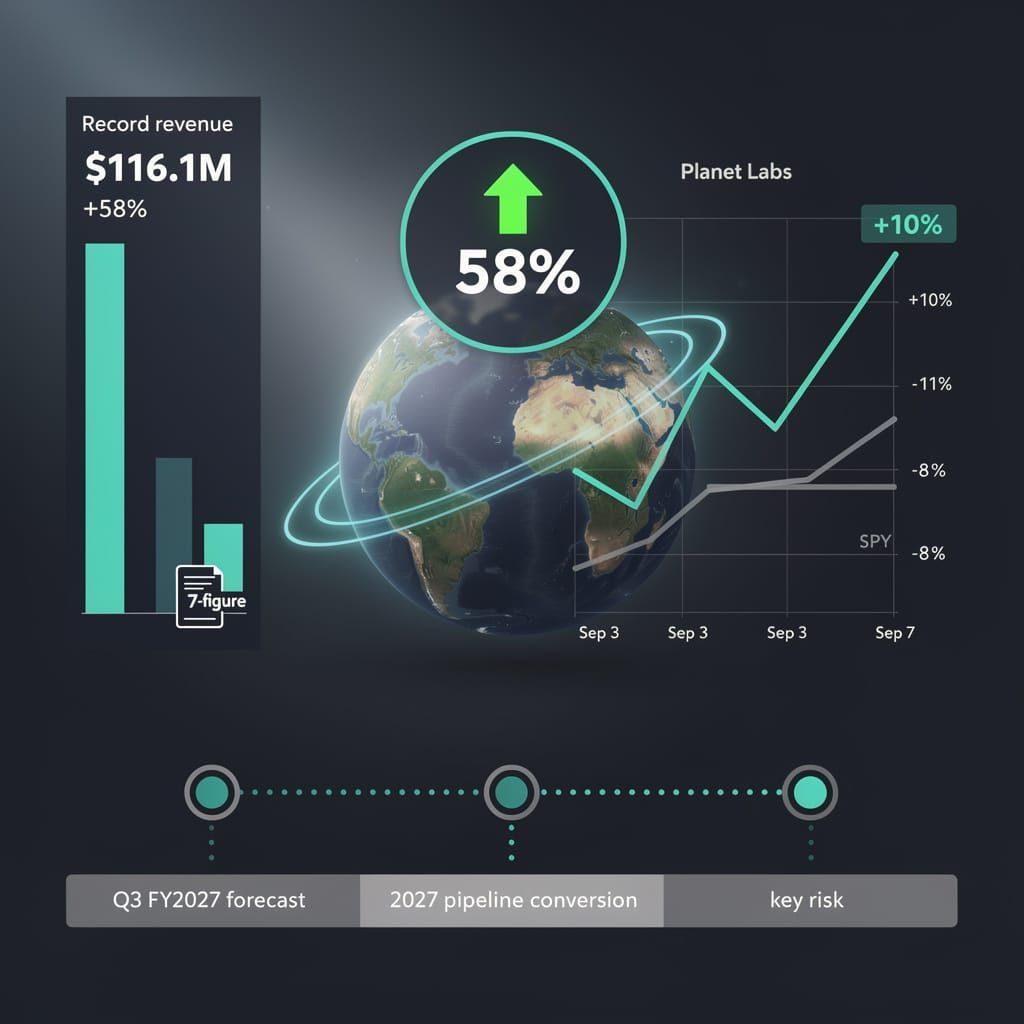
Planet Labs reported record revenue of $116.1M (+58% YoY), beat EPS estimates, and grew defense revenue 90%. The stock dropped 8% because a seven-figure European contract was smaller than prior eight- and nine-figure awards 📉 That is a sign of a market that panics over a mid-sized deal while ignoring a $4B pipeline, not a broken company. October earnings will settle whether space-stock valuations still make sense. European institutional investors paying attention? — Does a single contract size really alter Planet Labs' long-term thesis for you?
The Drop That Made Everyone Squint
September 3, 2026. Planet Labs shares shed 8% in a single day, closing at $18.35. That is not a flash crash. That is an institutional shrug directed at a company that just reported record quarterly revenue—$116.1 million, beating consensus by 58%. The immediate culprit? A newly disclosed seven-figure European defense contract that disappointed investors expecting something larger.
Let us parse that. Record revenue, adjusted EPS of $0.02 against an expected loss of $0.02, and a fourth consecutive quarter clearing the Rule of 40—none of it outweighed anxiety about a single mid-sized deal.
What Actually Happened
The numbers tell a straightforward story:
- Record quarterly revenue: $116.1 million, +58% YoY, beating consensus of $104.22 million.
- Defense and intelligence revenue: +90% YoY. EMEA revenue: +130% YoY.
- The new European contract: A seven-figure, one-year agreement—smaller than previous eight- and nine-figure awards in 2026.
- Stock reaction: Down 8% on the news, while the S&P 500 (SPY) rose 0.6%.
Investors sold first, asked questions later. By the close, Planet Labs had lost nearly a tenth of its market value over a contract that, by the company's own disclosure, represents a fraction of its growing sovereign pipeline.
The Sarcastic Reading
Here is the logic on offer: a company with defense revenue growing 90% year-over-year, a sovereign pipeline exceeding $4 billion, and an $8 million NGA contract plus a German government tender worth up to €25 million in hand is suddenly less valuable because one European deal was smaller than prior awards. Never mind that the company raised its full-year fiscal 2027 revenue outlook to $430–$441 million. Never mind that CEO Will Marshall stated he has "never seen it as big as it is now." The market decided that a single seven-figure agreement outweighed all of that.
Analyst Michael Filatov at Berenberg initiated Buy coverage with a $25 price target shortly after the drop—a move that smells suspiciously like acknowledging a panicked overreaction. October earnings will now carry more weight than they should.
What This Demonstrates
The episode reveals a recurring pattern in space-sector equities: low liquidity amplifies sentiment swings, and institutional investors treat minor procurement signals as existential threats. Planet Labs is not a defense contractor dependent on a handful of deals. It operates one of the largest commercial Earth-observation constellations, images the entire planet daily, and now counts 90% of its end-of-period book of business as recurring annual contract value. None of that changed on September 3.
The counter-narrative, if anyone wants it: defense budgets tighten in cycles, but demand for persistent, high-cadence Earth observation has accelerated. Europe's fiscal consolidation does not cancel the need for agricultural monitoring, carbon tracking, or disaster response imagery. The first Pelican satellite was handed to the Swedish Armed Forces. The German government filed a tender up to €25 million. Rwanda signed a program.
The Outlook
- Immediate aftermath (September 7): Stock surged 10% to $20.10 after the full earnings release, recovering most of the post-contract drop.
- Short term (Q3 FY2027): Projected revenue of $101–$105 million trails the $114.49 million consensus—a fact that will test whether the recovery holds.
- Medium term (2027): Conversion of the >$4 billion sovereign pipeline into signed contracts will determine the trajectory. The NGA and German tenders are proof of mechanism.
- Key risk: Sector-wide fear around government spending could suppress multiples even as revenues grow—investors may demand defense-adjusted valuations for companies delivering commercial data services.
Planet Labs reported record revenue, beat earnings expectations, grew defense revenue by 90%, and got punished for a mid-sized European contract. That is not a sign of a broken company. It is a sign of a market that has forgotten how to read a quarterly report without panicking.
Bottom Line
An 8% single-day drop on a seven-figure contract, while revenue sits at an all-time high and the stock rebounded 10% three days later, is either a buying signal or a warning that space-stock valuations have detached from fundamentals. October earnings will settle the argument.



Comments ()