⚡ Fusion startups raised $14.6B and produced zero megawatts
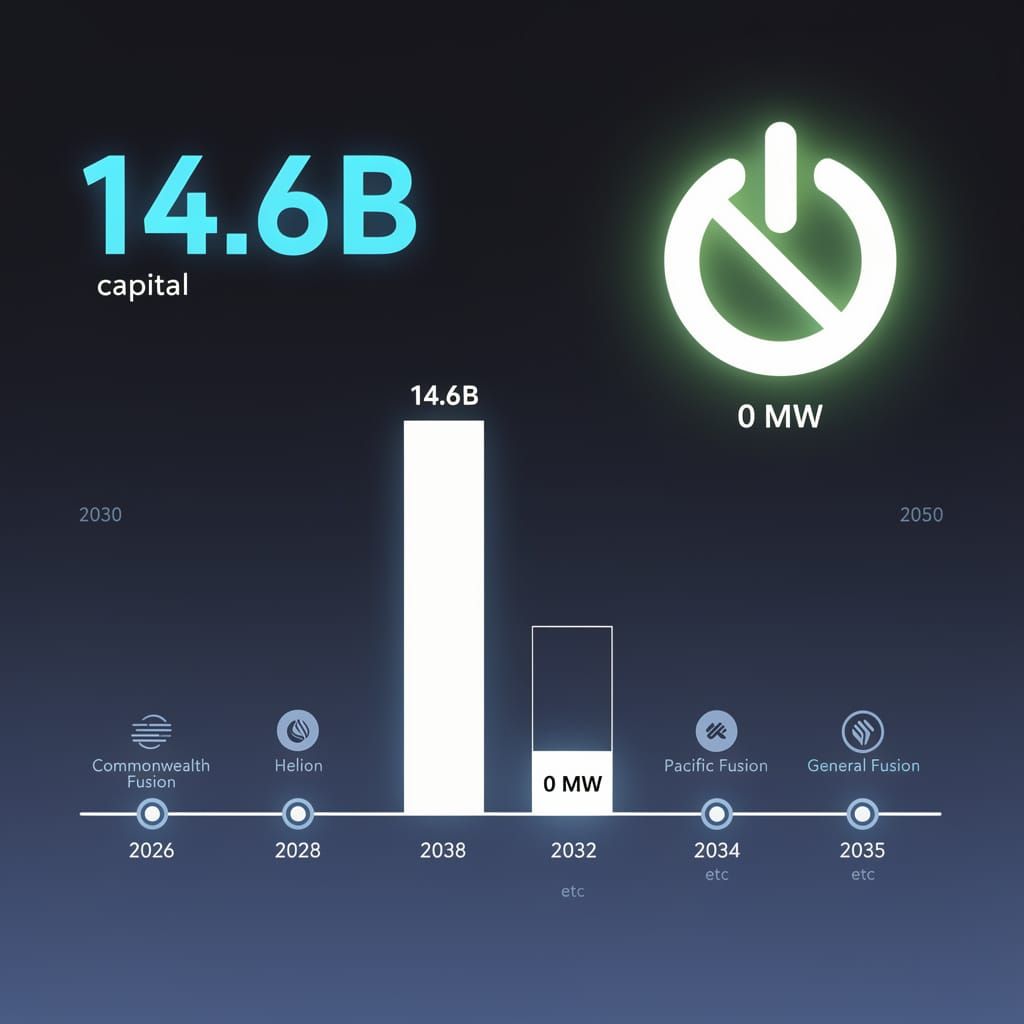
$14.6 billion in. Zero megawatts out. ⚡ That's the scorecard for fusion startups after 10 years and 46 companies — not a single electron sold to the grid. Commonwealth Fusion alone has raised $4B. Helion's valued at $15.5B. Yet the first commercial reactor is projected for the early-to-mid 2030s, and government subsidies already cover 40% of development costs. Meanwhile, solar-plus-battery keeps getting cheaper every year. The market window is narrowing before fusion even ships a product. So what happens to fusion's unit economics when solar hits $15 per MWh in 2030?
Forty-six fusion startups. Nearly fifteen billion dollars deployed. And still not a single electron sold to the grid. That's the state of commercial nuclear fusion in September 2026 — a science experiment dressed in venture capital suits, increasingly impatient to prove it can do more than consume cash.
The numbers are staggering. Since the first private fusion companies emerged from government labs a decade ago, the sector has absorbed $14.6 billion in cumulative investment as of August 1. Commonwealth Fusion Systems alone grabbed another $1 billion on July 30, bringing its individual war chest past $4 billion. Helion, which closed a $465 million Series G on June 5 at a $15.5 billion valuation, Pacific Fusion ($1 billion facility breaking ground in Albuquerque August 25), and Type One Energy aren't far behind. Chevron, Shell, Equinor, Microsoft, and Google have all placed bets. Even the TVA signed on, hosting Type One Energy's fusion test site at the Bull Run Energy Complex. General Fusion went a different route entirely: after completing its SPAC merger with Spring Valley Acquisition Corp on July 10, it now trades on Nasdaq under GFU.Z, a liquidity play that gives it more runway than most.
But here's the uncomfortable truth hiding behind the press releases: adoption remains stuck at zero.
The Physics Isn't the Only Problem
Let's be clear — nobody credible doubts that controlled fusion works. The Joint European Torus and China's EAST reactor have both demonstrated net energy gain in laboratory conditions. Multiple startups have now reached scientific breakeven — producing more energy than input — thanks to advances in HTS magnets, computing, and reactor physics. The engineering challenge, as every fusion CEO loves to remind journalists, is containment and commercialization. Squeezing a star into a magnetic bottle and extracting useful power without melting everything within a quarter-mile radius is hard.
What they mention less often is the business model gap. The Fusion Industry Association projects the first commercial reactor won't deliver grid power before the early-to-mid 2030s — some academics argue even that timeline is overly optimistic. Meanwhile, government subsidies now cover 40% of development costs, which should tell you something about how far fusion is from standing on its own feet.
That timeline places fusion uncomfortably between two competing realities:
- 2026–2028: Solar-plus-battery installations continue to fall in cost, with Lazard estimating utility-scale solar at $24–$38 per MWh. Fusion needs to land somewhere competitive.
- 2029–2032: First-generation fusion plants, if on schedule, will face a grid already saturated with cheap renewables and long-duration storage from companies like Form Energy and Fluence.
The market window is narrowing before the product even ships.
Who's Actually Building Something?
The field splits into two camps. Magnetic confinement — tokamaks and stellarators — dominates the big-money end. Commonwealth Fusion is building SPARC at its Devens, Massachusetts site, now roughly 80% complete and aiming for net-positive energy by 2027. Helion, backed by $1.7 billion in private funding plus a 50 MW power-purchase agreement with Microsoft targeting 2028 delivery, claims its sixth-generation pulsed-nonignition design will demonstrate net electricity generation by late 2027. Pacific Fusion broke ground on a $1 billion Albuquerque facility on August 25, targeting net facility gain by 2030.
On the inertial confinement side, First Light Fusion (UK), Marvel Fusion (Germany), and newcomer Inertia Enterprises (aiming for a million fusion pellets per day and 10 Hz laser firing by 2030) pursue laser-driven approaches. Focused Energy, meanwhile, secured €60 million from RWE on July 1 as part of EU space program incentives—a sign that European money is now flowing to laser fusion in a serious way.
What's notable is who's setting the pace: the US Department of Energy allocates less than $800 million annually to fusion — dwarfed by private-sector flows. Big oil is muscling in. Eni plans a European fusion plant by the early 2040s, a $1 billion deal to buy power from Commonwealth Fusion's first US plant, and a tritium fuel-cycle facility at the UKAEA Culham Campus due in 2028.
The Uncomfortable Parallels
Fusion today looks a lot like the silicon photonics hype cycle of 2021–2023, or the vertical farming boom of 2020. Massive capital inflows, charismatic founders, promises of imminent disruption — followed by delayed timelines, technical surprises, and a slow realization that the underlying physics doesn't care about fundraising targets. The difference is scale. A failed vertical farm costs investors $50 million. A failed fusion startup burns through $2 billion and delays the entire sector's credibility curve by a decade.
What Comes Next
Three signals worth watching:
- Commonwealth Fusion's SPARC commissioning — if it hits net-positive, expect a fresh wave of Series C rounds across the sector. If it misses by more than 18 months, expect consolidation.
- Helion's Q4 2027 demo — the first attempt to sell actual power to a paying customer (Microsoft). Failure here wouldn't kill the industry, but it would force a hard reset on valuation expectations.
- General Fusion's Nasdaq listing — the first publicly traded pure-play fusion company. If GFU.Z trades above its SPAC floor six months out, it signals retail and institutional appetite for the long slog. If it sinks, expect SPACs to stop looking at fusion altogether.
For now, fusion remains a high-conviction bet on long-duration R&D with an uncertain payoff timeline. The science is real. The money is real. The product? Not yet.
Investors betting on fusion should ask one question that no PowerPoint deck has answered cleanly: What happens to your unit economics when solar hits $15 per MWh in 2030?


Comments ()