📉 ASX200 Slips to 9,008 as Markets Ignore Another Warning
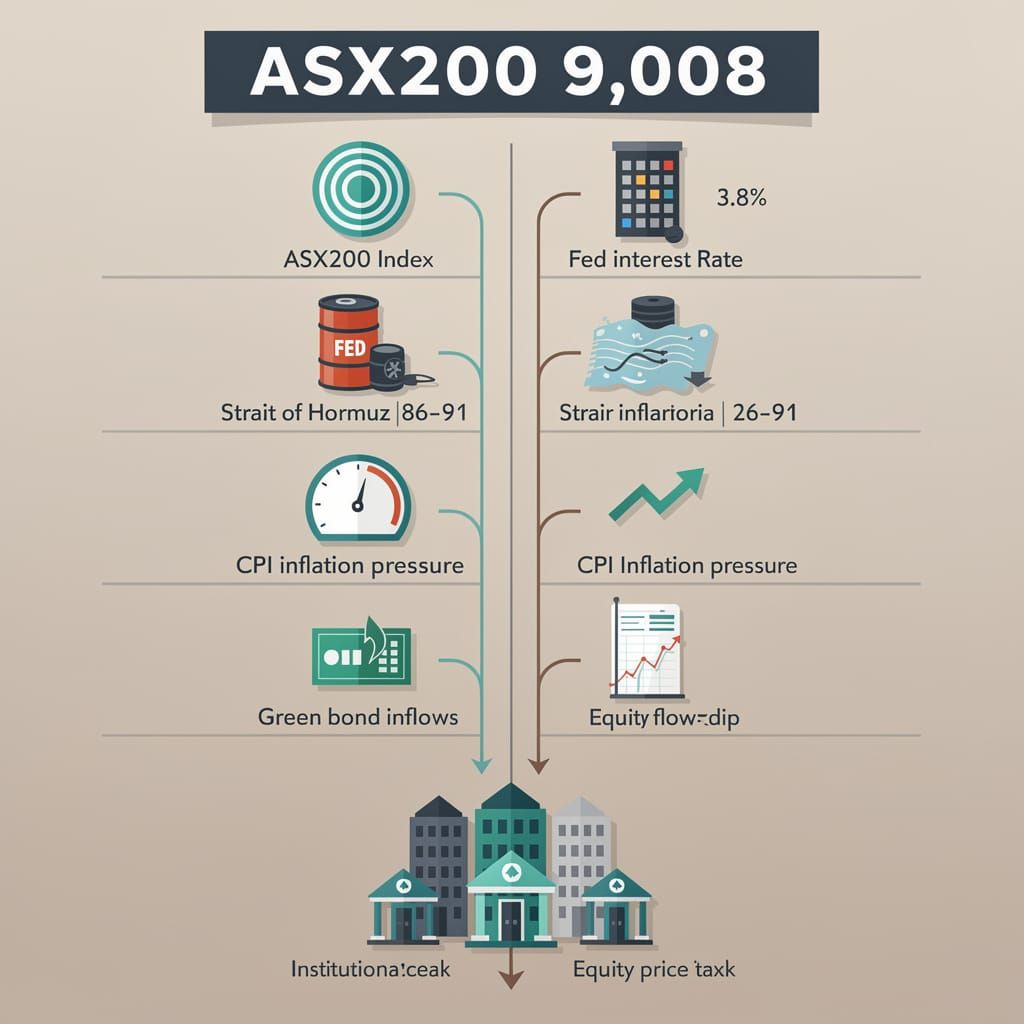
ASX200 slid to 9,008.3 — down 11.8 points in a session that felt less like trading, more like watching paint dry. 📉 The Fed is still hinting at rate hikes (Polymarket: 62% odds by September), Hormuz re-mines itself every few weeks, and eurozone CPI at 3.3% kills any dovish narrative. The "buy the dip" crowd is running out of dips. Institutional desks are quietly preparing exits. Australian investors watching Westpac and AGL for the first cracks — how are you positioning for a market that keeps promising a floor and then lowering it?
The Australian market finished Monday where it always does lately: slightly lower, slightly more nervous, and carrying an extra layer of denial. The ASX200 dropped 11.8 points to 9,008.3, a number that looks nice and round until you remember it represents capital quietly exiting stage left.
The Usual Suspects
Let's run the checklist of excuses that keep getting trotted out:
- The Fed blinked: Wall Street's favorite punchline — "data-dependent" — now means "we'll get around to cutting rates eventually, stop asking." By July 28, the FOMC had held rates flat near 3.8% while markets assigned a 33% probability of a 25-basis-point hike — not a cut. A hike. By July 29, that probability had already slipped to 27%. Polymarket's July 23 numbers were even more blunt: 62% odds of a hike by September 2026, and a 36% probability of two rate hikes before year-end. Markets responded with the enthusiasm of someone who just realized happy hour ended an hour ago.
- The Hormuz yo-yo: Another week, another unresolved conflict — except the Strait of Hormuz reopened on June 18 after an informal U.S.-Iran deal, only to see Iranian forces strike two supertankers on July 18, sending Brent to $86–$91. By July 27–28, with no further strikes, Brent crashed back down — the ceasefire that briefly pushed prices to $77.70 on June 22 looks less like peace and more like a pause button. The Strait is now a permanent roulette wheel, and investors are treating it the way they treat a leaky roof: acknowledged, ignored, budgeted for.
- CPI says "not yet": August eurozone inflation landed at 3.3%, with energy components surging 14.3% year-on-year. Eurozone government bonds are in their worst selloff in years — Germany's 10-year Bund hit 3.39%, UK gilts 5.29%. Traders now price ECB rate hikes with >60% probability for March 2026. The number itself wasn't catastrophic — but in a market desperate for any excuse to rally, a warm CPI reading is treated like a fire alarm.
The Real Story Nobody Wants to Admit
Underneath the daily noise, the damage is structural. New Zealand's market collapse isn't a one-off correction — it's a warning flare for the entire Asia-Pacific liquidity chain. Credit spreads across European prime bonds are widening at a pace that institutional risk desks describe as "concerning." The EU is funnelling capital into green bonds — TenneT alone raised €3.5 billion on July 8, oversubscribed sixfold, for a €67 billion grid upgrade plan — and even that sum looks like a hedge against something worse. One €650 million Philips green bond issued in late August was oversubscribed 2.7 times. When the "safe" continent needs to spend billions just to keep the lights on, what exactly is "risk-free" anymore?
Safe-haven currencies — CHF, EUR/JPY — are the only assets trading with genuine conviction. Everything else is just noise with a ticker attached.
What's Actually Happening
Equity valuations: Compressing globally. The "buy the dip" crowd is running out of dips to buy.
Institutional positioning: Entering what analysts politely call the "final phase before an orderly liquidation event." Translated: exits are being prepared, tidy labels applied, and a lot of fund managers are about to blame "unprecedented macro conditions" for losses that were entirely predictable.
Australian specifics: Westpac and Amotiv are being watched for early signs of domestic credit strain. AGL's bond spreads are symptomatic of a broader energy-sector repricing that nobody in Canberra seems eager to discuss.
The Forecast That Writes Itself
- Short-term: Continued devaluation of non-reserve holdings across the Pacific Rim. The ASX200 will flirt with 9,000 like a bad relationship — breaking it, recovering, then breaking it again.
- Medium-term: Reserve erosion accelerates as central banks discover their ammunition is largely metaphorical. The "orderly liquidation" mentioned above will, in practice, resemble the opposite of orderly.
- Long-term: Markets will eventually stabilize. When they do, the narrative will be "resilience" and "recovery." It always is. The intervening losses will be memory-holed, the responsible forecasters forgotten, and a new generation of retail investors will be told that this time, the fundamentals are different.
They aren't. They never are.


Comments ()