🎭 Azure plays the classified cloud card as Dell backlog hits $95B
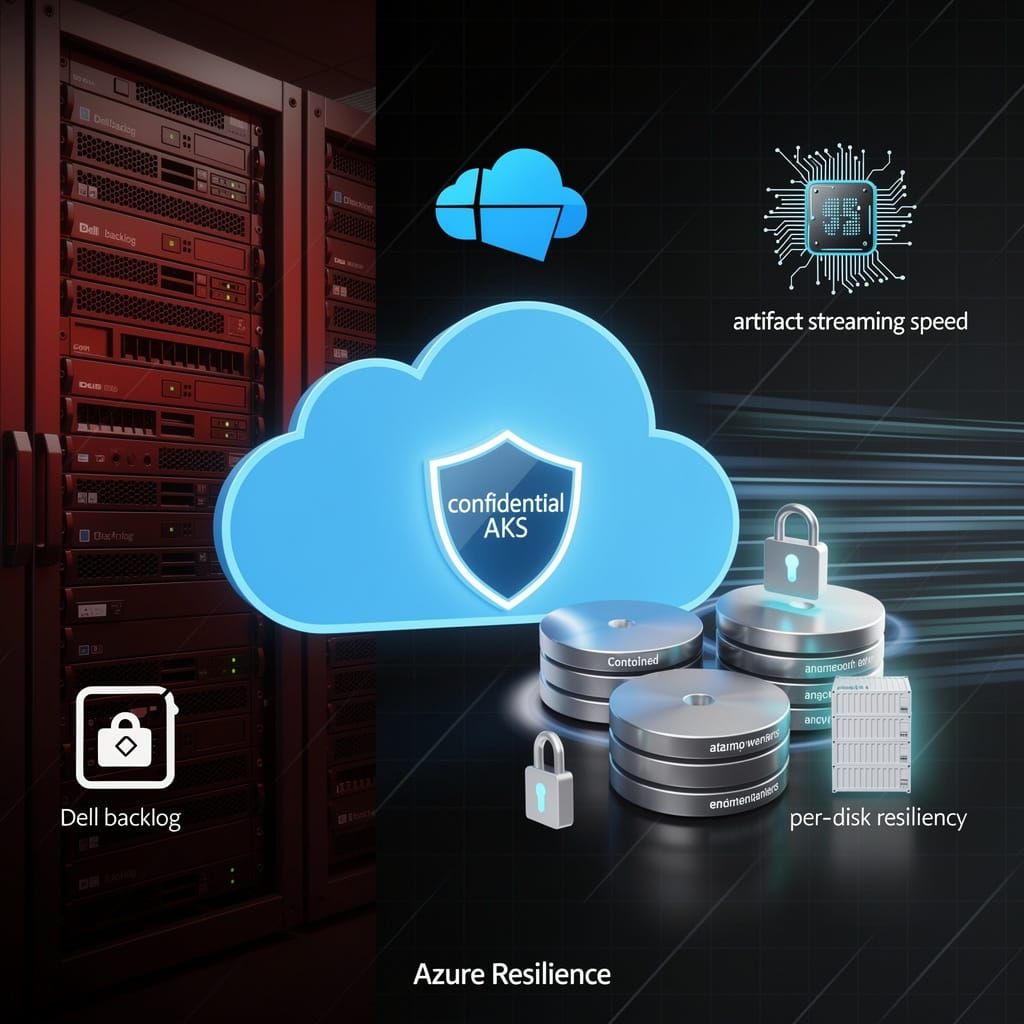
Azure VM Image Builder just hit Gov and Top Secret + China North 3. Per-disk resiliency keeps VMs alive when storage dies. Confidential AKS encrypts Linux containers at hardware level. Artifact streaming pulls only the layers you need. 🎭 Translation: your VMs survive disk failures, containers get memory encryption, devs stop waiting like it's 1999. Same RAID tech. Fancier clearance sticker. Dell's sitting on a $95B AI backlog — $130B+ in AI server orders over 12 months. Inventory doubled. Free cash flow down 47%. Customers waiting 18 months for hardware. Microsoft's real hack: "On-prem? See you in 2028. Or… just Azure." Boring features. Brilliant timing. Now that's a procurement play. Your move, enterprise — still waiting on Dell or shipping to sovereign cloud today?
Azure VM Image Builder just hit Gov, Gov Secret, Gov Top Secret, and China North 3. Per-disk resiliency keeps VMs alive when storage dies. Confidential VMs for AKS encrypt Linux containers at the hardware level. Artifact streaming pulls only the layers you need.
Let's translate: your VMs survive disk failures, your containers get memory encryption, and your devs stop waiting for builds like it's 1999.
The Supply Chain Tax That Writes Itself
Intel's still having a rough year. Dell's sitting on a $95B AI backlog—confirmed September 3, 2026 earnings—with customers ordering early just to secure hardware. Dell booked $61B in AI server orders in the three months ending July 31 alone, totaling over $130B in the past 12 months. ISG revenue surged 89% to $31.8B. Microsoft's response? Deploy existing infrastructure features under a classified clearance banner and call it sovereign innovation.
- Per-disk resiliency: VM keeps running when the storage layer shits itself. September 4 announcement confirms data disk unavailability won't kill the instance. Not new tech. Just RAID that got promoted.
- AKS confidential VM layer: Linux containers running on hardware-enforced encrypted memory. Microsoft announced support September 4. Because running sensitive workloads on shared silicon was always "fine" until auditors started asking questions.
- Artifact streaming optimization: Startup pulls only required container layers. September 4 update confirms reduced boot time by eliminating full-image downloads.
What This Actually Means
- 2026 Q4: Gov cloud customers stop losing VMs to disk failures. Per-disk resiliency eliminates entire class of rebuild tickets.
- 2027 H1: Classified workloads migrate to confidential AKS. Cryptographic boundary enforcement at the hardware level. No performance degradation claims stand until benchmarks prove otherwise.
- 2027 Q2: Cold-start delays drop. Artifact streaming cuts boot time by eliminating full-image pulls. Devs stop alt-tabbing during deployments.
The Realpolitik Hack
Dell's infrastructure supply constraints aren't recovering. $130B+ in cumulative AI server orders over 12 months. Customers facing purchase delays. Dell raised FY2027 AI-server revenue guidance from $60B to $74B, and overall revenue outlook from $167B to $192B—but inventory doubled from January to July while free cash flow dropped 47% to $986M. Microsoft's play: "On-prem hardware? Sure, see you in 18 months. Or… just Azure."
- Procurement angle: "Sir, the alternative is waiting for Dell to fulfill your $95B backlog. Or we deploy today."
- Security angle: Confidential VMs with hardware-level attestation. No more pleading with auditors about shared tenancy when the silicon itself enforces isolation.
- Performance angle: Fast boot times, resilient storage, encrypted compute. Boring but contract-winning.
The Punchline
Per-disk resiliency is good. Confidential AKS is good. Artifact streaming is good. But the real feature isn't technical—it's leveraging hardware shortages to make Azure the only viable option for classified workloads. Microsoft deployed resilience features under a classified clearance banner and called it a response to supply chain disruptions.
In reality, they're selling sovereign cloud capabilities with a side of "we have capacity, you have budget constraints, let's make a deal." Now that's a hack. 🎭


Comments ()