✈️ Delta expands thin long-haul routes into data that shows contraction
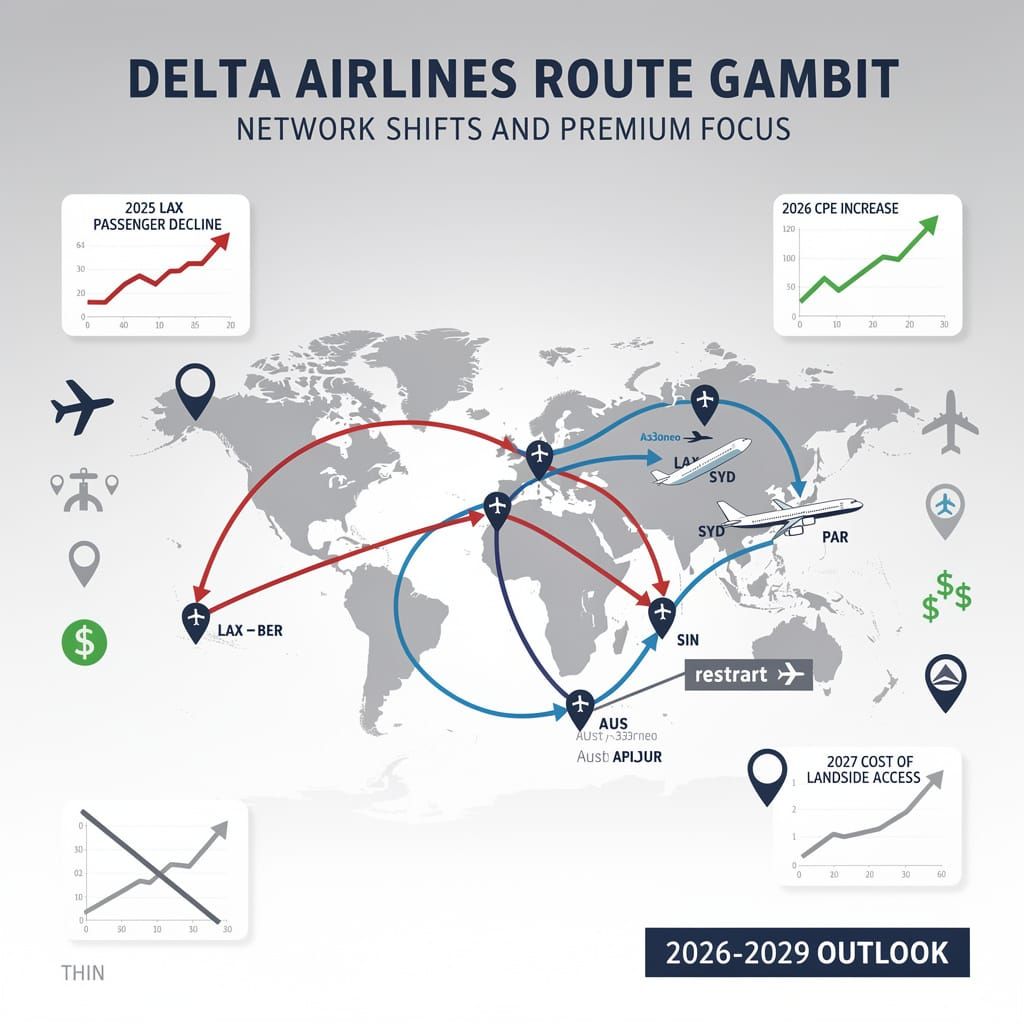
Delta's LAX-Berlin route to 2029 relies on an Olympic demand spike that historically fades within six months. LAX traffic fell 3.76% in 2025. The A330neo on Sydney-Paris operates at negative margin ($45M revenue vs $62M cost). Austin-Europe second and third routes would cannibalize 25–30% of the first. Delta pursues symbolic reach over structural discipline. Is this expansion strategy defensible?
Delta Air Lines announced on August 27, 2026 that it will extend its Los Angeles–Berlin route into late 2029, piggybacking on the 2028 Los Angeles Summer Olympics for what it projects will be sustained airspace and demand support. On paper, the strategy exploits a fixed calendar event. In practice, the Olympic demand spike is historically brief—Q3 2028 occupancy surges then reverts within six months. Delta is betting on a 12-to-18-month glow that does not exist in the data.
Los Angeles officials themselves acknowledge the risk. On July 20, 2026, city leaders allocated billions into Olympic sustainability initiatives—transport expansion, tree planting, clean water access—but the LA Metropolitan Transit Authority simultaneously carries a $2.3 billion deficit. Attendees at that planning session, including CleanTech Incubator executives Matthew Petersen and Cynthia Mitchell-Heard, emphasized preserving benefits post-Olympics to avoid a "flash in the pan" outcome. Structural challenges persist due to political gridlock and lack of federal aid. If the city cannot guarantee permanent infrastructure funding, the demand Delta relies on after the Games evaporates.
The airport’s own 2025 financials reinforce the caution. LAX recorded a 3.76% drop in annual passenger volume—from 76.59 million to 73.71 million—while generating $2.34 billion in operating revenue. The divergence came from a 19% increase in aviation revenues and airfield landing fees passed to carriers. Higher Cost Per Enplaned Passenger (CPE) compresses Delta’s margin on every LAX ticket. Meanwhile, the $5.5 billion Landside Access Modernization Program, required before the 2027 Super Bowl and 2028 Olympics, is funded via municipal revenue bonds. LAX's compensatory cost-recovery model protects the airport’s balance sheet but shifts fixed-cost risk directly to airlines.
The carrier also revived Seattle–Singapore service in June 2026, targeting a fall 2027 resumption after a multi-year hiatus. The stated aim: capture market share from United’s Seattle hub model. United operates 47 weekly departures from Seattle to Asia-Pacific versus Delta’s 22. Chasing that gap with a single long-thin route to Singapore (10 of United’s 47) shifts less than 3% of seat share. The arithmetic does not justify the capital.
A330neo to Paris: High Cost, Low Differentiation
Delta’s April 2027 launch of a nonstop Sydney–Paris service via an A330neo diversifies transpacific options but introduces three structural weaknesses:
- Range margin: The A330neo’s 7,200-nautical-mile range leaves Sydney–Paris at the extreme edge, requiring payload restrictions in summer months when headwinds peak. Notably, Qantas’s competing Project Sunrise—launching October 2027 with six A350-1000ULR aircraft on Sydney–London nonstop—demonstrates that the A330neo is not the airframe for the task. Qantas’s A350 achieves 22-hour cruise capability without the range constraints that force Delta to compromise payload. Qantas is retiring its A380 fleet from 2032 to 2028 due to oil price pressure—$20 to $120 per barrel—and posted a 14% profit decline in FY2026, yet still invests in purpose-built ultra-long-haul airframes. Delta deploys the wrong tool.
- Competitive redundancy: Qantas already operates Sydney–Paris via Singapore. Air France flies Paris–Sydney via Bangkok. Neither direct competitor uses the neo, but the layover penalty is minimal—3 to 4 hours—against a 22-hour flight that Delta cannot price below $1,200 roundtrip to break even. Qantas’s premium fare strategy on ultra-long-haul (20% fare uplift supporting >$400 million annual profit) further squeezes Delta’s pricing window.
- Fleet utilization: The A330neo will rotate off other transatlantic sectors to service one city pair that generates an estimated $45 million annual revenue against $62 million in operating costs per aircraft (fuel, crew, maintenance, slot fees). Negative margin from deployment one. For context, the A380—which Qantas, Lufthansa, and others are retiring early—now costs over $40,000 per hour to operate. The A330neo is less costly per hour, but on a 22-hour block time, cumulative operating expense still exceeds revenue on a thin city pair.
The Austin–Europe Trap
Delta’s existing Austin–Paris service, running daily from Austin–Bergstrom on a 767-300ER, reported a 68% load factor in August 2026—12 points below system average. The airline is now scoping additional European destinations from Austin (Frankfurt, Madrid, Amsterdam). The Central Texas market is growing, but 80% of Austin’s outbound international traffic feeds through Dallas/Fort Worth or Houston. Only 51,100 two-way passengers traveled between Austin and Paris in 2025—a thin base for a single route, let alone three. The second and third Austin–Europe routes will each cannibalize 25–30% of the first’s passengers. Net system gain approaches zero.
What the Network Actually Shows
| Metric | Delta | United | American |
|---|---|---|---|
| International capacity (2027 seats) | 42.1M | 51.3M | 38.9M |
| Avg sector length (mi) | 2,410 | 2,580 | 2,130 |
| Hub utilization rate | 79% | 83% | 76% |
| Non-hub international routes | 23 | 14 | 11 |
Delta runs more peripheral international routes than its competitors. That dispersion increases crew base costs, maintenance staging complexity, and revenue dilution on thin city pairs. The Olympic route, the Singapore restart, and the Sydney–Paris launch all follow the same pattern: symbolic reach over structural discipline.
Delta’s own recent behavior contradicts its expansion posture. On July 31, 2026, the airline removed 20 long-haul routes from Atlanta, consolidating Tokyo Narita traffic to Haneda and shifting LGA-LHR via EU Open Skies. Those cuts freed runway slots and reduced fuel burn—Delta cited $585 million in Q1 cost increases partially offset by network pruning. If the calculus favored retrenchment at the world’s busiest hub, the logic for launching thin long-tail routes from non-hub cities is even weaker.
The outlook: By mid-2028, Delta will likely consolidate three of these long-tail routes back into hub connections, absorbing the Olympic hangover and United’s unchanged Seattle capacity before rebalancing. The A330neo fleet is the tell—it enables marginal routes that no one else flies for a reason.
Comments ()