🛩️💊 Three Air India Incidents, One Pattern: Rule-Breaking, Not System Failure
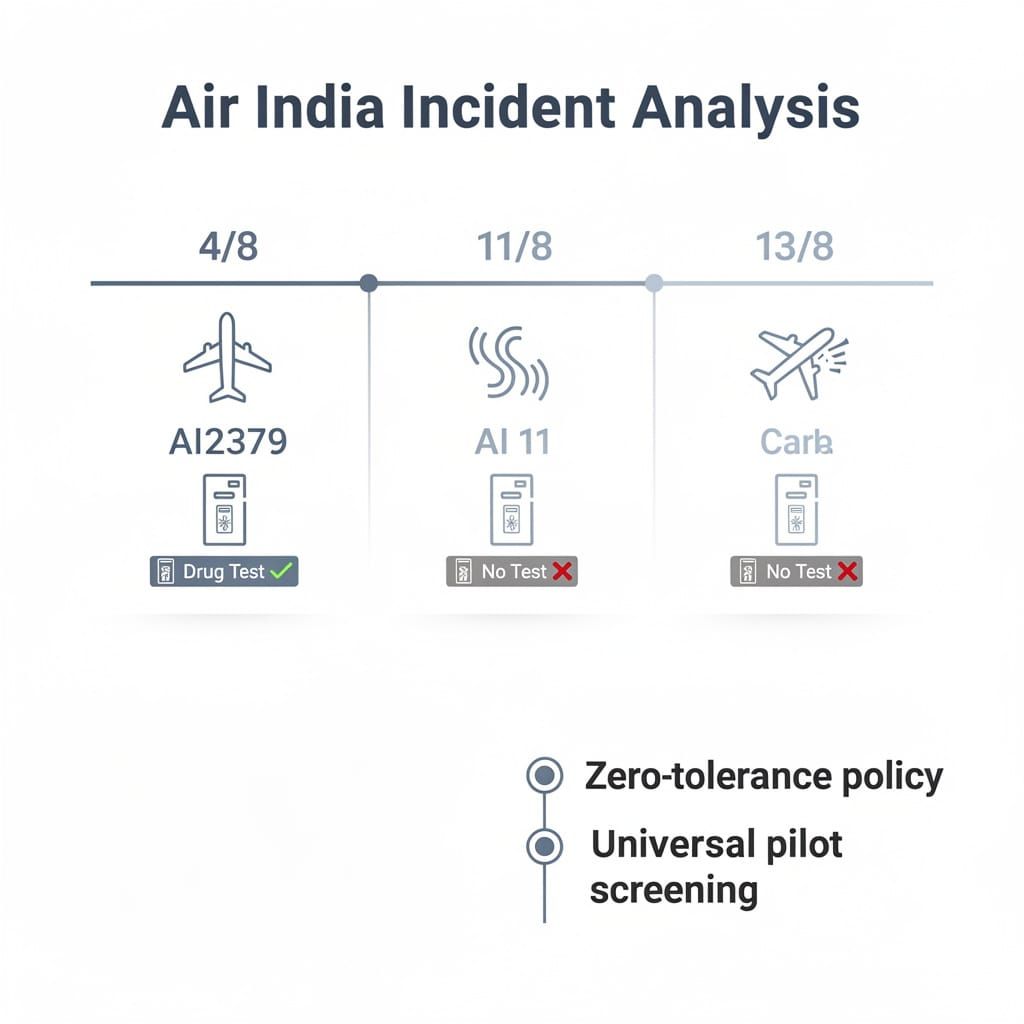
Air India: 3 incidents in 9 days, 2 positive drug tests, 1 fatal crash. The AAIB confirms triple-hydraulic failure on Flight AI2379 — a complete fluid leak, no shared part defect with the other events. Correlation is not causation. Systemic negligence is a convenient narrative, but each failure is distinct. The pattern isn't engineering decay — it's rule-breaking by individuals. Air India mandated universal pilot doping tests by Aug 13; Malaysia Aviation Group followed Aug 7 after a co-pilot was caught with 70,000 ecstasy pills, 26 kg of MDMA, and cocaine. These are targeted enforcement gaps, not institutional collapse. Drug tests exist. The problem is administering them before, not after, the flight. Does enforcement failure qualify as a system failure? 🛩️💊
Headlines since August 4 have painted a picture of cascading engineering failure, regulatory collapse, and a global aviation system on the verge of fracture. The narrative is convenient. It is also misleading.
Let us begin with the facts. On August 4, a captain on Air India Flight AI2379 from Phuket to Delhi tested positive for marijuana. The aircraft suffered a triple-hydraulic failure causing autopilot disengagement and a 292-foot altitude drop. Twenty-four people were injured. On August 11, another Air India flight experienced severe turbulence during descent with three aerodynamic failures logged. On August 13, an Air India Express pilot tested positive for illegal drugs during ascent; the aircraft subsequently crashed with fatalities.
Three incidents. Two positive drug tests. One catastrophic outcome.
Media and regulatory bodies have converged on a diagnosis: systemic engineering neglect, injection control failures, global standards in jeopardy. The $5 billion in annual insurance claims cited across reports is presented as reinforcing the scale of concern — but that figure originates from the broader insurance industry's AI-driven claims automation data published June 17, not from aviation-specific loss projections tied to these events.
What the causal chain actually shows
The drug tests are not evidence of widespread maintenance failure. They are evidence of individual criminal misconduct—a pilot and a co-pilot breaking laws that already prohibit exactly this behavior.
Within days of the August 4 incident, Air India mandated universal pilot doping tests across all flights, exceeding Indian DGCA guidelines that require only 10% annual coverage. The company began full-pilot substance screening on August 13, covering both main carriers after two prior events: a June 2025 crash that killed 241 and an August 2025 altitude drop causing injuries. The August 13 initiative formalized a zero-tolerance policy that had existed on paper but was enforced only reactively.
Malaysia Aviation Group followed on August 7, ordering universal drug screening for 1,260 pilots after a Malaysia Airlines co-pilot was detained in Jakarta carrying 70,000 ecstasy pills, 26 kg of MDMA, and cocaine. Detection occurred when the pilot failed a drug test despite carrying adulterated urine. The subsidiary's screening, made retroactive to August 1, requires all pilots to complete urine tests by August 15; non-compliance halts flight operations until clearance.
These are targeted operational corrections, not symptoms of institutional rot.
The AAIB investigation into Flight AI2379 confirms a triple-hydraulic system failure caused by a complete hydrostatic fluid leak that destroyed primary flight controls and locked elevator and aileron actuators for approximately four seconds. The aircraft was an Airbus A320, not a Boeing 787. No shared component failure, common software glitch, or recurrent supplier defect connects the August 4 hydraulic failure to the August 11 aerodynamic anomalies or the August 13 crash. The correlation is temporal, not mechanical. The AAIB's preliminary conclusion identifies no systemic design flaw; routine surveillance is recommended.
To claim "systemic engineering neglect" requires demonstrating that a common engineering process, part, or protocol caused all three events. No investigation has produced that evidence. What exists instead is a coincidence of calendar dates and a rush to assign structural blame where individual accountability suffices.
The damage of overcorrecting
Rhetoric matters. When regulators and commentators declare a system broken based on three events in nine days, they invite costly overreactions: blanket grounding of aircraft, suspension of air traffic protocols that functioned correctly, and diversion of resources into broad overhauls rather than specific enforcement of existing drug screening and cockpit discipline rules.
The titanium alloy durability testing flagged in impact domains is a non sequitur—no incident involved alloy failure. The June 13 crash of an IAF AN-32 transport aircraft at Jorhat Air Base in Assam killed five crew members, making it the twelfth major accident involving this Russian-built aircraft type in service since 1976. The cause is under investigation for technical or human factors relevant to Indian defense logistics, not a materials defect pertinent to commercial aviation. The incident involves military cargo operations, not the Airbus or Boeing fleets that carried the August incidents.
AI-based anomaly detection algorithms are being proposed as solutions to a problem (drug-impaired pilots) that existing urine and blood tests handle with near-perfect reliability when actually administered. Substituting technology for enforcement addresses nothing.
What works, what doesn't
The three incidents demonstrate a narrow failure mode: pilots violating narcotics prohibitions. The solution is enforcement, not reengineering. Random drug testing, zero-tolerance penalties, and license revocation—applied consistently across carriers and jurisdictions—would have prevented all three events. The August 13 crash may have been avoidable if the pilot had been screened before that flight rather than during it.
AAIB investigation reports remain pending. The insurance claims and liability disputes will run for years. But the aviation system itself was not broken in August 2026. It was circumvented by individuals who broke rules that were already in place.
That distinction matters. Confusing individual criminal acts with system failure guarantees expensive, irrelevant reforms that protect no one.
Comments ()