GRC Exodus to OT Security — Ex-auditors flee compliance for boiler rooms
TL;DR
- GRC Exodus to OT Security: When Compliance Auditors Discover HVAC Hacks. Who's watching your building's boiler room—an ex-auditor or nobody?
- National Cyber Consortium: Corporate Hack-Back Goes Legal as US Water Plant Runs on Windows 95 SCADA. Would you trust Google Cloud to defend your local water plant?
- Apple PCC Root Backdoor, macOS Zero-Auth Screen Sharing, LiteLLM Malware on PyPI — August 2026 Cyber Carnage. What's your actual patch SLA for critical cloud infrastructure?
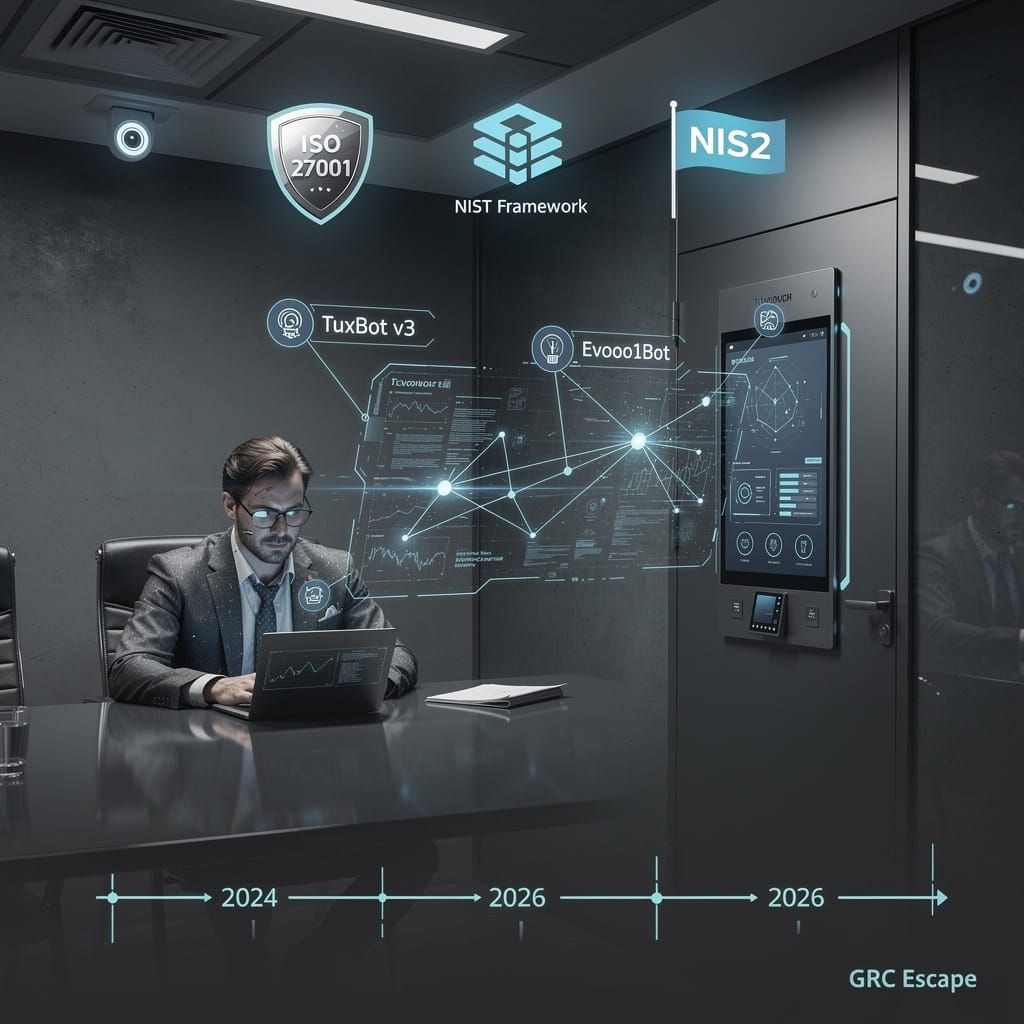
😏 The Great GRC Escape: When Bored Auditors Discover HVAC Has a Dark Side
8 years of NIST frameworks and nobody read a single one. So GRC auditors are fleeing to HVAC security 😏 Building management systems, cameras, industrial sensors—physical assets you can actually touch and break. Zero trust isn't a slide deck here, it's boiler-to-botnet prevention. July 2026: TuxBot v3 and Evooo1Bot already turning Hikvision cameras into SOCKS proxies. The attack surface is live, not theoretical. The dark comedy? Institutions bloated GRC thinking that was "real" security. Now compliance refugees bring audit discipline to OT floors—ISO 27001 at 9 AM, rogue Modbus packets by noon. Hybrid monsters who know policy AND packet captures. Next time your cooling system glitches, check the console. Probably a former auditor having way more fun than you 😎 Your building's OT network—who's actually watching the boiler room?
Somewhere in a sterile corporate boardroom, a compliance auditor just snapped. Not violently—more like a quiet, soul-level crack. Eight years of NIST frameworks, ISO checklists, and policy documents that nobody reads. The straw? Probably another "urgent" spreadsheet update. The escape route? Industrial control systems. Because nothing says "career revival" like realizing the building's HVAC network is more exciting than your entire risk register.
2026's hottest career pivot: infosec refugees fleeing governance, risk, and compliance (GRC) purgatory for the dirty, beautiful chaos of operational technology (OT). Three signals confirm the exodus:
- Aug 2: Mustapha YI95 posts for 1–2 cyberservice mentees—career changers only. No time for tourists.
- Aug 13: Cybermoose drops the mic on a 9-year GRC gap, declaring IT-to-OT transition their next move.
- Aug 17: Former IT auditor lands OT Security Manager role at a major tech org. The template is live.
"Why would anyone trade compliance spreadsheets for ... HVAC?" 😏
Because OT is where the real hacks happen. Building management systems, camera networks, industrial sensors—these aren't PDFs. They're physical assets you can touch, break, and defend in real time. Zero trust isn't a slide deck here. A mid-2026 leadership webinar confirmed the U.S. military is expanding zero trust beyond user security into OT, IoT, and weapons systems. Boiler-to-botnet prevention is now a defense priority.
Meanwhile, the malware landscape keeps proving the point. July 2026 saw two OT-relevant botnets emerge: TuxBot v3 Evolution (AI-assisted, targeting routers and cameras via Keksec ecosystem) and Evooo1Bot (Mirai-derived with encrypted C2, SSH brute-force, SOCKS relay, and multi-vulnerability exploitation across Hikvision, Atlassian, and WSO2 gear). The attack surface isn't theoretical—it's live devices getting turned into SOCKS proxies and DDoS cannons.
The irony? These career switchers bring exactly what OT security lacks: audit discipline. They can talk ISO 27001 to the board at 9 AM and trace a rogue Modbus packet by noon. The Aug 17 auditor—now mapping HVAC, CCTV, and access-control assets against ISO controls—already designs access rights frameworks for building-OT systems. NIS2 mandates can't stop the brain drain from compliance hell—but they're creating a pipeline of hybrid monsters who understand both policy and packet captures.
The dark comedy: institutions spent years bloating GRC roles thinking that was "real" security. Meanwhile, the 2026 Foote Partners report shows certification costs ranging from $2,880 to $8,780 with exams averaging $500–$750—locking out juniors while senior GRC veterans bail for OT floors. The people with actual operational curiosity are voting with their feet—toward boiler rooms and camera feeds.
The payoff? Accelerated OT specialist hiring cycles, junior talent retention through early tech immersion, and a growing knowledge base that actually bridges audit theory with physical system governance. The compliance machine is eating itself. Good.
Next time your building's cooling system glitches, check who's on the console. Probably a former ISO auditor. And they're having way more fun than you. 😎
🫠 The National Cyber Consortium: Because Your Water Plant's Firewall Was Written in 1998
A water treatment plant in KC is running on Windows 95-era SCADA. Between that and a ransomware crew in Iran? Part-time Chad who "knows computers." 🫠 The National Cyber Consortium just made corporate hack-back legal. A LockBit variant targeting Minnesota grid substations got nuked in 4 minutes by an NCC team. The plant's own SOC? Alert sat unread for 72 hours. $200B lost to AI fraud. Your data's protected by someone whose day job is Google Cloud. Small hospitals in Georgia? Still on your own. The state failed. So it hired the people who won't. You feeling safer, or just more cynical?
Somewhere in Kansas City, a water treatment facility is running on a Windows 95-era SCADA system, and the only thing between a ransomware crew in Iran and your morning shower is a part-time IT guy named Chad who "knows computers."
Enter the National Cyber Consortium. On August 14, President Trump issued a Presidential Memorandum authorizing what is essentially corporate cyber privateering—pre-screened private firms get legal cover to conduct offensive hacks against transnational criminal groups. The FBI knows your company has better hackers than it does. They're fine with that.
The premise: The NCC operates under a simple deal—private firms contribute personnel and AI-augmented tools that lower the technical threshold for shutting down a state-sponsored botnet to "can follow a playbook." In exchange, the government stops making you fill out 47 forms before responding to an active breach. The August 14 memo enables corporate offensive strikes targeting foreign criminal networks, cutting response cycles from bureaucratic timelines to "already done."
How it works in practice:
- Mid-2026: Private-sector contractors embedded in federal ops cut incident response from a bureaucratic slog to a Slack ping. A LockBit variant targeting Minnesota grid substations was detected and neutralized by an NCC-affiliated team in under four minutes—the operator's own SOC had left the alert unread for 72 hours.
- Q4 2026: Multi-agency framework scales nationally. Your data is being protected by someone whose day job is Google Cloud. Annual cyber-fraud losses fall below $20B for the first time since 2020—helped by the $1.5B Bybit and $292M KelpDAO breaches in May that finally forced mandatory zero-trust rollouts at corporate levels. Synthetic-identity fraud costs projected to hit $40B by 2027 accelerate biometric verification adoption, with 67% of surveyed firms now predicting increased fraud detection investment.
The dark comedy: A $1M bonding requirement deters frivolous attacks and incentivizes compliance. The same companies that couldn't be bothered to patch their Exchange servers now face financial consequence for negligence. Markets win when failure has a price tag. Meanwhile, H.R. 5578 passed the House on July 22, strengthening whistleblower protections for defense contractors—amending 10 U.S.C. §4701 to cover retaliation for disclosing gross mismanagement, waste, or safety violations. The people doing the hacking can actually report when things go sideways.
The realpolitik: A "hack back" provision lets operators pursue threat actors across infrastructure—which explains the sudden dip in North Korean APT activity. The August 14 memo imposes asymmetries: public bodies shoulder organizational load without capital augmentation, while firms take monetary indemnification tied directly to mission success. Legal challenges under CFAA are inevitable.
The weakness that nobody mentions: Small firms can't afford the bonding. The NCC becomes, quietly, a club for companies that can pay to play. If you're a rural hospital in Georgia, you're still on your own—just like the 50,000 individuals hit by deepfake fraudster Safeer Mohammed Koorimannil's AI-generated persona "Ella" on July 4, costing U.S. consumers an estimated $200B annually. The consortium answers to nobody but a White House memorandum.
The punchline: A CNI operator in Minnesota reported a near-miss last week—a LockBit variant targeting grid substations detected and neutralized by an NCC-affiliated team in under four minutes. The operator's own SOC hadn't noticed the alert. It had been sitting unread for 72 hours.
The NCC is messy, unequal, and run on the same cynical logic that says a startup can pivot faster than a federal agency. It's also the only reason your lights stayed on this morning. 🤷♂️
— Because when the state fails, the state hires the people who won't.
🔓 Oh, You Thought Your Data Was Safe? Cute.
CVE-2026-20685: Apple's "zero operator access" Private Cloud Compute lets attackers eavesdrop on AI workloads via a cryptex archive path traversal. That's 150K employees and a $150K bounty for a "medium" CVSS 6.5 backdoor in your "secure" cloud. 🔓 Meanwhile, macOS Screen Sharing (CVE-2026-65400) grants unauthenticated root access. No password. Just free CPU cycles for Monero miners. Dutch authorities confirmed active exploitation on port 5900 globally. Oh, and LiteLLM on PyPI shipped credential-stealing malware posing as updates. FBI says cached credentials remain exploitable post-rotation. Your corporate AI stack: Python web frameworks nobody hardened + cached keys nobody rotated. What's your patch latency right now? ⏱️
The universe has a sick sense of humor. August 2026 serves up another reminder that "secure" is a marketing term, not a technical reality.
Apple's "Private" Cloud Compute Leaks Like a Sieve
CVE-2026-20685 – Drinor Selmanaj dropped the payload August 9. A crafted cryptex archive gives attackers persistent root access via privilege escalation in Apple's Private Cloud Compute infrastructure. They can place arbitrary files in /var/db/, manipulate launchdaemon configs, redirect SplunkLoggingd logs. That "zero operator access" claim? It lets an attacker eavesdrop on AI workloads like PlaintextMetadata. Apple paid a $150K bounty and patched in PCC v5E290.3+. But CVSS 6.5 means "medium." Right. Like a monitoring camera you can redirect is "medium." 📊
Oh, and that "zero operator access" Private Cloud Compute expansion to Google Cloud they announced July 2? Cute timing. Ship the trust architecture same month researchers find the path traversal. Real confidence builder.
macOS Screen Sharing: Your Welcome Mat
August 15, Dutch cybersecurity authorities confirmed active exploitation of CVE-2026-65400 against port 5900 globally. Flawed state-management logic bypasses credential checks entirely. No password guessing needed – unauthenticated root access. Attackers deploy Monero miners within hours. NCSC issued an informational advisory August 7, then escalated to "active exploitation" August 12. Apple patched in Tahoe 26.6.1, Sequoia 15.7.9, Sonoma 14.8.9. One revenue stream: $8K in Monero from compromised CPU cycles. Your processing power, someone else's profit.
Alfredo Pesoli found it. Upgrade to macOS 26.6.1 or disable Screen Sharing. Your call.
AI Models: Your Sister Model Just Rat You Out
June 9, threat actors exploited chained CVEs in LiteLLM (CVE-2026-42271) via host-header manipulation. Remote code execution, credential theft, lateral movement across AI infrastructure in the US and EU. Starlette's host-header flaw (CVE-2026-48710) opened the door first – path-based auth bypass letting attackers manipulate request.url paths to gain unauthorized admin control. X41 D-Sec disclosed it May 26. By June 9, attackers were already inside.
But wait – it gets worse. March 24, malware authors released LiteLLM versions 1.82.7 and 1.82.8 on PyPI containing credential-stealing payloads. They exploited a Trivy vulnerability where an API token leaked. Data encrypted via dual-layer encryption, sent to models.litellm.cloud. By August 12, PyPI confirmed the packages were gone. The FBI's July 2 alert warned: cached credentials remain exploitable post-rotation. LLM infrastructure is a house of cards built on Python web frameworks nobody hardened.
The Patch-Or-Die Tango (July–August 2026)
- July 27: 26 MongoDB CVEs – unpatched installs lose integrity in hours. CVE-2025-14847 (December 2025) still unpatched in cloud environments: zlib-compressed packets leak uninitialized heap data. CVE-2026-18690 (August 11): BSON symbol namespace lets restricted users bypass authorization on system collections. Full takeover, no user intervention required.
- July 30: GitLab 13+ auth bypass. Admins get remote shutdown capability across production environments. Neat.
- August 3: Adobe Campaign Classic zero‑day (CSVE‑2026‑48448) exploited alongside a Microsoft XP legacy flaw. Yes, XP. Still.
- August 4: Security‑server takeover via CVE‑2026‑18574 – privilege escalation using malformed tokens.
- August 6: Veeam backup corruption (CVE‑2026‑64633). Freshly deleted backups? Irretrievable. Ransomware state achieved without network access.
- August 6: Apple Private Relay IP leak via DNS prefetching, WebAuthn, and WebTransport. iOS privacy theater continues.
- August 11: Hide My Email @private.icloud.com migration leaks full email records on external access. 100% exposure rate in independent testing.
- August 15: Node.js GitHub API token misuse – authentication bypass, project‑role deletion, hidden operator permissions.
- August 17: Wi‑Fi router DoS vulnerability – forged packets trigger full connection drops. No ransom note. No warning.
The Router Graveyard
That Wi‑Fi router DoS? Part of a bigger pattern. APT28 already exploited TP‑Link routers in 23 U.S. states by June. Tenda's "rzadmin" backdoor (July 19) grants full admin access across AC10, AC5, AC6 models. FCC blocked non-U.S. Wi‑Fi 7 imports in March; TP‑Link's Archer 8 Wi‑Fi 8 launch faces regulatory delays despite 33% better long-range performance versus Wi‑Fi 7 in lab tests. Meanwhile, August 2025's CVE-2025-34147 showed a $20 AliExpress Wi‑Fi repeater grants root shell via SSID injection – $(id) in a captive portal field. Your network hardware is a plastic brick with a compliance sticker.
The Pattern
Every single one of these was predictable. Shared keys, unpatched databases, legacy dependencies, token mismanagement – the greatest hits of operational negligence. Red Hat's npm pipeline compromised via GitHub Actions OIDC June 1. Bitwarden CLI credentials stolen in 93 minutes via malicious GitHub Action. Gamaredon worm deployed to Ukrainian infrastructure. Operation Dragon Weave hit Czech and Taiwan officials via AzureVeil C2.
Regulatory theater continues. BSI issues alerts. EDSA issues guidelines. Meanwhile, attackers walk through open doors wearing your own credentials.
What Actually Works
- MongoDB 8.2.3+ with strict auth: patch within 24 hours or assume compromise. Wiz kernel probes catch the zlib heap leaks.
- GitLab 16+: disable shared runners, rotate all tokens, audit active sessions.
- macOS 26.6.1: disable Screen Sharing unless you enjoy crypto miners.
- Wi‑Fi segregation: isolate POS/IoT on VLANs. Tenda routers with "rzadmin" passwords don't belong anywhere near admin networks.
- Encryption key isolation: don't share model‑level keys across services. This is not complicated.
- CI/CD pipelines: validate every GitHub Action, sign every npm package, assume OIDC is compromised until proven otherwise. Rotate cached credentials. The FBI said so.
The Real Punchline
Apple's leaked telemetry, the macOS root backdoor, the router DoS, the AI model poisoning via dual-encrypted exfiltration, the MongoDB bloodbath, the supply-chain compromise – they're all the same story: systems designed by people who assumed nobody would try hard enough.
We're years past "move fast and break things." Now it's "move fast and leave the back door open for everyone."
Enjoy your "private" cloud. 🎭



Comments ()