$3.6B Frozen: FCC Blocks Chinese Robot Vacuums as Surveillance Assets
TL;DR
- $3.6B Frozen: FCC Treats Robot Vacuums as Surveillance Drones, Blocks Chinese Imports. Are we securing supply chains or just splitting them?
- 573 crashes per million miles: Tesla Cybercab crash rate is 9× human drivers as real-time audits begin. How many robotaxi crashes per million miles would you tolerate in your city?
- $30 Tau Robot: FCC-Banned Supply Chain, Permanent Home Surveillance, No Autonomy. Would you trade $10/hr savings for a Chinese-linked humanoid filming your home forever?
🚫 The Robot Vacuum That Wasn't Just a Vacuum
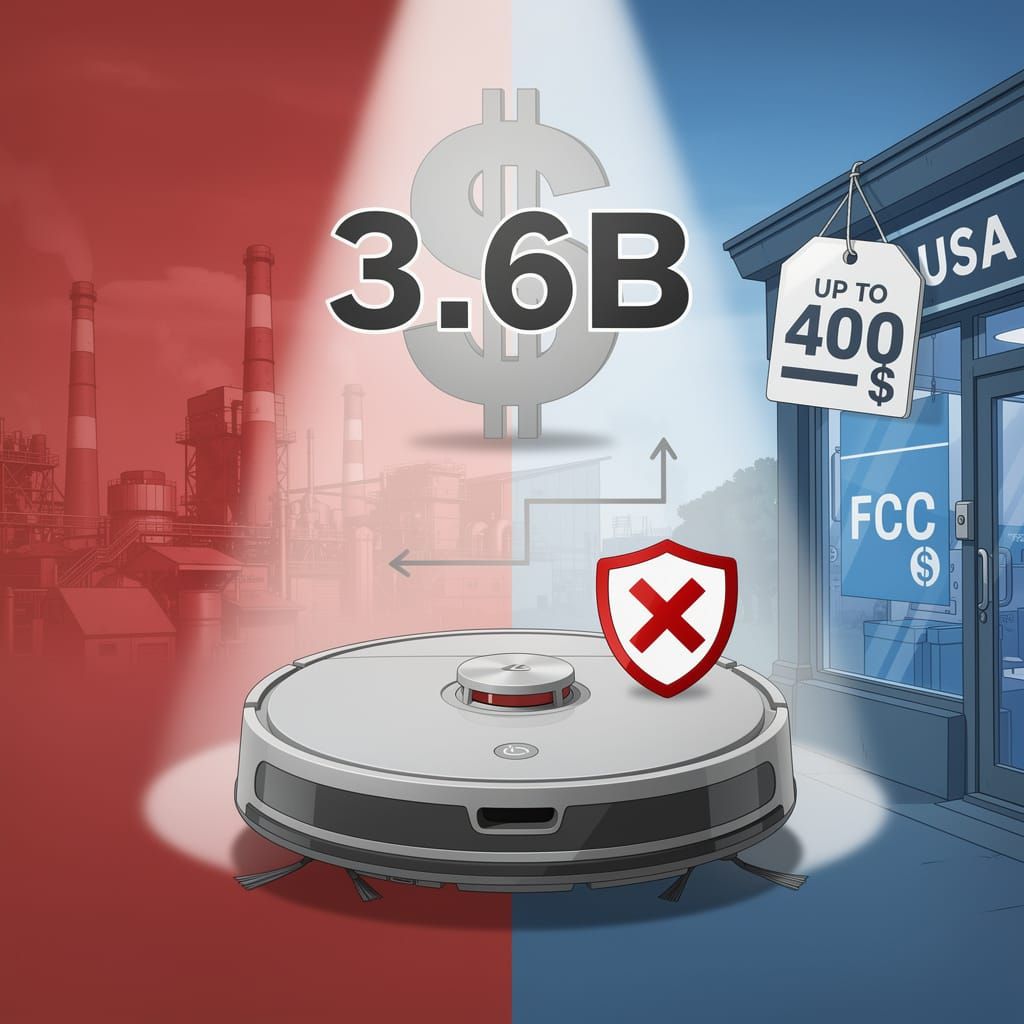
97% of humanoid robot shipments this year came from Chinese suppliers, and now the FCC has quietly blocked their robot vacuums from U.S. entry. 🚫 A Roomba with a 720p camera gets treated like a surveillance drone. $3.6 billion in annual trade is suddenly frozen—while the software stacks (SLAM, AI, cloud APIs) keep flowing unregulated. U.S. consumers get fewer choices at higher prices. 65% domestic-content mandate hits in 2028—no major OEM has acknowledged it yet. Are we securing supply chains or just splitting them?
The U.S. government now requires export screening for robot vacuums. As of late July, these devices—alongside other small-to-midweight autonomous systems—entered a restricted category under the Federal Communications Commission's expanded authority. The stated rationale: built-in cameras, microphones, and compute modules that could function as covert telemetry nodes.
What This Actually Means
This is not a ban on robot vacuums. It is a structural shift in how autonomous hardware crosses U.S. borders.
- Supply disruption: Roborock, Dreame Technology, Ecovacs, and Narwal—the four largest Chinese manufacturers by global unit volume—face indefinite delays on new U.S. shipments after the FCC's July 31 addition of "foreign-produced advanced robotic devices" to its Covered List. Existing inventory continues operation; new shipments require DHS-DoD conditional approval and domestic sourcing ratios exceeding 65 percent. No company has received clearance since the designation.
- Market fragmentation: U.S. consumers will increasingly find only domestic or allied-nation alternatives (Shark, Samsung, iRobot) in retail channels. iRobot's Roomba 415X launched at $399.99 on June 26, and the Roomba Plus 405 hit $399 on July 29—both signaling price competition, but iRobot's annual production volume cannot absorb the gap left by 6 million Chinese imports. China produced an estimated 38 million robot vacuums in 2025; roughly 6 million entered the U.S. market at average unit prices of $420–$850, placing affected trade value near $3.6 billion annually.
- Regulatory drift: The FCC simultaneously canceled consideration of self-driving car frameworks and unmanned aircraft rules. The robotics export regime expands while the regulatory infrastructure for other autonomous categories stalls.
The Causal Chain Nobody Is Discussing
The restriction targets form factors, not functions. A robot vacuum with a 720p camera and Wi-Fi module triggers the same screening as a surveillance drone with equivalent sensors. This equivalence follows the same logic applied to Huawei routers in prior years: connected home devices are now strategic assets.
Consider the numbers. Chinese suppliers delivered approximately 97 percent of all worldwide humanoid robot shipments up to August 2026—a concentration that mirrors the vacuum market. Only 23 percent of buyers report satisfaction with those units, citing short battery life, yet high volume yields operational data that lowers costs and reinforces supplier ties. The vacuum restriction blocks hardware, but the software stack—SLAM algorithms, edge-computing architectures, AI models—continues flowing through SDKs, cloud APIs, and open-source repositories. The control plane remains unregulated while the physical chassis requires clearance.
What Remains Unaddressed
The 65 percent U.S.-content requirement scheduled for 2028 mandates domestic manufacturing reconfiguration within 18 months. No major robotics OEM has publicly acknowledged this timeline. Meanwhile, RobotPlusPlus launched an autonomous climbing robot on July 28 achieving 98 percent hull coverage on vessels exceeding 100,000 deadweight tonnes—proof that Chinese industrial robotics advances continue across form factors unaffected by the vacuum restriction.
ROs in manufacturing facilities, autonomous floor scrubbers in hospitals, delivery bots on sidewalks—all fall under the same weight-and-origin criteria. The rule is technology-agnostic in its language but China-specific in its effect. South Korea, Japan, and Germany receive expedited pathways. Iranian and Russian imports were already blocked.
The Outlook Through 2027
- Q4 2026: No approved imports from restricted-origin manufacturers. Secondary market prices for existing compliant units rise 30–40 percent. Domestic manufacturers announce expedited production lines for Q2 2027.
- H1 2027: First provisional clearances possible but limited to units with hardware-disabled cameras and micro-solder-disconnected microphones. Software functionality remains full.
- 2028: 65 percent U.S.-content rule activates. Current restricted-origin OEMs face binary choice: establish U.S. assembly operations or exit entirely.
This is not a consumer-protection measure. It is a supply-chain security intervention framed through consumer electronics. Whether it achieves its stated aims or simply fragments an integrated global robotics supply chain depends entirely on whether software and data flows receive equivalent attention. So far, they have not.
🚨 Tesla’s Robotaxi Safety Data Undermines the “Safe-With-Monitor” Narrative
Cybercrashes at 9× the rate of human drivers — 573 vs. 65 per million miles. That's not "safe with monitor," it's a gap wider than the industry's lidar debate. 🚨 40% of Cybercab miles are empty deadhead trips inflating the denominator. Three remote-attack vulnerabilities found in Q2. Tesla lost $45B in 48 hours. Insurers now demand separate robotaxi riders in CA, TX, FL. Rider price tolerance has dropped 18–24%. Real-time telemetry audits begin for fleets over 500K annual miles — Tesla surpasses that threshold by 4.2×. If crash parity with professional drivers (≤70 per million miles) isn't proven under audit, four states will suspend expansion permits. The "proof" was promised. The data was never delivered. Your city, your roads — how many crashes per million miles are you willing to accept?
On August 11, 2026, Tesla disclosed that its Cybercab fleet crashes at nearly nine times the rate of experienced human drivers—573 crashes per million miles versus roughly 65 per million miles. The figures come from NHTSA-mandated filings, not third-party audits, and validate long-standing doubts about the "safe-with-monitor" approach.
Why deadheading inflates the denominator
Approximately 40% of Cybercab vehicle-miles are deadhead trips with no occupants. These miles count toward total VMT without any passenger safety baseline, effectively lowering the per-mile incident threshold. NHTSA now separately tracks remote teleoperator interventions from fully automated miles, a regulatory distinction that exposes the gap between supervised and unsupervised operations.
Cybersecurity exposure: Each teleoperator handoff creates a remote-attack surface. In Q2 2026, researchers identified three critical vulnerabilities in the Cybercab's teleoperation channel, each allowing an attacker to inject false sensor data or seize low-speed control. No exploits have been publicly confirmed, but the architecture introduces failure modes absent from fully onboard autonomy.
Investor and insurer recalibration
The equity consequences emerged within 48 hours: Tesla shares fell 6.3% , erasing roughly $45 billion in market capitalization. More quietly, the Insurance Institute for Highway Safety updated its premium models to reflect a 9.2× higher incident frequency per mile for autonomous fleets versus human-driven equivalents. Insurers including State Farm and Geico now require separate rider policies for robotaxi usage in California, Texas, and Florida.
Consumer willingness to pay has dropped measurably. Survey data from May Mobility and Waymo shows average rider price tolerance in robotaxi markets declining 18–24% since March 2026, with respondents citing "unpredictable braking," "phantom stops," and "erratic routing" as primary deterrents.
The regulatory audit pipeline
Regulators are moving beyond self-reported data. The National Bureau of Economic Research, in collaboration with Virginia Tech, has initiated a mandatory real-time telemetry audit for fleets exceeding 500,000 annual miles. Tesla's seven markets collectively surpass that threshold by 4.2×, meaning the audit applies immediately.
Key requirements:
- Real-time brake-event logging via encrypted ledger
- Independent collision reconstruction for each reportable incident
- Quarterly certification renewal tied to month-over-month crash-rate decline
These conditions mark a shift from trust-based to evidence-based compliance.
Standardization stalled
Full-scale deployment of automotive autonomy now depends on consensus around cybersecurity and sensor infrastructure standards—something the industry has failed to achieve through three fiscal cycles. Without an agreed baseline for lidar-camera-radar fusion validation, edge-case handling, and remote-attack mitigation, the path to Level 4 certification remains fragmented across jurisdictions.
The gap: Tesla's sensor suite omits lidar entirely. Competitors like Waymo and Amazon's Zoox deploy multi-lidar arrays that cost $30,000–$50,000 per vehicle. Tesla's cost advantage (~$8,000 per sensor stack) collapses if regulators mandate lidar coverage for autonomous operations beyond 35 mph. Tesla's own engineering updates—including the July 2026 FSDS computer upgrade with double GPS redundancy and 64 GB GPU memory—resolve prior localization glitches but do not address the fundamental lidar gap.
What the forecast indicates
The robotics and autonomous systems sector faces a credibility inflection point. If crash-rate parity with professional drivers—defined as ≤70 incidents per million miles—cannot be demonstrated across six consecutive months under audit conditions, regulators in New Jersey, New York, and Virginia have signaled they will suspend autonomous fleet expansion permits until external validation thresholds are met.
- 2027: Certification requirements tighten; lidar mandate proposed for California and Florida.
- Q1 2028: Real-time telemetry audit results due for all fleets ≥500,000 annual miles.
- 2029: Sector-wide crash-rate benchmark freeze if parity not achieved; expansion permits revoked in four states.
Tesla's robotaxi program now carries liabilities—regulatory, financial, and reputational—that its architecture was not designed to manage. The "safe-with-monitor" claim may have been the premise. The data shows it was never the proof.
🚫🤖 Tau Robotics Puts a $30/Hour Humanoid in Your Living Room
$30/hr for a remotely operated humanoid that records your every move forever — and the hardware comes from a Chinese vendor the FCC just banned 🇺🇸🚫🤖 Tau's $30/hr cleaning robot sounds cheap vs Bay Area services ($40-60/hr). But it skips benefits, insurance, worker protections — converting labor into a surveillance subscription. And every session is stored permanently for model training, no sunset clause disclosed. The supply chain problem? Tau's humanoids are partly built by Unitree, which commands ~20% of global humanoid share. On July 28, the FCC banned imports of Chinese humanoid robots citing espionage and infrastructure-attack risks. Tau's hardware pipeline sits inside a federal prohibition. Vacuums got added the next day. Meanwhile Flexion just demonstrated a fully unsupervised 4-minute multi-step delivery with zero human corrections. Tau's model remains tethered to central command watching your living room. $10 off the hourly rate — worth letting a third-party operator, a federally restricted vendor, and a permanent surveillance architecture into your home?
On August 11, 2026, Tau Robotics expanded its San Francisco home-cleaning pilot, deploying remotely operated humanoid robots at $30 per hour. The July 31 initial launch placed units in select households; the August expansion signals intent to scale citywide by early 2027 and globally by 2028.
What the Pilot Actually Reveals
The robots handle housekeeping tasks via AI-driven manipulation while a human operator monitors remotely via VR goggles. CEO Alexander Koch positions the service below San Francisco's $19.07 minimum wage—but the comparison omits operator labor costs, central-command overhead, and the fact that $30/hour is 57% above that wage floor, not below it.
Privacy: Units record sessions forever for model training, per Koch's own July 31 announcement. No retention sunset clause has been disclosed → permanent surveillance architecture inside residences, with behavioral and task-performance data stored indefinitely. Safety: Remote supervision prevents autonomous mishaps such as mechanical falls and gripper pinching—but every incident is observed, recorded, and analyzable by a third-party operator and the company. Persistent autonomy deficits persist: Robotics Summit demonstrations on June 18, 2026 showed humanoid prototypes still constrained by unreliable gesture prediction and fragmented sensor inputs, requiring continuous human oversight for basic tasks. Supply chain: Tau's humanoids are built partly by Chinese firm Unitree, which commands ~20% of the global humanoid share. Days before Tau's launch—on July 28, 2026—the FCC banned imports of Chinese humanoid robots, citing espionage and infrastructure-attack risks. Tau's hardware pipeline immediately sits inside a federal prohibition. The restriction extended to robot vacuums on July 29, signaling expanding scrutiny of all AI-enabled robotic devices relying on IoT communications. Economics: $30/hour undercuts Bay Area cleaning services ($40–$60/hour) but avoids benefits, insurance, or worker protections—converting a regulated labor market into a subscription service.
The Forecast Problem
Tau projects a $200 billion market by 2035. That figure appears in press releases and pilot announcements, but University of California, Berkeley researchers involved in the pilot express skepticism that true domestic utility remains more than a decade away. The math assumes mass adoption of tele-operated humanoids in homes—a scenario that depends on trust in persistent surveillance, tolerance for remote operators in central command watching daily life, and a supply chain that was federally restricted three days before the service launched. Meanwhile, a competing system demonstrated genuinely autonomous task completion: on July 26, 2026, Flexion's humanoid executed a fully unsupervised four-minute multi-step delivery involving stair negotiation, door manipulation, elevator summoning, and package placement—processing no mid-task corrections. Tau's tele-operation model remains tethered to human oversight while competitors prove end-to-end autonomy is reachable.
No independent audit of the data pipeline exists. No regulatory framework for in-home humanoid surveillance has been proposed in California. No privacy impact assessment has been published.
What Comes Next
- Early 2027: Municipal rollout across San Francisco, targeting 5,000–8,000 households, generating ~$15–$20 million in annual revenue and petabytes of household behavior data.
- 2028: Expansion to Los Angeles and Seattle—contingent on resolving actuator supply after the FCC ban on Chinese humanoid imports and Unitree's $42 billion Shanghai IPO, which prioritizes domestic Chinese R&D over U.S. compliance.
- 2030–2035: If privacy regulations remain absent and trust holds, Tau projects 15%–20% of urban U.S. households using tele-operated humanoid cleaning, representing $40 billion–$60 billion in annual service revenue. Academic forecasters project autonomous full-home cleaning within five years—but the Dyna model trained on one million hours of raw human video and robot feedback achieved 90% lockbox key-turning accuracy and 20–53% score increases across 14 tasks, suggesting generalist autonomy training scales faster than Tau's tele-operation model can justify.
The technology works. The question—unanswered—is whether households should accept a remote-operated, data-harvesting machine built by a federally restricted vendor in exchange for $10 off the hourly cleaning rate.


Comments ()