±2° Angular Error at Sub-Second Rotation: Single-Axis PID Swerve Fails Day-After Repeatability Test
🚩 Robotics: Yet Another PID Loop Wrapped in Hype
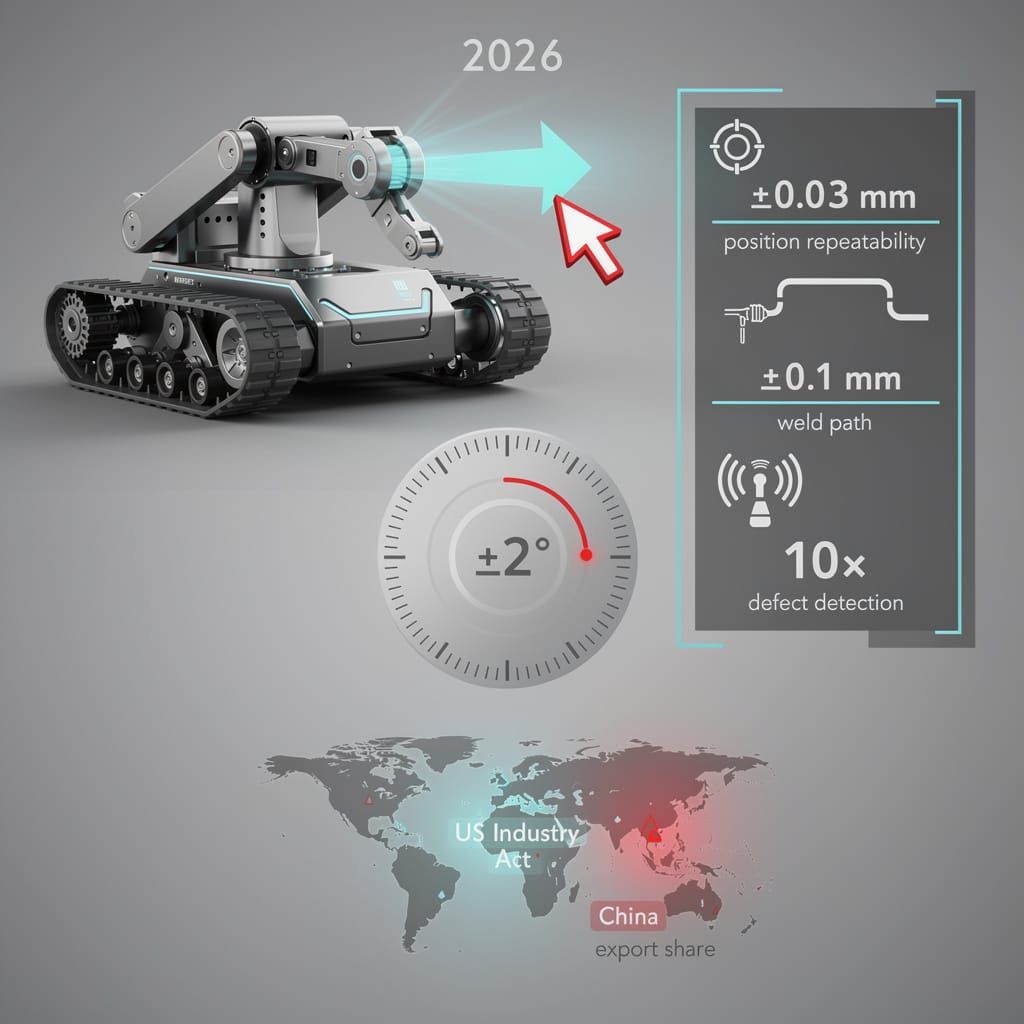
A PID-controlled swerve system failed its own turn initiation the day before—and then barely held ±2° stability with a 0.2s loop. 🚩 Universal Robots holds ±0.03mm at 1,000mm/s. Path Robotics welds at ±0.1mm under 10kg. Kawasaki's RL030N cuts defect detection by 10x. This single-axis rotation is an undergraduate lab exercise that couldn't run reliably twice. The U.S. passed the National Robotics Act while China exported 10M+ robots in H1 2026. Domestic exports fell to 5.4%. Meanwhile, this system can't close a basic PID loop two days in a row. Industrial relevance: zero. AV relevance: none. Humanoid relevance: negligible. If a gyro-to-motor pipeline this fragile is called progress, what does failure actually look like?
The TurnToAngleCommand executed on August 13, 2026, using real‑time gyroscopic feedback, a PID loop capping motor acceleration at ±0.5 deg/s, and achieving rotation stability within 0.2 s to roughly ±2 degrees. The prior day, however, a turn initiation failed due to unit inconsistency that produced incorrect motor output regardless of prior movement history—an error that persisted after reset. The system cannot reliably repeat its own single-axis rotation.
What the signal actually documents: A swerve system rotating on a single axis with no load, no torque disturbances, no payload inertia, and no environmental variance. The gyro reads angular displacement modulo [-180°, 180°], the PID computes an error signal clamped to [-0.5, 0.5] throttle, the motors turn. Completion triggers after 0.2 seconds of stable state. That is a textbook control loop, achievable in any undergraduate mechatronics lab—and it still failed the day before.
The metrics against deployed systems: Universal Robots' e-Series holds ±0.03 mm position repeatability at 1,000 mm/sec TCP speed. Production welding robots—such as those Path Robotics demonstrated on July 10 2026—achieve ±0.1 mm path accuracy under 10 kg payloads over 6 degrees of freedom, using AI‑guided vision for real‑time weld path navigation. Kawasaki’s RL030N 8‑DoF robot, unveiled at Automate 2026 on June 26, integrates predictive maintenance and reduces defect detection time by 10x compared to manual methods. A ±2‑degree angular error at sub‑second rotation is functionally irrelevant for any of these use cases.
The gap in causal logic: Gyro reading → PID output → motor command → rotation → stability check → pause. Vehicle heading control demands yaw‑rate prediction, lateral acceleration limits, tire friction models, and perception‑to‑actuation latency under 10 ms. A 0.2‑second stabilization loop is two orders of magnitude too slow for autonomous navigation. Bipedal balance requires 1 kHz IMU fusion with model‑predictive control and ground reaction force estimation. The TurnToAngleCommand demonstrates none of these.
What the broader signals reveal: On June 19 2026 the U.S. passed the National Robotics Act as industrial robot adoption surged to 38,000 units annually—yet domestic robot exports dropped to 5.4% while China captured 54% global share and reported exporting over 10 million robots in the first half of 2026 alone. Path Robotics and Kawasaki are shipping systems that close real‑time vision‑actuation loops under production loads. The TurnToAngleCommand, meanwhile, remains a single‑axis simulation that could not execute reliably two days in a row. It is a baseline, not a milestone.
- Industrial relevance: Zero. Production welding holds ±0.1 mm over 6 DoF under 10 kg.
- AV relevance: None. Vehicle heading control demands sub‑10 ms latency across perception, planning, and actuation.
- Humanoid relevance: Negligible. Bipedal balance operates at 1 kHz with MPC and ground reaction force models.
The gap between a gyro‑driven PID rotation and a deployable autonomous system is the entire field of modern robotics. This is not progress. It is a reminder of the distance still remaining.


Comments ()