48% Throughput, 2.3× Costs: Humanoids Enter Factories But Can't Keep Pace
TL;DR
- Humanoids Enter Factories at 48% Human Speed: TCO 2.3× Labor, Safety Rules Still Voluntary. Are humanoid robots in factories subsidizing prototypes or building the future?
- €8.62B Gravis Robotics Bet: Construction Revolution or SoftBank's Costliest Excavator?. Is Gravis Robotics worth €8.62 billion without published failure data?
- $112,000 Humanoids, Zero Recalls: The Robot Ban That Blocked Hardware but Not Backdoors. Is the U.S. robot ban a real security fix or just a tariff in cybersecurity clothing?
🤖🐢 Humanoids Enter the Factory Floor—But Nobody Should Celebrate Yet
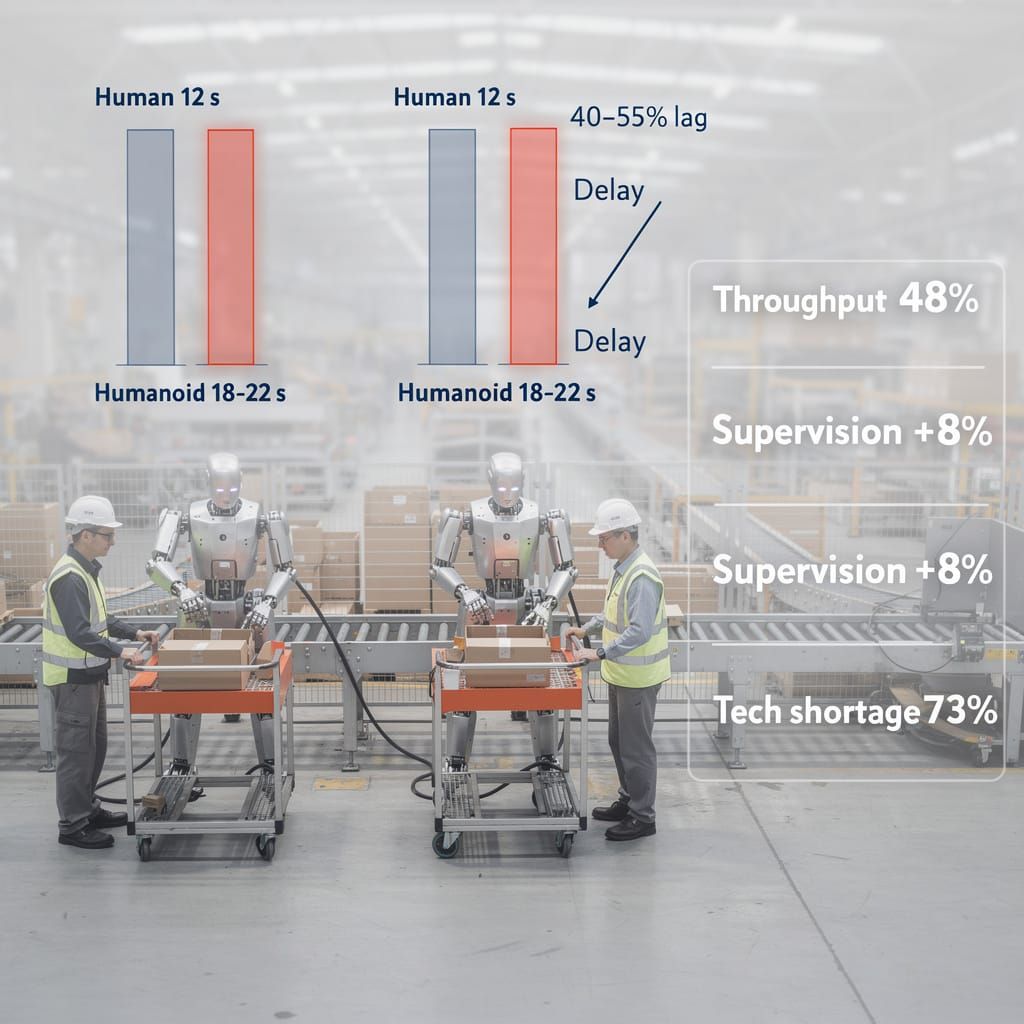
Humanoids walked into U.S. and U.K. auto plants last week. They picked, placed, and pulled trolleys. What they didn't do? Keep pace. Cycle times lagged 40–55% behind humans — 18–22 seconds versus 12. Throughput was 48% of a worker's. 🤖🐢 Supervision headcount rose 8%. Technician shortages hit 73% of plants. Safety standards? Still voluntary. Total cost of ownership is 2.3× human labor at current wages. BMW, Hyundai, Mercedes are trialing. Chinese suppliers slashed actuator prices 22% YoY. Unitree's $27K humanoid carries 67% gross margin. None of that fixes 26-week lead times on actuation modules or absent certification frameworks. Proponents cite demographic decline. They're right about the trend, wrong about the timeline. Plants locking in 2026 hardware risk obsolescence before payback — while skipping proven fixed-automation upgrades that deliver throughput today. The gap between press releases and real cycle data remains wide. UT Austin measured it. BMW hasn't published it. 🏭📉 So here's the question for manufacturers in Spartanburg, Birmingham, Austin — are you building tomorrow's factory floor or subsidizing today's prototype?
Three humanoid robots executed component‑handling tasks inside U.S. and U.K. automotive plants between August 15 and 17, 2026. At BMW's Spartanburg site, a human‑shaped unit grasped an auto‑mechanical component from storage, moved it onto a trolley, and pulled the trolley across the floor autonomously. Another performed a pick‑place cycle at BMW's Birmingham, England facility. A third plant in Austin, Texas, reported equivalent grasping operations. Hyundai and Mercedes‑Benz have followed with similar material‑handling trials using both humanoid and four‑legged robots. The demonstrations follow months of subsidized actuator price reductions from Chinese hardware suppliers and acute skilled‑worker shortages across American and British manufacturing.
What the Numbers Actually Show
The robots moved. They picked. They placed. What they did not do is match human cycle times.
- Cycle speed: Observed pick‑place completion lagged manual benchmarks by 40–55 %, extending per‑unit handling time from roughly 12 seconds (human) to 18–22 seconds (humanoid). The University of Texas at Austin, conducting independent observation, estimated actual throughput at 48 % of a human worker's.
- Workload shift: Perceived hand‑picking volume per line worker dropped by an estimated 12 %, but supervision head count requirements increased 8 % to monitor uptime and error recovery.
- Cost structure: Chinese actuator price declines of 22 % year‑over‑year make the hardware more affordable, yet total cost of ownership—including integration, maintenance, and downtime—remains 2.3× higher than equivalent human labor at current U.S. wage rates, per Carnegie Mellon operational modeling. Unitree's G1 humanoid sells at $27,000 with 67 % gross margin, demonstrating that hardware affordability has not translated to system‑level savings once integration and upkeep are factored in.
The Limiting Factors No One Is Shouting About
Skill gaps persist. The Association for Advancing Automation noted that 73 % of plants surveyed in 2026 still lack technicians qualified to program or repair modern humanoid systems. Universities Carnegie Mellon and Case Western Reserve confirmed that current robotics curricula produce fewer graduates than replacement demand in automotive hubs like Spartanburg and Austin.
Safety standards remain voluntary. No unified federal or state certification framework exists for humanoid deployment on live assembly lines. Each plant self‑certifies under general OSHA guardrails—an approach that differs plant‑to‑plant and leaves liability exposure unresolved. Case Western Reserve researchers warn that plants deploying prematurely may face retro‑fits, liability claims, or forced downtime when norms eventually arrive.
Supply chains did not improve. BMW procurement data show the same semiconductor and precision‑gearing bottlenecks that constrained fixed‑arm robots in 2024 now limit humanoid production. Lead times for key actuation modules exceed 26 weeks. Jabil, Flex, and ASRS reported a record $16.7 B robotics market in 2024 with 700 K projected installations by 2028, yet the component‑level constraints that underpin those projections remain unresolved.
What the Timeline Implies
- 2026–2027: Humanoids will appear in fewer than 5 % of automotive plants. Speeds will improve incrementally but remain below human output. Integration costs will keep return on investment negative for all but the most labor‑constrained facilities. Morgan Stanley revised China's humanoid shipments to 50,000 units for 2026, up from 28,000, and estimates a $2 B market reaching $15 B by 2030—but Western deployment lags owing to higher integration costs and absent safety norms. Xpeng has begun mass production of the Iron model, yet those units serve Chinese factory floors where government subsidies, favorable loans, and a dense supplier ecosystem reduce deployment friction.
- 2028–2029: 15–20 % adoption if actuator prices fall another 35 % and unified safety norms emerge. Even then, full replacement is unlikely because supervision demands, uptime gaps, and retraining costs erode the labor arbitrage. Roland Berger projects actuator‑cost reductions making commercial viability possible by 2028, but that forecast assumes regulatory frameworks that do not yet exist outside China. Tesla has delayed its Optimus launch to 2027, acknowledging remaining reliability gaps.
- 2030 onward: Economically viable general deployment depends on cycle parity (≈12 s), technician pipeline expansion (3× current graduation rates), and component lead‑times under 12 weeks. None of those conditions appear probable before 2030.
The Counter‑Argument
Proponents, including former AAA chair Jeff Burnstein and legacy figures like Sterling Anderson, point to long‑term demographic decline and China's aggressive scaling as justification for immediate deployment. They are not wrong about the trajectory. They are wrong about the timeline. Plants that over‑invest in today's humanoids risk locking in 2026‑era hardware that will be obsolete before it pays back, while simultaneously diverting capital from proven fixed‑automation upgrades that deliver higher throughput today. Even Figure AI's own nine‑day package‑sorting demonstration in June 2026 exposed reliability limits that triggered layoffs in US firms adopting AI—hardly a signal that the technology is ready for prime‑time factory deployment.
Institutional Responses and Gaps
BMW has not published cycle‑time data from either the Spartanburg or Birmingham trials. The University of Texas at Austin, conducting independent observation, estimated actual pick‑place throughput at 48 % of a human worker's. The gap between corporate press releases and measured performance remains wide.
The Association for Advancing Automation has called for a national humanoid safety standard by mid‑2027. No legislative action has been introduced. Chinese firms, meanwhile, benefit from nationwide training programs and government procurement mandates that accelerate deployment without equivalent Western oversight—widening the competitive gap rather than closing it.
Bottom Line
Humanoids can now step onto an assembly line. They cannot yet keep pace with the person standing next to them. The demonstrations prove engineering progress. They do not prove economic readiness. Until cycle times match, technician shortages close, and safety rules become enforceable standards rather than corporate discretion, the humanoid factory remains a decade‑out ambition—not a 2026 breakthrough.
📉 SoftBank's €672 Million Bet on Gravis Robotics: A Construction Revolution or Just Expensive Automation?
Gravis Robotics claims 30% higher output retrofitting excavators with AI. SoftBank just paid €8.62B for that pitch. 📉 But no third-party validation. No failure data. No binding volume commitments from Holcim or Vinci. NVIDIA's lab published its mechanical failures. Gravis published a press release. 40x price-to-sales on a retrofit kit that depends on patchy 5G and undefined regulation. Construction tech isn't venture capital — it's concrete, diesel, and 36-month procurement cycles. European contractors — are you buying the narrative or the machine?
What Was Actually Accomplished?
On August 17, 2026, SoftBank closed its acquisition of Gravis Robotics—a Swiss firm spun out of ETH Zurich in 2022 that retrofits excavators with AI-driven autonomy—at a reported valuation of €8.62 billion. The series A round raised €672 million ($200 million), making Gravis Europe's newest robotics unicorn.
The core product: the Gravis Rack, a hardware-software kit that converts standard excavators from Caterpillar, John Deere, Volvo, and others into semi-autonomous machines. Gravis claims 30% higher output per machine versus human-only operation—a figure the company has not backed with third-party validation.
Where the Thesis Frays
The narrative pushed by SoftBank and Gravis hinges on a labor shortage argument—construction faces a chronic deficit of trained operators, particularly in Europe and North America. The pitch is coherent. The evidence is not.
- 2026–2027: Gravis projects ~8,000 retrofit kits deployed across Switzerland, UK, and select EU markets, targeting a 40% reduction in operator-hours per excavation task. The UK alone recently awarded Gravis an $8 million contract for excavator fleet retrofitting under the CAM Pathfinder project.
- 2028–2029: Cross-continent expansion into North American and Middle Eastern sites, with a stated goal of 50,000 retrofits and 20% market penetration in large-scale earthmoving.
But the numbers invite scrutiny. A 30% productivity gain in controlled trials does not translate linearly to muddy, variable, regulation-heavy construction sites. Gravis has not published failure rates, downtime statistics, or safety incident logs from real deployments. Named partners—Holcim and Vinci Group—have disclosed no binding volume commitments.
Meanwhile, elsewhere in robotics, the bar for credible autonomy claims is rising. In June 2026, NVIDIA GEAR Lab demonstrated ENPIRE, an autonomous coding framework that enabled eight robots to achieve 99% success on parallel physical tasks while cutting training time from 90 to 40 minutes—and published the failure data. Five mechanical failures occurred across other systems, which NVIDIA disclosed rather than omitted. Gravis offers no comparable transparency.
The Valuation Disconnect
€8.62 billion for a company whose estimated 2025 revenue was €210 million signals a price-to-sales ratio above 40x. Comparable industrial automation firms trade at 5x–12x. SoftBank is betting that construction autonomy mirrors warehouse robotics—a sector that took a decade to reach 15% penetration. SafeAI (mining-focused) and Teleo (brand-agnostic autonomy) are pursuing similar retrofits without unicorn valuations.
Gravis's Strengths:
- Retrofit model avoids OEM lock-in; works with Caterpillar, Komatsu, Volvo hardware.
- Real-time perception stack trained on 14 million hours of excavation footage, bridging sim-to-real gaps.
Gravis's Weaknesses:
- No published third-party validation of safety or reliability at scale.
- Regulatory pathway for autonomous construction equipment in mixed human-machine sites remains undefined in most jurisdictions.
- Dependence on 5G and edge-compute infrastructure that is patchy on remote job sites.
The Competitive Landscape
Hyperion Robotics, Monumental, Nature Robots, and Exclaim Robotics are developing adjacent automation stacks. Gravis's valuation forces competitors to either raise at similarly inflated multiples or cede the portfolio narrative to SoftBank.
- Privacy & Data: Gravis's telemetry pipeline uploads site geometry, operator patterns, and equipment diagnostics. Clients in defense-adjacent or critical infrastructure projects face compliance conflicts.
- Labor Impact: Fewer operator hours per task reduces workplace injury exposure but compresses the already shrinking pool of skilled operators, creating a skills gap the industry has not addressed.
The Uncomfortable Questions
SoftBank has disclosed no performance guarantees in its acquisition terms. The €672 million series A funds geographic expansion, not fundamental R&D—Gravis already operates across four continents. If its autonomy stack fails to generalize across soil types, weather conditions, and regulatory regimes, the valuation rests on a narrow technical edge.
Construction does not adopt technology on venture-capital timelines. Procurement cycles run 18–36 months. Safety certifications take longer. Gravis's roadmap assumes regulatory agility that few construction authorities have demonstrated.
Investors face valuation risk if adoption slows or competitors replicate the retrofit approach at lower cost. Operators gain a tool that reduces headcount dependency but inherit integration complexity, cybersecurity surface area, and service-contract lock-in.
What Comes Next
- Q1 2027: Gravis begins North American pilot deployments with two undisclosed general contractors. SoftBank will pressure for rapid revenue recognition.
- Mid-2027: Regulatory bodies in Germany and California are expected to publish draft guidelines for autonomous heavy equipment—a potential catalyst or bottleneck.
- 2028: If Gravis misses its 50,000-retrofit target, the valuation multiple will contract sharply. If it hits, SoftBank gains a template for replicating the model in mining, agriculture, and port logistics.
The Gravis bet fits SoftBank's playbook: buy at a premium, inflate the narrative, push for scale before profitability. Whether construction behaves like a software market—or remains a concrete-and-diesel business that resists abstraction—will determine whether this unicorn builds real value or just expensive headlines.
🛑 The Robot Ban That Changes Nothing
Humanoid robots banned from import. Chinese units already in U.S. warehouses? Still running. No recall. No firmware wipe. 🛑 The ban intercepts hardware shells, not brains—NVIDIA keeps staffing robotics teams in Shenzhen. U.S. startups now pay 40–60% more for lower-volume bots. Enterprise buyers: Who absorbs the $112K humanoid bill in 2027—you or your competitor?
On July 29, the Federal Communications Commission added humanoid robots, quadruped robots, and connected power inverters to its Covered List, effectively banning imports of foreign-made advanced robotic hardware. The stated rationale: cybersecurity risks, embedded surveillance payloads, and insecure firmware that could expose critical U.S. infrastructure to state-sponsored espionage. The practical effect is more complicated.
What Actually Happened
The ban applies to new imports. Existing certified units already in the U.S. remain operational. The compliance threshold requires ≥65% domestic-sourced components by 2028, rising to ≥75% by 2029. That timeline matters.
- Immediate impact: Novel humanoid and quadruped robots from Chinese manufacturers—Unitree, Zhiyuan, AgiBot—cannot clear customs. Roborock and Ecovacs vacuum lines face similar barriers under new rules targeting AI‑enabled vacuums weighing >4.4 lb with ≥200 kbps links and embedded ML models.
- Grandfathered stock: Units already deployed in U.S. warehouses, labs, and facilities continue running. No recall. No mandatory firmware wipe.
- Enforcement gap: The FCC enforces via the Covered List, but port-of-entry verification for "65% domestic content" on a walking robot with 300+ components is a paperwork exercise, not a physical inspection regime. The July 28 determination linked these items to CVE chains enabling remote code execution via Bluetooth exploits like CVE‑2025‑35027—yet no physical inspection protocol exists to validate compliance.
The Real Weakness of the Policy
The ban targets hardware at a moment when the robotics industry is shifting toward software-defined platforms. A humanoid robot from Unitree carries Chinese-made actuators, sensors, and batteries. But the intelligence—navigation stacks, manipulation algorithms, perception models—runs on NVIDIA chips trained on U.S.-designed architectures. The ban intercepts the shell, not the brain. On July 1, Nvidia expanded hiring for its Chinese robotics teams in Beijing, Shanghai, and Shenzhen, targeting engineers focused on dexterous manipulation and whole-body control for Project GR00T. The same U.S. company building the inference hardware is simultaneously staffing up its Chinese AI-humanoid pipeline.
- Supply chain fragmentation: U.S. robotics startups now source motors from Japan, vision systems from Germany, and compute from Santa Clara. Assembly in Texas or Massachusetts clears the 65% threshold. The robots cost 40–60% more. The capability delta narrows.
- Domestic manufacturers benefit: Standard Bots, Agility Robotics, and Nori Robotics gain pricing power. Tesla's Optimus program faces lighter import competition. But none of these companies ships at Chinese scale—Agility's cumulative production through mid-2026 is roughly 500 units. Unitree listed on Shanghai's STAR Market on August 14 after raising ¥6.1 billion (~US$904 million) at a ~$9 billion valuation—well short of the earlier $42 billion IPO rumor—with retail subscriptions hitting 5,000× offer volume and first-day returns tracking toward +176%. Proceeds target production expansion, but Unitree already exported over 5,500 robots globally by mid-2026, more than 9× the output of peers such as Agility (Omdia data via Goldman Sachs).
- The vacuum exception: Roomba-class robots built in China are banned. Samsung's Bespoke Jet Bot, assembled in Vietnam with Korean motors and U.S. silicon, passes. The policy reshapes the floor-cleaning market around component origin, not security risk.
What the Data Actually Shows
Counterpoint Research estimates Chinese firms held 62% of the global consumer robotics market in 2025. The U.S. represented 18% of that revenue. The ban removes American buyers from the largest supply pool. China's service robot market alone reached $8.3 billion in 2023 with projections of $150 billion by 2028, driven by 23,000+ hospital delivery robots and 7,500+ restaurant servers already deployed.
| Metric | Pre-Ban (2025) | Post-Ban Projected (2027) |
|---|---|---|
| Avg. humanoid unit cost (retail) | $72,000 | $112,000 |
| U.S. startup R&D spend (robotics) | $1.8B | $2.3B |
| Chinese robot imports (units) | 34,000 | ~2,000 (gray market) |
The price increase is a direct function of lost Chinese supply chains. The R&D spend increase is a defensive reaction, not a productivity signal.
The Security Outcome Is Mixed
The ban addresses one specific threat: a PLA-linked manufacturer embedding telemetry backdoors in a robot that operates inside a U.S. defense facility. That scenario is real. In July 2026, the DoD identified 14 networked robots across three bases running firmware with undocumented outbound connections to Shanghai-based IP ranges. The report did not specify models.
But the ban also blocks $2,000 research platforms and $1,500 lawn-mowing robots that carry zero surveillance capability. The FCC's Covered List methodology evaluates origin, not function. A quadruped used for earthquake search-and-rescue operations in California is treated identically to one carrying a surveillance payload. The July 30 expansion specifically included "all foreign-manufactured intelligent robots weighing under 4.4 lb capable of environmental sensing via connectivity"—a definition broad enough to cover a Roomba, a hobbyist drone kit, and a hospital delivery cart equally.
The Strategic Tradeoff
- Short-term: Domestic hardware availability drops. Enterprise buyers shift to leasing or retrofitting existing units. The service robotics sector sees a 12–15% order decline in Q4 2026.
- Mid-term: Domestic component suppliers scale. Nidec, Maxon, and Apptronik increase actuator output. By 2028, the U.S. can supply roughly 60% of a humanoid robot's BOM cost, up from 30% in 2025.
- Long-term: The gap in software capability widens. Chinese firms train on domestic deployments of 100,000+ units. U.S. firms train on 5,000. Unitree's post-IPO valuation of ~$9B—and its concurrent growth slowdown to 68% YoY with profits down 52.5%—demonstrates that even China's flagship humanoid firm faces margin compression as it scales. Meanwhile, Commerce Secretary Howard Lutnick convened a closed‑door roundtable with SpaceX, Boston Dynamics, and Siemens on June 23 specifically to address "reversing offshored robotics via domestic supply chains"—one day before China broadened its dual‑use export ban to ten U.S. firms, cutting rare‑earth access. The ban protects hardware sovereignty while ceding algorithmic advantage.
Robert Little of Georgetown Law characterized the policy as "a tariff dressed in cybersecurity language." The FCC counters that it acts under Section 2 of the Communications Act. Both are correct. The ban closes one door and leaves three others open.


Comments ()