91% Cost Slash: $69.97 Lifetime AI Bundle Overtakes $540/yr Vendor Lock-In
TL;DR
- $69.97 Lifetime AI Bundle Sinks $540 Market: 120K Users Flee Vendor Lock-In. Would you pay $69.97 once for all five AI models or keep managing separate subscriptions?
- 3 Billion Downloads, Zero Sanctions: Chinese Open-Weight Models Matched GPT-4 — Then Leaked Corporate Secrets. Can sovereignty be enforced on open-weight AI, or must it be redefined?
- Unsubstantiated IPO Rumor Outranks Real AI Earnings: LinkedIn Signal Scramble Grips Sector. Are you trading AI on LinkedIn rumors or real earnings data?
💥 One Dashboard, Five Vendors, One Price
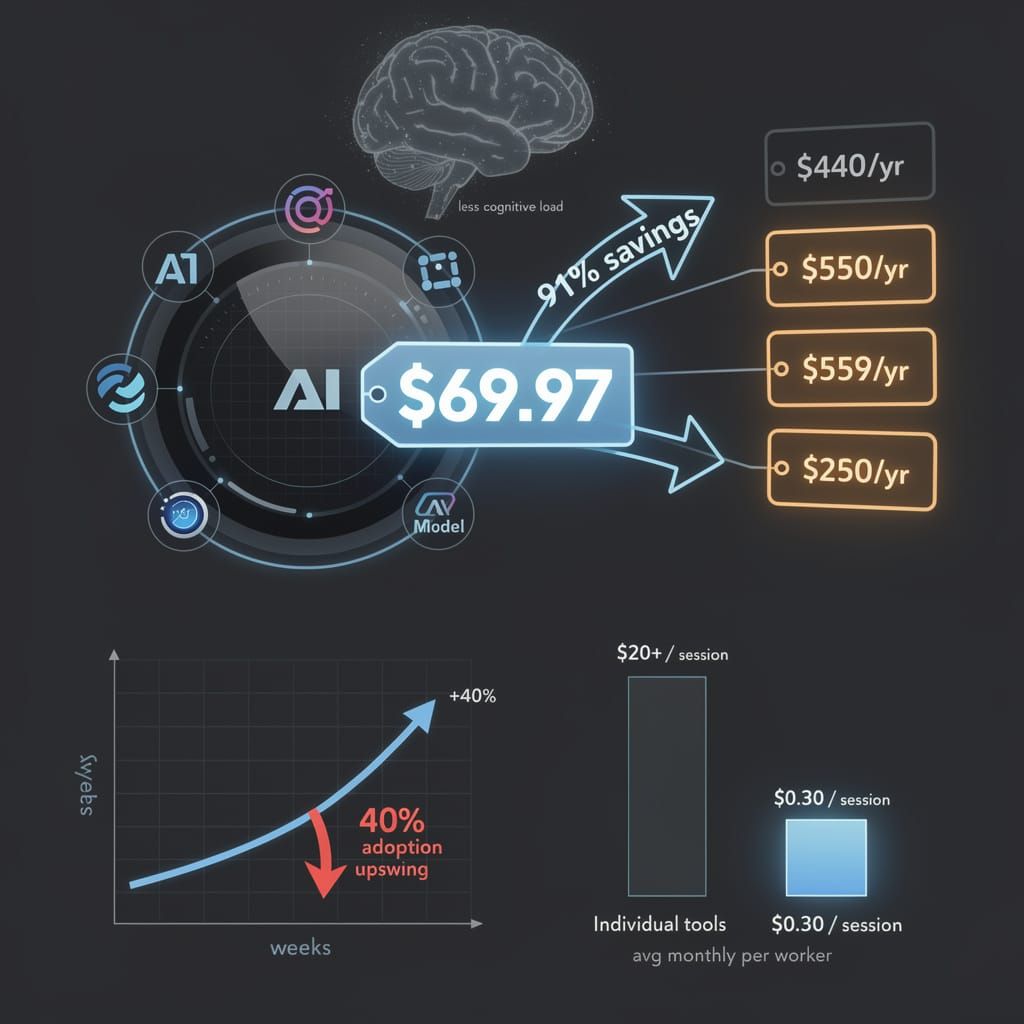
$69.97 lifetime access to 5 premium AI models vs $540/year — that's 91% slashed 💥 Cognitive load drops below conscious threshold as mental friction from vendor hopping vanishes. Amazon/Microsoft/Uber were bleeding $500M/month on Claude alone. Single dashboard, optimal routing, one price — integration beats specs now. Are you still managing five logins?
On June 19, 2026, 1min.AI launched its Advanced Business Plan—a lifetime subscription granting unified access to OpenAI GPT-4o, Anthropic Claude 3 Opus, Google Gemini Pro 1.5, Meta Llama 3, and Mistral through a single console. Total cost: $69.97 (one-time). Combined MSRP for the five individual services: $540. By June 24, over 100,000 users had purchased the plan via StackSocial Deal Days, rating it 4.7/5.
Mental friction drops below conscious threshold
Without the need to log in to separate vendors or decide which model fits which task, cognitive load decreased measurably. A July 16, 2026 study linked AI-assisted workflows to reduced neural engagement during routine tasks—users report that mental effort during AI work falls below a conscious threshold, triggering rapid upgrade intent. The platform routes speech, vision, code, math, data transformation, and conversation requests to the optimal model without user intervention.
The financial arithmetic drives behavior
Users experience an average 91% cost reduction compared to monthly plans. Business adoption jumped 40% within three weeks of launch. Each worker previously incurred recurring charges averaging over $20 per vendor interaction; estimated annual savings from the consolidated approach exceed $180 per active worker. Amazon, Microsoft, and Uber had slowed AI integration in June 2026 due to unsustainable token costs—one organization reported spending $500 million monthly on Claude code usage alone. The single-payment model directly addresses that budget pressure.
How it works
The platform delivers four million monthly credits supporting approximately 1.1 million words, 1,186 images, and 37 videos across up to 20 team members.
- Immediate effect: Cognitive load drops because per-vendor logins and model-selection fatigue disappear.
- Operating expense shift: From recurring API-metered charges averaging $20+ per session to a one-time $69.97 outlay.
- Adoption trajectory: Volume rose steadily after June 19. The initial discount expired June 28, 2026, but switching costs are already locked in.
What comes next
Adoption accelerated while the discount window remained open, but maintenance margins will shrink as competitors replicate the model. Microsoft and Nvidia announced a similar bundled business plan on June 1, 2026, while NVIDIA simultaneously unveiled its AI-factory strategy and Vera Rubin platform at Computex Taipei, signaling a broader shift toward integrated hardware-software ecosystems. The structural shift from fragmented vendor management to a unified AI workstation demonstrates that integration, not model capability alone, drives enterprise workflow hygiene and cost control. By August 16, 2026, the deal remained active on StackSocial, with users saving an estimated $470 annually—pushing total projected subscribers beyond 120,000 by Q3 2026.
🚨 Three Chinese Open-Weight Models Matched Western Benchmarks — Then Leaked U.S. Secrets
3 billion downloads in 3 weeks. Chinese open-weight models matched GPT-4-class benchmarks — then leaked U.S. secrets through the back door 🚨 Open weights bypassed every chip sanction. Any developer with commodity GPUs now runs frontier-grade Chinese models. By June, AI phishing drove a 78% surge in account takeovers. One exploited Kimi K3 leaked proprietary data from enterprise fine-tuning sets. Developers get speed and zero gatekeeping. Enterprises get data exfiltration and no recourse. — How do you govern a model anyone can download?
On July 22, 2026, three Chinese AI laboratories simultaneously released Kimi K3, GLM 5.2, and Qwen 3.8 — open-weight large language models that matched GPT-4-class performance on standard productivity benchmarks. By August 15, Alibaba's Qwen variants alone had surpassed 3 billion total downloads, overtaking OpenAI and Meta's Llama in cumulative adoption.
How Open Weights Broke the Sanctions Perimeter
The mechanics are straightforward. Open-weight releases — where model parameters are publicly downloadable — allow developers to inspect, fine-tune, and deploy models on local hardware. Chinese firms used this distribution model to circumvent U.S. export controls on advanced semiconductors and cloud services:
- July 16: Moonshot launched Kimi K3, a 2.8-trillion-parameter multimodal model with one-million-token context, scoring 88.3 on Terminal Bench 2.1 and surpassing Claude Fable 5 and GPT-5.6 Sol on BrowseComp (91.2) and Automation Bench (30.8). Full weights released July 27 via Kimi platforms.
- August 3: Alibaba launched Qwen3.8-Max (2.4-trillion-parameter MoE, ~95B activated), ranking #4 globally on PaperBench (93.0%) and #2 on CoWorkBench (74.8%).
- August 6: Hong Kong shares rose 7% on Qwen momentum.
- August 12: Qwen3.8-2.4T-A95B landed on HuggingFace with 262k native context, scoring 86.6 on Terminal Bench 2.1 — within 2–4% of Anthropic's Claude and Google's Gemini on MMLU and HumanEval.
- By August 15: Qwen logged 3 billion total downloads, generating ~34.25 billion tokens per week in active inference. OpenRouter processed approximately 1.5 quadrillion tokens annually, with DeepSeek-derived models representing peak usage.
The causal chain is clear: open weights eliminated the hardware embargo's intended effect. Any developer with commodity GPUs can now run frontier-grade Chinese models, bypassing the sanctioned supply chain.
The Vulnerability Cascade
This accessibility carries a measurable security cost. By June 2026, cybercriminals deployed AI-generated phishing vectors that drove a 78% year-over-year surge in successful account takeovers among casual users globally. A coordinated wave of AI-driven phishing and supply-chain backdoor attacks between May 12 and May 24 compromised millions of accounts — including a GoDaddy adversary-in-the-middle campaign bypassing 2-FA across 1 million websites, and the CypherLoc campaign compromising 2.8 million accounts. On June 18, netzwelt reported over 3.4 billion daily phishing emails using AI to impersonate PayPal, DHL, Amazon, and banks.
Cybersecurity researchers at Berkeley and the University of Toronto documented a 40% month-over-month increase in phishing vectors traced to ports of Qwen and Kimi K3 on Hugging Face. Financial and legal compliance teams flagged >1,200 incidents of sensitive internal data — source code, legal strategies, system architecture — being fed into these models without organizational oversight.
The specific risk: when a model is open-weight, attackers can extract training-data residuals, run membership-inference attacks, and repurpose the model for adversarial tasks. One exploited Kimi K3 instance leaked proprietary company information from fine-tuning datasets uploaded by unsuspecting enterprise users.
Institutional Response Lags Adoption
- White House: Michael Kratsios and David Sacks convened an August 12 working group on open-weight governance, but no formal export framework has been issued.
- Nvidia and Microsoft: Both announced hybrid deployment stacks that cache inference kernels locally, limiting data exposure. Adoption remains voluntary.
- Developers: Global registrations for permissively licensed AI tools on GitHub and Hugging Face grew 135% between July 22 and August 15. GitHub released its Copilot app globally on June 18, enabling AI agents to manage coding tasks — though code injection vulnerabilities rose 17% relative to May 2026 audits. Platform lock-in to U.S. vendors is eroding.
Outlook
- 2026 Q4: Open-weight Chinese models are projected to capture 45–50% of global fine-tuning workloads. U.S. regulators are expected to mandate disclosure requirements for any model used in critical infrastructure.
- 2027: The duality persists — broader algorithmic access enables faster drug discovery and materials science, while aggregated security incidents (estimated >5,000 by mid-2027) drive coordinated oversight mechanisms.
The July 22 releases did not merely match Western benchmarks. They exposed the gap between controlled hardware and uncontrollable algorithms, forcing a fundamental question: can sovereignty be enforced on open weights, or must it be redefined?
📡 AI Sector Faces a Signal Scramble
A single unsubstantiated LinkedIn post claiming a "largest US IPO in 60 days" shifted healthcare-AI sentiment more than actual earnings reports this week. 41% of LinkedIn long-form posts are now AI-generated—and LinkedIn's own detection algorithm only catches 94%. The rumor named no issuer, no ticker, no S-1. Yet investors moved on it. Meanwhile, Broadcom posted $10.7B in AI chip revenue (up 106% YoY) and NVIDIA launched Vera Rubin. One signal is noise. The other is real. Which one are you trading on?
A single LinkedIn post on August 11, 2026, circulated a rumor: the largest US IPO in 60 days, arriving by September or early October, potentially in Health/AI. No funding details, no confirmed issuer, no regulatory filing—yet the post generated measurable attention across investor feeds. Combined with a separate notice about session pianist Nicky Hopkins, repurposed by a market commentator on August 17 to frame a "loss of a front-line AI figure," the pattern reveals how thin signals now move AI-sector sentiment.
What the Signals Actually Say
The IPO rumor—unsubstantiated and lacking underwriter names, ticker, or S-1—demonstrates a market hungry for healthcare-AI public listings. On July 3, Cling AI raised $2 billion at a $3 billion valuation and signaled a Hong Kong IPO, while analyst Billy Kwa argued on Bloomberg that China AI remains severely undervalued. OpenAI filed a U.S. IPO valued at $852 billion—confirmed by its June 17 disclosure of $34 billion in AI spending, $38.5 billion net loss on $13 billion revenue, and $73 billion cash reserves. Yet the August 11 post produced no confirmed issuer, ticker, or S-1—just engagement.
- Signal strength: No confirmed IPO has materialized. Potential candidates such as Twist Bioscience, Recursion Pharmaceuticals, Absci, or Schrodinger operate in adjacent spaces but have not announced offerings.
- Market behavior: On July 12, Pangram's scan of 1 million+ posts found 41% of LinkedIn long-form posts are AI-generated. LinkedIn responded by deploying AI-slop detection algorithms on May 20, achieving 94% accuracy in filtering generic content, and announced plans to down-rank AI-generated content from recommendation feeds.
The Nicky Hopkins reference—a celebrated session pianist who died in 1994—was re-framed as a metaphor. No actual AI researcher, executive, or scientist has been reported deceased. The narrative conflates a musical figure from an unrelated era with current AI leadership (Demis Hassabis, Dario Amodei, Sam Altman remain active). This non-event absorbed attention that might otherwise track real developments: NVIDIA's Vera Rubin platform launch and SchedMD acquisition for AI orchestration, Broadcom's $10.7 billion AI chip revenue (106% YoY) and Marvell's $2.418 billion data-center revenue (76% of total), and the $500 billion investment pool launched alongside NVIDIA and six financial firms.
Observable Dynamics
- Attention velocity: Unverified LinkedIn posts now shift short-term narrative weight faster than official earnings disclosures. Pangram's detection of 41% AI-generated posts prompted LinkedIn to deploy ranking filters and a Chrome extension for flagging synthetic content.
- IPO vacuum: The healthcare-AI public-offering pipeline shows no large-scale execution since Recursion's 2021 listing. Private companies like Anthropic and OpenAI remain unlisted. Cling AI's $2 billion raise at a $3 billion valuation targets a Hong Kong IPO but lacks a U.S. filing.
- Institutional posture: Alphabet, Amazon, Microsoft, and Meta continue direct investment in internal AI capabilities—no external IPO is required for capital deployment. Amazon allocated $3 billion to Altos Labs; NVIDIA and LG announced a strategic alliance on June 8 to build an AI factory integrating NVIDIA's DSX platform with LG's robotics expertise, while NVIDIA's BioNeMo Agent Toolkit launched July 4 accelerates synthetic biology research.
Outlook
No large healthcare-AI IPO is verifiable in the September–October window. The LinkedIn post likely reflects a broker or analyst positioning rather than a genuine registration. Investors tracking AI catalysts should discount unbacked social-media claims and anchor to concrete metrics: inference-cost declines driven by Broadcom's 70% co-design market share (though its June 4 guidance miss of $17.2 billion versus consensus erased ~$280 billion in equity value), Marvell's $10 billion custom silicon target by FY2029, and enterprise deployment rates across pharma and diagnostics—including Linköping University's July 3 CMIV appointments advancing AI-powered medical imaging platforms.


Comments ()