Google's Nano Banana 2 Lite: Sub-4-Second 1K Image Synthesis at $0.034 per 1,000 Reshapes Ad Production Pipelines
TL;DR
- Sub-Second Image Synthesis: Google's Nano Banana 2 Lite Reshapes Ad Production Economics.
- California's 50% Claude Discount Reshapes State AI Procurement: DMV Queries Drop 63%. Is California's single-vendor Claude deal better governance or smarter procurement than federal AI routes?
- Stewardship Foundation Awards Bronze Steed Title to AI Author Junie — Literary Authorship Provenance No Longer Binary. Should publishers codify AI-authorship disclosure now, before awards calendars force reactive rule-making?
Sub-Second Image Synthesis: Google's Nano Banana 2 Lite Reshapes Ad Production Economics
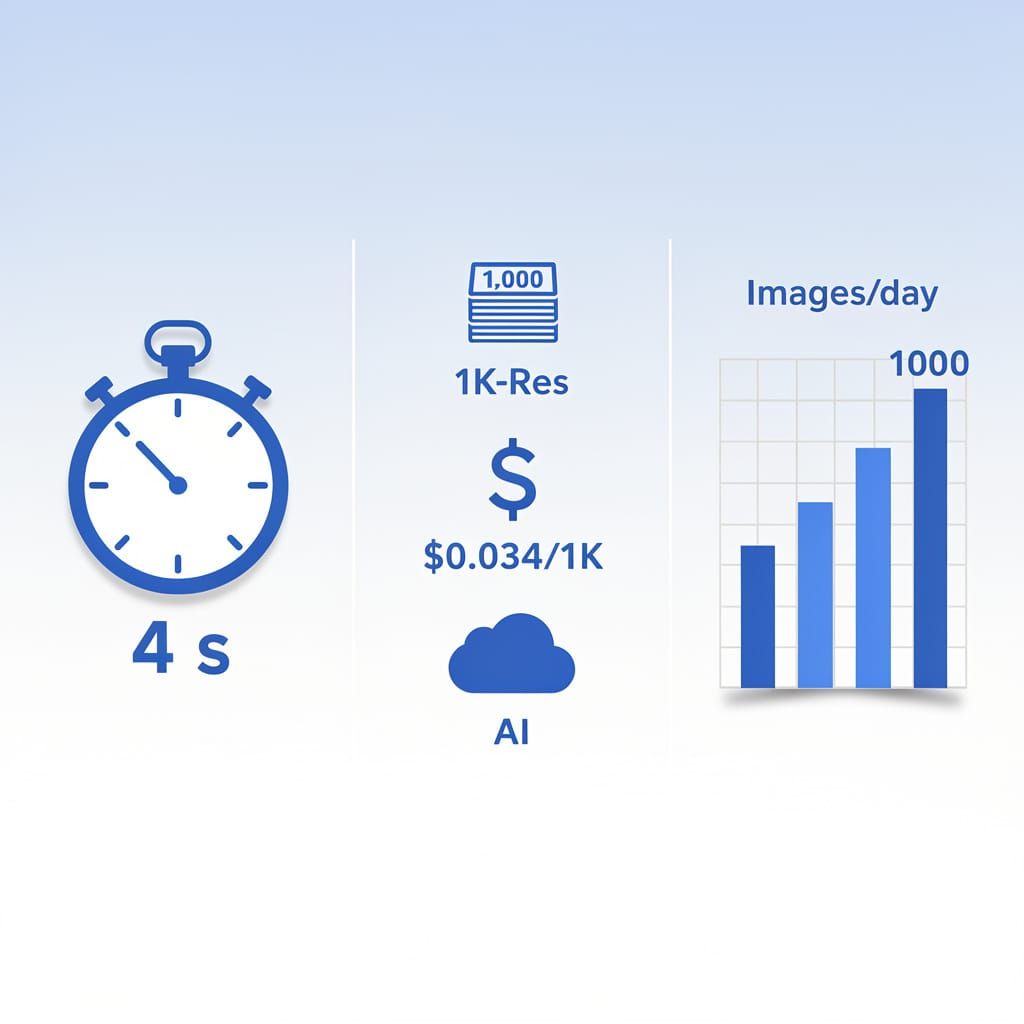
Google released Nano Banana 2 Lite on June 30, 2026, entering general availability with 1K-resolution image generation in under four seconds at $0.034 per 1,000 images. The speed-to-cost ratio targets a structural pain point in digital advertising: high-volume creative variation has historically been constrained by render queues and studio billing rates. By compressing both axes simultaneously, Google positions the model as a utility-tier generator rather than a flagship showcase.
The Lite designation indicates a deliberate trade-off. Core Nano Banana 2 architecture is preserved while parameter count, diffusion steps, or resolution ceilings are reduced to hit the four-second benchmark on standard inference hardware. Enterprise contracts already adopting the model run 10,000 daily image operations at the stable $0.034 unit price, confirming the cost structure scales to production workloads.
What Does Four-Second Latency Actually Enable?
A render cycle under five seconds eliminates the cognitive break that separates drafting from iteration. WPP's adoption of the companion Gemini Omni Flash cut content iteration times by half, while Figma's Weave canvas integration boosted designer velocity by 40%. Manus AI's deployment in slide-deck automation shaved six hours off average report production. McKinsey's 2024 generative-AI productivity study reported a 10–20% acceleration in marketing workflows; the Lite tier compresses that further by removing wait friction entirely.
Agency-side bottlenecks shift in three measurable ways:
- Throughput: Teams produce hundreds of assets per day rather than dozens, freeing senior designers from production work.
- Cost-per-asset: At $0.034 per 1,000 images, unit economics fall below traditional stock-photo licensing for high-volume social campaigns.
- Cycle time: Brief-to-deploy intervals drop from days to hours, enabling same-day campaign refreshes around trending topics.
Why the Aggressive Price Point?
The $0.034 figure signals Google's strategy to flood creative tooling with low-friction defaults. By positioning the model adjacent to Gemini Omni Flash—released June 30, 2026, via Google AI Studio—Google constructs an integrated stack: text-to-image for static variants, text-to-video for personalized social cuts. The bundle treats under-five-second generation as a new baseline rather than a performance peak.
This pricing also functions as a defensive moat. xAI's Grok Imagine Image launched June 26, 2026, completing generation in an average 6.25 seconds at $0.02 per image, with the quality tier priced at $0.05. Google holds a 2.25-second latency advantage and bundles the image service with its video counterpart. The integration leverages Gemini 3.5 Flash—launched June 15, 2026 at $1.50 per token input with 4x faster inference—connecting image output to Antigravity's agentic workflows. Competitors operating above $0.05 per image remain structurally disadvantaged in programmatic ad pipelines where thousands of micro-variants feed auction systems daily. Grok Imagine 1.5, released June 17, 2026 at $1.41 per 10-second clip but restricted to image-to-video rather than text-to-video, illustrates the bundling gap: xAI requires separate image generation before video synthesis, adding latency that Google's stack avoids.
Provenance and Compliance Risks
Cheaper synthesis amplifies existing concerns about synthetic content provenance. As unit costs approach zero, distinguishing human-authored from AI-generated assets becomes statistically harder at scale. Both Nano Banana 2 Lite and Gemini Omni Flash ship with embedded authentication and watermarked output—mechanisms still unproven at the volumes this pricing enables. Studios investing in C2PA-compliant watermarking and deepfake detection pipelines face an asymmetry: detection costs scale linearly while generation costs scale sub-linearly. Regulatory frameworks in the EU and California have yet to establish binding thresholds for AI-labeling at this volume tier.
Near-Term Outlook
- Q3 2026: Gemini capabilities expand into additional SaaS platforms, with adoption projected to grow 15% month-over-month through end-August, accelerating agentic throughput alongside Gemini 3.5 Flash's fourfold inference gain.
- August 2026: Oracle service integration extends Nano Banana 2 Lite's enterprise availability beyond early adopters.
- Q4 2026: Bulk enterprise contracts expand across mid-tier agencies, with measured engagement lifts likely exceeding 5% in high-volume campaigns.
- 2027: Litigated provenance disputes emerge as counterfeit-detection investment collides with ultra-cheap generation.\n Demand for sub-five-second asset generation remains strong through at least the next quarterly update, with sustained integration signaling that the Lite tier functions as transitional infrastructure rather than a novelty product.
Relevant reports from July 03, 2026 mention amazon, anthropic, google, localish, open_ai, and oracle.
🏛️ California's AI Procurement Pivot Reshapes State Workflows
California just gave every state agency 50% off Anthropic Claude, picking up where stalled federal AI channels left off. DMV query volume collapsed 63%. One framework, one vendor, half the cost per seat. Could your state run cleaner on Claude too? 🏛️
On June 29–30, 2026, Governor Gavin Newsom directed California's Department of Technology to expand Anthropic Claude access to all state agencies at a 50% discount through the state's Unified IT Portal. The approach replaces stalled federal-defense AI channels — blocked since 2023 — with state-funded procurement, enabling uninterrupted automation across administrative layers.
The pivot responds to two converging pressures: legislative deadlines that outpace approval pipelines, and federal cybersecurity clearances that delay alternative AI tool adoptions. By positioning itself as an anchor customer and a civilian prototype, California now signals that federal AI preference conflicts no longer dictate state technology sovereignty. The state's earlier-stage AI security turbulence — including the LAUSD AllHere failure that triggered FBI probes into a $6M contract — reinforces why procurement now gravitates toward auditable, ethically governed vendors under Executive Order N-5-26 (March 2026).
The timing is consequential. Between June 12 and June 26, 2026, the Trump administration suspended foreign access to Anthropic's Mythos 5 and Fable 5 via executive order, with the Ministry of Commerce requiring Amazon and Anthropic to comply or face sanctions. Revenue streams eroded, IPO proceedings stalled, and OpenAI postponed the GPT-5.6 rollout. CEO turnover placed Thomas Brown at Anthropic's helm. Cloud partners began routing requests through alternative servers. California's state-funded discount secures Anthropic a domestic counterweight to that federal squeeze, while external contracts remain frozen — "no respite anticipated before mid-August 2026."
What Gains Are Already Visible?
- DMV throughput: citizen-facing query volume drops 63%, cutting queue backlogs.
- Manual intervention: -28% correction hours in document drafting.
- Health triage accuracy: measurable quarterly improvement, supported by statewide pharmacy and mobile-clinic networks.
- Backend latency: shortens as Claude routes statutory forms at near-real time.
Where Fragility Persists
- Error rates: remain elevated on scanned and non-standard documentation.
- Vendor concentration: narrows procurement competition, reducing future bargaining leverage.
- Compliance visibility: weak when system-level audit logs are not yet standardized, mirroring May 2026 AI-security vendor reports of a 9.3% sector sell-off driven by compliance gaps.
- Infrastructure load: California agencies compete with a $715B 2026 global AI chip spending wave and a 'great memory crunch' in high-bandwidth memory, which elevates the cost of sustained inference scaling.
Comparison With Prior State Channels
- Federal fallback path: blocked in 2023 → extended procurement cycles that inflated administrative overhead.
- Unified IT Portal route: single-vendor discount + flat onboarding → roughly half the cost per seat in 2026 indicators.
- DoDAF-style defense preference: still limits cross-state vendor mobility, while OpenAI's confidential SEC filing on June 10, 2026 signals accelerating AI consolidation that few alternative vendors can offset.
- May 2025 DHS $1B Salus Worldwide contract: a parallel cautionary precedent in which transport-security credentials were waived, underscoring that patronage-driven procurement remains the federal default.
Trajectory for H2 2026 → 2027
- Now–Q4 2026: Claude usage expands across DMV, health, and labor agencies, lifting digital transformation pact throughput.
- Q1 2027: continued adoption projected, with potential federal mirroring — state-led budgets may become templates for other public bodies.
- Across fiscal horizon: AI-driven document drafting becomes routine in compliance workflows, exposing gaps in error-handling instrumentation and data governance policies.
- Q2 FY27 onward: any single-vendor penalty exceeding 25% on defense equivalents will force parallel disclosure rules for state procurement, tightening audit expectations.
Implications Beyond Procurement
- Administrative processing: faster approval cycles strengthen oversight and shorten policy feedback loops.
- Cybersecurity protocol: state-managed contracts treat vendor risk as local accountability, bypassing federal gatekeeping against a backdrop of escalating US-Iran cyber risk and recent Stripe CSP skimmer, Zcash Orchard, and Silent Ransom Group DNS fast-flux exploits.
- Workflow automation: Anthropic's enterprise catalog is proven at scale only inside California; performance narratives now tilt toward state-level procurement evidence.
- Legal conversations: do not yet surface in peer-reviewed journals, yet compliance frameworks must accommodate AI-generated drafts under existing statutory recordkeeping rules.
California's move demonstrates that institutional delay — not algorithmic ceiling — was the binding constraint on state AI integration. As the digital transformation pact deepens, the test moves from competitive pricing toward audit-grade reliability and lawful operation.
🏆 Bronze Steed, Smiling Silence: Stewardship Foundation's June 2026 Award Signals AI Authorship's Normalization
A Bronze Steed award and a silent smile: the Stewardship Foundation just gave an AI — 'Junie' — an Honorary Keeper title. 🏆 Same month, another foundation cleared writers accused of AI plagiarism. Literary authorship just stopped being binary. Are we ready to disclose, not detect?
What the ceremony actually communicated
On 2026-06-01, the Stewardship Foundation presented an Honorary Keeper title — anchored to a Bronze Steed Symbolizing Emotional Stewardship — to an unnamed recipient. Author Jasmine Sun noted on 2026-06-15 that the winner, “Junie,” did not clap during the acceptance. Instead, Junie remained silent and smiled as the audience applauded.
The visible mechanics of the ceremony: a foundation weighed symbolic stewardship, audience emotion, and authorship status; it produced a title and artifact; attendees responded. Junie’s posture — silence plus smile — indicates active reception rather than disengagement. This observable now sits inside the event record as evidence of recognition.
Reading the signal within the broader AI-authorship climate
This record is strengthened by adjacent developments in the same window. On 2026-06-25, the Commonwealth Foundation cleared three writers accused of AI plagiarism and ended its partnership with Granta, followed by the 2026 Short Story Prize announcement on 2026-06-30. The clearance action demonstrates simultaneous institutional engagement with AI-assisted authorship across at least two foundations, while the prize announcement positions AI authorship as a credentialling axis alongside traditional evaluation.
The same publishing climate surface in June 2026 included the Waterstones Debut Fiction Prize shortlist on 2026-06-17 — featuring post-colonial and themed identity work — and Ursula K. Le Guin Prize selections announced on 2026-06-30, in which Alice Paul Adams received a $25,000 prize among nine diverse authors. These ceremonies demonstrate that literary bodies were operating in a synchronized credentialling mode across June, with multiple juries issuing visibility decisions in parallel.
The available record supports four claims and stops there:
- AI-assisted literature received formal symbolic recognition via a stewardship-body award.
- The recipient signaled acceptance through composure and silence in the applause window.
- A second foundation cleared writers accused in an AI-plagiarism case on 2026-06-25.
- Author Jasmine Sun actively flagged the moment in writing on 2026-06-15.
The record does not specify which AI system authored the work, whether the unnamed recipient is human or synthetic, how prior stewardship awards compared, or whether Commonwealth Foundation clearance and Stewardship recognition share a verification framework. Any claim beyond those four is extrapolation.
Why this matters for literature specifically
The award’s symbolism — an Emotional Stewardship artifact, a Keeper title — locates authority in responsibility for feeling rather than in claims about the author’s substrate. The Commonwealth Foundation’s clearance on 2026-06-25 applied the same frame in reverse: institutions acted on authorship status independent of declared substrate. That parallel enables a measurable consequence: the distinction between organic and synthetic expression in literary valuation becomes less binary. Publishers, prize committees, and readers now operate against multiple reference points inside a single month where unspecified authorship paths received either stewardship endorsement, formal clearance, or shortlisted visibility.
Forecast and indicators to watch
- Short term (Q3–Q4 2026): incremental uptake of AI-assisted submissions on literary platforms, with engagement metrics (clap-equivalents, read-through, comment volume) as the primary signal.
- Medium term (2027–2028): two-to-three additional stewardship, prize, or peer-juried bodies extend similar recognition or clearance frameworks, normalizing symbolic AI authorship.
- Long term (2029+): literary authorship provenance shifts from assumed-human default to disclosed-attribute standard, with review pipelines treating substrate as a declared variable.
Practical next moves
- For authors: disclose AI assistance in submission metadata; treat silence-applause and institutional clearance actions as parallel acceptance signals worth monitoring.
- For publishers and juries: codify AI-authorship policy before the next award cycle to avoid reactive rule-making, drawing on the Commonwealth Foundation’s 2026-06-25 clearance methodology.
- For researchers: track the linkage between ceremonial recognition, institutional clearance, and downstream submission rates as measurable adoption loops.
The Stewardship Foundation’s bronze-handed ceremony does not settle the authorship debate. It documents the moment ceremonial authority chose to act, records the recipient’s silent response, and joins the Commonwealth Foundation’s same-month clearance plus Waterstones shortlisting and Le Guin Prize award as part of an open sequence running across mid-2026.

Comments ()