2.6M Devices Infected, 200 CVEs in a Week: Microsoft's Patch Tsunami Exposes Security Crisis
TL;DR
- Riot's Vanguard 180: Kernel Driver Now On-Demand—But Your 2019 Rig Might Not Survive The Hardware Gauntlet. Riot accidentally built better security—but only after legal threats forced their hand. Did gamers win, or did we just get a shinier cage?
- Microsoft CloudScan's 89% Recall Problem: The AI Security Pipeline That's Winning for Attackers. Is your AI security tool optimizing for the metrics that actually stop threats—or just the ones that look good in demos?
- Microsoft Scrambles as 2.6M-Device Malware Infestation Exposes Broken Security Pipelines. Is your CI/CD pipeline secretly a malware delivery mechanism in disguise?
💀🖥️ Riot Games' Vanguard Gets a Glow-Up—But Your Rig Might Not Survive It
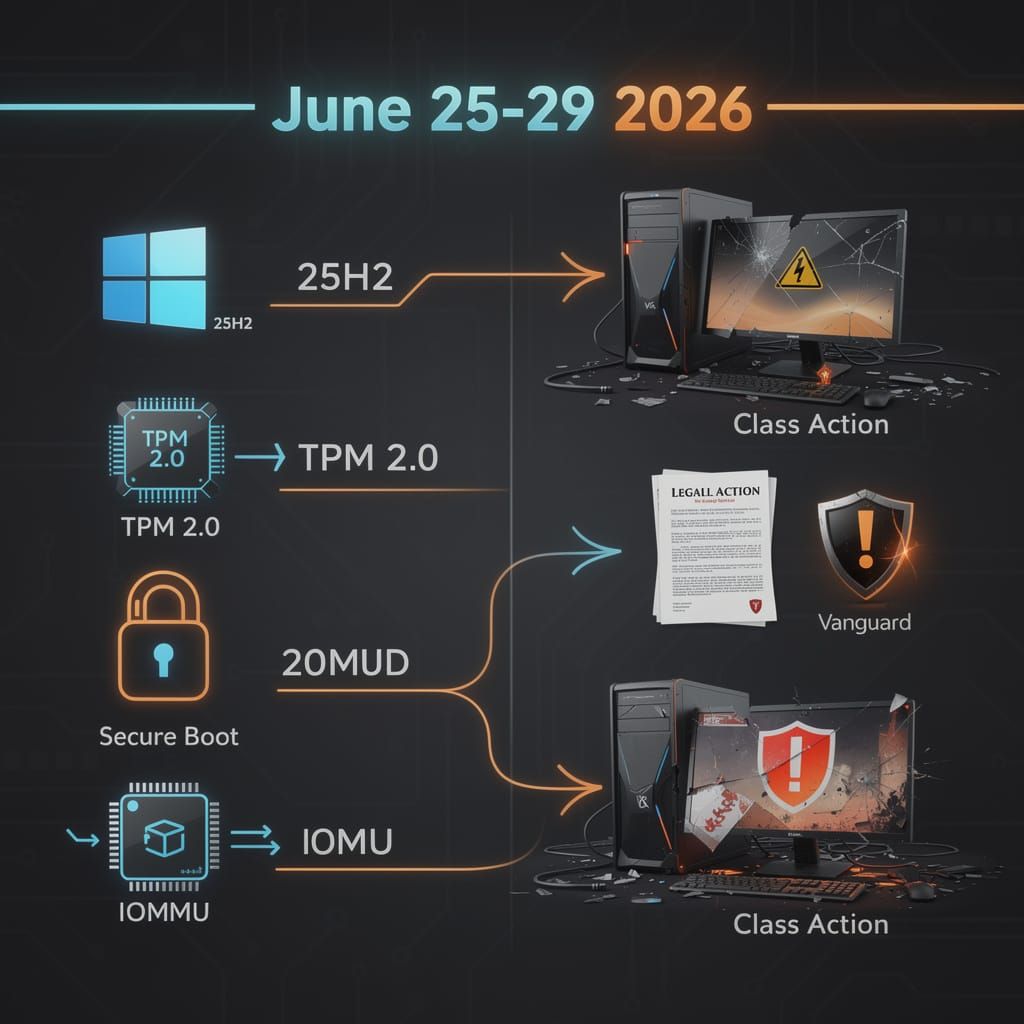
🎮 Vanguard finally went 'on-demand'—but only after class-action threats made Riot's lawyers nervous. The security improvement? Actually solid. The real reason? Legal cover, not player safety. Your 2019 gaming rig is now collateral damage in a war between a game publisher and Microsoft. Upgrade or become obsolete.
So Riot Finally Listened. Sort Of.
Let's be real: when Riot Games dropped Vanguard in 2020, it was the cybersecurity equivalent of installing a security system that watches your every move—while you're sleeping. Continuous kernel-level access, always-on monitoring, zero opt-out. Gamers screamed. Privacy advocates clutched their pearls. Riot shrugged and called it "necessary."
Fast-forward to June 2026, and apparently someone in a boardroom finally Googled "PR disaster kernel driver" and decided to do something about it. But here's the thing—the timing wasn't coincidental. It was reactive.
On June 25, Riot rolled out Vanguard-on-Demand. By June 29, they pushed the update live. The pitch: instead of running its intrusive monitoring loop 24/7, Vanguard now fires up only when a match starts. Session-triggered. On-demand. Revolutionary? Eh. Better? Marginally. But the catalyst wasn't altruism—it was legal threat.
Because here's the catastrophic little detail Riot buried in the patch notes: the update requires Windows 11 25H2, Secure Boot, TPM 2.0, IOMMU, and signed-code attestation so airtight you'd need NASA clearance to run a custom fan curve.
The Hardware Gauntlet Nobody Warned You About
Microsoft's Runtime Driver Attestation Report didn't just tighten a few screws—it welded the whole damn cabinet shut. Windows 11 25H2 now mandates HVCI and TPM 2.0 as baseline. This isn't a suggestion. It's a gate.
And it's blocking people at scale. By June 2026, Riot's update targeting DMA-based cheats triggered widespread player complaints—false detections, unintended device damage, and full-on disruption of gaming experiences. We're talking PC bricking reports, system instability complaints, and community backlash so severe that legal discussions over potential class-action claims started circulating. Riot scrambled to issue public clarifications stating no permanent damage to PCs—while simultaneously pushing the "on-demand" architecture as a fix.
The irony? The on-demand model is a legitimate security improvement. Kernel-level drivers running 24/7 are a juicy attack surface—nation-state actors, rootkits, supply-chain nasties love that attack surface. Shifting to session-triggered monitoring reduces the window of opportunity. That's not propaganda; that's basic threat-modeling.
But here's the kicker—Riot didn't do this for your safety. They did it because Vanguard became a recruitment liability. The May 2026 wave of complaints—including bricking reports and class-action chatter—created regulatory scrutiny risk. Prospective players saw "kernel driver = always on" and went running to games that didn't require a CompSci minor to install. The on-demand model introduces conditional execution models requiring hardware validation—paving the way for anti-cheat functions that double as diagnostic infrastructure for broader security postures. Clean hands. Plausible deniability. Masterful deflection.
The Road Ahead (If Your Rig Makes It)
- Q3 2026: Wider adoption likely as more PCs upgrade to Windows 11 25H2; adoption normalizes among newer PC users.
- 2027: On-demand is the template. Other publishers are watching. The controversy has sparked possible regulatory scrutiny and forced the industry to reconsider anti-cheat strategies—at least publicly.
Bottom Line
Riot Games accidentally stumbled into a better security architecture—then handed Microsoft the credit. The "improved player experience" narrative conveniently obscures the fact that player complaints—not just Microsoft's OS requirements—forced this change. Your 2019 gaming rig is now collateral damage in a war between a game publisher and an OS vendor who both want your upgrade budget. Upgrade, comply, or watch from the sidelines. Welcome to 2026. 🎮🔥
🤡 The AI Security Snake Oil Pipeline Is Flowing, and Yeah—It's Poison
95% precision. 300% throughput. Beautiful marketing deck. Chef's kiss. But 89% recall means ransomware clusters are slipping through the net like it's a comedy of errors. Meanwhile, Mythos Preview generated 18 Windows kernel exploits in 6 hours. That's your AI security pipeline vs. AI attack tooling. Spoiler: attackers aren't crying over recall metrics. They weaponized YOUR precision.
So here's the deal. Microsoft dropped their shiny new AI cybersecurity tools into CloudScan on June 28th, 2026, and the marketing machine immediately started cranking out dopamine hits: "95% precision! 300% throughput! Next-gen threat detection!"
Cool. Almost impressive. Except—
Someone forgot to check if the model actually catches things worth catching.
See, precision tells you how often an alert is correct when it fires. Recall? That's how often it fires at all for the bad stuff. You want both. Microsoft got precision right—screaming loud about correct detections—but that 89% recall drop means ransomware clusters are sliding through the net like it's a comedy of errors. Classic. Beautiful, actually.
Now here's the kicker. The very same week Microsoft was pitching CloudScan, Mythos Preview generated working exploits in hours: 8 exploits from 18 Firefox patches in one hour, 18 Windows kernel vulnerabilities in under six hours, and SYSTEM-level access chains in 31 minutes. CISA had to mandate patches across SolarWinds Serv-U (CVE-2026-28318), Check Point VPN (CVE-2026-50751), LiteLLM (CVE-2026-42271), and Oracle PeopleSoft (CVE-2026-35273) by June 19. That's your AI security pipeline racing against AI-generated attack tooling. Spoiler: the attackers aren't crying into their coffee over recall metrics.
And those workflow upgrades? Required 48-hour rollback windows. Forty-eight hours. While rollback's deploying, active response teams twiddle thumbs. Meanwhile, Microsoft just shipped Point-in-Time restore in KB5095093—72-hour automated snapshots with ~40-minute recovery. Nice fix. But your SOC team is still staring at a black-box alert with zero clue why it triggered. Congratulations: you have a dashboard screaming "threat!" while your analysts scratch their heads and shuffle tickets.
What's Actually Moving
- Throughput: 300% boost, genuinely useful for volume workloads. Cost efficiency gains are real.
- Precision: 95% correct when firing—solid for filtering noise.
- Recall: Below historical benchmarks—AI-generated exploit capture tanked. Threats slipping through.
- Rollback overhead: 48-hour windows—response lag increased during critical updates. Point-in-Time restore now addresses this.
- Attribution: Cloud-dependent only—no native origin tracing beyond aggregator logs.
- Active exploitation: Mythos Preview generated working exploits within hours of disclosure. Window is shrinking fast.
- Vulnerability discovery: Project Glasswing uncovered >10,000 zero-day vulnerabilities in partner software, with Cloudflare identifying 2,000 (400 high/critical) via automated scanning, leading to 271 Mozilla fixes and $1.5M fraud prevented.
So What?
The AI security hype machine delivered exactly what it always does: metrics that look great in demos, gaps that burn you in production. Organizations using these tools are faster at scanning, better at noise reduction, but worse at catching sophisticated threats and understanding what's happening when alerts fire.
The May 25 coordinated ransomware pushback and the LA Metro breach made one thing loud: AI-generated malware is ahead of AI-generated detection. Iranian-linked actors deleted virtual machines, dropped databases on 58 SQL servers, manually deleted 16 daily backups, and deployed AI-assisted scripts automating infrastructure destruction. Meanwhile, state-sponsored actors exploited outdated F5 BIG-IP appliances via Azure-hosted instances, performed lateral movement through Kerberos relay and unpatched Confluence (CVE-2025-33073), and harvested credentials across on-prem and cloud environments. Ninety percent of leaked malware contains exploitable weaknesses attackers already know how to use. Meanwhile, CVE-2026-28318 left 12,000+ SolarWinds Serv-U instances exposed—and nobody noticed until after the fact.
This is the enterprise security paradox of 2026. We traded recall for precision, speed for visibility, and operational capacity for a dashboard full of "trust us, it's AI."
The ransomware escalation hitting European manufacturing supply chains? That's not background noise—that's the real-world cost of a 9.3% market drop triggered by cybersecurity incidents. And while you pivot your SOC to the new dashboard, Iranian-linked actors are already using AI-generated scripts that automate the destruction of your backups. Chef's kiss.
Improved early threat scoring is projected for Q3 as alert filtering matures. Hope they're right.
Because right now? Threat actors aren't dealing with a 95% accuracy problem.
They're dealing with an 89% recall problem—and that's a feature, not a bug, from their perspective. 🤡
😈💀 StegoAd Shitshow: Microsoft Slaps a Band‑Aid on a 2.6 M‑Device Malware Mess
2.6 MILLION devices infected. Microsoft patched ~200 CVEs in ONE week. That's not Patch Tuesday—that's a PATCH TSUNAMI. 😈 StegoAd is gone but the zero-day toolbox overflows. Your browser extensions might be plotting RIGHT NOW. Treat 'optional update' as optional? Congrats—you're running a malware petri dish. 💀 How many extensions do YOU have installed?
If you thought your laptop was just a humble workhorse, think again. On June 29 2026, Microsoft yanked the plug on a sneaky campaign dubbed StegoAd that had slithered onto an estimated 2.6 million devices worldwide. The operation masqueraded as vendor‑support pages, slipped malicious extensions into browsers, and waited for the perfect moment—user interaction—to unleash payload‑delivery scripts. 😈
What Actually Happened
- Detection: Microsoft spotted abnormal traffic patterns, traced the calls to fake support pages, and blocked the downstream command‑and‑control (C2) channels.
- Exploit Chain: The attackers relied on vulnerable third‑party components to chain together privilege‑escalation steps. A single user click was enough to trigger stealthy activation and instant data exfiltration. This isn't some isolated incident—Pwn2Own Berlin 2026 just showcased 15 unique zero‑day exploits across Windows 11, Microsoft Exchange, and container environments in a single weekend. The toolbox is overflowing.
- Immediate Fallout: Private keys and dashboard logs were dumped in real time, giving attackers a free ride to account takeover and ad‑revenue hijacking. Meanwhile, the same week, the "Adblock for YouTube" Chrome extension got caught executing arbitrary JavaScript across all websites via a server‑side config flip—malware reanimated after removal. Classic undead scenario.
- Concurrent Chaos: On June 10 alone, Microsoft dropped patches for ~200 Windows vulnerabilities, GitHub yanked 73 repos after credential reuse attacks, and Check Point's VPN auth bypass (CVE‑2026‑50751) got actively exploited by Qilin ransomware before the ink dried on the advisory. That's not a Patch Tuesday—that's a patch tsunami.
Why This Is a Big Problem
- Account Takeover: Stolen logins → phishing storms, identity theft, and a nice little KPI for the bad guys.
- Revenue Leakage: Redirected ads bleed money from legitimate publishers and taint Microsoft's ad ecosystem.
- Dormant Infections: Some compromised machines sit quiet until a user revisits a "support" page—think of it as a malware nap that can wake up at any moment.
- Scale: Mobile infections in Russia alone jumped 70% in a single week, with Babymom RAT spreading 15%. The Nx Console supply‑chain compromise spawned CVE‑2026‑48027, hitting thousands of repos with zero user interaction required. If your CI/CD pipeline trusts automated tooling, congratulations—you're part of the problem.
- AI‑Accelerated Threats: Mythos Preview is now building working exploits in hours. And 90% of leaked malware samples contain at least one exploitable weakness. Your defensive window keeps shrinking.
Forecast – The Malware Show Never Ends (Unless You Fix the damn pipelines)
- 2026–2027: Expect 10‑15% rise in similar browser‑extension attacks if update pipelines stay a patchwork of third‑party libs. TanStack's supply‑chain gut punch compromised CI/CD pipelines globally; that's the baseline now.
- Q3 2026: If enforcement tightens—think automated dependency scanning, continuous usage audits—infection rates could drop by ~30%; otherwise, we're looking at a potential 5 M device pile‑up. Microsoft's already patching like it's going out of style: CVE‑2026‑41091, CVE‑2026‑45498, the works—some landed in the Known Exploit Database before the fix shipped. That's how dire it's gotten.
- 2027+: State‑sponsored crews (Kimsuky, Nimbus Manticore) keep weaponizing AI for intrusion—expect more "one click = whole network pwned" scenarios until pipelines get locked down.
Low‑Cost, Hack‑Friendly Mitigations (Because Fancy Enterprise Solutions Are a Scam)
- Open‑source dependency scanners (e.g.,
npm audit,cargo audit) catch the vulnerable components before they ship. TanStack wasn't a zero‑day—it was a package trust failure. Lock that down. - Continuous usage audits: periodic checks on installed extensions, especially after any "support" page visit.
- Minimal‑privilege browsing: run a separate sandboxed profile for vendor‑support interactions—keeps the blast radius tiny.
- Patch religiously: Microsoft dropped patches for ~200 CVEs in June alone, CISA mandated fixes by June 19 for actively exploited flaws (SolarWinds Serv-U CVE‑2026‑28318, LiteLLM CVE‑2026‑42271, Oracle PeopleSoft CVE‑2026‑35273). If your IT team treats "optional update" as optional, you're not running infosec—you're running a malware petri dish.
The Cheeky Bottom Line
Patch early, audit constantly, and for the love of sanity, stop trusting any pop‑up that says "Your device needs immediate attention." Unless you enjoy handing over your credentials to a script kiddie in a basement. 💀



Comments ()