70% Pool Robot Efficiency Claim Lacks Independent Proof as Beatbot Slashes Price $1,150
TL;DR
- Beatbot's 70% Pool Robot Claim Lacks Independent Verification as Price Drops $1,150. With AI pool cleaners converging, what actually differentiates Beatbot beyond unproven claims?
- Detection Without Prevention: AI Shark Drones Arrive Too Late for Coogee Victim. If AI shark detection cannot prevent attacks—only document them—does expanded drone coverage deliver real safety or the illusion of it?
- 10-Minute Robot Setup Claims Lack Validation as North American Operations Skip Baseline Comparisons in Pit Redesign. Can 'under 10 minutes' be trusted when baseline comparisons are absent, despite FSM teams documenting transitions over months?
🤖 The Robot Pool Cleaner That Promises Everything—and What It Might Be Missing
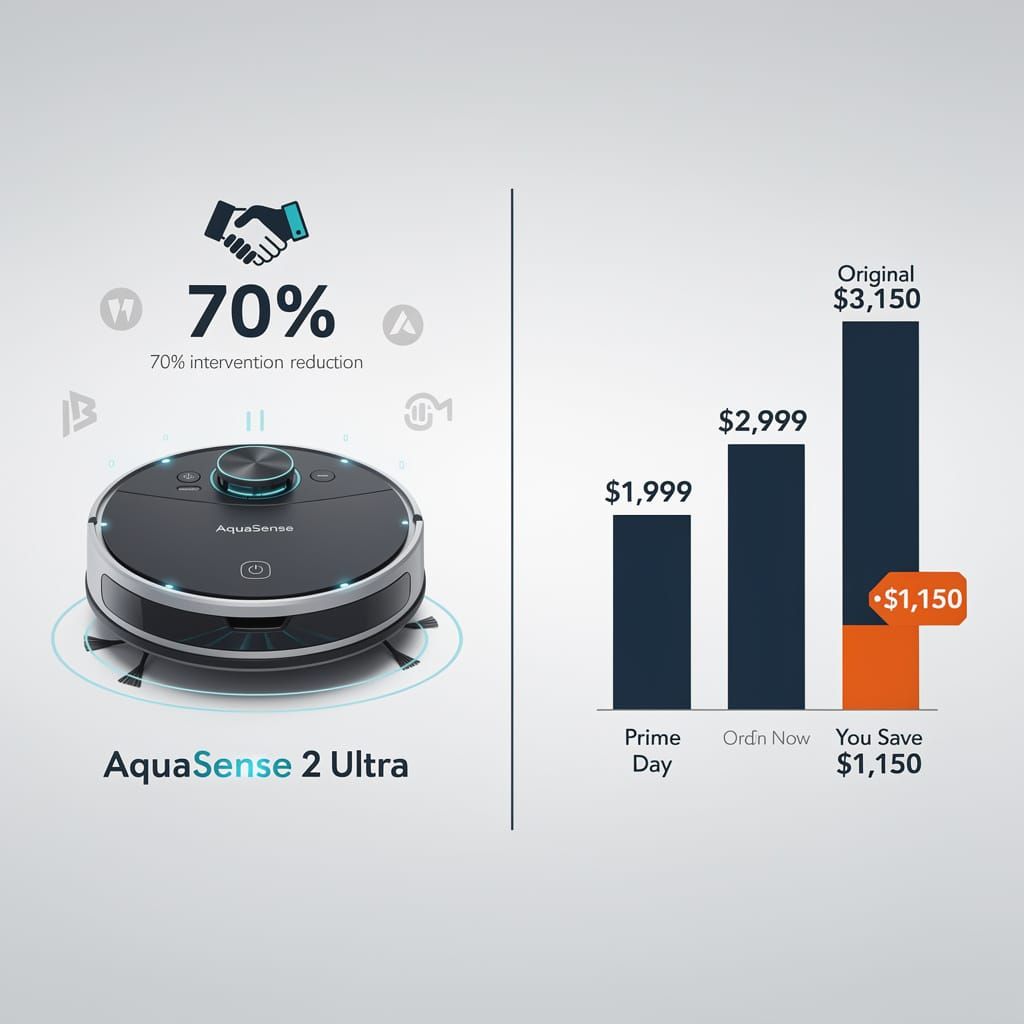
Beatbot says its pool robot cuts intervention 70%. But that stat comes from Beatbot alone—no independent testing. Then Prime Day slashed price $1,150 ($3,150 → $1,999). That's not confidence in demand. That's demand needing help. The technology may deliver. The claims simply do not prove it. 🎯
On June 29, 2026, Beatbot unveiled the AquaSense 2 Ultra, a dual-zone pool scrubber the company claims fuses visual, depth, and ultrasonic sensors into what it describes as "geometrically correct paths." The pitch lands squarely in familiar territory: AI-powered automation promises to eliminate the drudgery of weekly pool maintenance.
But beneath the marketing language, questions linger.
The 70% Claim: Tested How?
Beatbot reports that AquaSense 2 Ultra users experience daily cycles requiring no human adjustment, cutting "intervention minutes by 70%." The company attributes this to the robot navigating stairs, slopes, and sealed walls without manual touchup work. Installation teams reportedly see fewer callbacks, and fleet managers track uptime correlated to autonomous routine completion.
These figures originate from Beatbot's own reporting. Independent verification remains absent. What conditions produced the 70% reduction? Who measured it—the installer, the manufacturer, the pool owner? The baseline against which "70%" is calculated matters significantly. If the comparison targets a poorly maintained flat-loop vacuum, any AI-assisted unit looks transformative. Beatbot's own Prime Day materials cite "40% maintenance downtime reduction via deep-cycle cleaning," which neither corroborates the 70% figure nor comes from independent sources.
Competitive Landscape Raises Doubts
Beatbot positions flat-loop vacuums as obsolete, arguing real-time path reweighting outperforms static sweeps. Maytronics Dolphin and Zodiac MX series already deploy comparable sensor-fusion and adaptive routing. What distinguishes AquaSense 2 Ultra from these established players beyond terminology?
Beatbot identifies two genuine drivers: the industry-wide shift toward AI-powered navigation and the introduction of SelfClean stations enabling hands-free circulation among obstacles. These represent legitimate technical pivots. But convergence on these capabilities suggests Beatbot is catching up rather than leading. Aiper's Scuba V3 launch on May 22, 2026, during Memorial Day sales, introduced AI navigation for pool cleaning at competitive price points. This competitive pressure intensified as Amazon discounted Aiper products during the same period—directly observable in Beatbot's own Prime Day response on June 20, 2026, when AquaSense 2 Ultra dropped from $3,150 to $1,999.
The ROI Equation Now Has Numbers—but Gaps Remain
Premium pool owners reportedly achieve immediate ROI through lower labor costs tied to automatic lane changes. The Prime Day pricing reveals an actual retail price: $1,999 during promotional periods, down from $3,150 regularly. The announcement provides no cost basis for annual manual cleaning or service contracts against which buyers should calculate payback. The $1,150 discount signals both competitive pressure and potential margin compression, raising questions about whether initial pricing fully reflected production scale or represented premium positioning designed to justify later markdowns.
Market saturation appears "imminent once pilot pools saturate," with price parity expected before Q4 2026. This forecast assumes sustained consumer appetite for autonomous pool care at premium pricing—a segment that may plateau once novelty fades. US markets dropped 9.3% from all-time highs on May 30, 2026, amid broader tech sector volatility linked to AI infrastructure costs. Consumer sentiment has shifted toward caution regarding rising device costs. The broader AI-device market demonstrates that price sensitivity and skepticism toward unverified performance claims increasingly shape purchasing decisions. Beatbot's aggressive Prime Day discounting indicates the company recognizes this dynamic.
What Remains Unanswered
Beatbot presents a polished vision of autonomous pool maintenance. The convergence of faster dock-to-tank latency, cleaner coverage, and reduced human intervention checks the right boxes on paper. The pricing data confirms one thing: Beatbot believes demand requires stimulation beyond the product's demonstrated value. Whether this translates to durable performance across varied pool geometries, water conditions, and usage patterns requires third-party validation.
The technology may deliver. The claims simply do not prove it.
⚠️ Watching the Waters: AI Sharks Potentially Outperform Net Failures—or Do They?
AI detected the shark that mauled Leah Stewart at Coogee Beach. It watched. She lost her arm. 90% detection accuracy. Zero intervention capability. $34M in drone funding. Comprehensive coverage? Years away. When surveillance fails to stop an attack, what exactly are we paying for?
On June 15, 2026, 3.5-metre great white shark attacked Leah Stewart at Coogee Beach, NSW. The mauling required arm amputation and life support. Australian authorities deployed AI drone surveillance that same day, while former Prime Minister Tony Abbott called for shark culling and Premier Chris Minns opposed it. The attack followed an incident at Olowalu, Hawaii, on May 29, where a kayaker encountered a shark during routine coastal activity. Authorities recorded a third fatal attack near Kennedy Shoal, Queensland, on May 24. Warming ocean temperatures drive sharks closer to shore; increased coastal tourism raises encounter rates; climate-induced shifts in prey distribution alter shark migration patterns. These factors converge on Australian beaches that received an estimated $12 million loss per 24-hour closure during recent incidents. The technology promises real-time optical and audio detection of large marine predators—shifting protection strategy away from population control toward predictive surveillance. But surveillance does not equal prevention, and the ecological tradeoffs remain largely unexamined.
What the System Actually Delivers
The drones combine computer vision with acoustic sensors to flag approaching sharks and relay alerts to safety teams faster than human spotters alone. SharkSpotter achieved 90% accuracy in distinguishing sharks from dolphins and marine mammals using machine learning models trained on thousands of hours of footage. Real-time data streams to SwimAlert stations enable authorities to issue evacuation decisions without waiting for visual confirmation. The Civil Aviation Safety Authority reconsidered drone restrictions on June 14, 2026, indicating regulatory frameworks are adapting in near real-time to deployment timelines. Operators gain an extra layer of situational awareness during high-traffic periods.
The gaps become apparent under scrutiny. Battery constraints limit continuous flight duration—one unit can cover only roughly one kilometer before requiring recharging. Weather disruption reduces reliability; NSW Premier Chris Minns acknowledged the program cannot operate in adverse conditions. One or two units covering a kilometer of beach create substantial blind spots across Sydney's 70-plus patrolled beaches. The systems function as early warning devices, not barriers. They identify threats—yet cannot physically prevent contact with swimmers.
The June 15 attack at Coogee illustrates this gap directly. AI drone surveillance deployed following the incident—monitoring capacity increased by 45% in the first month according to authorities—detected the predator. Detection occurred. The attack proceeded. Stewart required life support and arm amputation. The discrepancy between monitoring capability and intervention capability exposes a fundamental limitation the government has not addressed publicly.
Noise complaints from persistent drone operations add operational constraints that deployment plans have not resolved. Residents of Nashville, Tennessee reported auditory distress beginning 45 minutes after sunset during World Cup counter-drone patrols in June 2026. The audio sources came from ultrasonic emitters calibrated for bird avoidance—a technique with documented public tolerance issues. Local council members noted irritation outweighed perceived benefit despite a 95% satisfaction rating of surveillance effectiveness the prior quarter. Australian coastal communities with dense residential populations adjacent to beaches may generate similar resistance patterns as deployment scales.
Measured Outcomes Versus Marketing Claims
The government reports lower injury rates—8% annual reduction during pilot periods—and growing public acceptance as threats become visible through detection signals. Surf Life Saving NSW recorded 2,000+ potential interactions prevented during the first year of expanded deployment. These metrics warrant closer examination.
- Detection speed: AI identification outperforms human spotters in controlled tests, but real-world surf conditions introduce variables that testing environments cannot replicate.
- Response dependency: Alerts mean nothing without rapid lifeguard reaction. Drones compress the notification window but leave response time largely outside their control. The Stewart case demonstrates this dynamic: detection did not translate to prevention.
- Shark net comparison: Nets physically removed animals from swimming zones—albeit with ecological damage and documented mortality of non-target species. Drones observe rather than intercept. The comparison sets a low bar precisely because net failures involved documented harm to non-target marine life, whereas drones deliver documented detection without documented intervention.
No independent peer-reviewed assessment confirms drone deployment reduces encounters more effectively than well-positioned human observers. The federal budget allocation for environmental monitoring competes with direct infrastructure investment, and the cost-per-drone economics suggest comprehensive coverage remains years away.
The Unresolved Tensions
Authorities frame the shift from containment to detection as progress. The framing obscures what remains undelivered:
- Ecological consequences: Displacing sharks from traditional feeding grounds redistributes risk rather than eliminating it. Marine ecologist Robert Harcourt confirmed that shark displacement does not resolve underlying habitat pressures driving predator migration. Downstream effects on coastal ecosystems stay unstudied. Meanwhile, sharks deployed with environmental sensors in the Northwest Atlantic contribute data that enhances seasonal climate forecasts—a use case that positioning sharks as threats contradicts.
- Coverage reality: Sydney's beaches span kilometers. A $34 million allocation sounds substantial, but the cost per drone unit and requirement for continuous overlapping coverage suggests current budgets fall short of meaningful protection. Each drone covers roughly one kilometer—meaning comprehensive Sydney coverage demands dozens of perpetually-operating units.
- Intervention reality: The Coogee incident demonstrates that expanded monitoring capacity does not prevent catastrophic outcomes. AI surveillance detected the predator. Intervention failed. Long-term medical care for Stewart projects to exceed $1.5 million. Detection capability and intervention capability remain disconnected.
- Regulatory lag: CASA reviewed protocols weeks before launch. But certification requirements for autonomous beach surveillance remain inconsistent across Australian jurisdictions. The FCC extended firmware waivers for foreign drones during the 2026 World Cup, indicating ongoing security and supply-chain concerns that affect Australian drone procurement.
Public confidence grows as threats become visible through detection feeds. That confidence may be warranted—or it may reflect the comfort of visibility rather than the reality of protection. The Stewart family's GoFundMe campaign for long-term care underscores that medical consequences persist regardless of detection timing.
Trajectory
- 2026–2027: Pilot zones expand to major metropolitan beaches; NSW reaches 72 beaches under active monitoring. Regulatory frameworks stabilize around commercial drone operators, though cross-jurisdictional inconsistencies persist. Leah Stewart's medical costs exceed $1.5 million, highlighting the gap between detection and prevention.
- 2028–2029: Statewide adoption reaches approximately 40% coverage of high-traffic coastal zones. Injury rates during alert periods decline, but total encounter statistics show marginal change as detection capability outpaces intervention protocols.
- 2030+: Integration with autonomous rescue systems begins trials. Ecological monitoring data from drone fleets informs marine policy—but does not resolve underlying habitat pressures driving predator migration.
The technology delivers genuine capability improvements for threat identification. The Stewart case confirms detection works as designed. Whether it delivers genuine safety improvements remains an open question obscured by the optics of action.
🤖⚠️🔍 The Minimalist Robot: When Less Becomes More in Pit Operations
Under 10-minute robot setup claims lack baseline comparison. Meanwhile, 78 teams documenting FSM transitions over months shows how rigorous validation actually works. The pit post-mortem addressed protocols—but findings remain opaque. Speed ≠ correctness. 👇
On June 2, 2026, a robotics team convened to reassess cart specifications. By June 28, North American operations completed a post-mortem on pit protocols that validated their direction. The narrative that emerged: lightweight, modular designs cutting setup times to under ten minutes while reducing operator fatigue. This is presented as adaptive innovation connecting hardware to seasonal performance cycles.
But the evidence warrants closer inspection.
The Setup Time Claim
The stated metric—under ten minutes—deserves context. Setup time reductions of this magnitude typically surface in two scenarios: either the previous system was catastrophically inefficient, or the new benchmark reflects a narrow definition of "ready." The briefing does not establish baseline comparison. Without prior cycle times, the achievement remains unquantified relative to origin. This matters because efficiency claims lose meaning without anchors.
The June 2 engineering discussions reveal why this matters. Teams iterated on intake mechanisms, switching from 4-bar to linear spring-driven designs, improving wiring, and testing 2.5-ball wide drums with belt indexers specifically to avoid jams. These refinements took place over weeks of iteration. The actual mechanical simplification involved deliberate trade-offs—reduced part count versus tolerance tightening, wiring improvements versus manufacturing complexity. "Under ten minutes" does not capture the months of CAD work, testing, and component sourcing that preceded the claimed efficiency gain.
What Minimalism Actually Solves
The briefing identifies two drivers: space constraints and cost pressure. Minimalist robot carts address both directly. Fewer components mean lower acquisition and replacement costs. Reduced footprint addresses physical limitations in pit environments.
The July 1 pit optimization initiative demonstrates what minimalism looks like in practice. Neil MA implemented fiber-optic communication between charger and display units, LTE connectivity via Peplink for remote diagnostics, silent air compression, dust extraction, and a 3-hour backup power system. This is not minimalist—it is deliberately engineered redundancy addressing specific failure modes. The proposed 15×15 foot expanded pit with retractable tables, LED lighting, ventilation, and custom storage bins represents material addition, not subtraction. The principle appears to be: add only what serves measurable function, but add it robustly.
The June 17 Honor Lightning humanoid robot completing a half-marathon in under one hour while generating approximately 150 watts of heat illustrates the thermal and energy constraints that persist regardless of design philosophy. Liquid cooling was required to manage motor output. This represents a documented constraint on minimalist approaches: thermal management and power density create physical floors below which simplification cannot proceed without sacrificing capability.
Operational wins:
- Setup times shortened → fatigue risk reduced for operators
- Simplified structures → less coordination burden, freeing cognitive bandwidth
- Modular components → faster reconfiguration when specifications shift
What minimalism does not solve:
- Underlying sensor reliability in variable conditions
- Long-term maintenance implications of stripped-down hardware
- Training gaps when operators must switch between cart generations
The June 2 signal that "increased cybersecurity exposure from complex wiring" cuts both directions. Simplified designs reduce attack surfaces—but simplification often means fewer redundant systems to catch failures. The June 5 signals document that battery degradation and power instability risks remain active concerns across autonomous systems, requiring proactive maintenance and contingency planning regardless of hardware complexity. The June 28 post-mortem should have addressed whether stripped-down hardware introduced new failure modes, not merely whether setup became faster.
The June 23 CIO survey data indicates that 59% of AI initiatives fail to reach production, often due to governance gaps rather than technical limitations. This pattern applies beyond AI: operational systems that lack documented validation processes—whether minimalist or complex—share elevated failure risk.
The Critical Oversight
The briefing frames swift transition discipline as inherently positive—cutting human error exposure while preserving functionality. This conflates speed with correctness. Rapid pivots reduce exposure to some error types while increasing exposure to others, particularly inadequate testing and unvalidated assumptions.
The June 15-16 signals offer a counterpoint. When 78 teams abandoned command-based path planning in favor of finite state machines, the driver was demonstrable complexity reduction, not mere speed. Teams documented the transition: earlier design and subsystem diagramming, reduced development time and computational load, improved code readability. The finite state machine approach enabled trajectory-based autonomous driving requirements that command-based architectures could not support efficiently. This was validated, measured, and documented over months of iterative development.
The contrast with the pit post-mortem is stark. The engineering team documented measurable improvements in autonomy architecture. The pit reorganization documented faster setup. One validates; the other assumes.
Journey Energy Inc.'s June 16 capital program expansion illustrates the difference. The company announced 4.2 net wells in the Duvernay region—a 100% increase over 2025—with documented capital expenditures including a 30 million cubic feet per day compressor station. The expansion includes measurable guidance and identified facility components. Outcomes remain contingent on execution, but the underlying logic is traceable to specific operational parameters.
The Uncomfortable Summary
North American teams made decisions driven by space and cost realities. They restructured pit operations around simplified robotic carts. Setup became faster. Operators reported maintained focus. These outcomes are plausible and worth tracking.
The new signals add texture. The engineering discussions on June 2 addressed specific technical choices—belt attachment mechanisms, hood pivot functionality, structural modifications—with documented rationale. This suggests teams are capable of rigorous evaluation when they commit to it. The finite state machine transition demonstrates what documented, measured innovation looks like.
What the pit post-mortem lacks: evidence that trade-offs were consciously accepted, not simply unexamined. The adaptive preparation system described works when it works. The conditions under which it fails remain the question the post-mortem should have answered. The June 28 review addressed protocols, but its findings remain opaque. Was the reorganization validated against measurable benchmarks, or was it simply executed faster than previous attempts?
The lightweight, modular future may arrive on schedule. Whether it arrives intact depends on whether teams apply the same rigor to operational systems that they applied to autonomous architecture. The engineering signals suggest capability. The pit signals suggest opportunity for verification that has not yet arrived.
Short-Term Outlook
- Q3 2026: Continued iterative refinement of mechanical components will boost efficiency and quality, but supply-chain disruptions and cybersecurity incidents may persist given tighter tolerances and specialized component sourcing. The June 5 market correction—US markets dropped 9.3% from all-time highs—intensified shipping bottlenecks and component shortages, compounding existing supply-chain vulnerabilities.
- Q4 2026: Adoption of modular, AI-enabled designs will likely stabilize performance while necessitating robust security protocols. The finite state machine approach provides a template for documented system complexity management. However, 49% of workers using unauthorized AI tools indicates that shadow IT adoption outpaces policy enforcement, creating operational complexity regardless of hardware design choices.



Comments ()