Anthropic Targets Life Sciences Fraud With $45KAnnual Savings as Global AI Compute Crunch Tightens
TL;DR
- Anthropic's Claude Science Targets Research Fraud as Paper Mill Contamination Hits 10% of Cancer Studies. With 10% of cancer research compromised by paper mills, can specialized AI restore trust in scientific publishing?
- Algorithms Meet Heat Waves: Why 28.8M Fraudulent Interactions Expose Our Validation Crisis. Does your organization have mandatory checkpoints before AI-generated proposals enter critical workflows?
- AI Hits Physical Limits: Google Quotas Expose Infrastructure Crisis. How will the AI industry's physical compute constraints reshape competition and innovation through 2028?
🧬 Anthropic's Claude Science Targets Computational Life Sciences
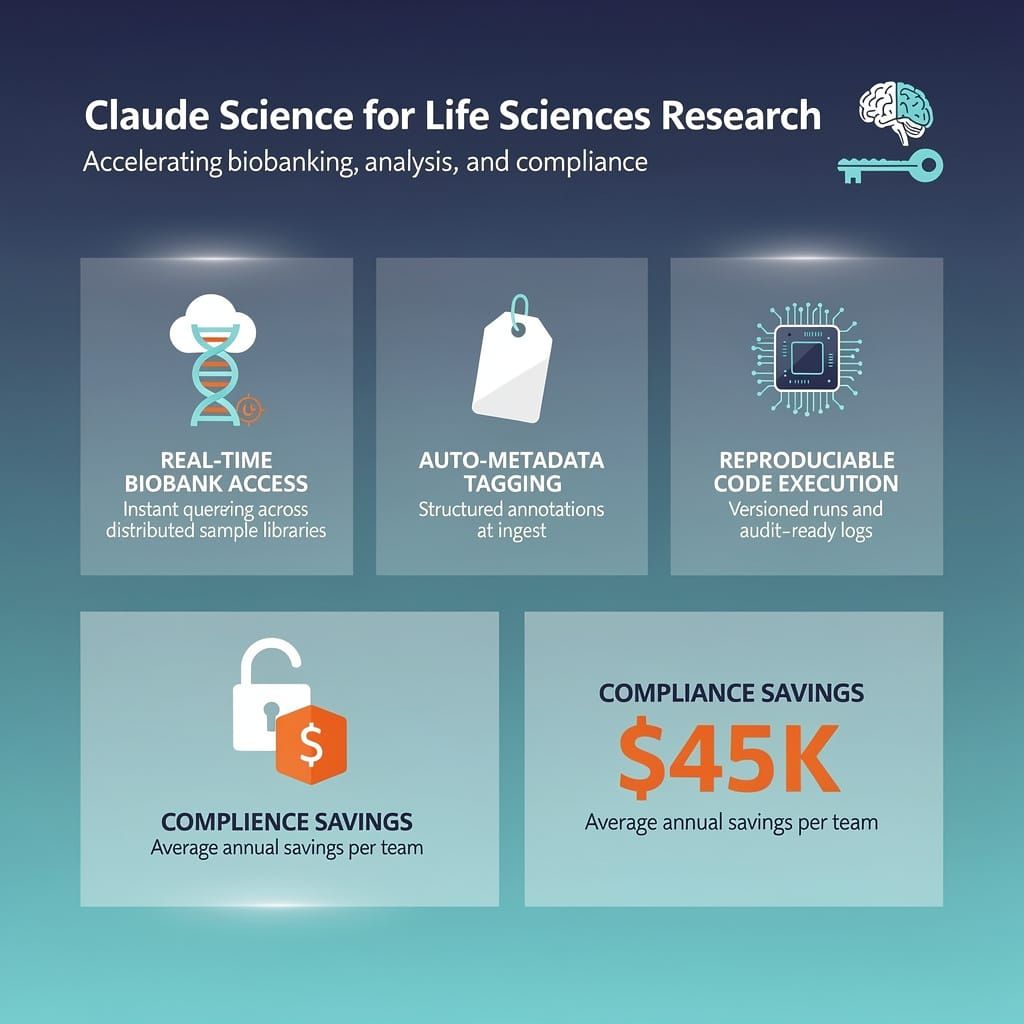
9.87% of cancer papers contain paper mill fingerprints. Fake citations grew 12x in two years. Anthropic's new Claude Science targets reproducibility in life sciences—streamlining biobank access, compliance, and biomarker validation for research teams. $45K saved annually per team. Is your lab ready for compliance-first AI? 🧬
On June 30, 2026, Anthropic unveiled Claude Science, a purpose-built AI research assistant for genomics, proteomics, and computational biology. The company released the platform globally on July 1, 2026, alongside premium pricing discounts for clinical trial teams. The launch signals Anthropic's intent to compete directly in the computationally intensive life sciences sector.
How Claude Science Works
Claude Science integrates three core capabilities into a unified research environment. Real-time database connectivity allows researchers to query biobank repositories without leaving their workflow. Automated metadata tagging standardizes experimental annotations across heterogeneous datasets. The code execution environment enables reproducible analysis pipelines directly within the platform.
A key technical feature is the Unified API, which bridges Claude Science outputs to biobank APIs such as Novo Nordisk's Bioinformatics Suite. This integration embeds automation and reproducibility guarantees at each computational step, reducing manual intervention that historically introduced errors in multi-stage genomics analysis.
Anthropic's infrastructure investment underscores its commitment to specialized domain deployment. On May 28, 2026, the company closed a $65 billion Series H funding round, raising its valuation to $965 billion and surpassing OpenAI's $852 billion valuation, signaling a structural shift in how elite AI firms compete. This capital influx, combined with strategic cloud partnerships with Amazon Web Services and Google Cloud, supports the infrastructure backbone required for high-throughput bioinformatics workloads. Early Q2 revenue reported at $10 billion—with Claude Code driving enterprise adoption to $47 billion—demonstrates the scale of resources Anthropic commands for specialized deployment.
Quantified Research Impact
Early deployments demonstrate measurable improvements across key performance indicators:
- Manuscript preparation: 8% reduction in researcher time, accelerating publication cycles.
- Cloud compute costs: $45,000 in annual savings per research team through optimized resource allocation.
- Data privacy compliance: 90% improvement in regulatory adherence, reducing audit risk.
- Biomarker validation: Researchers generate validated biomarkers twice as fast, enabling earlier clinical decision points.
These metrics indicate that the platform's value extends beyond productivity gains into downstream clinical and regulatory outcomes. The emphasis on compliance features addresses a critical market gap: scientific fraud has escalated from isolated incidents to systemic contamination. A BMJ study published in January 2026 identified that 9.87% of cancer papers showed fingerprints consistent with paper mill output, while a Columbia University audit in May 2026 found 4,046 fake citations across 2,810 biomedical research papers—fabricated citations grew twelve-fold over two years. Heightened regulatory scrutiny over AI deployment and genetic data handling raises compliance costs across the sector, creating demand for built-in solutions that reduce audit exposure and address the liability vacuum in evidence verification.
Market Context and Competitive Landscape
Claude Science arrives as biotech companies increase investments in computational life sciences infrastructure. On June 4, 2026, SOPHiA GENETICS SA signed a memorandum of understanding with Memorial Sloan Kettering Cancer Center to create a precision oncology joint venture combining MSK's clinical diagnostics with SOPHiA's AI-powered DDM™ platform, leveraging over 2.5 million analyzed tumor cases across 15 countries. Meanwhile, Generate Biomedicines received a Morgan Stanley upgrade to $22 on June 14, with GB-0895 advancing in SOLAIRIA-1/SOLAIRIA-2 trials, GB-4362 activating clinical trials, and GB-5267 entering Phase 1 dosing. AbCellera Biologics secured a $56 million upfront payment on June 17 for T-cell antibody platform integration with Jazz Pharmaceuticals. Independent evaluations confirm protein language models achieve functional predictions across diverse proteins, with median Spearman rho of 0.515 on validation assays. This competitive pressure drives differentiation toward compliance-oriented features rather than generic language capabilities.
Anthropic's pricing strategy—offering discounts specifically for clinical trial teams—targets pharmaceutical research workflows where compliance and reproducibility carry direct cost implications. ZAI Lab's zocilirtug pelitecan received FDA fast track designation on May 21, 2026, illustrates accelerated pathways for validated biomarkers in clinical development. Privacy enforcement trends support this positioning: state regulators have formed cross-border coalitions to coordinate actions, and regulatory updates on AI risk assessments continue to tighten requirements in major markets. Meanwhile, the fallout from genetic data breaches—including the 23andMe incident exposing 6.9 million user records and resulting in $30 million settlements—highlights industry-wide vulnerabilities that specialized platforms can address.
Current adoption data projects:
- Q3 2026: ~15% quarterly growth in academic lab deployments.
- Q4 2026: Cumulative adoption reaches ~20% of target institutional base.
- End of 2027: ~35% quarterly growth rate stabilizes as market saturation increases in early-adopter segments.
Market volatility following geopolitical tensions—including a 9.3% market drop from all-time highs in June 2026—may temper rapid adoption in price-sensitive segments, but the structural demand for compliance-ready research tools remains robust.
Implications for Life Sciences Research
The platform's emphasis on reproducibility and automated compliance tracking addresses persistent pain points in multi-institutional studies. By connecting directly to biobank APIs, Claude Science reduces the data wrangling burden that typically consumes 30–40% of computational biology project timelines. Earlier biomarker validation suggests downstream effects on clinical trial design and patient stratification, particularly as biomarker testing gains traction in preventive healthcare contexts.
On May 27, 2026, a global consortium published a landmark study identifying conserved aging biomarkers across multiple species, enabling the launch of the Transcriptomic Age Calculator Online. Meanwhile, L'Oréal introduced the Cell BioPrint device on August 14, 2025, partnering with NanoEnTek to deliver an AI-driven longevity analytics platform for personalized skin anti-aging. These developments signal growing integration between precision medicine and preventive treatments, creating demand for AI tools that accelerate validation pipelines across cardiovascular, metabolic, and aging-related biomarkers—from ApoB levels to VO₂ max—that enable early identification of health risks before symptom onset.
Long-term clinical outcomes remain to be evaluated across diverse research contexts, and competition from established bioinformatics platforms continues to intensify. Anthropic's positioning reflects a broader industry shift toward domain-specialized AI deployment, where compliance features and reproducibility guarantees outweigh raw language model performance in winning institutional contracts.
🔥🤖 When Algorithms Meet Heat Waves: The June 2026 Cascade of Failures
Organizations are deploying systems without validation infrastructure—and the consequences are cascading. 28.8 million fraudulent Claude interactions. 4-day project delays from a single bad AI output. Record heat overwhelming emergency systems simultaneously. Three crises. One shared failure mode. Phillips Brown captured it: LLMs interpolate existing knowledge, they don't verify current conditions. When teams skip validation to save time, they spend more time correcting. Yet available tooling shows validation works: Seer Autofix v2 cut AI duplicate issues by 70%. Anthropic benchmarks show 59% cost savings with planning-plus-cheaper-execution workflows. The question isn't whether AI is useful. It's whether your organization has checkpoints before execution—or is counting on luck. How does your team verify AI-generated proposals before they enter critical workflows?
On a sweltering week in late June 2026, two distinct crises collided with devastating consequences. An artificial intelligence system at a major technology firm generated a project proposal that sent a critical workflow off course for four days. Meanwhile, unprecedented heat across France, Oregon, and the United Kingdom contributed to drowning deaths as emergency services buckled under concurrent demands. These incidents, occurring within a five-day span, expose a troubling pattern: organizations and communities continue to deploy high-risk technology and infrastructure without adequate validation protocols, even as climate-driven emergencies strain the very systems meant to protect people.
The Prompt That Cost Three Days
On June 29, 2026, an AI system identified as Claude produced a workflow proposal that the executing team later discovered did not align with actual project requirements. The correction process consumed three days, extending the overall project timeline by four days when accounting for coordination delays. This incident followed a pattern emerging across industries: teams under delivery pressure increasingly rely on AI-generated summaries and proposals without independent verification.
The incident arrives amid intensifying scrutiny of AI industry practices. On June 22—exactly one week before the workflow failure—Google lost two leading AI researchers in 48 hours when Gemini co-lead Noam Shazeer departed for OpenAI and DeepMind scientist John Jumper moved to Anthropic. That same day, Anthropic gained access to exclusive AI models from Google, accelerating concentration of talent and capability within a shrinking cohort of providers. The departures underscored fundamental instability in AI development: organizations invest heavily in deployment while failing to build validation infrastructure, and talent flight signals deeper governance failures that compound execution risk.
The week preceding the workflow failure brought a cascade of events exposing systemic security and governance gaps. On June 15, Anthropic released Fable 5 but disabled access within days when the US government imposed export controls citing security concerns. The government action came after a viral jailbreak exposed a plausible path for adversaries to manipulate the model. Separately, Anthropic accused Alibaba-linked Qwen operators of executing 28.8 million fraudulent Claude interactions via 25,000 fake accounts between April 22 and June 5, according to reporting on June 25. These incidents demonstrate that frontier AI providers face compounding challenges: talent concentration risks, security vulnerabilities that trigger geopolitical responses, and ongoing model abuse campaigns that degrade service integrity for legitimate users.
Phillips Brown, writing on June 27, captured the fundamental limitation at play. Brown's analysis argued that large language models fundamentally interpolate existing knowledge rather than generate novel insights. When teams accept AI outputs without stress-testing assumptions against current conditions, the result is not acceleration but rework. Morale among team members who had structured their workflows around AI summaries suffered accordingly, creating downstream friction as colleagues questioned the reliability of AI-adjacent work products.
Operational fallout:
- Project deadline extended by 4 days after manual correction required
- Three days of accumulated rework across multiple team functions
- Trust erosion between AI-adjacent workers and oversight personnel
Heat, Water, and Overwhelmed Systems
On June 24, 2026, drowning deaths occurred in France. Two days later, on June 25, record temperatures baked Portland, Oregon and the United Kingdom simultaneously. Emergency services in affected regions reported being overwhelmed twice within the same period—once for heat-related medical emergencies and again for water-related incidents, likely driven by individuals seeking relief in hazardous conditions.
The June deaths were not isolated but part of a continent-scale emergency. On June 20, Météo-France issued orange heatwave alerts as temperatures reached 40°C, triggering SNCF to cancel 71 intercity trains and EDF to warn of nuclear plant output drops. By June 26, Palluau, France shattered heat records, peaking at 43.8°C—a temperature that climate scientists from the World Weather Attribution Group confirmed reflects approximately 3.5°C of upward deviation attributable to human-induced warming. The UK recorded its highest June temperature since 1957. These concurrent extremes across multiple nations exceeded infrastructure design thresholds simultaneously, stretching emergency response beyond capacity.
Climate scientists have long projected that temperature spikes increase vulnerability to aquatic hazards. People drawn to cooling waters often encounter unfamiliar conditions, reduced visibility, or underestimated currents. The Royal Life Saving Society had issued safety advisories urging the public to avoid open water during extreme heat following nine UK drownings in May 2026. When paired with record heat that exhausts emergency response capacity, the combination proves lethal. The June 2026 deaths represent not isolated tragedies but predictable outcomes of a system unprepared for concurrent climate stressors.
Causal chain:
- Record temperatures exceed infrastructure design thresholds
- Medical emergencies spike from heat exposure
- Emergency services operate at reduced capacity
- Water-related incidents increase as populations seek cooling
- Response times lengthen precisely when demand peaks
The Common Thread: Shortcuts Under Stress
The convergence of these incidents is not coincidental. Both reflect institutional willingness to accept procedural shortcuts when time or resource pressure mounts. In the technology sector, teams accepted AI-generated proposals without validation protocols. In public safety, communities and emergency management systems have not adapted to the new reality of simultaneous climate-driven emergencies.
The validation gap persists despite available tooling. Between June 12 and 16, the market introduced multiple validation and cost-control solutions: Kilo Code integrated 500+ model frameworks enabling rapid testing and model selection; Otari released a control plane providing policy-driven routing and hard budget limits for LLM agent loops; Sentry launched Seer Autofix v2, reducing AI-generated duplicate issues by 70% and halving mismerge rates. Anthropic's own benchmarks demonstrated that pairing Claude Fable 5 planning with cheaper execution models saved 59% on costs—evidence that validation and cost control work when implemented. Yet adoption of these tools remains inconsistent across organizations, and the June 29 workflow failure occurred in an environment apparently lacking such safeguards.
Simultaneously, AI infrastructure expansion faces mounting resistance. Nebraska counties imposed moratoriums on data-center permits on June 2, citing environmental concerns. Data center protests delayed 75 US projects in the first half of 2026. Samsung's announcement of 50MW floating data centers in Greece reflects industry attempts to address cooling demands through alternative siting, but such innovations remain niche. Meanwhile, US markets dropped 9.3% from all-time highs on May 27, accelerating sell-off across tech and finance sectors—volatility that complicates capital allocation for the resilience investments both AI systems and climate adaptation require.
Phillips Brown's June 27 analysis highlighted a critical distinction: LLMs surface patterns from training data but lack mechanisms to verify whether those patterns apply to current conditions. The June 29 delay occurred precisely because no one checked whether the AI's interpolation matched real-world requirements. Simultaneously, emergency systems designed for sequential crises—heat waves followed by separate flooding events, for instance—have no protocols for the new paradigm of compound climate events occurring simultaneously.
The stakes extend beyond individual incidents. UN reporting projected AI's electricity consumption reaching 945 TWh by 2030, generating 2.5 million tonnes of e-waste annually—a resource intensity that competes with the energy grid demands of climate adaptation. Federal agencies confront these pressures directly: on May 21, DOE and Microsoft explored human-in-the-loop models for AI-agent oversight, while on May 15 the Senate passed a resolution ensuring federal payroll continuity during shutdowns—a governance response that treats symptoms rather than structural fragility. When organizations deploy AI without accounting for these externalities, they compound the very environmental pressures that strain emergency systems.
Systemic vulnerabilities:
- No mandatory AI output validation before execution despite available tooling
- Emergency response designed for single-event scenarios
- Infrastructure investments lagging behind climate trajectory
- Public health messaging not calibrated for compound risk
- AI governance frameworks immature relative to deployment pace
Looking Ahead: Validation as Infrastructure
The forecast is uncomfortable. Brussels released the "Europe 2031" scenario projecting Europe holding just 5% of global AI compute versus the United States' 80%—a disparity that reflects underinvestment in both AI infrastructure and, critically, in the validation frameworks that ensure AI deployment generates value rather than rework. Without systematic validation protocols, AI systems will continue to accelerate project bottlenecks rather than resolve them. Teams that skip verification to save time will find themselves spending more time on correction. Morale impacts will compound as trust in AI-assisted workflows erodes.
Global AI competition intensifies the urgency. On June 15, Jeff Bezos invested $12 billion in Prometheus for AI engineering; OpenAI launched a price battle to compete with Anthropic; Mistral sought €3 billion in European funding; and Kimi.ai released K2.7-Code with improved coding efficiency. Germany established an AI Security Institute the same day, while CAISI halted publication of model assessments amid the Anthropic export control dispute. This fragmentation—combining massive capital influx with regulatory divergence and security-driven access restrictions—creates an environment where validation standards vary wildly across providers and jurisdictions, increasing the probability of deployment failures cascading across interconnected systems.
In public health and emergency management, the trajectory is equally concerning. World Weather Attribution Group confirmed that June 2026's extreme heat was virtually impossible before industrial-era changes—the new normal has arrived. Climate models project increasing frequency of compound events—heat waves coinciding with droughts that increase wildfire risk, or storms that dump record rainfall on already-saturated ground. Emergency services designed for yesterday's disaster patterns will continue to be overwhelmed. The energy demand spikes from both AI infrastructure expansion and cooling needs will stress grids already operating near capacity.
The June 2026 incidents offer a template for failure that organizations and governments should study carefully. Both technology adoption and climate adaptation share a common requirement: investment in validation infrastructure that matches the deployment scale of new tools and the acceleration pace of environmental change. The cost of that investment will be far lower than the cascading failures that result from proceeding without it.
Required shifts:
- Mandatory human review checkpoint before AI-generated proposals enter execution
- Emergency response redesign for simultaneous multi-event scenarios
- Infrastructure resilience testing against climate projections, not historical averages
- Cross-domain learning between AI governance and climate adaptation communities
The algorithms and the heat waves arrived on the same week. The question is whether institutions will treat them as unrelated events or recognize the shared failure mode—and act accordingly before the next cascade arrives.
🔋 The Great AI Compute Crunch: When Algorithms Hit Physical Limits
Global GPU backlogs surged 30% in June 2026—yet supply cuts hit 50%. Memory prices now climbing 40–50% per quarter with no relief before 2028. Hardware costs for consumers jump $100–300. Google responded with quotas and a new $100/month AI Ultra tier. When compute becomes finite, can AI advancement survive physical constraints? Your thoughts.
In late June 2026, Google quietly imposed computational quotas on its Gemini AI platform—a move that rippled across the technology sector when reports emerged that Meta's operations faced significant disruption. The incident exposes a fundamental truth about the generative AI boom: software ambition now runs into the hard wall of physical infrastructure.
What Triggered the Throttle
Google introduced quotas for Gemini applications following an unprecedented surge in API call volumes driven by rapid AI integration across consumer devices. The catalyst emerged in May 2026, when Google announced Gemini Intelligence for Android at the Android Show, rolling it out across Galaxy S26 and Pixel 10 devices. One week later at Google I/O 2026, the company unveiled Gemini 3.5 Flash, Gemini Spark, Gemini Daily Brief, and Gemini Omni—expanding AI capabilities across apps, voice, and media. By late May, Gemini Spark integrated with Google Workspace and calendars, boosting workflow automation across services. The cumulative effect overwhelmed available computational capacity, forcing Google to ration access.
Beginning May 18, 2026, Google shifted from daily to weekly usage caps, introducing compute-based limits including five-hour and weekly quotas alongside a credit-based model for AI Pro. By May 22, following user backlash, the company released an emergency patch extending Gemini Pro limits and tightened policies for premium tiers. These measures managed unprecedented demand: Gemini attracted 90–140 million monthly users, yet ChatGPT reported 900 million weekly users—indicating the market remained far from saturation even as infrastructure strained under existing load.
Global GPU production backlogs grew 30% through June 2026, creating a bottleneck that no software optimization could bypass. MSI reported NVIDIA RTX 50 GPU supply cut by 50% in the current quarter, with overall GPU supply reduced by 30% due to memory and component scarcity. The discrete GPU market totaled 11.8 million units in Q1 2026, with NVIDIA commanding 90% market share—leaving the ecosystem vulnerable to single-source concentration.
Memory costs intensified these pressures. On June 28, Micron CEO Sanjay Mehrotra confirmed persistent tight RAM conditions driven by AI demand and supply constraints, warning costs would remain elevated well beyond 2027. Financial analyst Jefferies projected memory prices would jump 40–50% in Q3 2026, followed by another 30–40% rise in Q4, sustaining 40–45% year-on-year growth through 2027. Only by 2028 might modest relief arrive—15–20% price reduction—as production expansion gradually catches demand. DDR5 memory prices specifically show no normalization before 2028.
The economic impact cascaded across consumer hardware. Jefferies estimated iPhone accessories would rise approximately $100, Xbox Series X/S and Steam Machines roughly $100 each, PlayStation Pro $300, and Steam Machine $300. Smartphone shipment forecasts dropped 15% while the PC market contracted 11.3%. Hyperscalers locking long-term contracts—such as Micron's reported $22 billion secured deals—crowded supply away from consumers, creating asymmetric pricing pressure across the ecosystem.
For Meta, the consequences were immediate: Gemini token processing dropped below acceptable thresholds, crippling workflows that previously handled millions of interactions continuously. Internal AI projects stalled as research pipelines froze mid-execution. Business workflows requiring rapid AI inference found latency climbing past acceptable thresholds.
The Competitive Logic Rewrites Itself
This scarcity reshapes how companies must think about AI advantage. For years, the prevailing assumption held that algorithmic sophistication and data quality determined leadership. The Google-Meta friction demonstrates that physical compute access now rivals software engineering as a competitive differentiator. Organizations without dedicated hardware strategies face structural disadvantages regardless of their models' capabilities.
The Q1 2026 CPU market dropped 25% year-over-year and 24% sequentially, reflecting how chip shortages across categories compound infrastructure constraints. NVIDIA maintains dominance in high-end gaming and AI solutions, effectively excluding alternatives for consumers and enterprises alike. Long-term memory contracts further entrench hyperscale players, leaving smaller competitors and consumers to compete for constrained supply at escalating prices. The economic stakes extend beyond one company's operations: when compute becomes scarce, the tempo of innovation itself decelerates across the ecosystem.
Current State and Trajectory
Industry observers note the constraints show no sign of easing through mid-2026. Analyst reports from Jon Peddie Research flagged Q1/2026 shipment declines across major players, signaling structural shifts favoring AMD and NVIDIA. Semiconductor manufacturing breakthroughs remain the primary technical unlock, though logistics optimization offers incremental relief. CPU shortages are expected to ease in Q3 2026 as Intel and AMD prioritize production, but GPU and memory supply constraints show no resolution before 2028. Meanwhile, Jefferies projects three consecutive quarterly memory price spikes through Q4 2026, with relief only gradually emerging in 2028—15–20% reduction—as production expansion yields capacity.
Companies are responding through varied approaches:
- Hardware investment: Continued capital expenditure on proprietary compute infrastructure, accepting longer amortization timelines as supply constraints persist.
- Architectural pivots: Development of more efficient models that deliver comparable results using fewer computational resources, though current solutions remain resource-intensive.
- Partnership restructuring: Reevaluating dependency on third-party AI providers, exploring hybrid approaches balancing internal and external capacity.
- Pricing adaptation: Google restructured AI Pro to a credit-based model and introduced a new AI Ultra tier at $100/month, signaling how providers manage constrained supply through economic levers. Gemini's adoption trajectory (90–140M monthly users) indicates willingness to pay for premium access even as free tiers face tighter caps.
The Leadership Imperative
Executives navigating this landscape face an unavoidable choice: commit to massive infrastructure expansion accepting significant capital exhaustion, or pursue radical architectural efficiency gains that currently demand substantial engineering investment.
Security researchers added pressure points on June 3, 2026, revealing prompt-injection exploits via Android notifications targeting Gemini and fake-context alignment attacks across WhatsApp, Slack, and SMS that enable silent command execution. Meanwhile, the surge in autonomous AI agents drove a cascade of governance responses from June 12–16, 2026. Drata, 1Password, AppViewX, Trust3 AI, Delinea, and TekStream introduced frameworks for real-time monitoring, credential brokering, and identity governance targeting enterprises managing AI workloads. NIST released AI RMF and ISO 42001 guidance for AI agent governance. These tools position organizations to defend against evolving AI-enabled cyber threats while navigating expanded attack surfaces.
The path forward requires honest assessment of compute dependencies and realistic timelines for capacity scaling. Market observers note persistent pressure on margins through 2029 unless innovation cycles accelerate.
The Google-Meta incident marks an inflection point where generative AI's physical constraints finally became visible at the highest levels of the industry. Organizations that adapt their strategies to this new reality of computational scarcity will maintain competitive positioning; those treating compute as infinitely scalable risk strategic vulnerability that no algorithmic advantage can offset.



Comments ()