+5lb Robot Weight Limit: Governance Shift in Robotics Increases Collision Risk
TL;DR
- 5lb Weight Increase: Robot Governance Shift Risks Safety Gaps in Global Competition. Does replacing standardized safety audits with discretionary oversight increase the risk of catastrophic robot collisions?
- $7 Billion Onsemi-Synaptics Merger: Hardware Consolidation Amid Rising AV Safety Failures. Does vertical hardware integration actually solve the latency and safety gaps in autonomous vehicle deployment?
- 44% Price Crash: AI Vacuums in US Face Commodity Collapse as Margins Erode. Has AI-powered hardware become a cheap commodity, and can robotic vacuum brands survive this pricing race to the bottom?
⚠️ The Weight of Oversight: Analyzing the July 1 Governance Shift
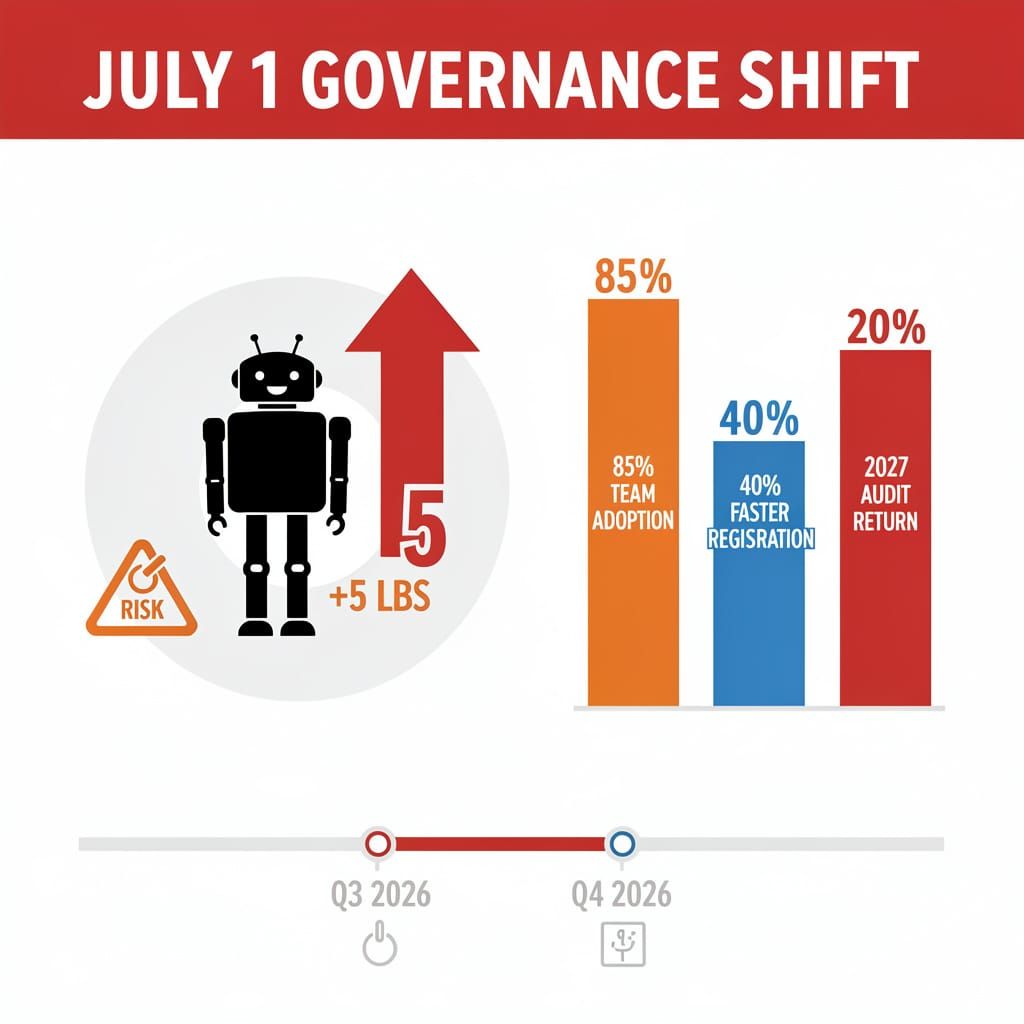
5 lbs heavier. A reckless shift toward discretionary oversight that replaces objective safety audits with 'judgment calls' ⚠️. This is the difference between a controlled collision and a catastrophic failure. Is hardware mass being prioritized over human safety? Robot teams—will this lack of standardization risk your safety?
On July 1, 2026, robotic competition governance implemented a revised regulatory framework. The updates permit a five-pound increase in robot weight, a shift presented as an evolution toward safety and integration. However, this move indicates a departure from rigid standardization toward discretionary enforcement at a time when commercial robotics is scaling without equivalent safety safeguards.
Does Discretion Equal Safety?
The new rules replace standardized audits with discretionary oversight, enabling officials to waive compliance markers based on situational judgment. This transparency gap occurs while the broader AI and robotics ecosystem faces critical instability. On June 13, the U.S. government forced Anthropic to disable its Fable 5 and Mythos 5 models globally due to national security vulnerabilities, demonstrating that even frontier AI lacks the codified standards required for safe deployment.
Simultaneously, the physical risks of heavier hardware are compounding. In Nashville, June 28 reports of respiratory distress and auditory irritation linked to counter-drone ultrasonic emitters indicate a declining public tolerance for robotic noise pollution. By removing objective weight and safety audits, the governance board ignores the causal chain between increased mass, higher kinetic energy, and the potential for catastrophic collision.
Equipment Adjustments
- Weight Limit: +5 lbs increase → enables heavier actuators and larger battery capacities.
- Autonomy: Modest expansion → permits onboard decision-making without manual overrides.
- Penalties: Refined structures → results in variable sanctions based on official interpretation.
Operational Impacts Safety: Discretionary oversight → inconsistent risk assessment across competition heats. Equity: Increased weight allowance → favors teams with high-density power sources. Compliance: Lack of standardized audits → reduces predictability of technical inspections.
The Context of Commercial Pressure
This governance shift mirrors a trend of aggressive hardware scaling over safety iteration. Unitree’s recent IPO on the STAR Market and the launch of the GD01 humanoid robot—priced at $537,000 for high-end versions—demonstrate a market prioritizing mechanical capability over regulatory caution. While the FCC issued conditional approvals for foreign-made educational drones on June 4 to expand market access, this deregulation happens amidst a climate of extreme volatility, such as the June 4 attack on a Texas ICE center, which underscores the risks of unregulated high-impact technology.
- Q3 2026: ~85% team adoption of new weight limits to maximize battery life.
- Q4 2026: Shift in meta-strategy toward high-mass stability over agility.
- 2027: Potential return to standardized audits if collision rates increase.
While FIRST has streamlined registration via a refreshed Dashboard—increasing participation velocity by 40%—administrative ease does not resolve the technical instability introduced by discarding objective safety audits.
📉 The Physical AI Consolidation: Hardware Hegemony or Integration Risk?
$7 billion spent for "Physical AI" 📉—roughly 1.35 shares per holder—yet Waymo recalls 4,000 taxis and Tesla crashes persist 🚨. Hardware consolidation is a gamble while software failures remain the bottleneck. Is vertical integration just a distraction from systemic safety risks? AV developers — do you trust the silicon or the code?
Onsemi's $7 billion all-stock acquisition of Synaptics, finalized June 30, 2026, attempts to bridge the gap between power-sensor engineering and AI-native compute. By establishing a "Physical AI platform," Onsemi seeks to reduce reliance on external silicon partners to accelerate the deployment of autonomous systems and edge robotics.
Does Vertical Integration Solve the Latency Gap?
Onsemi asserts that consolidating connectivity and power components enables seamless hardware-ML integration. However, the causal chain from acquisition to performance remains unproven. This hardware-centric push coincides with a shift toward AI-generated software efficiency; GM reported June 21, 2026, that 90% of its autonomy team's safety-critical code is now AI-generated, validated by simulations of 100 days of daily driving. This indicates that software iteration, rather than silicon integration, drives current autonomy gains.
Financials: $7 billion valuation → Synaptics holders receive 1.35 shares per original share. Market: Projected $243 billion TAM by 2030 → high dependency on AV adoption rates. Safety: Waymo recalled ~4,000 robotaxis (June 18) due to construction zone navigation errors, while a Tesla Model 3 crash in Katy, Texas (June 20), resulted in one fatality.
The Infrastructure Paradox
While Onsemi pursues terrestrial consolidation, the broader automotive sector faces systemic volatility. The June 14 completion of the Dana and Eaton Mobility Business merger signals a trend toward supplier consolidation, yet retail fragility persists. American auto dealers secured regulatory loan extensions in mid-June to avoid default amid supply-chain disruptions and $2 billion in industry losses.
Furthermore, the pursuit of "frontier" compute—such as NVIDIA's June 30 confirmation of orbital quantum stability—contrasts with basic energy constraints. Microsoft's 20-year power deal with Chevron for its Texas AI data center demonstrates that energy stability, not quantum coherence, is the primary bottleneck for physical AI.
- June 14, 2026: Dana and Eaton Mobility merger completes, consolidating automotive supply.
- June 18, 2026: Waymo recalls 3,900 robotaxis after 13 construction-zone incidents.
- June 20, 2026: Fatal Tesla autopilot-linked crash in Texas; NHTSA investigates ~3.2M FSD vehicles.
- June 30, 2026: Onsemi-Synaptics integration finalizes; NVIDIA confirms orbital quantum coherence.
The Efficiency Trade-off
Merging power electronics with edge compute intends to optimize energy efficiency, but the industry relies on theoretical TAM expansions rather than proven power-per-inference reductions. The emergence of "sovereign AI" stacks, such as Sarvam's $234 million raise, suggests a fragmentation that could undermine proprietary hardware hegemony.
Strengths: Direct manufacturing for smart-compute; reduced vendor dependency. Weaknesses: High equity dilution; unproven synergy metrics; vulnerability to spoofing (e.g., dashboard-mounted figurines bypassing FSD cameras). Competition: Sovereign AI stacks and Chinese NEV dominance (62.9% market share) → fracture of U.S.-centric supply lines. Impact: Immediate consolidation of sensing → increased market concentration in AI hardware.
📉 The Commodity Trap: The Erosion of AI Vacuum Value
44% price cuts. The robotic vacuum market is in a brutal race to the bottom—essentially a clearance sale for 'AI' 📉. Hardware has become standardized and margins are evaporating. Is AI just a baseline utility now, not a premium asset? Homeowners: would you pay a premium for a robot that's 50% off next month?
Between May and June 2026, the robotic vacuum market transitioned from a premium tech sector to a high-volume commodity battleground. This systemic pricing collapse, accelerated by synchronized Memorial Day and Prime Day events, demonstrates that "AI-powered" functionality no longer justifies premium pricing. When the Ecovacs Deebot X11 OmniCyclone hit an all-time low of $799 on June 4, it signaled a broader shift: AI has evolved from a competitive advantage into a baseline requirement.
Strategic Growth or Inventory Liquidation?
Retailers frame aggressive discounting as "increased accessibility," but the causal chain indicates a failure to sustain margins. The cycle began in mid-May, with Roborock and Eufy slashing prices for Memorial Day, followed by a June 23–26 Prime Day peak. During this window, the Shark AV series dropped from ~$550 to $249.99, and the Roborock Saros 10R saw a 44% price reduction to $270.
This devaluation is not isolated. The June 14 discontinuation of the Lenovo Idea Pad due to budget-segment saturation mirrors the robotics trend. When hardware becomes standardized, the budget tier collapses, forcing brands into a "race to the bottom." The reliance on affiliate marketing—such as Localish to drive traffic to sub-$50 deals further proves that the industry is now chasing mid-tier shoppers through volume rather than value.
Operational Realities:
- Pricing: Ecovacs Deebot X9 Pro Omni → $599; Roborock Q7 M5+ → $250 (31% reduction).
- Volume: Memorial Day promotions drove a 15–20% lift in sales volume over baseline.
- Risk: Expanded deployment of connected devices has resulted in heightened cybersecurity exposure.
Competitive Dynamics:
- Margins: Deep discounts ($300–$400 per unit) → eroded per-unit profitability.
- Brand Value: Chronic flash sales → diminished perception of "cutting-edge" innovation.
- Consumer Logic: Extreme price volatility → delayed purchasing cycles in anticipation of the next sale.
The Commodity Cycle
The trajectory for household robotics projects a period of extreme instability as manufacturers struggle to differentiate hardware.
- 2026–2027: Discount-driven models dominate, forcing a sector-wide price floor below $300 to maintain retail visibility.
- 2028: Market stability requires a pivot from one-time hardware sales to subscription-based software services to recover lost margins.
This volatility demonstrates that while AI increases utility, it fails to create sustainable economic value. The industry's reliance on 30–50% discounts to move inventory proves that the market treats AI as a standard utility, not a premium asset.


Comments ()