€30B European Funding — But a Third Went to Just 3 AI Startups | London's Fintech Reality Check
TL;DR
- VaidehiGlobal Rejects Startup Theater — Opens Cofounder Call for Physical Goods Only. Would you trade the valuation circus for a real supply chain?
- €30B EU Funding Hides a Ugly Truth: Three AI Startups Took a Third, Actual Deals Shrunk. Is London's fintech boom building companies or just expensive talent wars?
- $593 Off Lectric Xp4 750 Bundle: E-Bike Price War Signals Commoditization — Riders Win, Margins Hurt. Is the e-bike price war great for riders or a sign the industry is eating itself?
🛑 VaidehiGlobal's Anti-Tech Cofounder Hunt: Finally, Someone Who Won't Pitch You an App
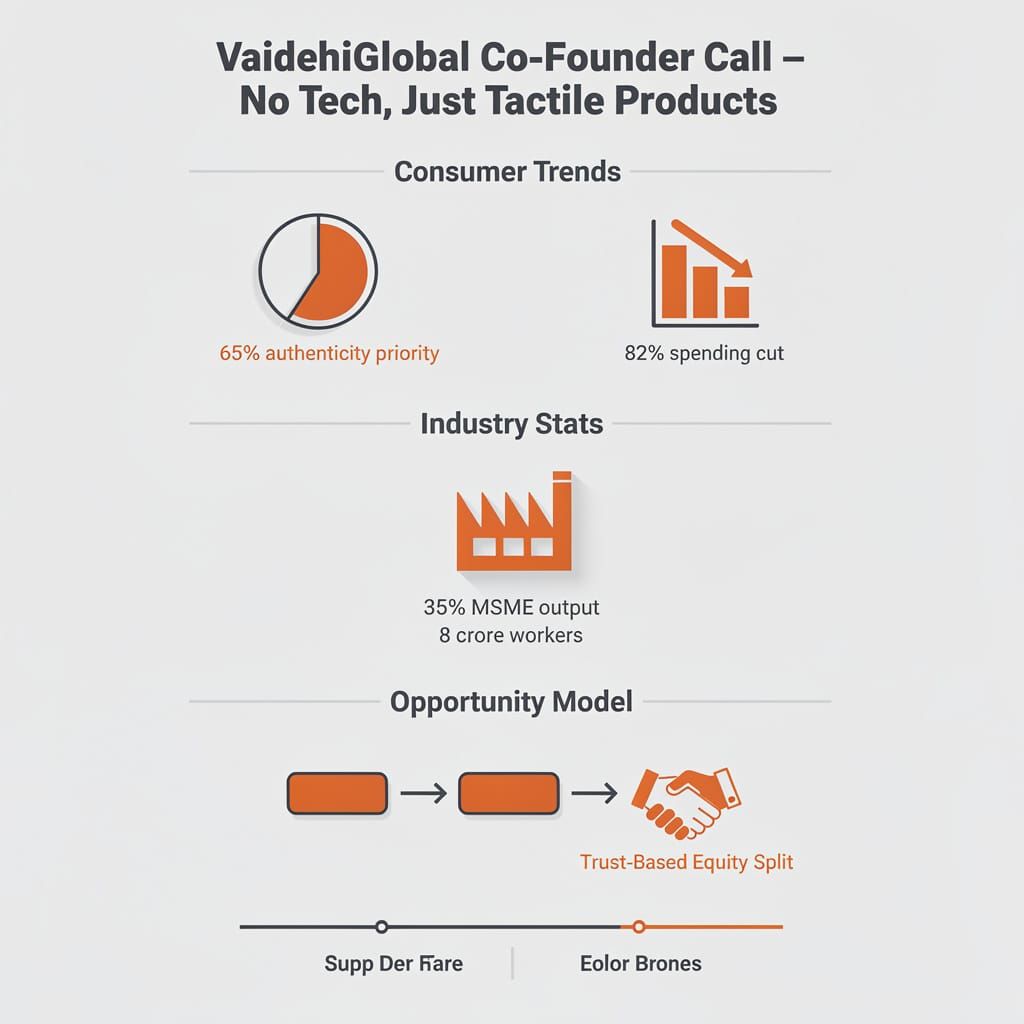
65% of consumers want affordability + authenticity over flashy marketing. Yet 82% are cutting discretionary spend. 🛑 VaidehiGlobal just opened a cofounder call in Bhopal — no SaaS, no AI, no blockchain. Tangible products. Real supply chains. Physical goods you can touch. Their bet: skip the unicorn theater, pair experienced founders with established manufacturing infrastructure, and push retail-ready products faster. 220+ unprofitable startups collapsed post-ChatGPT. Meanwhile, Indian MSMEs already power 35% of manufacturing output with factory-in-a-shed models using CNC & robotics. Hardware isn't slow. B2B SaaS dashboards are just less honest. You're an experienced product founder. No pitch deck. No spin. Would you trade the valuation circus for a trust-based equity split and a real supply chain?
Let's be honest: if you've sat through one more startup pitch that's "Uber for houseplants" or "AI-powered chapati roller," you've earned the right to be cynical. So here's a plot twist that actually matters.
On August 2, VaidehiGlobal—a Bhopal-based export and supply chain operator—opened a public call for true cofounders. The catch? No tech startups. No SaaS. No blockchain anything. They want physical products: tangibles, shelf-stockers, real-world goods.
What's actually happening: VaidehiGlobal builds global eco-brands using Indian manufacturing as its distribution backbone. They already source from Indian suppliers and run export channels. The open call invites experienced founders who can bring a product, a story, and a willingness to work—not a pitch deck with 50 slides about disruption.
Why now: A June 18 survey confirmed what everyone suspected: 65% of consumers now prioritize affordability and authenticity over flashy marketing, with ethical practices driving conversion intent. In parallel, June data showed 82% of consumers cutting discretionary spend due to inflation, while 79% of Gen Z still demands sustainability. Marketers have already pivoted to influencer-led, values-aligned campaigns—doubling conversion rates. Even Unilever, on June 20, rolled out transparent biodegradable packaging that boosted trust by 12 points and earned a 28% price-premium acceptance rate. Consumers can smell institutional marketing from a mile away. VaidehiGlobal's thesis is simple: pair a proven physical-goods founder with established supply chain infrastructure, skip the bloated valuation theater, and get products into retail networks faster.
The mechanics: The model runs on trust-based, transparent equity splits. No algorithmic bias, no "we'll figure it out post-Series A." Just human commitment and documented contributions.
What it signals: A quiet skepticism about technology-first venture logic. In a funding environment where hardware startups often get dismissed as "capital-intensive" and "slow", VaidehiGlobal is betting the opposite. The data backs them: Indian MSMEs already generate >35% of manufacturing output and ~31% of GDP while employing 8 crore people through factory-in-a-shed models using CNC, 3D printing, and robotics. Meanwhile, in VC land, ChatGPT's June 1 launch triggered the collapse of 220+ unprofitable unicorns, and funding has dried up for companies without clear AI differentiation. Tangible goods with real supply chains have higher reliability and less churn than another B2B SaaS dashboard.
- Q3 2026: Partnership negotiations begin; stable cofounder agreement expected before Q4, pending valuation alignment.
- Mid-term: Private-label launch rates across domestic retail networks accelerate, with exports scaling through established India manufacturing hubs.
The risks: Valuation negotiation is the bottleneck. One mismatched equity expectation can derail a deal faster than any product flaw. Confidence is high, but impact is medium—this isn't a unicorn factory. It's a deliberate, small-batch approach to building brands that don't require a Series C to survive.
Bottom line: VaidehiGlobal's cofounder call is a rejection of startup theater. No traction-milestone gymnastics, no fabricated urgency. Just supply chains, trust, and products people can actually touch. If that's not refreshing, what is?
🤯 London's Fintech Money Magnet: That €30 Billion Figure Might Need Asterisks
€30 billion in EU funding sounds huge until you see three AI startups gulped a third of it 🤯 London raised £13.1B; the rest of the UK scraped £4.2B. Funding rounds actually dropped from 543 to 490. The money's there—but it's picky. Startups are handing out equity like candy with zero liquidity. CEO's 1% stake = $500K paper value? 95% chance it's worth zero. Employees can't cash out and they're noticing. Talent wars + illiquid equity + narrowing exit doors. London's fintech boom: sustainable companies or just expensive chaos? 🤷♂️
It's 2026, and London hasn't quite unofficially crowned itself the fintech fundraising capital of the Western world—at least, not single-handedly. The narrative of €30 billion pouring into European ventures sounded like a clean coronation. Then July 8th landed: UK tech firms raised $15.3 billion in H1 (up 84% YoY), making the country the world's third-largest tech funder. Sounds like a victory lap, right? Not so fast. Actual funding rounds dropped to 490 from 543. One-third of that cash went to just three AI startups—Isomorphic Labs ($2.1B), Nscale ($2.0B), and Wayve ($1.2B). And £13.1 billion landed in London versus £4.2 billion everywhere else. The money's still in London. But it's getting picky.
How it works: Wealth concentration, not sector consolidation, is the real engine. On July 2nd, European VC deployed a record €3.29 billion across just 10 major funds—Kembara alone led €750 million into DeepTech and DefenceTech. Meanwhile, Expedition Ventures raised €197 million for Fund II (2.6x prior commitments) on July 8th, riding the EU's pivot to sovereignty-linked defence projects. Traditional fintech hubs aren't seeing a super-concentrated market; they're watching late-stage deal sizes get squeezed by AI's insatiable appetite.
The Talent Tango
Here's the rub. All that cash fuels aggressive hiring sprees, and startups are handing out variable equity grants tied to headcount growth. Sounds great on paper.
- The upside: Product innovation cycles are shrinking—new features ship in weeks.
- The catch: As one founder noted back in February 2025, confusing a cash business with an equity business leads to strategic failure. By June 2026, the gap was obvious: profitability ≠ liquidity when delayed client payments and biweekly salaries create zero cash runway. Those equity instruments remain illiquid. Employees wait.
"Talent competition directly threatens profitability when cash flow cannot match promised rewards."
What Breaks Next
The causal chain is uncomfortable. Cash-rich firms chasing talent → equity-heavy compensation → no exit mechanism. A June 2026 equity-vesting model showed a CEO's 1% stake valued at $500K, but only a 5% chance of a $1B exit—otherwise, zero. On June 27th, entrepreneurs exposed "double-traction vouchings"—tactics artificially inflating perceived status while the actual cap table stays murky. Employees are promised equity they can't cash out, and they're starting to notice.
- 2026 Q3–Q4: Expect stock dividends deferred until the next raise cycle—just as dividend-paying equities face pressure from growth-fund reallocation (observed June 25th). With only two IPOs this quarter versus seven previously, exit options are narrowing.
- 2027 outlook: Firms must balance aggressive hiring against realistic exit planning—or watch their best people walk.
The Uneven Playing Field
One more wrinkle: firms treat degree markers over adaptive expertise, and the July 23rd Lockheed Martin Ventures announcement—$100 million expanding into European DefenceTech with a London office reviewing 300–500 deals—signals a new competitor for the same talent pool. If the pipeline narrows, innovation momentum stalls.
The verdict? London's fintech boom is a fascinating experiment in concentrated growth. Whether it builds sustainable companies or just expensive talent wars depends entirely on how—and when—those equity promises become real money. And right now, the money's heading to Leeds.
🔥 Lectric's Xp4 750 Bundle: Saving $593 While the E-Bike Market Eats Itself
Lectric just slashed $593 off its Xp4 750 bundle — that's not a sale, that's a fire alarm 🔥 Aventon dropped its Level 3 by $600. Heybike gave $828 in savings. Brands are throwing discounts at each other because warehouses are full and demand isn't catching up. Riders win cheap e-bikes. But companies training customers to never pay full price? That's a slow bleed. Is your next commute about to get cheaper — or is the industry just burning cash to stay alive?
You know things are getting spicy when a company practically pays you to take a folding bike home. On August 3, Lectric dropped its Xp4 750 bundle deal, slashing $593 off the total package. That's not a coupon—that's a white flag wrapped in a sales pitch. The move had been telegraphed since July 22, when Lectric first reduced the Xp4 750's base price, cut costs on the Xpeaks2, and sweetened the Xpress2 Long-Range bundle by tossing in $345 in free accessories.
Why the Fire Sale?
Urban riders feel it at the pump, sure. But the real story is the industry eating itself alive. On July 31, Aventon ran a weekend flash sale dropping its Level 3 Smart Commuter by $600—the first time it dipped below $1,299 since launch. Martes and Aventon have sliced mid-range e-bike prices as much as 18% since June, with Aventon's July 4th promo hitting record lows ($1,749 for the Aventure 3, $2,649 for the Aventure M) and bundling $42 water bottle cages for extra perceived value.
Heybike joined the fray on July 1 with up to $828 in savings on its Saturn Moped-Style e-bike, then doubled down on July 22 with a $200-off coupon code 9TO5TOYS200, dropping models from $1,499–$1,799 to $799–$999. Monarc Bikes bundled a $229 smart helmet free with its Marker All-Terrain model on July 31—and on the same day launched the Tracer Urban Commuter at $1,899 with that same free helmet, a 130-mile range, and a 28 MPH motor. By July 23, Aventon was still holding prices below historical averages ($1,699 vs $1,899 on the Level 3) with no active sale—just automated algorithms keeping discounts sticky.
Too many brands, too many models, too many batteries sitting in warehouses.
The Clock Is Ticking
- August 3, 2026: Lectric bundle goes live. Expect a surge in urban commuter sales.
- Mid-August 2026: Heybike continues promotions through the holiday stretch. Aventon's discount frenzy could extend into Q3.
- 2027 outlook: If discounting becomes the norm, margins compress across the sector. Early players with good unit economics survive; late entrants eat dust.
Who Wins, Who Loses
Riders: Clear win. A foldable e-bike with utility features at effectively used-bike pricing.
Lectric: Volume play. Move units now, build the brand, train customers to never pay full price.
Competitors like Aventon and Martes: Squeezed. Aventon's already trading margin for volume—its flash sale velocity is up, but margin compression is the trade-off.
Legacy bike shops: Sitting on overpriced inventory, wondering why nobody's walking in.
The Bigger Picture
E-bikes aren't a novelty anymore. They're competing with $4-a-gallon gas and $200 monthly transit passes. The Xp4 750 bundle isn't just a good deal—it's a signal that the industry has entered its commoditization phase. Margins shrink. Volume rules. And the customer, for once, wins the short game.
For now.
Comments ()