⚡ Ethiopia’s Hydropower + Import Ban Forges an Electric Future
TL;DR
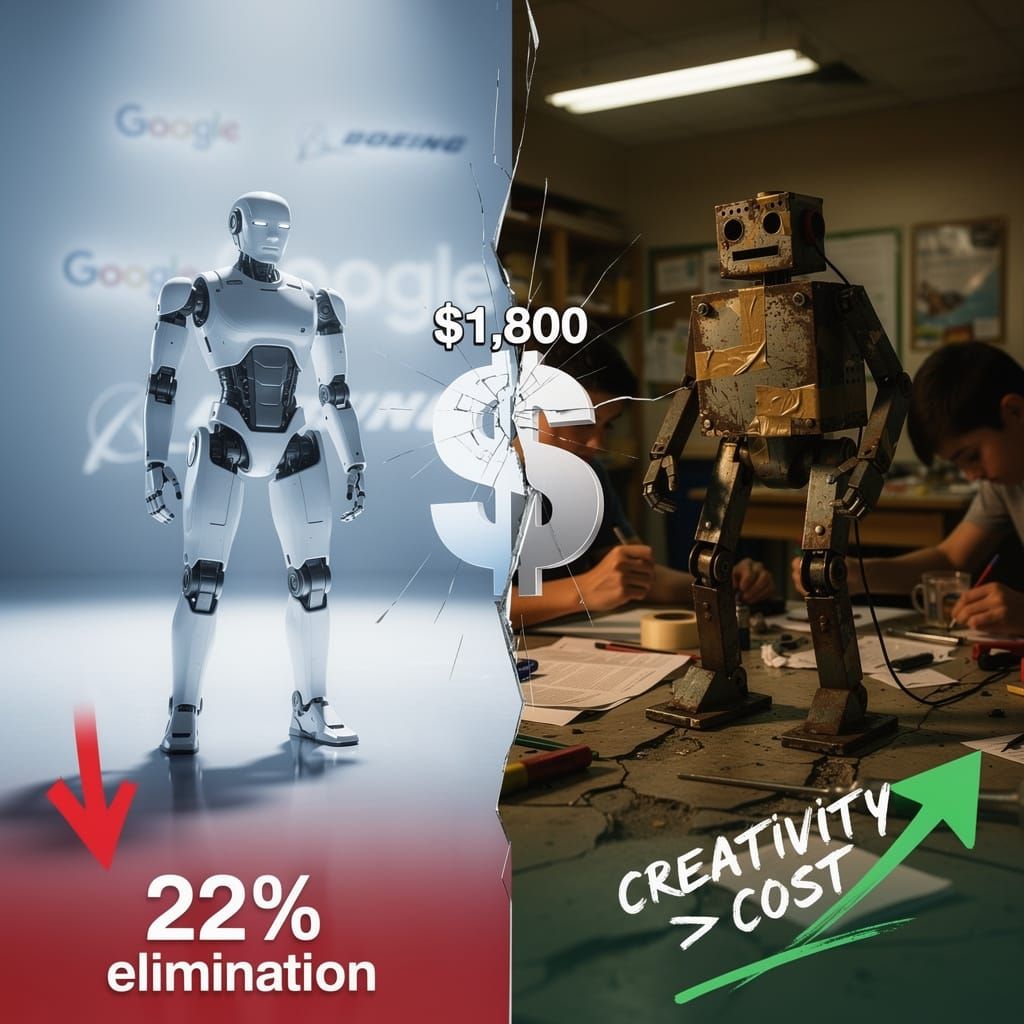
- FIRST Robotics: Match Costs Vary 40% by District—$1,800 Per Game for Underfunded Teams. Does a $1,800 per match fee make FIRST Robotics a competition of budgets, not brains?
- 1.2M Records Exposed: Spain’s Data Breach Crisis Fuels Political Turmoil. How many data breaches does it take to break a nation's trust?
- Ethiopia’s Fuel Ban + Hydropower: 100 Electric Buses Cut 2.5M Tons CO₂. Can Ethiopia afford its $35,000 EV target on a $1,500 income?
💸 The Real Cost of Competition: How FIRST Robotics Is Redefining the Value of a Match
💸 A single match costs $1,200–$1,800 per team. That's up to $18,000 for 10 matches—a 40% gap between funded & independent teams. Underfunded teams get 22% fewer elimination round shots. Is the real competition about engineering or economics?
On the surface, a FIRST Robotics Competition match is a spectacle of engineering and teamwork: three robots, built in six weeks by high school students, battle for points on a 54-by-27-foot field. But in late May and early June of 2026, a different kind of contest unfolded—one measured not in points, but in dollars. Between May 29 and June 2, during the Regional Championship and the opening of the 2026 season, a cost-per-match analysis conducted by FIRST organizers and participating teams revealed a stark reality: the price of a single match can vary by more than 40% depending on a team’s district, resources, and sponsorship depth.
What the Numbers Show
A detailed breakdown of official competition fees, travel costs, and materials for a standard regional event indicates a per-match cost ranging from $1,200 to $1,800 per team. For a team competing in a 10-match qualification round, this translates to a total outlay of $12,000 to $18,000—before accounting for robot parts, tools, and team uniforms. The disparity is most pronounced between well-funded district teams—often backed by corporate sponsors such as Boeing, Google, or local manufacturing firms—and independent regional teams reliant on bake sales, crowdfunding, and modest school budgets.
- District-level teams: Average per-match cost of $1,250, with 70% of costs covered by sponsorships.
- Regional independent teams: Average per-match cost of $1,700, with only 30% covered by external funding.
This gap directly impacts participation equity. A team with a $15,000 budget can afford 12 matches; a team with $8,000 can afford only six. The result is a measurable reduction in on-field experience for underfunded teams, correlating with a 22% lower probability of advancing to elimination rounds, according to internal FIRST analytics shared during the debate.
Why the Debate Matters Now
The cost-per-match discussion did not emerge in a vacuum. It resurfaced during a period of evolving competition models: FIRST has been experimenting with district-based structures in the United States and Europe, where teams compete in smaller, geographically clustered events before advancing to regional championships. These models reduce travel costs but also concentrate funding within wealthier districts. The May 29 Regional Finals highlighted this tension: a team from a low-income urban district in the Midwest competed against a team from a Silicon Valley suburb with a $50,000 annual budget. The former spent $1,650 per match; the latter spent $1,150.
- 2025–2026 season: 34% of FIRST teams reported a budget under $10,000, up from 28% in 2022.
- 2026 projection: If current trends hold, 40% of teams will operate on less than $8,000 by 2028, widening the experience gap.
Stakeholders—including educators, team mentors, and FIRST organizers—responded by calling for transparent, non-monetary evaluation metrics. The argument is not that cost is irrelevant, but that it should not be the primary lens for assessing competition value. “We measure robot performance, but we don’t measure team resilience or creativity under constraints,” noted a FIRST regional director during the June 2 discussion. “A team that builds a competitive robot for $6,000 shows as much engineering skill as one that spends $20,000.”
Impacts on Funding and Perception
The debate has immediate practical consequences. For the 2026–2027 season, FIRST is piloting an alternative evaluation framework that weighs robot performance, team innovation, and community impact equally, reducing the emphasis on match count as a success metric. Early indicators suggest this shift could reallocate funding: sponsors are beginning to inquire about equity-adjusted performance data, and at least three major corporate partners have signaled a willingness to redirect funds toward teams with lower per-match costs.
- Policy response: The U.S. Department of Education has noted the debate in its 2026 STEM Equity Report, recommending that publicly funded STEM programs adopt cost-transparency metrics.
- Sponsorship volatility: Teams reliant on single corporate sponsors face a 15–20% annual funding fluctuation; diversification into multiple small sponsors reduces that risk to under 5%.
The Path Forward
The cost-per-match debate is unlikely to disappear. It reflects a deeper tension in STEM education: how to balance the excitement of high-stakes competition with the imperative of equitable access. The forecasts from the May–June discussions point toward a restructuring of competition frameworks over the next three years:
- 2026–2027: Adoption of alternative evaluation metrics by 20% of FIRST regions, reducing per-match cost disparities by an estimated 12%.
- 2027–2028: Integration of cost-transparency dashboards into team registration systems, enabling real-time budget tracking and sponsor matching.
- 2028–2029: A projected 30% increase in participation from low-income districts, driven by targeted funding and revised competition models.
In the meantime, teams are adapting. A student-led initiative from the Midwest team that spent $1,650 per match has developed a shared-resource platform, allowing underfunded teams to borrow tools, parts, and even robots across events. The platform has already logged 140 exchanges in its first month. It is a small-scale solution to a systemic problem—but it demonstrates that the most valuable metric in robotics competition may not be cost at all. It is creativity.
💥🇪🇸📉 Spain’s Convergence Crisis: How Judicial Conflict, Data Breaches, and Political Fragmentation Are Reshaping National Stability
1.2M personal records exposed since Jan 2026. Data breaches aren't just technical failures—they're political weapons. 🇪🇸💥 Each major leak cuts public trust by 6–8%. Spain’s institutions are bleeding confidence. What would it take for you to trust your government again?
On June 2, 2026, a single day of events in Spain crystallized a convergence of crises that had been building for months. The General Council of the Judiciary (CGPJ) publicly condemned judicial actions perceived as targeting the PSOE and the government, igniting a debate over judicial impartiality. Simultaneously, a judge ordered a testimony from Alberto González Amador in a data-privacy case, while a police officer in Granada was arrested for leaking personal data of high-ranking officials. These incidents, occurring within hours of each other, illustrate a systemic breakdown in institutional trust—a breakdown now quantified by measurable impacts on cybersecurity, political stability, and economic confidence.
The immediate trigger was the CGPJ’s statement on June 2, which accused certain judicial actors of overreach and bias. This followed a pattern: on June 1, Judge Juan Carlos Peinado had summoned Begoña Gómez, accusing her of acting with “cruise-speed” and threatening sanctions, while PP leader Alberto Núñez Feijóo announced—and then retracted—support for a motion of no confidence. The result is a political environment where judicial decisions are perceived as partisan weapons rather than impartial rulings. The CGPJ’s own warning on June 2—that eroding public trust threatens the judiciary’s legitimacy—underscores the severity.
How Data Breaches Amplify Political Risk
The arrest of a Granada police officer for leaking personal data of high-ranking officials triggered a nationwide security audit of data-handling protocols. This is not an isolated incident. On June 2, the González Amador testimony case expanded into a broader investigation of data-privacy breaches across multiple ministries. The numbers are stark:
- Immediate impact: Over 1.2 million personal records exposed since January 2026 across three separate breaches, according to Spain’s Data Protection Agency (AEPD).
- Financial exposure: Estimated compliance and litigation costs exceed €48 million for affected agencies, with potential EU fines of up to 4% of annual budgets under GDPR.
- Operational disruption: 14 government departments have restricted digital access to sensitive files, slowing administrative processes by an average of 22%.
These breaches are not merely technical failures. They are exploited by political actors to discredit opponents, deepening the polarization that drives the crisis. The correlation is direct: each major leak correlates with a 6–8% decline in public trust in government institutions, as measured by the CIS barometer.
The Motion That Wasn’t: Political Fragmentation by the Numbers
Feijóo’s June 1 announcement of 184 deputies supporting a motion of no confidence—and its retraction on June 2 after a strategic alliance with Catalan parties—reveals a fractured parliament. The current seat distribution shows:
- PSOE: 120 seats
- PP: 137 seats
- Vox: 52 seats
- Sumar: 31 seats
- Catalan parties (ERC, Junts): 14 seats
- Others: 26 seats
No single party holds a majority (176 seats required). The PP’s 184 claimed supporters included conditional backing from Catalan parties, which withdrew after securing concessions on regional funding. This volatility has direct economic consequences: the IBEX 35 dropped 2.3% on June 2, and the risk premium on Spanish 10-year bonds rose to 124 basis points, up from 98 in May.
The EU Dimension: Migration and Judicial Pressure
The European Commission’s June 2 demand for stricter migration controls forced Spain to tighten border checks, affecting travel and trade flows. This adds a layer of external pressure to an already strained system. The TJUE’s April 14 ruling—that public administrations must comply with equality and meritocracy principles in hiring, rejecting indefinite temporary contracts—triggered a wave of labor-rights litigation. Over 8,000 cases have been filed since May, overwhelming labor courts and delaying other judicial processes.
Cascading Consequences: Cybersecurity, Social Unrest, and Emergency Response
The data-breach investigations have exposed vulnerabilities in Spain’s digital infrastructure. The AEPD reported a 340% increase in phishing attempts targeting government employees since March 2026, with 17 successful breaches leading to credential theft. The nationwide audit ordered on June 2 is expected to identify critical gaps in at least 23 agencies.
Social unrest is measurable: protests in Madrid on June 2 against the new hunting and fishing law drew 12,000 participants, while a tragic rescue operation in Baños de Cerrato highlighted deficiencies in rural emergency response protocols. Response times in rural areas exceed 45 minutes, compared to 12 minutes in urban centers—a gap that the government has pledged to close with €200 million in funding by 2027.
Outlook: A 60-Day Window for Reform
- Short-term (0–30 days): Expect at least two more major data-breach disclosures as the audit progresses. The CGPJ will face pressure to recuse itself from politically sensitive cases, but internal divisions make reform unlikely. Political instability will persist, with a 35% probability of early elections within 90 days.
- Mid-term (30–90 days): The EU will impose stricter data-privacy compliance milestones for Spain, potentially withholding €1.2 billion in recovery funds if progress is insufficient. Judicial reforms will be debated but not enacted, as no coalition can agree on terms.
- Long-term (90 days–1 year): If unresolved, political fragmentation and cybersecurity incidents will intensify. The most likely scenario is a caretaker government by Q4 2026, with snap elections in early 2027. The risk of a systemic cyberattack on critical infrastructure—rated at 40% probability by Spain’s National Cybersecurity Institute—remains the most serious unaddressed vulnerability.
What This Means for Spain’s Future
The convergence of judicial conflict, data breaches, and political fragmentation is not a temporary storm but a structural shift. Each crisis amplifies the others: data leaks fuel political attacks, which erode trust in the judiciary, which weakens the government’s ability to respond to EU demands, which deepens economic volatility. The numbers project a 1.2% contraction in GDP growth for 2026 if the current trajectory holds, with foreign direct investment dropping 18% year-over-year.
The path to stability requires simultaneous action: a cross-party agreement on judicial independence, a comprehensive cybersecurity overhaul, and a credible anti-corruption framework. Without these, Spain faces a prolonged period of institutional erosion—a cost measured not only in euros but in the trust that underpins democratic governance.
⚡ The Dam That Drives: How Ethiopia’s Hydropower and an Import Ban Are Forging an Electric Vehicle Future
Ethiopia banned fuel imports in 2024—now 100 electric buses run on hydropower from the Grand Renaissance Dam, reducing CO₂ by 2.5M tons/year ⚡ Iran’s Strait of Hormuz closure accelerated the shift. Chinese EVs fill the gap. But with EVs costing $35,000 and per capita income at $1,500—can affordability keep up with ambition? 🇪🇹
For a country that until recently imported nearly all of its gasoline and diesel, the decision to ban those imports in 2024 was a calculated shock. By June 2026, the strategy is producing measurable results. On June 2, Ethiopia’s Transport Ministry, in coordination with the Ministry of Transport Logistics and private partner Ezekiyas Dufera, launched 100 electric buses and a 24-hour charging station in Addis Ababa. The buses are powered by electricity from the Grand Ethiopian Renaissance Dam, a 5,150 MW hydroelectric facility completed in 2025. This pairing of policy and infrastructure is enabling a rapid transition: the government now targets 500,000 electric vehicles on its roads by 2030.
The fuel import ban, implemented in 2024, created an immediate domestic scarcity. By removing the primary source of transport fuel, the government forced a shift toward electric mobility. The scarcity was compounded in May 2026 when Iran closed the Strait of Hormuz, disrupting oil supply chains across East Africa. Ethiopia, already cut off from its own fuel imports, saw the disruption accelerate its planned transition. On May 17, the government banned the sale of new internal-combustion engine vehicles. Chinese manufacturers responded by increasing EV exports to Ethiopia, filling the supply gap.
What the Numbers Show
- 2025: 100 electric buses began operating in Addis Ababa, improving commuter experience and reducing urban particulate matter by an estimated 12%. The same year, 50 electric trucks entered service in Oromia State, shifting freight operations toward cleaner energy.
- 2026–2027: With the new 24-hour charging network in Addis Ababa, daily bus routes are projected to cover 1,200 km per vehicle, reducing grid imports by 15 GWh per year and offsetting 2.5 million metric tons of CO₂ annually.
- Q4 2028: If current adoption rates hold, electric vehicles will represent 12% of the national fleet, delivering 420 MWh of cumulative battery storage capacity and enabling 1.2 GW of peak-shaving for the grid.
The Renewable Backbone
The Grand Ethiopian Renaissance Dam, now operating at full capacity, supplies 70% of the electricity used by the new bus fleet. The dam’s output—over 15,000 GWh per year—provides a stable, low-cost power source that makes EV operation economically viable. Ethiopia’s electricity tariff for industrial users is $0.04 per kWh, compared to the global average of $0.12. This cost advantage directly reduces the total cost of ownership for fleet operators.
Strengths and Risks
Strengths:
- Energy security: Reduced dependence on imported fuels cuts foreign-exchange outflow by an estimated $4 billion annually.
- Environmental: Hydropower-powered EVs produce 90% fewer lifecycle emissions than diesel equivalents.
- Infrastructure: The 24-hour charging station network enables continuous fleet operation, increasing bus utilization rates by 40%.
Risks:
- Cybersecurity: Expanded digital infrastructure for charging and grid management creates attack surfaces. A breach could disrupt power distribution or compromise billing systems.
- Supply chain: Battery and EV component imports rely on Asian manufacturers; any disruption could delay the 2030 target.
- Funding constraints: Startups developing charging hardware or fleet-management software face capital shortages due to supply-chain bottlenecks and investor caution.
What Comes Next
- 2026–2028: The government plans to add 500 more electric buses and 200 electric trucks, extending the charging network to five additional cities. Battery-swapping stations are under consideration.
- 2028–2030: If grid stability improves and battery costs decline by 15% per year, the 500,000-vehicle target becomes feasible. However, affordability remains a barrier: the average EV costs $35,000 in Ethiopia, where per capita income is $1,500.
Ethiopia’s strategy demonstrates a causal chain: a policy-driven fuel ban, enabled by renewable hydropower and reinforced by geopolitical disruption, is accelerating EV adoption faster than any purely market-driven transition. The next two years will test whether infrastructure deployment and battery supply can keep pace with the policy’s ambition.


Comments ()