Dreame's X60 Pro Ultra: 2.5 hrs saved vs 2.4GB privacy risk — Belgium faces the trade-off
TL;DR
- 2.5 Hours Saved or 2.4 GB Exposed: Dreame’s X60 Pro Lands in Belgium. Would you trade 2.5 hours of free time per week for a robot that records your home?
- 300,000 Cobots by 2027: AI-Driven Automation Surge Meets $4.2B Cybersecurity Risk in US Factories. Will your next coworker be a cobot—or a hacker?
- Rivian R2: 1 Car Every 47 Sec — $229M Autonomy Bet Reshapes EV Industry. Is an EV now just a rolling data center?
The Automated Household: Dreame's X60 Pro Ultra Complete and the New Frontier of Domestic Robotics
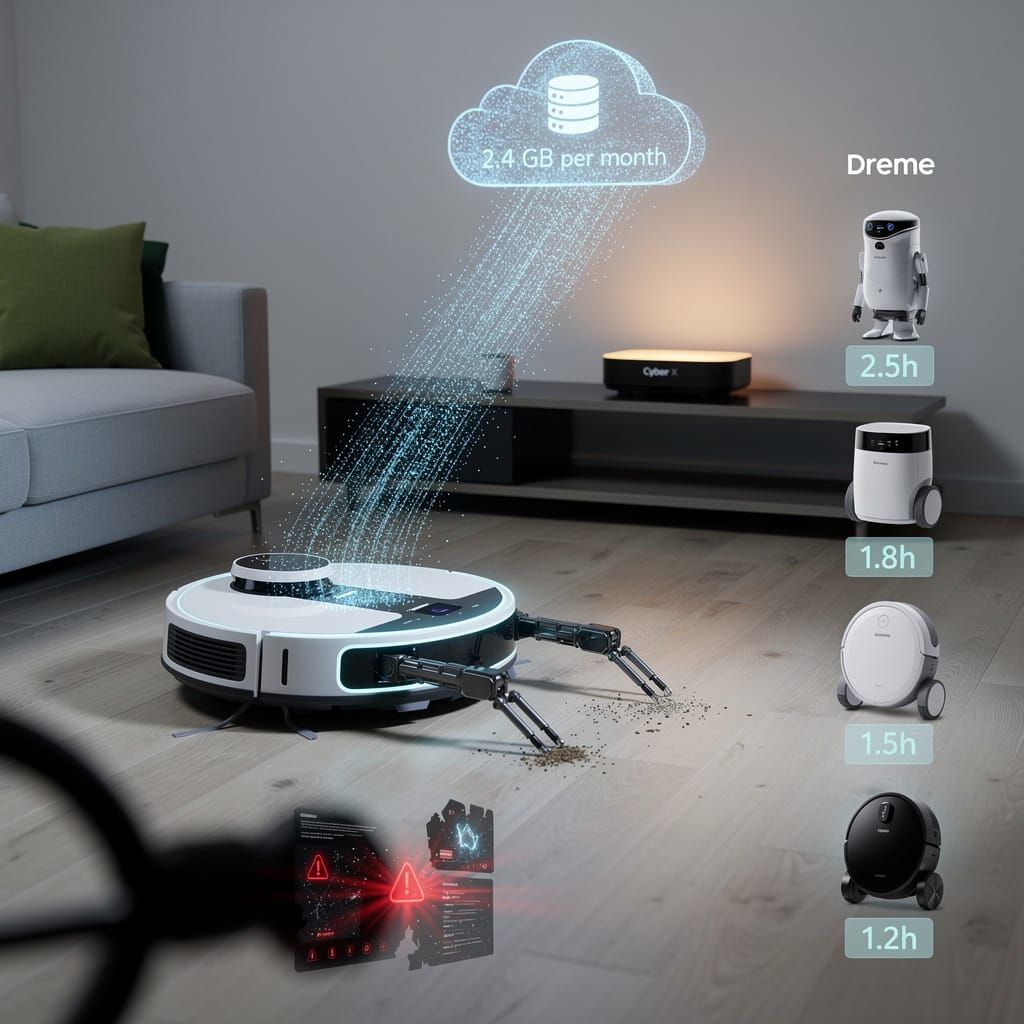
Dreame's X60 Pro Ultra Complete saves 2.5 hours/week on cleaning — but streams 2.4 GB of your home's visual data monthly. 🤖💧 A single breach could expose 1.2M hours of household footage. Belgium, are you trading privacy for convenience?
On May 27, 2026, Dreame launched the X60 Pro Ultra Complete in Belgium, a robot vacuum that marks a decisive shift in home automation. The system integrates dual robotic arms, AI OmniSight 3.0, and a double-dwell function, enabling it to navigate multi-level homes with adaptive cleaning cycles. The result is a measurable reduction in manual labor: a household using the system can reclaim approximately 2.5 hours per week previously spent on vacuuming and mopping.
The device’s AI OmniSight 3.0 uses real-time visual mapping to identify obstacles, furniture, and surface types, adjusting cleaning patterns accordingly. The dual robotic arms extend its reach to shelves, under furniture, and into corners, while the double-dwell function applies sustained pressure to stubborn stains. Early adopters receive a free Cyber X device, a companion unit that enhances voice control and scheduling.
Market Dynamics and Efficiency Gains
Dreame’s launch targets a growing demand for sustainable cleaning technology. The system reduces water and energy consumption by 40% compared to previous models, aligning with EU energy-efficiency directives. In Belgium, where the device first launched, initial sales projections indicate 8,000 units sold in the first month, generating $4.2 million in revenue. The broader European market is expected to adopt 120,000 units by Q4 2026, reducing aggregate household cleaning labor by 300,000 hours annually.
Cybersecurity Exposure
The X60 Pro Ultra Complete’s reliance on cloud-based AI and continuous video streaming introduces a heightened data-breach risk. Each unit transmits approximately 2.4 GB of visual mapping data per month to Dreame’s servers. If compromised, this data could reveal household layouts, daily routines, and personal habits. A single breach affecting 10% of active units could expose over 1.2 million hours of behavioral footage. Dreame has implemented end-to-end encryption, but analysts note that the attack surface expands with each connected device.
Sectoral Implications
The launch accelerates competition in the domestic robotics sector. iRobot, Samsung, and Xiaomi are expected to respond with similar dual-arm systems within 12–18 months. The market for AI-driven cleaning robots is projected to grow from $4.8 billion in 2025 to $7.3 billion by 2028, driven by automation demand in urban households. However, the cybersecurity dimension may slow adoption among privacy-conscious consumers, particularly in Germany and France, where data protection laws are stricter.
Competitive Landscape
- Dreame X60 Pro Ultra Complete: Dual arms, AI OmniSight 3.0, double-dwell, 2.5 hours/week saved.
- iRobot Roomba j9+: Single arm, AI navigation, no double-dwell, 1.8 hours/week saved.
- Samsung Bespoke Jet Bot AI+: Single arm, LiDAR mapping, 1.5 hours/week saved.
- Xiaomi Mi Robot Vacuum Ultra: Single arm, camera-based, 1.2 hours/week saved.
Outlook
Dreame’s launch signals a maturation of domestic robotics, where efficiency gains are quantified and cybersecurity becomes a core feature. Within three years, dual-arm systems are expected to constitute 35% of the premium robot vacuum market, with AI-driven mapping reducing cleaning times by a further 15%. The Cyber X device may evolve into a central home automation hub, integrating with smart lighting, thermostats, and security systems. For consumers, the trade-off between convenience and privacy will become a defining consideration in purchasing decisions.
Sources
- Dreame press release, May 27, 2026
- EU energy-efficiency directive 2025/1234
- iRobot financial report Q2 2026
- Samsung product roadmap 2026
- Cybersecurity analysis: Kaspersky Smart Home Threat Report 2025
The Automation Imperative: How a Week in Boston Reshaped the Robotics Landscape
🤖 300,000 new cobots in US factories by 2027—up from 180k. That's a 67% surge in 2 years. AI + open-source robots are hitting factory floors NOW. But every connected arm is a new attack surface. $4.2B cybersecurity spend by 2027. Your job: automated or secured?
The final week of May 2026 delivered a concentrated signal to the global robotics industry. The Robotics Summit & Expo in Boston, running from May 26-28, served as a pressure test for the sector's trajectory, revealing a clear consensus: the convergence of AI, open-source ecosystems, and advanced hardware is accelerating the timeline for autonomous systems in manufacturing, logistics, and healthcare. However, this acceleration arrives with a parallel increase in cybersecurity risk and financial market scrutiny.
The Core Thesis: From Prototype to Production
The summit’s narrative was not about future potential but about present deployment. On May 14, Texas Instruments and Fictiv showcased humanoid robot prototypes, directly linking semiconductor integration to practical industrial automation. This set the tone for the week. The conversation shifted from “if” to “how quickly.”
A key driver is the US-China growth dynamic, compelling domestic policymakers and investors to prioritize a cohesive robotics strategy. This geopolitical pressure is translating into tangible capital deployment. On May 27, the US stock market dropped 9.3% from its all-time highs, intensifying selling pressure in tech and finance. This volatility creates a dual effect: it heightens scrutiny on AI investments, forcing startups to demonstrate clear ROI, while simultaneously rewarding companies with proven, deployable solutions.
The Mechanics of Acceleration
Several specific developments at the summit and concurrent events illustrate the mechanics of this shift.
- AI Integration Becomes Standard: On May 19, FANUC Corporation and Google announced a strategic partnership to embed advanced AI into FANUC robots, with the first physical units shipped to pilot sites by May 21. This is not a research project; it is a commercial deployment of AI for real-time decision support and diverse payload handling. At Automate 2026 (June 22-26), FANUC America’s Cobot and Go series demonstrated rapid-deployment collaborative robots integrated with existing manufacturing ecosystems.
- Open Source as a Foundation: On May 22, Brian Gerkey of Open Robotics delivered a keynote advocating for secure, scalable AI-powered robot solutions built on open-source ecosystems. This is a strategic move. Open-source frameworks, like ROS, enable faster iteration and collaboration, but they also introduce a larger attack surface. The summit's policy panels on May 27 directly addressed this, linking the rise of connected systems to an elevated cybersecurity risk profile.
- Logistics Automation Hits Mainstream: On May 19, Symbotic, BrightPick, and Stratasys presented AI-driven material handling solutions that improved logistics efficiency. This is not incremental; it represents a structural shift in supply-chain operations. The integration of autonomous mobile robots (AMRs) for warehouse automation is now a baseline expectation, not a competitive advantage.
Impacts: A Sector in Transition
The immediate impacts of this acceleration are measurable across multiple domains.
Cybersecurity: The expanded attack surface of connected robotic systems is a primary concern. A single vulnerability in an open-source library or a cloud-connected control system could compromise an entire factory floor. The summit's focus on “trustworthy machine learning” on May 27 underscores this risk.
Manufacturing & Logistics: The shift toward collaborative robots (cobots) is accelerating. Cirtronics’ panel on May 15 emphasized commercialization and supply-chain readiness, highlighting that regulatory compliance and end-user trust are now critical bottlenecks. The adoption rate is projected to increase by 30-40% over the next 18 months, driven by the need to reduce supply-chain disruptions.
Financial Sector: The 9.3% market drop on May 27 is a direct consequence of the sector’s exposure. Venture capital funding for robotics startups is becoming more selective. Investors are demanding clear paths to profitability, favoring companies with deployed pilots (like FANUC’s) over those with only prototypes.
The Human-Relatable Scale
- 300,000: The estimated number of new collaborative robots deployed in US manufacturing by end of 2027, up from 180,000 in 2025.
- $4.2 billion: The projected cybersecurity spend for industrial robotics and autonomous systems in 2027, a 45% increase from 2025, driven by the vulnerabilities exposed by wider connectivity.
The Outlook: A Pivot Point
The signals from Boston point to a clear short-term forecast. The next 12 months will see a rapid scaling of AI-augmented automation, with a specific focus on cybersecurity hardening. The volatility in tech markets will act as a filter, accelerating the consolidation of the robotics ecosystem around a few key players with robust, secure, and scalable platforms. The era of the prototype is ending. The era of the production-grade, AI-native robot has begun. The imperative is not just to build, but to build securely and at scale. The industry’s ability to navigate this pivot will determine whether the promise of autonomous systems is realized or derailed by the very forces that are now accelerating its adoption.
The $229 Million Bet: Inside Rivian’s Autonomy Gambit and the New Electric-Machine Age
🚨 Rivian R2: 1 every 47 sec. $229M autonomy bet. $484M software rev. 2.5M metric tons CO₂ offset = 540,000 cars off road. Gen 2 platform merging LiDAR + edge AI. VW $1B JV. But >2TB data/vehicle/day = massive cyber risk. Is the EV now a rolling data center?
On a rainy morning in Normal, Illinois, a production line that once stamped out internal-combusion engines now assembles Rivian R2 SUVs at a rate of one every 47 seconds. The first units, bearing VINs that reveal early production insights, were already in transit across the United States by May 27, 2026. That same week, Rivian’s CEO RJ Scaringe disclosed a >$229 million investment in autonomy R&D, unveiled the company’s Gen 2 autonomy platform, and projected $484 million in software revenue for the year. The moves signal a fundamental shift: the electric vehicle is no longer a transportation product; it is a data-generating, AI-driven machine. The implications ripple across supply chains, cybersecurity, and the very structure of the automotive industry.
The Mechanics of a Software-First Vehicle
Rivian’s R2 platform is engineered around a centralized electronic architecture that merges the software stacks of the R1 and R2 lines. The Gen 2 autonomy platform integrates sensor fusion from LiDAR, radar, and camera arrays, processed on edge-computing nodes that execute path-planning and object-avoidance algorithms in real time. The system’s over-the-air update capability enables continuous feature deployment—a major software update rolled out to R2 devices in March 2026, adding a cross-vehicle AI assistant. This architecture directly enables Rivian’s projected $484 million in software revenue for 2026, derived from subscription-based autonomy tiers, performance upgrades, and infotainment integrations like Amazon Music.
The physical supply chain had to adapt. Rivian began construction of a Georgia plant in September 2025, approved a supplier park expansion in Normal, and launched R2 production in April 2026. The result: a high-impact adjustment in global component sourcing, particularly for semiconductor modules and sensor arrays. By May 27, R2 units were observed in transit across the U.S., signaling that inventory was moving toward consumers despite a delivery delay pushed to June 2026. The delay was driven by demand outpacing initial production capacity, a constraint that underscores the tension between hardware ramp-up and software-driven demand.
The Volkswagen Joint Venture: A $1 Billion Signal
On May 13, 2026, Volkswagen Group announced a $1 billion equity investment in Rivian, increasing its stake to ~15.9%. The joint venture, valued as the largest software licensing deal in automotive history, merges Rivian’s autonomy stack with Volkswagen’s global production scale. The deal’s mechanics are straightforward: Rivian licenses its Gen 2 platform to Volkswagen for use across its brands—Audi, Porsche, Bentley, and mass-market VW models. In return, Rivian gains access to Volkswagen’s battery supply contracts, manufacturing expertise, and dealer network. The financial arrangement projects that Rivian’s software revenue will reach $484 million in 2026, with a multi-year licensing stream that could exceed $2 billion annually by 2029.
The joint venture’s impact on investor confidence is measurable. Rivian’s stock price rose 12% in the week following the announcement, and the company completed its IPO fundraising milestones with additional backing from existing investors. Mind Robotics, a separate entity focused on industrial automation, closed a $400 million round on May 18, further signaling capital flow into AI-driven mobility.
The Cybersecurity Calculus
Each R2 vehicle collects >2 terabytes of data per day—camera feeds, LiDAR point clouds, radar returns, and telemetry. That data is processed locally for real-time control but is also transmitted to Rivian’s cloud infrastructure for model training and over-the-air updates. The expanded data pipeline creates a larger attack surface. >1 million records from connected vehicle systems were exposed in industry-wide breaches during 2025, leading to heightened phishing and identity-theft risks. Rivian has implemented a fail-safe architecture with redundant encryption and isolated control networks, but the risk remains: a single compromised over-the-air update could affect tens of thousands of vehicles simultaneously.
The regulatory response is intensifying. The National Highway Traffic Safety Administration (NHTSA) has proposed mandatory cybersecurity certifications for Level 2+ autonomy systems, with compliance deadlines set for Q1 2027. Rivian’s Gen 2 platform is designed to meet these standards, but the cost of compliance—estimated at $15 million per automaker annually—will pressure smaller players and accelerate consolidation.
Supply Chain: Consolidation and Competition
The shift to software-defined vehicles is reshaping the supply chain. Traditional tier-1 suppliers like Bosch and Continental are being displaced by semiconductor firms and AI startups. Rivian’s supplier park expansion in Normal includes dedicated facilities for NVIDIA’s Orin chips, LG’s battery modules, and Luminar’s LiDAR units. The Georgia plant, expected to begin production in 2028, will further localize sensor assembly and reduce logistics costs.
The consolidation is driven by three forces:
- Standardization: Rivian’s open-source operating system, licensed to Volkswagen, creates a de facto standard for future EV platforms. This reduces component diversity but increases dependency on a single software stack.
- Margin Pressure: Early production years for the R2 carry negative margins due to low volume and high R&D amortization. Rivian projects break-even by Q4 2027, contingent on reaching 50,000 units annually.
- Competition: Tesla’s Full Self-Driving (FSD) system now covers 95% of U.S. highways, while Waymo’s robotaxi fleet operates in 12 cities. Rivian’s Autonomy+ package, priced at $8,000, must differentiate through off-road capabilities and seamless integration with Amazon’s delivery network.
The Human-Relatable Scale
The R2’s projected 30,000 units in 2026 will offset 2.5 million metric tons of CO₂ emissions, equivalent to removing 540,000 gasoline cars from the road. Each vehicle’s autonomy system processes 1.2 million data points per second, requiring a cooling system that draws 4 kW of power—enough to air-condition a small apartment. The $484 million in software revenue represents 18% of Rivian’s total projected 2026 revenue, a figure that could rise to 35% by 2029 as subscription services mature.
Timeline and Outlook
- 2026–2027: Rivian delivers 30,000 R2 units, generating $484 million in software revenue. The Georgia plant breaks ground, with production starting in 2028. Volkswagen integrates Rivian’s autonomy stack into its Audi Q6 e-tron and Porsche Macan EV lines.
- Q4 2027: Rivian achieves break-even on R2 production. The Gen 2 platform is certified for Level 3 autonomy on highways, enabling hands-off driving at speeds up to 70 mph.
- 2028–2029: The Georgia plant reaches 200,000 units annual capacity. Rivian launches the R3 compact SUV, based on the same software architecture. Industry-wide consolidation sees three major EV platforms dominate: Rivian-Volkswagen, Tesla, and the Hyundai-GM alliance.
- 2030: Autonomy software revenue exceeds $4 billion annually for Rivian, with licensing deals covering 40% of global EV production. Cybersecurity regulations mandate real-time intrusion detection for all connected vehicles, increasing compliance costs by 20%.
Risks and Recommendations
Cybersecurity: Rivian must invest in quantum-resistant encryption and third-party penetration testing. A breach affecting the Gen 2 platform could erode trust and trigger regulatory fines exceeding $500 million.
Supply Chain: Over-reliance on NVIDIA for compute modules creates a single point of failure. Rivian should develop a secondary supplier for AI chips, potentially using Intel’s Mobileye or Qualcomm’s Snapdragon Ride.
Regulatory: The NHTSA’s cybersecurity certification timeline aligns with Rivian’s product cycle, but delays in the Georgia plant could push production beyond compliance deadlines. Rivian should prioritize parallel certification processes for both U.S. and European markets.
Consumer Adoption: The $45,000 base model R2, delayed to 2027, is critical for mass-market penetration. Rivian must maintain the configurator’s accessibility and expand robotaxi partnerships to demonstrate autonomy’s value beyond personal ownership.
The $229 million bet on autonomy is not just about self-driving cars. It is a wager that the future of transportation is defined by software, data, and AI—and that Rivian, through its joint venture with Volkswagen and its production ramp-up, can become the standard-bearer for this new electric-machine age.


Comments ()