🚁💥 News Helicopter Crash Deaths Renew Aviation Safety Scrutiny
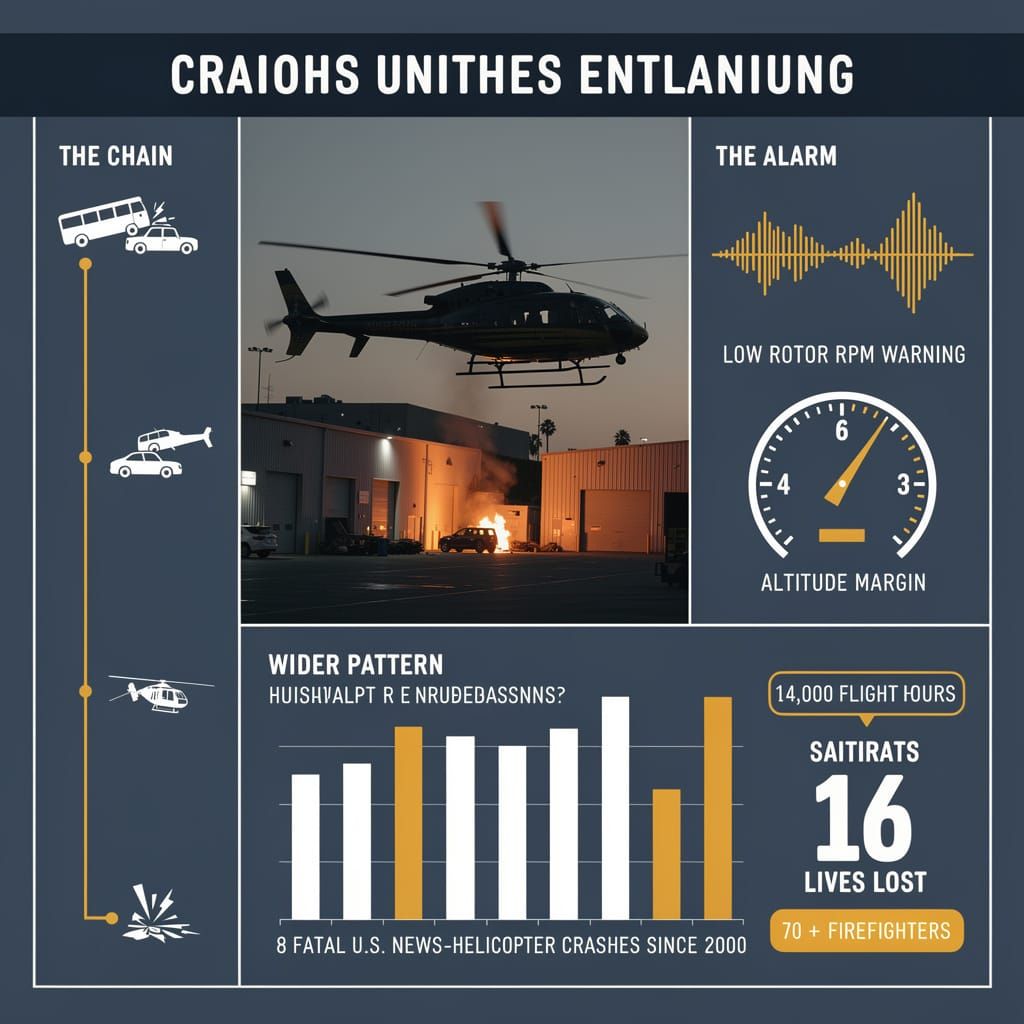
14,000 flight hours couldn't save the pilot. A low-RPM alarm sounded—then silence. A news helicopter hovering to frame a live shot has almost no altitude for autorotation. The Chatsworth crash is the 8th fatal helicopter accident in the US since 2000—16 lives lost. Should a chopper have been overhead covering a routine bus collision at all? 🚁 Was this a mechanical failure or a systemic risk we've been ignoring for decades? What would you change?
On the evening of September 15, 2026, an NBC4 NewsChopper4 Eurocopter AS350 B2 descended out of the skies over Chatsworth, Los Angeles, and struck a parking lot near an industrial building. Aboard were 38-year-old aerial reporter Eliana Moreno and 70-year-old pilot George Marciniw, a veteran with more than 14,000 flight hours. Both died, along with 29-year-old Guatemalan bystander Edy Gutierrez Mejia. Four vehicles and two storage containers caught fire at the impact site, and more than 70 firefighters responded.
The crew was covering a fatal collision between an SUV and a Metro Line 166 bus roughly 1.5 miles away. That earlier crash had claimed two passengers—Gage Weida, 31, and Daniel Castillo, 46—and injured six. The chain of events raised an uncomfortable question: should a news helicopter have been overhead at all?
A Low Rpm Alarm, Then Silence
The National Transportation Safety Board's preliminary report is due within 30 days; a final determination could take up to 18 months. But audio from the aircraft already sketches an outline. Investigators recovered a low rotor RPM warning sounding in the cabin before the helicopter swayed and dropped. In the final moments, the pilot is heard asking, "What? You can't pull up?" Dashcam footage captured by driver Yera Valencia shows the rapid, uncontrolled descent.
A Eurocopter AS350 B2 executing a power-loss at low altitude has little room to maneuver. Autorotation, the emergency procedure that uses the RPM of the turning rotor to slow a fall, requires altitude to execute. Hovering near a crash scene to frame a live shot, the crew had almost none. Investigators reviewing video and wreckage at the site, along with the NTSB-recovered pristine audio for sound spectrum analysis, have flagged the mechanical RPM alarm as a likely sign of engine power loss and rotor speed reduction at a height where recovery was not possible.
Part of a Wider Pattern
The Chatsworth tragedy is not isolated. It marks the eighth fatal news helicopter crash in the United States since 2000, a category that has now claimed 16 lives. The most remembered predecessor came in Phoenix in July 2007, when two news helicopters collided while covering a police chase, killing all four journalists aboard—pilots Craig Smith and Scott Bowerbank, photojournalists Rick Krolak and Jim Cox.
News helicopters have operated in Los Angeles since KTLA's "Telecopter" debuted in 1958, an innovation that made aerial reporting a competitive weapon for stations eager to beat rivals to breaking scenes. Nearly seven decades later, that competitive logic remains largely unexamined. The safety record since 2000 suggests the risk calculus deserves scrutiny—especially for routine coverage assignments like a bus collision two hours after the fact.
A Second Incident No One Asked For
The crash also layered a second tragedy onto an avoidable first one. Motorist Bailee Lynn Rios, 36, faces murder charges after authorities allege she drove a 2004 Ford Expedition the wrong way on De Soto Avenue, ran a red light, and struck the Metro bus on Nordhoff Street. She is being held on $4.03 million bail.
What the aviation record does not support is treating this as an isolated equipment failure. The NTSB will likely weigh whether the operational context—low-altitude hovering over an active emergency scene with first responders already congesting a tight airspace, and a pilot logging a long shift—factored into the outcome. Marciniw's experience did not save him. That is precisely the point investigators will wrestle with: resilience is not a substitute for margin.
The Outlook
For NBC4 and Telemundo 52, which operated the aircraft through Angel City Air, the immediate future is investigative and emotional. A memorial service was held at Whiteman Airport, from which the helicopter, built in 2004, had departed; a community vigil occurred at St. John Eudes Parish. The station's own anchor, Robert Kovacik, was visibly shaken on air—the crew had been his colleagues.
Longer term, the question is whether regulators and stations will treat this as a systemic issue. With eight fatal crashes and 16 deaths since 2000, aerial news operations in congested urban airspace have yet to demonstrate they can be made meaningfully safer. The NTSB's findings, whenever they arrive, will test whether the industry is willing to hear the answer.


Comments ()