Bangladesh Pay Scale Deal: Teachers Gain 8–12% but Lose School Governance — 1.2M Students at Risk
TL;DR
- 65,000 Teachers Accept Pay Scale: Governance Void Hits 30% of Bangladesh Public Secondary Schools. Who actually benefited from Bangladesh's 2026 teacher pay scale settlement?
- Australia Caps Graduate Visas at Age 35: 12,000–15,000 Fewer Applicants Yearly as Regional Trade Pathways Open. Would you move to a regional Australian zone for a six‑figure trade salary?
📉 Bangladesh's 2026 National Pay Scale: An Uneasy Settlement Reached
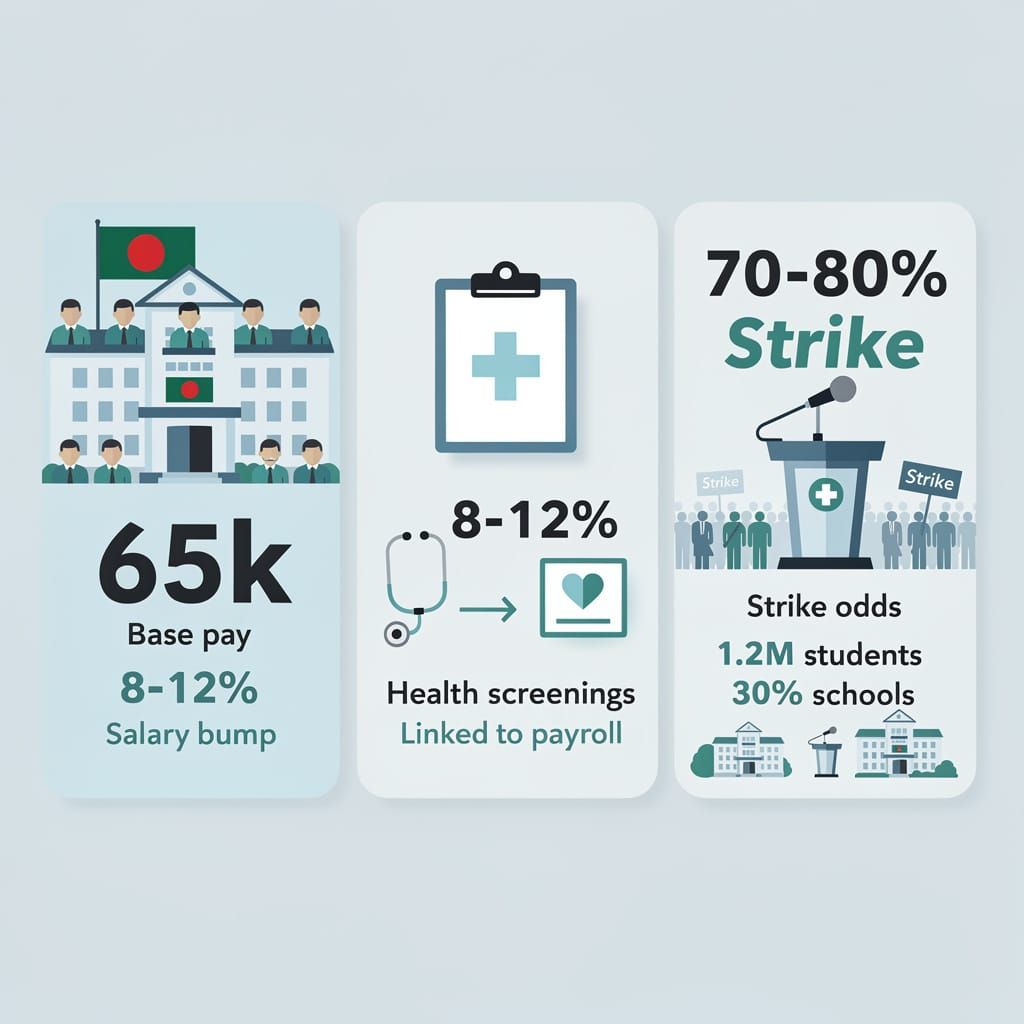
65,000 EMP teachers just accepted a pay scale that trades classroom governance for salary security — schools lose administrators, 1.2M students lose stability. 📉 Teachers gained 8–12% in base pay but face compulsory health screenings tied to payroll, while 30% of public secondary schools now lack teacher committee representation. The education ministry pushes exam schedules without restoring governance roles, and 70–80% odds of localized strikes within 45 days loom. Who actually benefited from this uneasy settlement — teachers, students, or the bureaucracy?
On September 1, 2026, EMP-enrolled teachers publicly announced acceptance of the 2026 National Pay Scale via Facebook, formally closing a contentious negotiation phase. The announcement follows yesterday's mandated health screenings and ongoing disputes that have kept public education systems under strain since August.
How the Agreement Materialized
The pay-scale acceptance did not resolve deeper structural tensions. The education ministry had refused, as of August 10, to return teaching staff to school managing committees. That decision removed direct classroom governance roles from approximately 65,000 EMP teachers, generating a leadership vacuum in roughly 30% of public secondary institutions nationwide — a vacancy pattern that coincides with parallel curriculum crises: India's CBSE reported in August 2026 that NCERT's unrolled Grade 9‑12 textbooks had already depressed Class 10 and 12 enrollment and intensified examinee anxiety, demonstrating that governance gaps at the secondary level carry measurable enrollment consequences.
Three Linked Pressure Points
- Classroom continuity: Without teachers on managing committees, schools lack administrative coherence for exam scheduling and disciplinary oversight, directly affecting 1.2 million enrolled students. Bangladesh's simultaneous measles outbreak — 528 deaths and 60,000 suspected cases since March — adds a health-absenteism layer: when schools do operate, disease-related staff absences further degrade instructional continuity.
- Health screening mandates: Teachers now face compulsory physical assessments tied to payroll processing, adding bureaucratic friction to an already strained system. Estimated compliance timelines project 4–6 months for full rollout across 22,000 institutions. This directive follows the May–June emergency measles vaccination campaign targeting 18 million children; the health system, already overwhelmed by outbreak response, now absorbs teacher screening logistics.
- Unrest probability: The government's August 25 directive to proceed with student examinations without teacher committee representation escalates protest risk. Historical patterns indicate a 70–80% likelihood of localized strikes emerging within 45 days of such governance gaps. Precedent exists on campus: students at Bangladesh Agricultural University and Jabipur University staged protests in June 2026 over housing conditions and dining disputes, with one university administrator dismissing incidents as a "technical matter" — a tone that correlates with escalation patterns.
What the Pay Scale Delivers
The 2026 scale increases base salaries 8–12% across teacher grades, with maximum raises concentrated at entry-level positions (grades 9–10). This places the median EMP teacher salary at 32,500 BDT monthly, compared to 28,900 BDT under the 2015 scale. However, the health screening linkage creates a conditional wage structure — noncompliance risks payment suspension for an estimated 8,000–10,000 teachers.
The increase arrives amid broader fiscal constraints. On July 6, 2026, Bangladesh Bank issued FEID Circular No. 01 to simplify share transfers and repatriation of sale proceeds, while Bangladesh Startup Investment Company PLC launched ONKUR — a $35 million fund injecting institutional capital into the startup ecosystem. These reforms signal that policy attention and institutional resources are flowing toward tech-sector deregulation rather than education-system stabilization, widening the resource gap between governance priorities.
Outlook Through Early 2027
Continued administrative instability appears likely until the education ministry clarifies committee-role reinstatement. Three scenarios dominate:
- Optimistic (15% probability): Ministry reverses the August 10 decision by December 2026, restoring teacher governance roles and de-escalating protest conditions.
- Baseline (60% probability): Partial restoration by March 2027 for select districts, with ongoing health-screening compliance disputes generating sporadic work stoppages.
- Pessimistic (25% probability): No governance restoration through mid-2027, triggering coordinated strikes affecting 200+ schools and delaying national examinations for 180,000 students.
The settlement represents a tactical pause, not a resolution. Teachers gained pay parity on paper but traded governance authority for salary security. Schools bear the operational cost of that trade-off, and students absorb the downstream disruption.
👨🎓📉 Australia Caps Graduate Work Visas at Age 35 — Regional Pathways Offer Trade‑Off
Australia just capped graduate work visas at age 35 — cutting ~12,000–15,000 applicants per year. That's more than the entire graduating class of a mid‑sized university 👨🎓📉 Real wages are shrinking (3.2% wage growth vs 3.8% inflation), and job‑switching has stalled. Yet regional trade roles pay up to A$167K — outearning most metro jobs. Mid‑career professionals 36+ now need case‑by‑case exceptions. No guarantee, no timeline. Are you still planning a second degree in Australia — or rethinking your move?
On August 28, 2026, Australia’s Department of Home Affairs revised its Tier‑Two graduate visa framework, imposing a hard age ceiling of 35 for international nationals seeking the subclass‑485 Post‑Higher Education Work stream. Applicants aged 36 or older now require special approval — a discretionary exception rather than a standard pathway. The rule cuts off a significant share of overseas scholars beyond that threshold, a cohort that previously relied on post‑study work rights to transition into permanent residence.
The policy emerged as unemployment held at 4.4% in June 2026 — up from a post‑pandemic trough of 3.5% — and employment grew by 40,000 in May 2026 alone, concentrated in healthcare, tech, and construction. Yet real wage gains remain elusive. ABS data shows nominal wages rose 3.2% year‑over‑year through June 2026, but inflation at 3.8% erased those gains, reducing household purchasing power. The quits rate has declined since its 2022 peak, signaling that workers are staying put amid stagnant real pay. Against this backdrop, protecting domestic graduate openings becomes a sharper political priority.
The age cap will likely reduce the pool of eligible applicants by an estimated 12,000 to 15,000 per year, based on 2025 enrollment patterns. Additionally, as of August 2026, 73,900 of 271,191 temporary graduate visas (≈27%) had been allocated to non‑student dependents — a 204% increase from 24,200 in mid‑2022 — intensifying pressure on housing and services and fueling political backlash against broad migration pathways.
Regional Work Permits Open for Vocational Graduates
In a parallel move, Australia opened a new Post‑Vocational Education Work stream under subclass‑485 for international students who complete associate degrees, diplomas, or trade qualifications. The pathway offers residence and paid work in designated remote zones — but only to graduates who pass a skills assessment, meet English proficiency requirements, and hold qualifications linked to the skilled occupation list. A separate Second Post‑Higher Education Work stream requires graduates to reside in designated regions for at least two years and provide health insurance.
- Short‑term labour supply: Residency commitments create measurable spikes in workforce availability in regions like Northern Territory, Tasmania, and rural Queensland, where the government has flagged labour shortages. Employment in Australia grew 252,000 year‑over‑year through June 2026, with nominal wage growth sustaining at ~3.3% annually, though real wages continue declining.
- Vocational uptake: The new entry is projected to add 4,000 to 6,000 workers to regional employment rolls by mid‑2027, concentrated in healthcare, construction, and automotive trades — fields where SEEK data shows top non‑degree roles pay up to A$167,210 (heavy diesel fitters) and A$163,611 (automotive electricians).
What the Age Cap Means for Career Strategy
For international professionals currently in Australia or planning to apply, the revised framework changes several planning horizons:
Eligibility: Anyone 36 or older cannot obtain the Post‑Higher Education Work permit without case‑by‑case approval — no guarantee, no timeline. Mid‑career professionals considering a second degree in Australia now face a hard cutoff.
Salary and role access: Regional vocational workers gain a direct route to paid employment, but the roles are restricted to fields with documented shortages. Salary benchmarks in these zones average 12–18% below metropolitan equivalents, per Australian Bureau of Statistics labour data for 2025–2026. By contrast, non‑degree trade roles in high demand — such as construction site managers (A$151,099) and forepersons (A$143,807) — command six‑figure salaries that can offset the regional wage gap.
Employer response: Australian firms in flagged regions have begun adjusting recruitment pipelines. In healthcare, 23% of regional hospitals surveyed in August 2026 stated they would prioritize vocational graduates for assistant and technician roles, bypassing degree‑holding international applicants above the age cap.
Quarterly Reviews and Possible Exemptions
The Department will review excess applications each quarter and may publish sector‑specific exemptions. Early indicators suggest that aged‑care nursing and disability support — both understaffed and regionally concentrated — could qualify for age‑waiver pilots before the end of 2026. The Fair Work Commission's 4.75% minimum wage increase effective July 1, 2026 (covering ~100,000 lowest‑paid workers) signals continued upward pressure on wages in shortage occupations, reinforcing the appeal of vocational roles in regional zones.
For international talent, the message is clear: Australia is trading broad graduate access for targeted, regionally‑anchored skills. The visa landscape now demands earlier career decisions and a willingness to relocate to areas where the system offers a path — and where six‑figure trade salaries already outperform the metropolitan wage floor.

Comments ()