50,000 Job Cuts at Volkswagen: German Auto Giant Collapses Under Chinese EV Pressure
🇩🇪 Volkswagen Faces a Reckoning: 50,000 Jobs at Risk as Chinese EVs Reshape the Industry
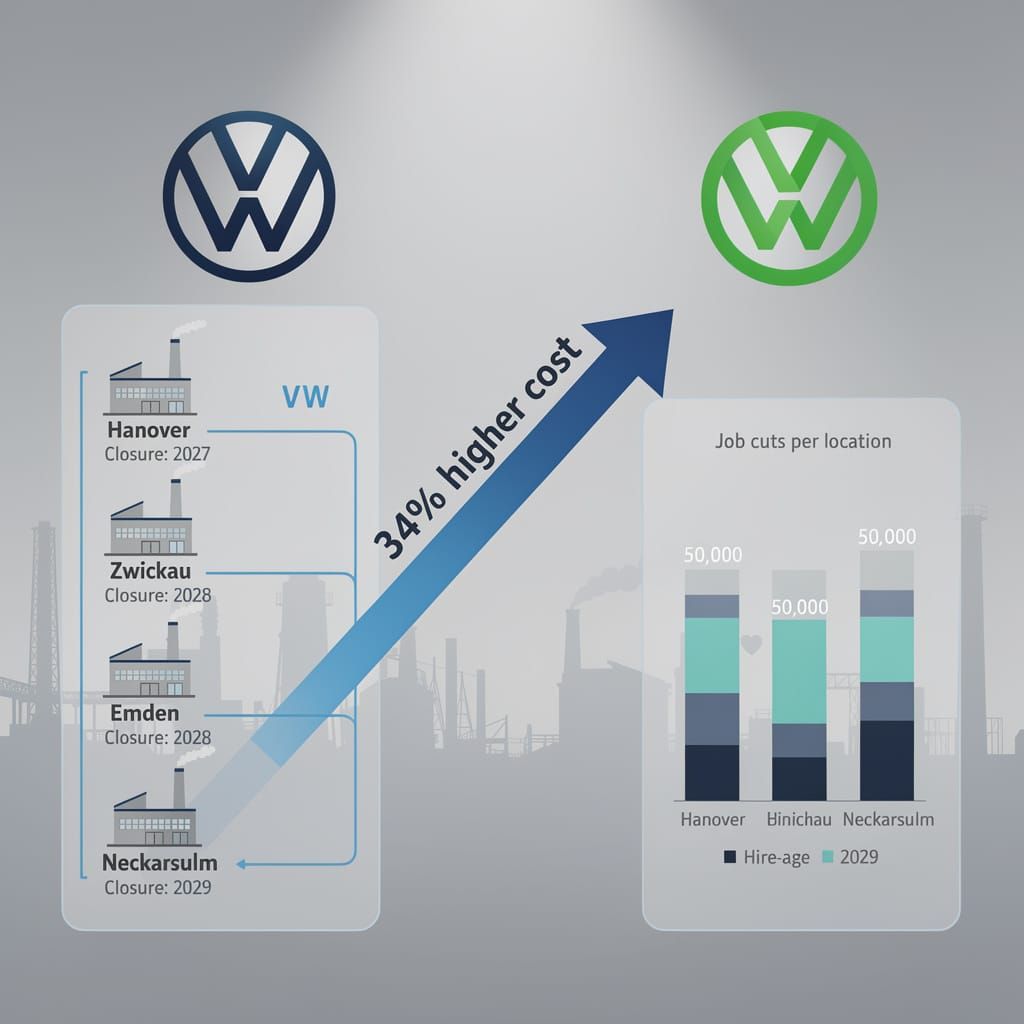
50,000 VW workers face layoffs—the largest workforce reduction in German industrial history 🇩🇪 The company's cost per EV is 34% higher than BYD's, and Chinese EV makers now capture 61% of their domestic market. Four German plants are closing. Union resistance is mounting, but the gap keeps widening. Is Germany's auto industry running out of time to catch up?
On June 26, 2026, Volkswagen Group executives presented a restructuring plan targeting 45,000 positions, citing a 14.3% quarterly profit decline to €2.46 billion. By August 7, CEO Oliver Blume activated the full plan—what may become the largest workforce reduction in German industrial history—after a €949 million profit collapse at Porsche SE in the first half of 2026.
Chinese EV makers now capture 61% of the domestic market and 18% of global EV sales, with BYD and Xpeng collectively seizing 10.7% of Western European EV sales by August 4. Global EV sales exceeded 23 million units by June 19—an 11% year-on-year increase representing 27% of total car sales—driven by lithium-ion battery cost declines that brought electric vehicles into direct price parity with internal combustion engines. Volkswagen's cost per EV remains 34% higher than BYD's—a gap that contributed to a Q2 operating profit drop of 32.9% to €1.54 billion and forced a 15% reduction in five-year investment to €130 billion.
The Mechanics of Restructuring
The plan includes:
- Up to 100,000 job cuts globally across Wolfsburg, Zwickau, Hanover, Emden, Salzgitter, Braunschweig, Neckarsulm, Dresden, Chemnitz, and Berlin facilities, with layoff plans announced July 20 and July 24.
- Four German plant closures (Hanover, Zwickau, Emden, Neckarsulm) approved by the supervisory board on July 9. Production of the Golf shifts to Mexico; the ID Polo moves to Spain.
- €1.5 billion annual cost reduction target by 2030, primarily through factory consolidation and workforce reductions.
Thomas Schäfer, head of the Volkswagen brand, indicated the cuts could span voluntary severance, early retirement, and phased attrition—but acknowledged that forced layoffs remain on the table if targets are unmet. The company's China operations have achieved 40–50% cost reductions through automation reaching 95%, leaving only ~150 workers in quality control at Chinese facilities.
Union Pushback and Government Stakes
Lower Saxony holds 20% of Volkswagen voting rights, placing state premier Stephan Weil in a dual role as regulator and shareholder. IG Metall initiated formal objections to mass layoffs, citing the 2023 collective agreement that bars operational layoffs through 2029. Union representatives signaled "unprecedented resistance" to any mandatory separations, though the supervisory board vote proceeded over their objections.
What Changes for Employees and Industry
For the 680,000 Volkswagen Group workers worldwide:
- Early retirement incentives: Workers aged 57+ receive severance packages between €35,000 and €98,000 depending on tenure. Germany's pension expansion for 1966-born retirees, announced June 5, may accelerate voluntary departures.
- Skill reskilling programs: Volkswagen allocates €247 million through 2027 for EV battery and software engineering training.
- Relocation risks: Zwickau, Emden, and Neckarsulm face the deepest cuts, with EV transition planned to absorb only 54% of displaced workers.
Germany's labor market, already absorbing 38,000 job cuts across automotive suppliers in 2026, now faces potential regional unemployment spikes as four manufacturing sites shut down.
Competitive Pressure Accelerates
Chinese OEMs undercut Volkswagen on cost by $9,200 per midsize EV. BYD alone sold 50,000+ vehicles in the United Kingdom—a sixfold increase over 2024 figures—while its vertical integration delivers 15–22% lower unit costs versus German rivals. Chinese firms invest €4.50 per vehicle for every €1.00 from German manufacturers. On July 30, BYD began exporting the Yuan Plus globally; global EV sales rebounded 35% in Q2 amid European subsidies and Asian affordability trends. Volkswagen responded by launching the ID. Era 5S plug-in hybrid at the Chengdu Auto Show on August 21, priced from 89,900 yuan (~$13,400)—half the price of a German Polo—leveraging Chinese development capabilities for cost efficiency.
Timeline and Forecasts
- June–July 2026: Supervisory board approves closures; labor negotiations reach federal mediation. Volkswagen board approves sale of Everllence (valued at €8–9 billion, employing 16,200) to a PE partner, signaling retreat from traditional ICE manufacturing.
- Q4 2026–Q1 2027: First voluntary separation tranche targets 12,000 workers at Emden and Zwickau; formal layoff notification period begins.
- 2026–2028: Volkswagen projects a 28% reduction in its German EV production workforce, transitioning 5,200 roles to battery-cell manufacturing at Salzgitter. EV shares forecast to exceed 30% within Q4 2026 as alternative fuels wane.
- 2029: Collective agreement expires; if restructuring targets remain unmet, compulsory layoffs become legally viable.
Volkswagen's restructuring demonstrates how a company founded in 1937, employing nearly one in 20 German industrial workers, must dismantle parts of its own infrastructure to survive the electric transition it initially dismissed. The question now is not whether the cuts proceed, but whether they arrive fast enough to close a cost gap that BYD widens with every quarter.

Comments ()