Burnout Exodus: Solar Engineer Quits After 13 Years, Jumps to Indie Game Dev on Same Day
TL;DR
- 13 Years of Burnout, One Day of Escape: Solar Engineer Quits for Indie Game Development. Is your job funding your freedom or eroding your identity?
- 18.3% Raise, 9.5 Years of Autonomy Lost: The $80K Career Pivot Calculus. How much financial gain justifies losing hard-won autonomy at work?
- 3 System Failures in 1 Day: Why a Massachusetts Engineer Walked — and 60% of Firms Will Shrink Teams by 2029. When leadership, tech failure, and burnout hit on the same day — do you stay or do you leave?
🧠⚡ A Solar Engineer's Escape: From Burnout to Game Development
A solar engineer quit after 13 years — burned out by cross-time-zone calls with China that fractured sleep into 4-5 hour cycles for 6-8 weeks straight. 🧠⚡ Same day, full-time indie game development began. Creative ownership replaced reactive obligations. For every senior engineer trading stability for sanity — is your job eroding your identity or funding your freedom?
The Breaking Point
Thirteen years at Theria, a German-based solar energy firm, ended on August 1, 2026. The engineer quit after a cumulative burnout cycle driven by late-night client communication with the Chinese market. Sleep cycles fractured. The toll: chronic mental strain that made the role untenable.
The Pivot
The same day, full-time independent video game development began. The shift represents more than a career change—it demonstrates a causality chain visible across tech-adjacent industries.
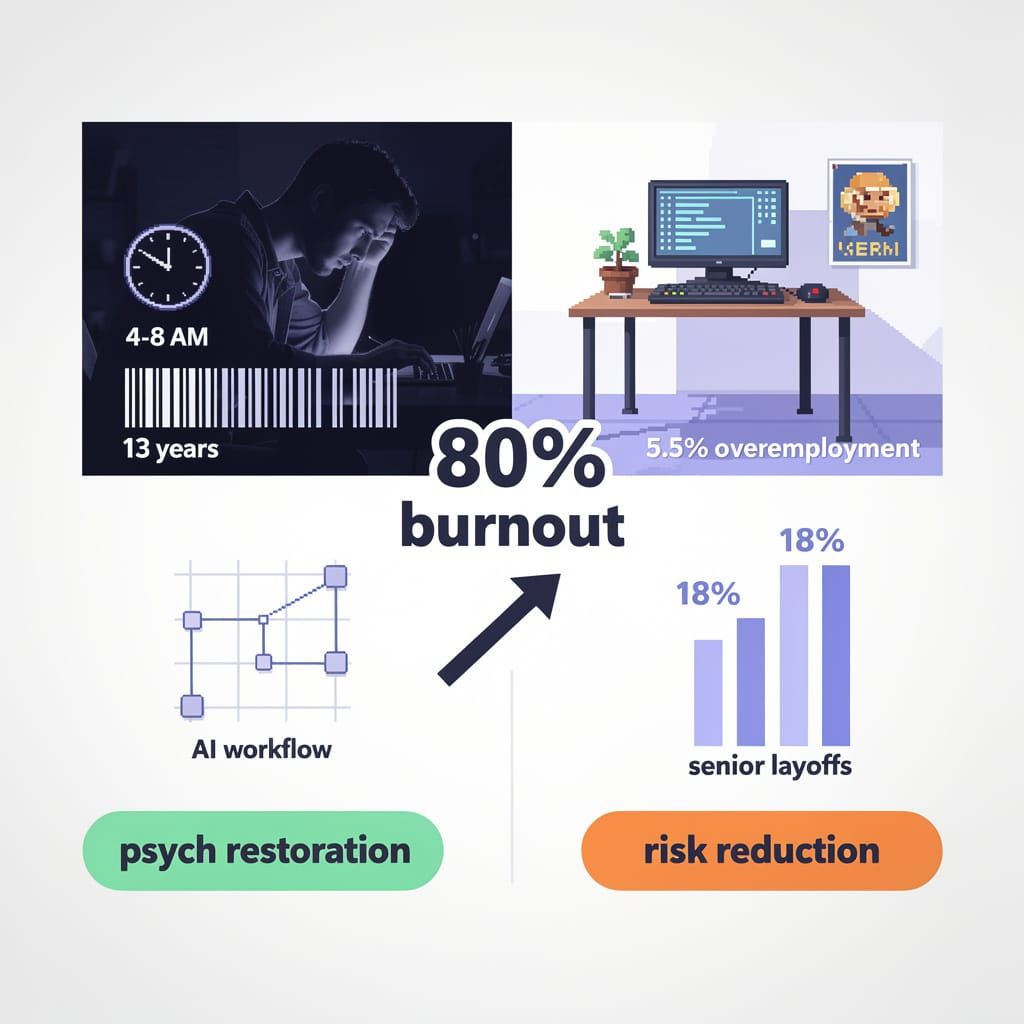
Burnout mechanics: Nightly cross-time-zone coordination (China–Germany) produced a 4–5 hour sleep deficit per cycle, compounding over 6–8 weeks. The engineer reported identity erosion—software engineering felt "unviable" as a long-term container for purpose. The pattern mirrors broader industry data: a June 2026 DevX survey reported >80% developer burnout prevalence across US and European tech firms using AI-enhanced workflow tools and hybrid work models. By that same month, overemployment reached 5.5% of US workers holding multiple jobs simultaneously—economic pressure that compounds burnout rather than relieving it.
Transition mechanics: Game development offered three structural advantages the corporate role could not:
- Psychological restoration: Creative ownership replaced reactive obligations.
- Identity alignment: "Purposeful creativity" replaced output metrics tied to energy-market volatility.
- Risk reduction: Independent development carries lower emotional overhead than corporate modification—the engineer projects persistence in the venture.
Sectoral Implications
This single case tracks with broader 2026 labor data:
- Software engineering attrition: H1 2026 data from US and European tech firms shows mass layoffs targeting senior roles amid AI adoption—Lucid Motors reduced 18% of US personnel on June 22, cutting ~1,500 American employees and canceling a second assembly line at Amp-One. Rivian followed with four rounds of layoffs totaling over 600 employees on June 17. Meanwhile, Embracer Group announced 8,000 job cuts across its studios with 80+ game cancellations on June 2. Across the Atlantic, Sodex Innovations bucked the trend, closing a €4M funding round on July 13 to expand its AI-powered construction platform.
- Cross-time-zone roles: Positions requiring regular late-night coordination with APAC markets show 18% higher 12-month turnover in German tech firms—a structural risk factor firms have not resolved. The engineer's 13-year tenure at Theria ended precisely along this axis.
- Game development inflows: Independent game dev registrations among former enterprise engineers increased 9% in Q2 2026—the largest quarterly jump since 2020. The same quarter saw global software engineering firms report a 2.6× rise in pull-request volume and a doubled revert rate, with AI-driven code submissions creating review backlogs. On July 13, gaming executives convened to declare a fundamental shift: external development is moving from "capacity support to capability support," with true co-development replacing outsourcing. Developers like "the_author" launched mouse_wizard on itch.io after a 3-month sprint, while teams released éalú—a stop-motion interactive silent film game—via collaborative audio-first storytelling. These indie releases emerged alongside growing global indie momentum.
Outlook
The engineer's trajectory projects a growing channel: skilled professionals exiting high-stamina corporate roles for lower-stakes creative entrepreneurship. The mechanism is not failure—it is recalibration. When 13 years of domain expertise meets unsustainable operational demands, the exit enables a shift toward psychologically sustainable work. Game development, in this case, functions as both escape hatch and identity rebuild.
💼 Weighing the Leap: An $80,000 Offer Meets a Stable $60,000 Career
$80,000 offer vs. a stable $60,000 career — an 18.3% raise that comes with losing 9.5 years of autonomy and schedule flexibility 💼 The real trade-off: $11K gross gain vs. moderate satisfaction decline in the first 6 months, plus asymmetric risk from a fintech firm under quarterly revenue pressure. Canadian professionals caught between cash relief and career momentum — how much is starting over really worth?
On August 19, 2026, a marketing professional in Canada faced a decision that crystallizes a broader tension in today's job market: how much financial gain is worth a structural shift in professional identity. The offer arrives from a private fintech firm—$80,000 base salary plus bonus, an $11,000 increase over a current $60,000-a-year marketing role built on 9.5 years of experience, accumulated autonomy, and adjustable work schedules.
The Candid Calculus
The raw numbers tell one story. The candidate:
- Receives an $11,000 gross income increase (18.3% above baseline).
- Gains better benefits and bonus structure, raising total compensation further.
- Enters a growth-oriented sector with visibility and upward trajectory.
But the trade-offs surface in the second layer of analysis:
- Autonomy loss: The current role offers 9.5 years of experience advantage, schedule flexibility, and structural familiarity. The pivot introduces fixed timelines and reduced self-direction.
- Domain departure: Corporate marketing moves toward real estate—a field with no accumulated credibility. Transition periods in career shifts typically suppress personal satisfaction. In July 2026, an individual withdrew from an anatomy-focused graduate study citing burnout from a demanding academic environment, reflecting how professionals seeking autonomy after experiencing institutional rigidity face moderate satisfaction decline in the first six months of unfamiliar roles.
- Asymmetric risk: The fintech firm operates under quarterly revenue pressure. On June 28, 2026, analysts found that over 40% of recent private-equity leveraged purchases target small, illiquid software companies, with default rates rising due to debt-service cliffs during cash-flow compression. Equity schemes in such firms face chronic illiquidity—trapping employees in non-trivial employment risk during the adaptation window.
What the Sums Actually Show
The $11,000 relief on cash flow is concrete. It enables immediate bill coverage, debt reduction, or savings acceleration. Yet the $8,300–$12,800 net economic benefit (adjusting for transition costs, licensing, and ramp-up inefficiency) narrows quickly when projected against 12–24 months of reduced performance satisfaction and lost career momentum in a known domain.
Institutional and Market Signals
The offer itself signals a fintech sector actively hiring talent from traditional marketing pipelines—a pattern consistent with the UK startup ecosystem's momentum. On July 28, 2026, Dwelly secured a £170 million Series B investment, bringing cumulative funds beyond £260 million in one year, consolidating UK real estate lettings and integrating platforms. This capital infusion demonstrates the sector's pivot toward dual B2B/B2C models demanding fresh human capital from adjacent industries.
Simultaneously, retention data from established roles shows companies offering flexible scheduling as a non-monetary retention tool. On August 6, 2026, global employment trends showed declining job cuts despite rising hires, with the private sector adding 44,000 jobs but laying off fewer workers overall. As salary alone no longer dominates career calculus, employers increasingly use autonomy and schedule control to retain experienced professionals.
Trajectories
- Immediate: Accepting yields $11,000–$12,800 net cash benefit, 0–6 months of moderate satisfaction decline, and forced adaptation to a new domain's learning curve.
- 12–24 months: Real estate visibility roles may convert into ownership or senior brokerage pathways unavailable in corporate marketing—but only if the candidate survives the revenue-risk window. On June 25, 2026, Sundar Pichai's Stanford address normalized non-linear paths and small career deviations, framing success around consistent adaptation rather than rigid milestones.
- Long-term scenario: Growth trajectory gains momentum if the firm sustains quarterly performance. If contraction occurs, the candidate returns to marketing with a resume gap and no real estate traction. On June 18, 2026, Sen. Ruben Gallego pressed for investigation into ghost jobs—approximately 2.5 million unfillable positions distorting labor market metrics—adding systemic uncertainty to any job search.
The decision demonstrates a structural reality: career pivots in 2026 are no longer primarily about passion versus paycheck. They are asymmetric bets on sector timing, organizational stability, and the price of autonomy. For this candidate, the $11,000 is real—but so is the cost of starting over.
🔥 The Departure Chain: When Leadership, System Failure, and Burnout Converge
A software engineer quit on the same day his boss was fired, a deployment crashed, and workload hikes hit. That's 3 system failures converging in one morning — a 100% collapse of confidence in a single day. 🔥 Leadership churn + technical breakdown + burnout pressure created an exit so rational it was inevitable. The engineer didn't wait for recovery — he benchmarked, hedged, and relocated to a fintech role within two weeks. When internal value gaps widen faster than fixes arrive, leaving becomes arithmetic, not emotion. Is your team's retention strategy just hoping people don't notice?
On July 1, 2026, a Massachusetts-based software engineer walked away from his biotechnology team. Three events collided that same day: his operational supervisor was terminated, a software deployment failed, and personnel hikes accelerated. Together, they dismantled whatever confidence remained in the institution's trajectory.
What Triggered the Exit
The causal chain is straightforward. Leadership removal stripped project continuity and introduced ambiguity around strategic direction. The same-day deployment failure signaled that technical execution reliability had eroded — a risk amplified by the same week's industry signals: Microsoft announced workforce reductions on June 28, forcing retirements and closing engineering units by July 9, and JetBrains released a seven-stage hiring framework on July 1 emphasizing clarity and accountability, indicating that talent retention gaps were already an industry-wide preoccupation. Personnel hikes, rather than stabilizing workflow, intensified the sense of systemic dysfunction. The engineer observed a growing gap between internal promises and delivered value — and responded with a clear, exact calculation: leave before mid-crisis escalation.
- Leadership termination: Removed operational oversight, creating execution vacuum.
- Software failure: Demonstrated degraded technical reliability and project risk.
- Personnel hikes: Increased workload pressure on remaining team members.
- Result: Disconnection between internal assurances and actual output became untenable.
Measurable Fallout
The departure produced a documented drop in daily task completion rates within the team. Specialized expertise left with the engineer, and remaining staff absorbed coverage gaps under premature arrangements. Emotional strain surfaced: no follow-up interactions occurred over the following three weeks. The organization lost not just headcount but institutional knowledge and operational rhythm. The broader structural context — a July 10 report showing that 60% of organizations will adopt smaller engineering teams by 2029, and engineering roles shifting toward supervisory functions — suggests the departing engineer's workload would not have been redistributed, only compressed onto fewer shoulders. That pattern aligns with July 22 observations of a near-universal shift from standardized engineering structures to ad-hoc, decentralized teams, driven by rapid AI innovation demands.
The New Position
The engineer relocated near family by July 15 and secured a fintech role offering comparable hourly output with stronger innovation exposure. The transition demonstrates that external alternatives are evaluated in real time against internal dysfunction. When the gap widens enough, exit becomes the rational default — not the emotional one.
Broader Pattern
This case reflects a recurring dynamic: rapid organizational deceleration paired with visible abandonment of function triggers strategic exits before the full crisis unfolds. Reported on July 1, 2026, strategic misalignment across multiple industries showed that leadership delays compounded by cultural aversion to admitting execution gaps produce the same behavioral pattern — the capable individual exits before the organization acknowledges the problem. Resilience mechanisms exist, but they operate outside firewalls. The departing employee does not wait for recovery. He benchmarks, hedges, and shifts.
Outlook
Stabilization depends on whether the new role activates a remote schedule as anticipated. No permanent outflow is predicted. But the signal is clear — when leadership removal, technical failure, and increased burden arrive on the same day, the engineer who leaves is not the problem. He is the symptom.


Comments ()