The One-Promotion Vacuum: 25% Error Rate After Two Engineers Leave Without Knowledge Transfer
TL;DR
- Two Promotions, One Vacant Team: The Promotion Pipeline That Collapsed Overnight. Is your promotion blocked by rules that reward tenure over capability?
- 1.9M BPO Jobs Lost to AI in Philippines — Diploma Graduate Weighs PHR vs SPHR as Credential Gap Emerges. Does your current role count toward HR certification experience or are you stuck in the gray zone?
- 2–3% Raise, 200%+ Workload: The Promotion That Costs You Money. Is a promotion worth it if your real hourly pay drops 12–15%?
🚨 The One-Promotion Vacuum
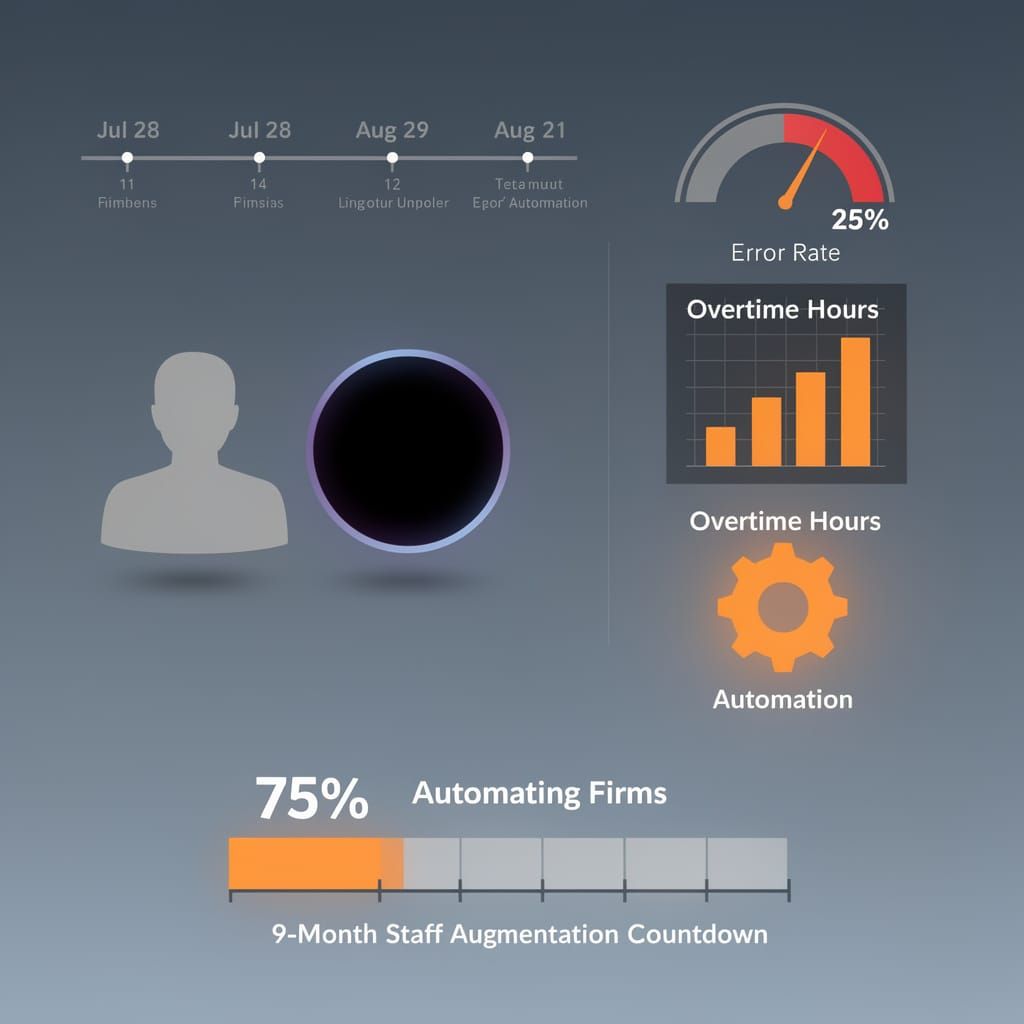
Two engineers promoted. One team vacated. Zero overlap. Zero knowledge transfer. 🚨 A substitute mentor with no systems access and no domain experience now runs the workflow—error rate above 25%. Overtime has tripled since January. Compliance flagged it. 75% of large firms are automating jobs. Staff augmentation has 9 months to resume—or the vacuum gets filled by systems, not people. Is your career path blocked by eligibility rules that reward waiting over capability? ⏳
On August 16, an East district engineer received an executive promotion based on demonstrated capability. The decision bypassed a seven-year eligibility rule that had already blocked title advancement on August 8. By August 21, the promoted engineer's former two-man team sat empty. The pattern mirrors an August 4 promotion where an engineer reached Engineering Director after seven years—delayed recognition that accelerated only after an external head-of-engineer offer triggered a retention incentive.
The causal chain:
- July 28: East district employee receives operational manager offer.
- August 6: Account completes a two-hour search for a new candidate. No hire results.
- August 8: Employed manager cites a seven-year rule that blocks internal title advancement.
- August 14: A service delivery manager assumes the vacant role's workload in the first week. Has no systems access rights. Has no prior experience with the team's workflows.
- August 16: Executive promotes the engineer based on capability, ending the failed recruitment episode. The engineer leaves the two-man team behind.
- August 21: Both positions remain unfilled.
The measurable breakdown:
Workflow collapse: A two-person team vacated overnight. No overlap, no transition, no knowledge transfer.
Error escalation: The substitute mentor—lacking critical systems access and domain familiarity—operates with an error rate above 25%. This mirrors an August 12 dashboard failure where a missing training tracker prevented confirmation of mentor readiness, creating workflow disruption during the pre-enrollment phase.
Compliance exposure: Overtime hours have tripled since January. A compliance audit flagged the trend on August 21. In June, a similar overtime dispute triggered a CIO intervention after a 3-minute workflow extension cascaded into halted medical response appointments. The pattern mirrors a broader labor tension: on July 2, 25 cardiac perfusionists across five Irish hospitals halted surgeries over unresolved pay disparities, pushing patient waitlists from 48 to 72 hours for elective procedures and postponing two pediatric cases.
Quality-gate gap: Executive oversight was removed from the quality gate due to a temporary coverage mandate. The gate now runs without senior review.
Root cause, not blame:
Corporate restructuring redirected personnel ownership upward. An award-winning performance cycle deferred promotion because structural gaps existed. Rapid expansion outpaced the human resource pipeline. External hiring eliminated the need to acquire internal candidates.
The outcome is not a hiring failure. It is the product of four structural decisions that converged on one team.
Outlook:
A March 2024 CFO survey indicates that 75% of large firms automated jobs due to rising wages, with automating firms projecting ~1.5 percentage points weaker employee growth. A June 2024 initiative demonstrates the pattern: engineering leadership decomposed margin goals into technical actions, but a team reduced onboarding exceptions without considering Tier 2 support dependency, causing budget overruns—underspecified success criteria that cost time and money. A July 2026 acquisition shows management enforcing immediate infrastructure upgrades through automated processes that marginalize human labor. Unless staff augmentation resumes within nine months, automation adoption will reduce labor dependence by default—not by design. The vacuum will be filled by systems, not people, because the pipeline no longer delivers candidates and the eligibility rules prevent internal mobility.
📉 The PHR–SPHR Calculus: One Diploma Graduate's Signal on Skill Relevance
1.9M BPO workers displaced by AI in weeks after Philippine operators deployed chatbots to cut costs 📉 Another 12.7M jobs threatened by generative AI per ILO. Clean energy may create 161K roles by 2030. A diploma grad now weighs PHR vs SPHR — but the credential that gets the interview is the one complete and credible. For Term Administrators in back-office contract work: does your current role count toward HR certification experience, or are you stuck in the gray zone? 🤔
On August 10, 2026, an individual completed a Post-Diploma in Human Resources Management. Two days later, they posed a direct question: which credential—PHR or SPHR—fits a Term Administrator bridging back-office contracts and student liaison work?
The query signals a broader pattern. This is not an emergency reskilling triggered by a layoff. The individual remains employed. The concern centers on transferability—whether theoretical HR knowledge earned in a diploma translates into a credential the labor market validates.
What the Two Credentials Deliver
- PHR (Professional in Human Resources): Tests operational and technical HR administration—compliance, employee relations, total rewards. Requires one year of exempt-level HR experience.
- SPHR (Senior Professional in Human Resources): Tests strategic and policy-level competence—workforce planning, organizational design, risk management. Requires four years of experience.
For a graduate holding zero months of dedicated HR title experience, the PHR is the structurally accessible option. The SPHR demand for strategic responsibility documentation creates a gate that a Term Administrator cannot yet open.
The Underlying Mechanics
The dilemma reveals a gap between course completion and role qualification. The diploma certifies learning. The PHR or SPHR certifies applied practice. The individual's position—administrative but not HR-titled—sits in the gray zone: they perform liaison and contract coordination, activities HR-adjacent yet uncounted toward credential experience thresholds.
This friction generates planning behavior. The individual is not stuck; they are mapping sequence. Across mid-2026, parallel signals reinforce this pattern. On July 19, a UK-based PR manager questioned whether CIPR diplomas offered sufficient value amid industry demands, weighing course length against credibility. On August 12, another individual with three years of freelance HR experience reported that non-traditional work histories triggered interviewer bias, seeking concrete reframing strategies. On August 10, another professional—Luhunny—posed the identical PHR-versus-SPHR question, citing a specialized analytical background and concerns about organizational succession risk. The data demonstrates that career anxiety in mid-2026 is increasingly about credential-market alignment, not job scarcity.
The Broader Labor Landscape
On July 1, 2026, Philippine BPO operators deployed AI chatbots to cut labor costs after revenue contraction, displacing over 1.9 million workers in weeks. Household incomes dropped sharply. On August 18, the ILO reported that generative AI threatens 12.7 million Philippine jobs—one in four workers—while clean energy transitions may generate 161,000 roles by 2030. On July 23, Thermo Fisher Scientific's GBS Manila leader noted employee engagement fell to 20% in 2025, with 38% of Filipino professionals reporting "quiet cracking" daily, costing 90% of employers in declining productivity.
On July 28, a global corporation confirmed a layoff triggered by an automated redundancy assessment—no performance deficiency cited. By August 22, 50 technology firms collectively eliminated 170,777 positions, with Oracle cutting 30,000 (18.5% of staff) and Meta reducing 16,000 (20.3%). Microsoft laid off 5,500 employees in early July, including Xbox studio developers, citing AI-driven restructuring.
In this environment, employers in back-office contract and student liaison verticals rarely differentiate PHR from SPHR for entry- to mid-level postings. The credential that gets the interview is the one complete and credible. A certified PHR signals operational readiness. An incomplete SPHR signals ambition without proof.
Near-Term Outlook
- 2026 Q4: PHR preparation, contingent on confirming that current duties meet the one-year experience bar. Study resources and exam scheduling dominate.
- 2027 H1: PHR exam attempt. A pass enables application for HR Generalist or Coordinator roles.
- 2028: Potential SPHR track opens if the individual secures an HR title position and accumulates the required strategic scope.
The recommendation follows the data: pursue PHR in 2026–2027, document every HR-adjacent responsibility during Term Administrator duties, and defer SPHR until an HR-specific role supplies the experience the exam demands.
💸 When Promotions Cost More Than They Pay
A 2–3% raise ($1,200–$2,400) for absorbing 200%+ workload — that's a 12–15% drop in effective hourly rate 💸 Top performers aren't being promoted; they're being stretched thin with flat pay while AI-driven budgets mask the inequity. For the senior analyst earning less in real terms while managing 8 direct reports — is a "promotion" worth the pay cut where you are?
A troubling pattern surfaced across multiple organizations between July and September 2026: top performers received nominal salary increases while absorbing unsustainable team loads.
The Mechanics of Misalignment
The sequence follows a consistent trajectory:
- July 23, 2026: High‑performing employees receive a 2–3% wage adjustment—roughly $1,200–$2,400 on a $90,000 base. Meanwhile, elite law firms (Axinn, Milbank, Cravath) pushed associate base salaries to $235,000–$250,000, and aerospace employers raised pay 4.5%. The gap effectively cuts real compensation for those outside bidding wars.
- August 4, 2026: Major corporations reallocate pay budgets toward performance over uniform growth, with 32% fewer planned raises versus the prior year. Visibility‑based initiatives replace structured promotion pipelines—as documented in internal restructures on July 2, 2026, where an intern acquired an executive‑director title while proven analysts remained excluded from C‑level gatherings.
- August 16, 2026: When promotions finally arrive, they pair 200%+ workload ratios with flat pay. Stress indexes rise 23% among affected teams, and KPI attendance drops below 70%.
What Drives the Breakdown
Aggressive hiring sprees throughout 2025–2026 expanded teams faster than reward infrastructure could adapt. Mid‑tier firms in the US, EU, and China competed fiercely for high‑wage tech and defense talent, driving salary inflation of 8–12% in those sectors. Yet internal compensation systems lagged. By August 4, 2026, firms shifted to AI‑driven pay allocation, targeting rewards without expanding total spend—even as CPI rose 3.5%. The result: leaders ask more, pay less, and rely on visibility programs to mask the inequity.
Tangible Consequences
For the individual: A senior analyst receiving a 3% raise while absorbing management duties for eight direct reports faces a real wage decline of 1.5% against 2026 cost‑of‑living adjustments. The effective hourly rate drops 12–15%.
For the team: Members witness peers stretched thin without equitable recognition. General stress undermines cognitive function, reduces security awareness, and erodes output precision—three documented failure modes from organizational psychology data on June 11, 2026.
For the organization: Replacement costs for a single high‑performing knowledge worker average 1.5–2× annual salary—$90,000–$150,000 per departure at median tech‑sector benchmarks. With turnover among the top quintile of performers projected at 18–22% within Q1 2027, a 500‑person firm risks losing 18–22 top contributors at a combined cost of $1.6–$3.3 million.
Outlook
- Q3 2026: Continued promotion delays; retention risk climbs to critical levels.
- Q4 2026: Performance reviews may surface grievances, but budgetary cycles limit corrective action until FY2027.
- H1 2027: Without structural adjustments to compensation pacing, organizations face a 25–30% loss in output from their most productive teams.
The recommendation is not complex: align reward velocity with hiring velocity. Promotions that arrive late and underfunded cost more in productivity, turnover, and morale than the salary increase ever saved.


Comments ()