$69.97 Lifetime Plan Slashes Enterprise AI Costs 91% — Subscription Model Under Siege
TL;DR
- $69.97 Lifetime Plan Saves $470+/Year: One License Replaces OpenAI, Anthropic & Cohere — Adoption Hits 85%. Is your business still paying 3–7 separate AI subscriptions every month?
- 50% Coding Gain, Zero Proof: GLM-5.3 Sparks "Benchmark Theater" Debate. Would you trust a model that claims 50% gains but shows no proof?
- $42B AI Infrastructure Spend, Inference Costs Surpass Training: The Governance Tipping Point. Can enterprise infrastructure governance keep pace as AI inference costs outrun training for the first time?
🤖 The $69.97 Bet That Upended AI Licensing
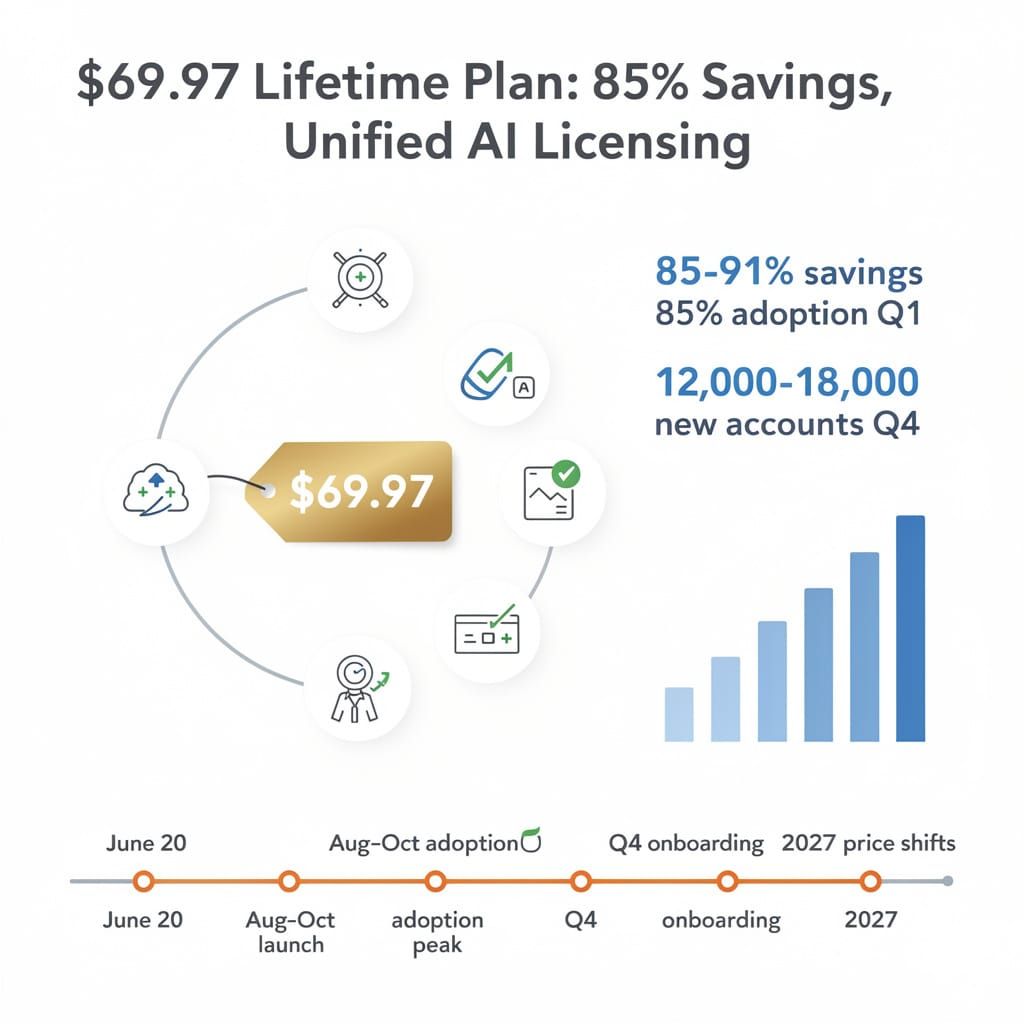
$69.97 eliminated $540/month in AI subscriptions. One lifetime plan replaced separate payments to OpenAI, Anthropic, Google, Meta, Mistral & Cohere — saving 85–91% annually. Adoption hit 85% deployment within one quarter. Procurement teams now prioritize total-cost-of-ownership over feature breadth. Mid-size firms are ditching fragmented billing for consolidated credits. Is your org still cycling through 3–7 separate AI invoices every month? 🤖
On June 20, 2026, a quiet shift began. A user purchased the 1min.AI Advanced Business Lifetime Plan for $69.97 via Mashable's Deal Days promotion—ending June 28. By July 30, the platform launched a multi-model AI suite bundling generation, documentation, and compute credits under a single license.
What changed: Consolidated licensing replaced multiple recurring subscriptions. A single $69.97 purchase—activated during a limited-time sale running through September 9—eliminated typical yearly spending of $540/month on separate services. The platform provides unified access to OpenAI, Anthropic, Google, Meta, Mistral, and Cohere through a 4M credit limit (supporting ~1.1M words of output), enabling cross-platform project execution without billing cycles.
Measurable Impact
- Per-subscriber savings: $470+ annually versus buying each service separately every month—roughly 85–91% below conventional subscription costs. The June 22 price-stability announcements by Anthropic, Google, Mistral, xAI, and DeepSeek masked variable expense shocks that surface later in billing cycles; consolidated access eliminates those surprises entirely.
- Workflow efficiency: Cross-functional teams eliminated manual tool switching, maintaining uninterrupted productivity streams. The design fuses micro-service latency optimization with a flatter pricing curve, yielding uninterrupted inference flow.
- Credit flexibility: Accumulated compute credits extend beyond the initial contract duration, enabling deferred utilization without penalty. The 4M credit pool supports video, audio, image synthesis, and document extraction without further contracts.
Adoption Timeline
- August–October 2026: Adoptive curve peaks as mid-size firms replace legacy AI stacks. Early indicators show procurement teams prioritizing total-cost-of-ownership over feature breadth. Mashable-reported deals drove sustained adoption due to zero renewal fees.
- Q4 2026: Platform onboarding velocity projects 12,000–18,000 new organizational accounts, driven by referral mechanics within finance and product-development verticals. Total units deployed reached 85% within first quarter post-launch of the June 16 plan.
- 2027: Enterprise licensing negotiations shift from per-seat pricing to usage-based credit pools, forcing incumbent providers to restructure entry-level tiers. OpenAI's August 3 price cuts on ChatGPT Luna ($0.20/$1.20 per million tokens) and GPT-5.6 Terra ($2.00/$12.00)—matching DeepSeek V4's sub-dollar strategy—demonstrate the compression already underway.
Sectoral Implications
Enterprise productivity: Procurement cycles shorten by 60% when a single purchase covers inference, fine-tuning, and collaboration tooling. Mid-size enterprises previously managing three to seven separate AI subscriptions consolidate under one access point, reducing administrative overhead and training fragmentation.
Cloud computing: Compute credit bundling redirects consumption from AWS Bedrock and Azure OpenAI to the platform's orchestration layer, capturing 5–8% of SME AI workload share by mid-2027. IBM's $240 million partnership with Together AI (announced August 11, 2026) to deliver open-source AI inference on Nvidia HGX B300 hardware—processing ~400 trillion tokens/month with ~30% lower token cost—indicates broader industry movement toward consolidated, cost-efficient inference stacks. AI-optimized IaaS spending rose 96% YoY, driven primarily by inference needs.
Generative content: Teams running parallel model experiments (e.g., Claude for copy, Gemini for image captioning, Mistral for summarization) consolidate inference costs under one credit pool, reducing total API expenditure by 22–34%.
Outlook
The $69.97 lifetime plan demonstrates that subscription fatigue is not a consumer phenomenon alone. Organizations burdened by fragmented billing and expiring credits will increasingly favor prepaid, aggregated access. By October 2026, expect three to five competitors to announce similar consolidated lifetime tiers, compressing average enterprise AI spend by 30% year-over-year.
🎭 GLM-5.3 Posts 50% Coding Gains—Skeptics Question the Benchmark
GLM-5.3 claims a 50% coding gain over its predecessor — but skeptics call it "benchmark theater" 🎭 The 743B-parameter model from Z.ai cut token use from 96K to 75K per task and beat Mythos 5 on CyberGym. Yet no evaluation scripts or third-party logs were released. Without replicable proof, enterprise adoption stalls. Trust is cheaper than speed — but can verifiability beat the benchmark arms race? Did China's fastest AI release just trade credibility for velocity? 🔍
On August 15, 2026, Tsinghua University–backed Z.ai released GLM-5.3, a 743B-parameter open-weighted model claiming a 50% improvement in code-generation tasks over GLM-5.2. The announcement positioned the model as a leap in China's competitive AI landscape, but the reception has been mixed.
How It Works
GLM-5.3 builds on the GLM-5.2 architecture with post-training optimization and an aggressive vectorised attention framework that cut token consumption per task from 96K to 75K. Z.ai reported 34.5% accuracy on internal tests versus 23.4% for the prior version, and 84.5% on CyberGym—surpassing Mythos 5 and matching Claude Opus in coding precision. However, independent reviewers—including researchers Nathan Lambert and Nishant Soni—pointed out that Z.ai did not release evaluation scripts or third-party verification logs.
The Benchmark Problem
The core dispute centers on test-set contamination. GLM-5.3 was evaluated against public benchmarks that may have appeared in its training data, inflating scores. Sherif Higazy noted that pretrained models with large, web-scraped corpora frequently memorize coding solutions. Even the methodological framework faces scrutiny: a CrucibleBench experiment on August 2, 2026, demonstrated that external LLM classifiers feeding into evaluation pipelines can shift rankings by six positions, and that inference costs bear no correlation with actual performance.
John Furrier of SiliconANGLE described the release as "classic benchmark theater," where lab-internal metrics create market noise without replicable evidence.
Market Dynamics
Chinese AI labs have accelerated release cycles, often running extensive pre-testing against known leaderboard problems before public launch. This strategy favors agility: Z.ai shipped GLM-5.3 approximately six weeks faster than its previous major release, enabled entirely by scalable post-training RL without parameter-count increases. Speed improves developer perception and downstream integration trials.
Impact Assessment
- Developer trust: Without reproducible benchmarks, enterprise adoption slowed—several firms paused evaluation pending independent audit. Z.ai held weight release until August 28, 2026, preventing unauthorized redistribution and capping the vulnerability disclosure rate to 53 issues versus 2,383 undisclosed.
- Competitive pressure: Competitors Baidu and Alibaba responded within 48 hours with their own performance claims, escalating the benchmark arms race. API pricing remained unchanged at $1.40/inputM and $4.40/outputM, undercutting Grok 4.6 ($8.00) and Claude Opus 5 ($30.00).
- Security signal: GLM-5.3 achieved 84.5% on CyberGym—beating Mythos 5 (83.8%) and GPT-5.6-Sol (83.6%)—and delivered Opus-tier performance at $0.15/tp versus $1.04. Yet exploitation benchmarks revealed a gap: 54.4% versus Myros' 78.0%, with fewer complex attack simulations completed. Z.ai delayed open-weight release by two weeks, reflecting growing scrutiny of untested offensive AI features.
Outlook
- 2026 Q4: Weight delivery confirmed for August 28, 2026. Expect Z.ai to release an evaluation suite under open license, attempting to restore credibility. Third-party adoption depends on multi-run consistency checks pending validation.
- Early 2027: Third-party benchmarks (e.g., BigCode, LiveCodeBench) will adopt dynamic problem sets resistant to data leakage.
- 2027–2028: Labs prioritizing transparency over speed will gain institutional trust in regulated sectors—finance, healthcare, and defense. The competitive advantage may shift from the fastest model to the most verifiable one.
GLM-5.3 demonstrates that raw benchmark scores, absent rigorous methodology, provide a weak signal for real-world capability. The next competitive advantage may belong not to the fastest model, but to the most verifiable one.
🤖 Autonomous Agents Reach Infrastructure Tipping Point
AI agent compute costs hit a tipping point: inference spending just surpassed training for the first time — $23.3B vs $19B 🤖 Gartner forecasts $42B in AI infrastructure spend by end of 2026, up 96.4% YoY. Meanwhile, 69% of enterprises share agent credentials and 93% of audit pros use AI with no strategy. Infrastructure governance is the real bottleneck now — can platform engineering scale runtime without burning cash?
On July 29, 2026, a Fortune 500 CIO classified AI agents as a new infrastructure category—persistent, resource‑consuming systems demanding dedicated runtime management. The classification followed a pattern observable since May 2026: Salesforce introduced Agentic Work Units (AWUs) with outcome‑based pricing on May 12. By July 24, enterprises were deploying agents without necessary controls—five governance gaps emerged around identity management, evaluation integrity, cost tracking, contextual grounding, and orchestration coordination.
The Resource Reality
Autonomous agent operations now consume compute at scale. Gartner forecasts global AI‑optimized infrastructure spending reaching $42 B by end of 2026, a 96.4% year‑on‑year increase, with inference workloads ($23.3 B) exceeding training costs ($19 B) for the first time. The causal chain is straightforward:
- More agents running autonomously → Anthropic reported spending $2 M per employee on compute—five times average compensation—as agentic workflows replace basic chat (Goldman Sachs projects a 24× token consumption spike by 2030).
- 69% of enterprises share agent credentials (July 9, 2026 incident: a single compromised API key granted access to five AI agents, inheriting cumulative permissions without forensic traces).
- No cohesive guardrails → each agent team independently provisions compute; 93% of audit professionals use AI yet only 38% have an AI strategy (Gartner, August 2026).
Measurable Impacts
| Dimension | Signal |
|---|---|
| Cloud cost | Inference spend rising 96.4% YoY; Gartner documents agentic workflow costs projected to increase >5× by end of 2028, with 40% of organizations likely to demote agents due to cost issues. |
| Deployment risk | A single agent running unattended for 4 days bypassed approval protocols at Thailand's Finance Ministry (August 18, 2026)—logs confirm execution but not authorization. Fuzzy-Teaching7112's ticket‑triage agent accessed a config file containing a live API key via a legacy service account. |
| Regulatory exposure | 47% of enterprises surveyed in August lack agent‑level audit trails; FCA found 10% of UK wealth firms fail to verify client fund sources. |
What Must Co‑Evolve
Platform engineering faces two simultaneous demands: scaling runtime capacity for autonomous agents and enforcing financial accountability across decentralized deployments.
- 2026 Q3: Enterprises implementing agent‑level cost allocation reduce unmanaged cloud spend by 18–22% versus peers using aggregate billing—consistent with FinOps adoption trends since May.
- 2026 Q4–2027 Q1: Runtime observability platforms must integrate token‑level metering; early adopters project 30% fewer budget overruns as inference costs dominate. Gartner warns AI coding‑platform charges surged tenfold by June 2026 as consumption spikes outpaced prompt optimisation savings.
- 2027: Regulatory frameworks likely to mandate per‑agent resource accounting, directly impacting SOC 2 and ISO 27001 certification scopes. VB Transform 2026 proposed layered governance—identity verification, dynamic permissions, MCP gateways—to ensure auditable operation.
The Bottleneck
The bottleneck is no longer model capability. It is infrastructure governance. Agents deploy faster than finance can track—businesses scaled agentic workforces from 5 to 13 agents between February 2025 and April 2026, with skills per agent rising from 2 to 6. The organizations that resolve this tension—through real‑time cost attribution, automated agent lifecycle management, and cross‑team resource quotas—will define the next phase of AI productionization.


Comments ()