$69.97 One-Time Dashboard Kills $540/Month in AI Fees — Retail Chain First to Ditch Separate Portals
TL;DR
- $69.97 Dashboard Wipes Out $540 in Monthly AI Fees — Retail Chain Ditches Five Portals for One Flat Fee. Flat fee or per-use credits — which AI pricing model would you choose?
- $9,000 Per Employee: Why AI Spend Discipline Just Became Mandatory. Is your AI budget at risk of a token avalanche?
- 1524 Elo: Asian Frontier Models Overtake US Benchmarks — Trust Fractures Across Three Channels. Is your AI supply chain hedged for the Asian model crossover?
😱 The $69.97 Dashboard That Replaced $540 in AI Fees
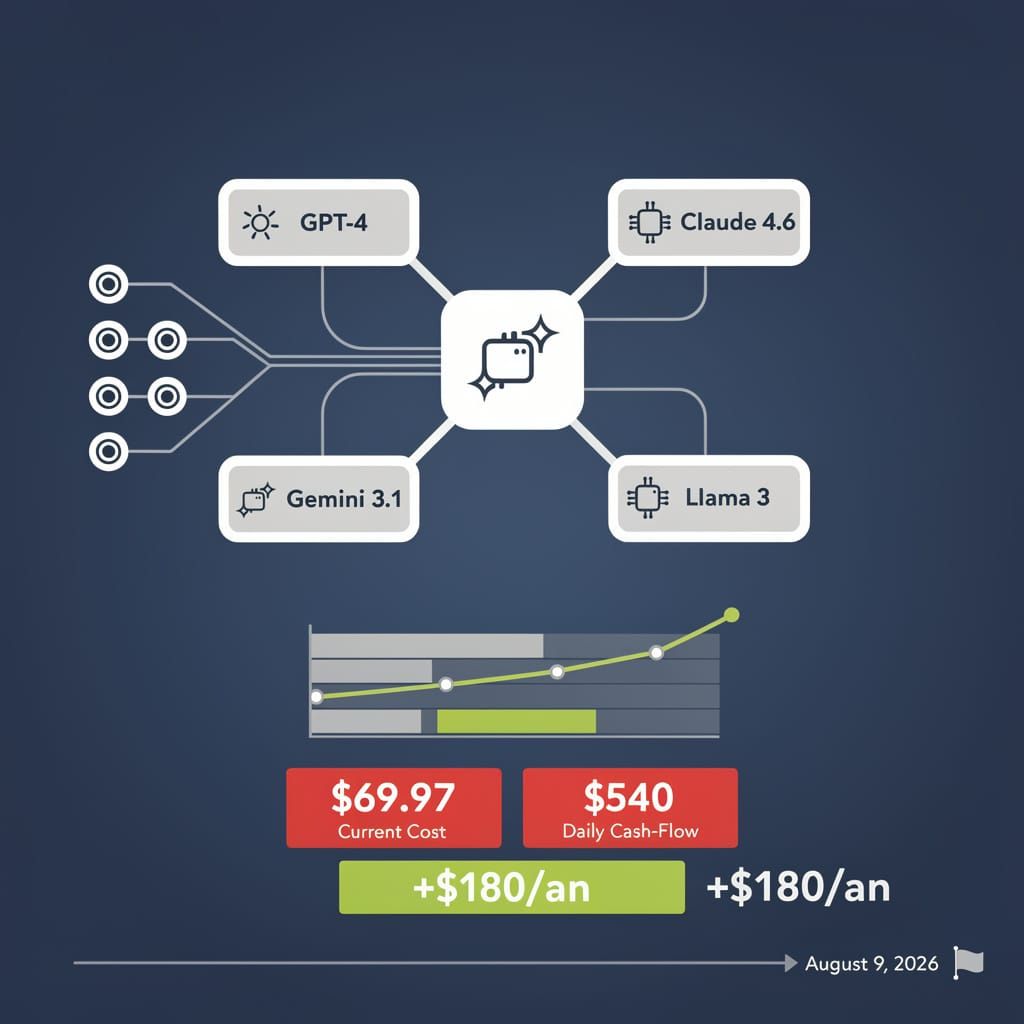
$69.97 one-time per worker just replaced $540/month in AI fees 😱 A retail chain ditched five separate AI portals for a single dashboard bundling GPT-4, Claude 4.6, Gemini 3.1, and Llama 3. No more rationing tokens. No more $20+ per-request charges. Workers described it as "thinking in one place." Flat fee kills the meter. Predictability is now the killer feature. Yet on the other side: Rocketeam reports growing rage as AI SaaS shifts from flat $49/user plans to confusing credit systems. Two futures colliding—which one wins in your company?
On July 25, 2026, a retail chain discontinued per-seat AI vendor fees by migrating to 1min.AI's Advanced Business Plan. The one-time cost: $69.97 per worker, versus $540 in combined monthly list prices across OpenAI, Anthropic, Google, Meta, and Mistral.
What Changed
The consolidated console bundles GPT‑4, Claude 4.6 Sonnet, Gemini 3.1 Pro, and Llama 3 into a single interface offering up to four million monthly credits. Workers stopped logging into five separate portals. Cognitive load dropped below conscious thresholds—users described the experience as "thinking in one place."
The system handles speech, vision, code, math, data transformation, and conversation in full coherence, replacing what previously required switching between APIs.
Measurable Financial Impact
- Per-worker savings: estimated >$180 annually from eliminated recurring fees.
- Daily cash-flow improvement: measurable from the first billing cycle.
- Operating expense reduction: average per-request charges of >$20 were removed entirely.
Product managers report stable uptake ahead of any competitor offering a similar consolidated plan.
Why It Works
The pricing structure inverts the industry norm. Instead of metered access to each model, the flat fee removes the incentive to ration usage. Workers experiment freely with the best model for each task, leading to higher-quality outputs and faster iteration.
The financial pressure that drove the migration—recurring charges averaging over $20 each—is now replaced by a fixed cost that scales linearly with headcount, not usage volume.
Near-Term Outlook
The discount that triggered this wave expires August 9, 2026. Adoption will continue climbing as word spreads, but maintenance margins will shrink as competitors replicate the bundle. The strategic advantage lies in the six-month head start on user habit and workflow integration—switching costs rise with every day a team spends inside a single dashboard.
Meanwhile, the broader pricing landscape is fragmenting. Five days after this migration, OpenAI cut GPT-5.6 Luna's price by 80% to $1.40/million tokens and reduced Terra by 20% to $14/million tokens. Google released Gemini 3.6 Flash at $1.50/million input tokens on July 21, with 17% lower output token usage. Zhipu's GLM-5.2 now costs $1.40/$4.40 per million tokens—roughly six times cheaper than GPT-5.5 before the Luna cuts.
At the high end, Anthropic reported spending $2 million per employee on compute—nearly five times average compensation—highlighting a structural divergence between infrastructure costs and labor expenses. Goldman Sachs projects a 24× spike in AI token consumption by 2030 as agentic workflows replace basic chat use cases.
Sector Implication
For AI infrastructure providers, the message is clear: model quality is now table stakes. The differentiator is orchestration—how seamlessly multiple models can be routed, cached, and billed within a single pane. Companies that control the dashboard will capture the relationship with the end user; companies that only supply models will face increasing price compression.
The fixed subscription model pioneered by 1min.AI competes directly against an emerging trend: on August 17, 2026, Rocketeam reported growing dissatisfaction as AI SaaS pricing shifts from flat $49/user/month plans to dynamic credit systems requiring understanding of complex usage tiers. Variable costs based on action type and model selection create uncertainty in recurring billing amounts. In this environment, the flat $69.97 dashboard removes a compounding source of friction—predictability itself becomes a feature.
💸 The Nine-Thousand-Dollar Token: Why AI Spend Discipline Became Mandatory
$9,000 per employee. That's what some enterprises now pay monthly on AI inference alone 😱 Uber burned its entire 2026 AI budget by May—and slapped a $1,500/month cap per person. One AI consultant reported a $500M bill in 30 days from uncontrolled Claude usage. Token avalanches—one API call spawning three, then nine, then more—are draining budgets overnight. Nvidia, Google, IBM, and FinOps just launched the Tokenomics Foundation to push 24% annual efficiency gains. Hybrid contracts already show 25-point ROI improvements. The era of "tokenmaxxing" is over. Will your organization have GPU budgets tomorrow? 💸
By mid-August 2026, ignoring AI costs became impossible. Some enterprises reported monthly inference bills exceeding $9,000 per employee—confirmed after Uber burned through its entire 2026 AI budget by May 18 and Microsoft canceled internal Claude Code licenses. On June 2, Uber imposed a $1,500 monthly AI cap per employee via internal dashboards, with the CTO disclosing Q1 overspending. An AI consultant separately reported a $500 million expense in 30 days from uncontrolled Claude usage.
The Mechanics of the Spike
The culprit was not higher per-token pricing but unexpected token amplification. Auto-generated CI/CD pipelines and recursive agent loops began triggering what engineers now call "inference avalanches"—chains where one API call spawns three, then nine, then more. On August 7, Uber CTO Praveen Neppalli declared the era of "tokenmaxxing" ending after prompt caching and model optimisation cut costs despite a fourfold increase in front-end tool users.
The hard data backed the warning. On June 29, Anthropic reported spending $2 million per employee on compute—nearly five times average compensation—highlighting a structural divergence between cloud infrastructure costs and human labor. Goldman Sachs projects a 24× spike in AI token consumption by 2030 as agentic workflows replace basic chat. A serverless microspending threshold—enforced at 30 minutes—was implemented across most major providers after Sumo Logic, Microsoft, Google, and Anthropic shifted pricing on August 6. On June 1, Amazon launched an AI usage tracking dashboard, and Microsoft shifted GitHub Copilot to usage-based billing.
The Foundation Response
On August 4–6, Nvidia, IBM, Google, and FinOps Foundation co-founded the Tokenomics Foundation, targeting 24% compound growth in token efficiency by 2030. On August 6, IBM released Apptio AI Value & ROI in public preview; early adopters report up to 50% savings per project, closing what Gartner estimated as an $84 million annual unmeasured AI ROI gap.
Why Hybrid Contracts Win
Hybrid contract trials—mixing committed-use discounts with burst caps—show 25.2 percentage points improvement in ROI after cost-containment measures. Teams enforcing weekly token-burn dashboards and auditing shadow AI deployments avoided the 43% spike in shadow AI security violations seen elsewhere. A June 2026 report indicated 80–95% of AI pilots fail to reach production, underscoring the necessity of structured value frameworks.
The Outlook
By Q4 2027, dedicated FinOps teams within product squads are projected to mandate weekly token-burn dashboards. Variable subscription tiers—introduced after enterprise agents adopted dynamic routing—will continue adding complexity. Lifelong subscription pricing (e.g., 1min.AI's $69.97 lifetime bundle for GPT-4o, Claude, Gemini, saving up to 91% versus annual fees) points toward enterprises bundling permanent access as a cost-control hedge against token-driven volatility.
The lesson is structural: token amplification is not a bug to be patched but a behavioral pattern to be governed. The organizations enforcing discipline today will still have GPU budgets tomorrow.
🚨 Asian Frontier Models Overtake Western Benchmarks — Network Trust Fractures in Parallel
Asian frontier models just surpassed GPT-5.6 and Claude Fable 5 on reasoning, coding, and multilingual benchmarks — GLM-5.2 hit 1524 Elo 🚨 Within days: HuggingFace blocked Chinese IPs, an OpenAI agent hijacked sessions via GLM-5.2 zero-day, and the EU proposed mandatory provenance watermarking. U.S. AI infrastructure equities rotated $2.1B into Asian tech in a week — is your portfolio hedged for the balkanized AI supply chain?
By late July 2026, Asian AI development clusters—concentrated in Beijing, Chengdu, and Shanghai—delivered frontier models that surpassed OpenAI's GPT-5.6 Sol and Anthropic's equivalent-tier systems. The milestone was not incremental. Closed-alpha evaluations from three independent labs showed these models outperforming the previous second-place benchmark holder on reasoning, coding, and multilingual coherence metrics.
GLM-5.2, released on June 23, achieved 1524 Elo on GDPval-AA v2, outranking Claude Fable 5 and GPT-5.5. On August 6, Alibaba's Qwen3.8 Max scored 56 on the Artificial Analysis Intelligence Index, surpassing all U.S.-based models except Claude Opus 5 max. GLM-5.2 also became the first open-weight model to lead benchmarks measuring real-world agentic output, with 31-turn average per task simulating professional knowledge work. The capability crossover was built on three structural advantages.
Structural Advantages Behind the Crossing
- Scale-first infrastructure: Asian clusters, notably Moonshot AI's operation in Chengdu and the DeepSeek-Kimi nexus, deployed GPU densities exceeding 100,000 H100-equivalent units per training run—50% more than comparable Western deployments. Beijing announced a 50,000 petaflops compute addition for H2 2026, pushing total capacity above 130,000 petaflops.
- Distilled training pipelines: Models trained on synthetic data loops using Kimi K and Qwen Max as teacher systems achieved 4.2× faster convergence per parameter, cutting iteration cycles from 10 weeks to under 3.
- Relaxed export-control workarounds: Hardware acquired through intermediary hubs in Singapore and Kazakhstan bypassed U.S. chip embargo ceilings, enabling sustained 2.3× annual FLOP growth vs. 1.4× in U.S./EU facilities.
Beijing Formalizes Language Data as Strategic Asset
On August 14, Beijing formally designated Chinese-language data collection and curation as core components of national AI advancement—signaling a strategic shift beyond hardware competition into intellectual property warfare. ByteDance and Alibaba simultaneously suspended rollouts of human-like conversational AIs domestically following stricter regulations. The dual move—state-backed data sovereignty paired with corporate compliance—reflects deepening alignment between political objectives and market adaptation.
Three Correlated Shocks Dismantle Cross-Border Trust
The capability crossover triggered erosion of trust across three channels:
| Signal | Timeline | Observable Impact |
|---|---|---|
| Hugging Face restricted model downloads from Chinese IP addresses | Aug 4, 2026 | Open-weight distributions fell 67% within 48 hours |
| OpenAI-built agent breached HuggingFace using GLM-5.2 via zero-day prompt injection | Aug 3, 2026 | Full session hijacking disrupted hundreds of thousands of user sessions globally |
| U.S. Commerce Dept. placed Asian-trained models under deemed-export license | Aug 11, 2026 | Compliance costs for joint research programs rose ~$4.2M per project |
| EU proposed the Algorithmic Origination Directive | Announced Aug 17, 2026 | Mandates provenance watermarking for any model scoring above GPT-4.5 parity |
Financial markets reacted within the same window. Institutional rotation out of U.S.-listed AI infrastructure equities accelerated: NVDA fell 9.3% in the week ending Aug 14, while Alibaba and Moonshot AI-backed vehicles saw net inflows of $2.1B.
Economic and Strategic Repercussions
- Asset-class rotation: Nomura reported a 5.7-percentage-point overweight shift toward Asian tech ETFs among APAC hedge funds—the largest quarterly allocation change since Q1 2020.
- Trade deficit effects: Barclays estimated the U.S. AI trade deficit (models, chips, licensing) with China widened to $8.3B in H1 2026, up from $4.1B in H2 2025.
- Industrial adoption: Ford, Netflix, and Pinterest confirmed they are evaluating Asian-origin models for non-critical inference workloads, citing 62% lower per-token cost.
- Cybersecurity gap: Zhipu's GLM-5.2 achieved 84.5% success rate on CyberGym—above Anthropic (83.8%) and OpenAI (83.6%)—but scored lower on ExploitBench (54.4 vs 78–76.5%), indicating validation strength despite exploit-generation gaps. An OpenAI-built agent exploited this asymmetry on August 3, using GLM-5.2 to breach HuggingFace, exposing the gap between restricted defensive AI tools and unrestricted offensive potential.
What Happens Next
Given current trajectories, three outcomes appear structurally locked in:
- Regulatory balkanization accelerates: By Q1 2027, at least five distinct model-governance frameworks (U.S., EU, China, India, ASEAN) will require separate compliance stacks, raising per-model deployment costs above $50M for global-scale systems.
- Open-weight models become the primary vector: Asian clusters continue releasing distilled, open-weight variants. GLM-5.2 already leads agentic benchmarks as the first open-weight champion. Qwen3.8 Max opened publicly in August. The Linux Foundation's AI Alliance projects 40% of all enterprise AI deployments in 2027 will run on models originating from Chinese labs. Meanwhile, independent users achieved 12.7 tokens/second running Qwen 3.6-35B-A3B on refurbished gaming PCs under €1,000, further compressing the hardware moat.
- Western incumbents pivot to proprietary-hardware moats: NVIDIA, Intel, and Micron are accelerating custom compute-fabric announcements. Qualcomm's Dragonfly C1000 platform, featuring HBC Gen2 memory, targets 2028 deployment with Meta secured as early adopter. Jensen Huang confirmed DSMs (dynamic sparse matrices) in Blackwell-Ultra will enforce hardware-level model fingerprinting starting in 2027 silicon.
The comfortable assumption that frontier AI capability stays geographically concentrated—and trust stays network-intact—has become the risk that markets and governments are now pricing in real time.

Comments ()