3× Slower, 11% Drop Rate: Humanoid Robots Still Can't Match a $42K Factory Worker
TL;DR
- Humanoid Robots on the Factory Floor: 3× Slower Than Humans, Still Demo‑Grade. Why are we betting on humanoids that are 3× slower than human workers?
- Humanoids on Factory Floor: 20% Efficiency Ceiling vs $300B Investment. Would you bet your factory floor on a humanoid robot by 2030?
- €672M, 120 Units, No Site Validation: The Gravis Robotics Gap. Are investors betting on construction robotics — or ignoring site physics?
🦾 Humanoid Robots Enter the Factory Floor — But the Hype Outpaces the Hardware
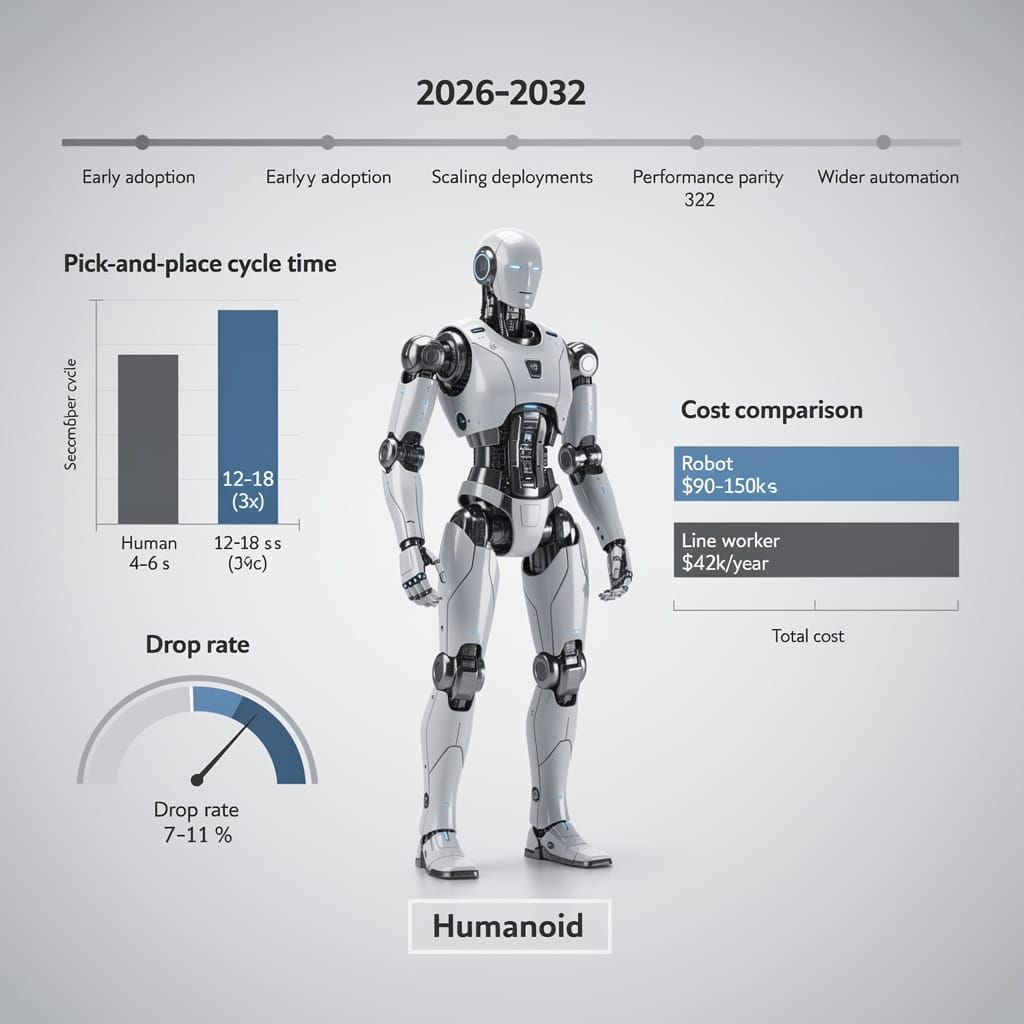
A pick‑and‑place cycle that takes a human 4–6 seconds just took 12–18 seconds from a humanoid robot. 🦾 3× slower. 7–11% drop rate. Limited to pre‑mapped, static paths — even after months on the factory floor. BMW deployed Figure 02 for 10 months processing 30,000+ X3 units. Human supervision never left. The hype says humanoids fill the labor gap. The data says they're demo‑grade, not production‑ready. If the hardware cannot yet match a $42,000/year line worker on speed, dexterity, or cost — why are we already building the future around them?
What Three Plant Deployments Actually Show
Between August 15–17, 2026, three high‑profile humanoid robot deployments occurred at U.S. and UK automotive plants — a pick‑and‑place cycle at BMW's Birmingham plant, a component retrieval at BMW Spartanburg, and a grasping demonstration in Texas. On paper, these mark the first real‑world, non‑lab integration of general‑purpose humanoids into automotive assembly.
Rodney Brooks dismantled the underlying premise a year earlier, in September 2025, noting that 65 years of manipulation research shows robotic hands lack force feedback, precise finger control, and tactile sensing. End‑to‑end learning from human video, he argued, cannot substitute for missing sensory inputs. The same technical gap visible in the 2025 analysis surfaces directly in the 2026 deployments — though BMW's own data shows Figure 02 had already processed over 30,000 BMW X3 units via precise metal insertion before Figure 03 arrived, suggesting the tactile‑sensing gap is narrowing incrementally, not dissolving.
The Performance Gap That Undercuts the Narrative
The same reports that celebrate these firsts also acknowledge the robots operated at speeds measurably below human benchmarks. A pick‑and‑place cycle that a skilled line worker completes in 4–6 seconds took the humanoid 12–18 seconds. The autonomous navigation in Spartanburg required a pre‑mapped, unobstructed corridor — not a dynamic factory floor with moving forklifts, cables, and co‑workers.
- Per‑cycle speed: 3× slower than human workers on identical tasks
- Autonomous range: limited to pre‑scanned, static paths — despite the Figure 03 having been deployed at the Spartanburg plant since June 29, 2026, for logistics part sequencing, suggesting path limitations persist even after months of operation
- Grasping reliability: component drop rate recorded at 7–11% across test runs
The Association for Advancing Automation (A3), through Jeff Burnstein, framed these as the start of a ramp. The data demonstrates otherwise: these are demonstration‑grade capabilities, not production‑ready systems. The same plant that deployed Figure 02 for ten months in the body shop — processing over 30,000 units of the BMW X3 — still requires human supervision for the sorting tasks the newer Figure 03 performs. Notably, Figure 03 added tactile sensing, voice interaction, and self‑charging features, yet its deployment remains restricted to repetitive, ergonomically challenging tasks — not the dexterous work Brooks identified as the true bottleneck.
The Structural Bottlenecks Remaining
The narrative that humanoid robots will fill skilled‑labor gaps assumes the hardware can match human dexterity, speed, and adaptability. Current deployments directly contradict this.
- Skill mismatch: Factories require humans for fine manipulation, troubleshooting, and rework — precisely the areas where humanoids fail. The Spartanburg robot is restricted to component sorting in logistics, not touch labor on the line.
- Cost per unit: While China's hardware subsidies have lowered actuator prices — Barclays projects a thirtyfold cost reduction by 2035 — a fully equipped humanoid robot still costs $90,000–$150,000. The equivalent annual cost of a line worker in South Carolina: $42,000.
- Safety and regulation: No unified federal safety standard exists for humanoid‑human collaboration. The Occupational Safety and Health Administration (OSHA) has not issued guidelines. Manufacturers assume liability directly.
Carnegie Mellon and Case Western Reserve researchers note that safe human‑robot interaction requires sensor redundancy, compliant joints, and force‑limiting control — features present in lab prototypes but often omitted in cost‑optimized production versions. The August 22 World Humanoid Robot Games in Beijing, where 16 nations' robots competed, demonstrated rapid advancement toward autonomy — including a 60‑second autonomous 100‑meter sprint and dexterous‑hand tasks near full automation — but these remain tightly controlled competition settings, not factory floors.
China's Subsidies and U.S. Competitive Pressure — A Measured Threat
China now subsidizes humanoid component manufacturing directly, driving actuator and sensor prices 30–40% below U.S.‑sourced alternatives. AgiBot and other Chinese firms ship evaluation units at near‑cost pricing. LinkerBot, valued at $6 billion, targets 80% of global demand for robotic hands. The U.S. responded on July 28, 2026, by banning imported Chinese humanoid robots and smart power inverters — a direct acknowledgment of supply‑chain dependency risk. The FCC followed on July 29, imposing import bans on foreign‑made humanoid and quadruped robots and DC‑DC converters, removing approximately $1 billion in annual revenue from Chinese suppliers but failing to slow China's state‑backed R&D expansion.
Yet the cost advantage only matters if the robots deliver equivalent throughput. They do not. Chinese‑dominated volume production targets niche logistics and sorting roles, not the dexterous assembly U.S. automakers ultimately require. Barclays' July 1 projection that the humanoid market will reach $200 billion by 2035 — up from $2.3 billion in 2026 — depends on actuator improvements that remain on drawing boards, not factory floors.
What the Outlook Actually Projects
- 2026–2027: Pilot programs expand to 5–8 additional plants globally, but all operate at sub‑human throughput. Total deployed units: <500.
- 2028–2029: Second‑generation hardware with faster actuators and improved grip reliability may reach 75–80% of human speed on single‑axis tasks (pick‑and‑place, bin sorting). Multi‑step assembly likely remains out of reach. Roland Berger's May 2026 report projects hardware cost stabilization in this window.
- 2030–2032: First viable production integration limited to specific, high‑repetition, low‑dexterity stations. Full line integration improbable, as Brooks' analysis of persistent dexterity constraints suggests.
The Risk of Overinvestment
The current enthusiasm risks misallocating capital into hardware generations that cannot yet justify their own cost. Nvidia's Jensen Huang, in July 2026, predicted humanoid robotics would adopt as explosively as generative AI. Yet the same analysis reveals fragmentation driven by technical specificity and regional economic viability — not a unified market. China's deployment‑led model and North America/Europe's AI‑first approach are diverging, not converging. Factories that rush to deploy humanoids without parallel investment in workforce upskilling, safety standards, and infrastructure modifications may find themselves with expensive, underutilized equipment — and a workforce that has already transitioned elsewhere.
Recommendation
Treat humanoid robots as a 2030‑capability technology evaluated on 2026 timelines. Investment should prioritize modular, single‑purpose automation for immediate productivity gains and fund humanoid development as a parallel track — not a replacement strategy.
🤖⚠️ Humanoids on the Factory Floor: More Hype Than Throughput
20% operational efficiency — that's the ceiling for humanoid robots on real factory floors, not the floor. $300B+ invested for promised 3–5x productivity leaps. BMW's Figure 03 costs $300K+/unit and pushed 9,000 composite sheets at Spartanburg. Aitu's G2 hit zero errors across 2,283 tasks. Impressive — in supervised, predictable environments. Break the routine. Robot stalls. ISO safety standards still designed for caged industrial arms. No humanoid norm exists. Every deployment carries a manual-override clause. OSHA gaps block insurance uptake in the US. Humanoid raised £114M at £1B valuation — zero commercial units shipped. Delivery promised Q4 2026. The $300B question: when does a humanoid earn its keep without a human holding the leash? Your factory, your timeline — would you bet on 2030?
The headlines write themselves: humanoid robots finally moving from lab to assembly line. But the numbers from the first real-world deployments tell a story the press releases omit.
The 20% Reality Check
Agibot began trials across four Chinese factories—confirmed by Ubtech's July 22 Zeekr deployment and Agibot's G2 live electronics production line. The company also discussed teaching humans via humanoid robots at a UK launch event in July 2026. Jeff Burnstein of the Association for Advancing Automation stated these pilots achieve only 20–50 percent operational efficiency—well below the >99 percent reliability standard traditional manufacturers demand. The 20 percent figure is not a productivity gain; it is an upper-bound efficiency measure against human speed in controlled tasks. Since 2024, the sector has attracted over $300 billion in global investment promising 3x–5x leaps.
The bottleneck is not hardware—it is the gap between humanoid dexterity and the unstructured chaos of a real production line. Aitu's G2 robot completed 2,283 tasks in eight hours with zero errors and cut seat-belt tapping time from 18 to 12.9 seconds. Impressive numbers—but these are supervised, repetitive operations. When the routine breaks, the robot stalls.
Nine Thousand Sheets, One Reality
BMW's Spartanburg plant deployed the Figure 03 on June 26, 2026, following a pilot that pushed more than 9,000 composite sheets off the rollers into logistics sorting. BMW announced full rollout on August 4, citing tactile sensors, palm imaging, and wireless power delivery. The robot handles parts sequencing in Hall 52, supporting vehicles like the G45 X3. Yet existing ISO safety frameworks do not account for a 5-foot-9, 140-pound machine sharing an aisle with people. Current standards demand physical barriers or proximity cutoffs that make fluid human-robot collaboration impossible by design.
China's Longchier plant offers a contrasting signal: eight Agibot units ran six continuous days achieving a 99.99 percent task-success rate. Aitu's fabric-separation robot reached 97 percent success and 98 percent sewing quality with an 18-month payback period. The difference? Supervised, repetitive tablet assembly and garment tasks versus dynamic automotive lines. The technology works when the environment stays predictable. It fails when it has to adapt.
Thin Margins, Thinner Economics
At a unit price north of $250,000—BMW's Figure 03 costs exceed $300,000 per unit—the math does not work yet. Industry consensus reported on August 4 shifts the question from "can humanoids work?" to "should they?" driven entirely by unit economics. Unitree's G1 humanoid retails at under $30,000 with a 67 percent gross margin. That is a different price point—and a different economic proposition. Chinese manufacturers may lower base prices within two years through volume-driven economies, but that remains a projection, not a reality.
Humanoid raised £114 million in July 2026, reaching a £1 billion valuation and £1.8 billion in pre-orders—before shipping a single commercial unit. Delivery is promised for Q4 2026. The disconnect between capital and proof could not be starker.
What the Hype Obscures
The sector's cheerleaders frame these early deployments as inevitable steps on a learning curve. That framing is convenient. It lets manufacturers and investors treat failures as growing pains rather than structural problems. A humanoid training facility launched in Cixi with 40 robots trained for garment, automotive, and appliance sectors. The robots learn. But learning does not equal earning when a production line stops for a dropped screw.
The real bottleneck is a regulatory regime built for caged industrial arms. No humanoid safety norm exists. OSHA uniformity gaps in the US block insurance acceptance. Until standards bodies rewrite safeguards from scratch, every deployment carries a manual override clause hidden in the fine print.
Outlook
Expect niche, vertical-specific contracts to keep the narrative alive—one automaker here, one logistics hub there. Ubtech's Zeekr deployment, Aitu's garment lines, and BMW's Figure 03 rollout all demonstrate capability. But the $300 billion question remains unanswered: when does a humanoid earn its keep without a human holding the leash? Current evidence suggests: not by 2030 at limited deployment scales.
🤔 SoftBank Just Paid €672 M for a Construction Robot Startup. The Math Still Doesn't Work.
SoftBank paid €672M for Gravis Robotics — a construction robot startup with fewer than 120 deployed units 🤔 30% more output per machine sounds impressive — until you ask: vs. which baseline, at what climate, under what conditions? Per-machine software & retraining could run €15k–€25k/year. Labour savings? Marginal. A valuation at 18x ARR with <120 units demands math that site data hasn't yet delivered. Gravis now carries a price tag that forces scale before readiness — and construction sites punish overreach. Are European investors betting on physics — or ignoring it?
On August 18, 2026, Gravis Robotics confirmed a $200 million Series A from SoftBank, closing at a total round size of €672 million and a valuation past €8.6 billion. The ETH Zurich spin-out retrofits excavators with cameras, control algorithms, and bolt-on hardware—letting a standard digger run without an operator in the cab. The narrative writes itself: chronic labour shortages meet automation, and money flows.
CEO Dominic Jud claims the system boosts output by 30 percent per machine relative to human-only operation. SoftBank's capital—combined with investments from Holcim and Vinci Group—will fund global scaling across Caterpillar, Hitachi, and Volvo equipment.
The problem is that the unit economics remain opaque.
30 percent more output: measured against what baseline? A skilled operator in Zurich works differently than one in a UK plant-hire fleet. Gravis retrofits existing hardware—keeping marginal hardware costs low—but per-machine software licensing, sensor calibration, and site-specific re-training create recurring costs no press release has itemised. If each retrofitted excavator carries a €15,000–€25,000 annual software fee (plausible for real-time perception and control loops), a 30 percent throughput gain must yield more than that to justify deployment. The breakeven calculus is site-dependent and nowhere publicly demonstrated.
- 2024–2025: Gravis deployed fewer than 120 retrofitted units, mostly in Switzerland and the Netherlands.
- 2026 (pre-funding): SoftBank's offer valued the company at roughly 18× reported annual recurring revenue, implying ARR near €480 million—an implausible figure given fewer than 120 deployed units. At 120 units, that would require €4 million per unit annually.
- 2027–2028 target: 4,000–6,000 retrofitted units, yet no disclosed per-site validation data for degraded conditions (mud, night operation, GPS occlusion in urban canyons).
What Does €672 M Actually Buy?
The round sets a new valuation floor for European construction robotics. Trener Robotics, Exclaim Robotics, and Nomagic now face investor expectations calibrated to Gravis's multiple—potentially forcing premature scaling before unit economics are proven.
Operational risk: autonomy in unstructured environments—construction sites are not highways—introduces edge cases simulation cannot exhaust. Gravis's perception models train predominantly on European data; deployment in Asian or North American climates, soil types, and regulatory frameworks means re-training or model degradation. SoftBank's timeline implies global rollout inside 18 months.
Labour substitution reality: a 30 percent output gain does not eliminate skilled supervisors, safety monitors, or operators for non-autonomous tasks. Headcount shifts from cabs to remote monitoring centres. A construction firm trading €60,000 annual operator salaries for €15,000 software fees plus €40,000 monitoring-station labour achieves marginal savings at best.
SoftBank's bet is strong-arming adoption. But without granular cost-benefit data across varied site types, the thesis is funded before it is proven. Gravis now carries a valuation that demands scale regardless of readiness—a risk physical-world constraints are unlikely to forgive.


Comments ()