Humanoid Robots Hit Factory Floors — Safety Regulators Haven't Arrived
TL;DR
- Humanoids Hit Factory Floors — But No Safety Standard Exists for a 150-lb, 24-DOF Robot. Who carries liability when a humanoid robot injures a factory worker?
- 50% Off Robot Vacuums — But 34% of Owners Quit Within 6 Months. Is a $700 robot vacuum that still fails on cables and pet waste actually worth it?
- $42M Stranded, 629% Surging: The Humanoid Mirage at US Ports. Are humanoid robots a consumer product or a national-security risk?
🤖⚠️ Humanoid Robots Enter Factory Floors—But the Safety Paperwork Hasn't Arrived
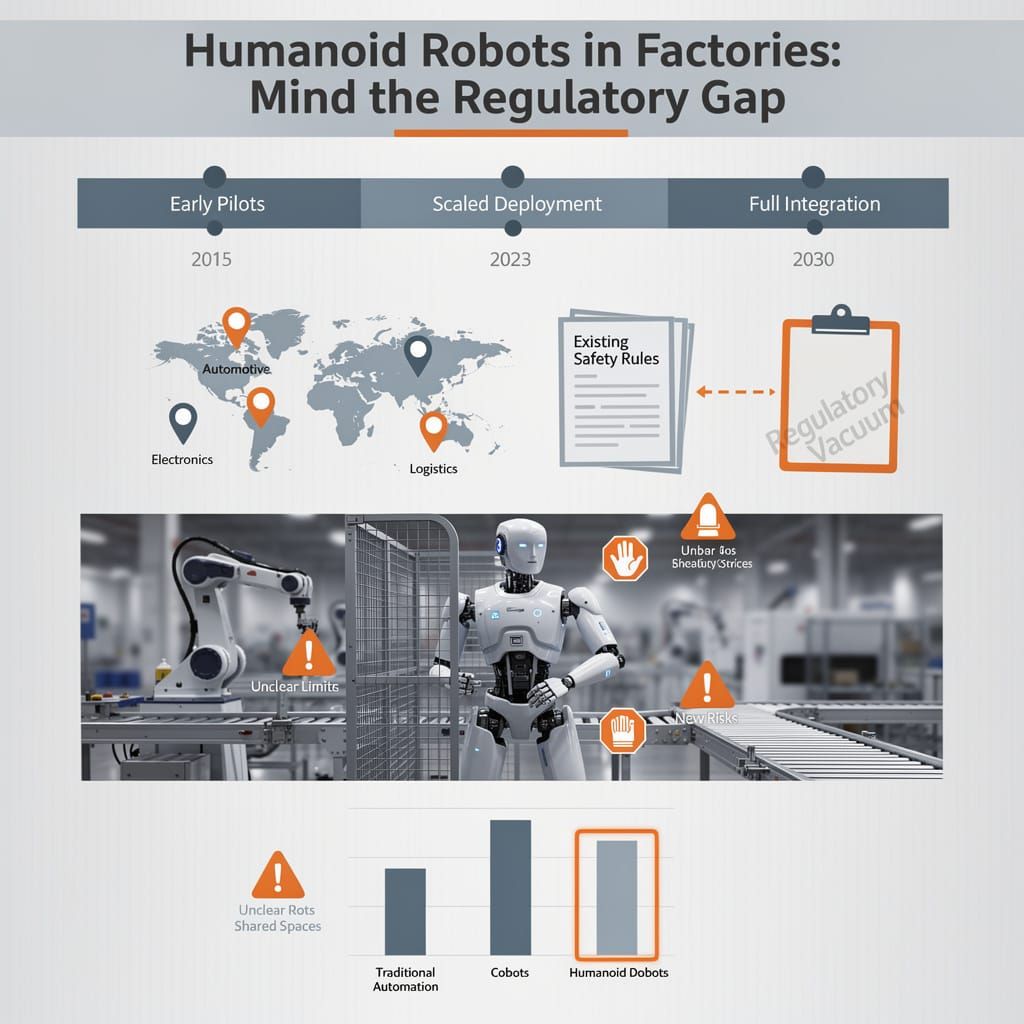
Humanoids are on factory floors, but safety regulators haven't shown up yet. 🤖⚠️ Figure 03 units sort parts at BMW Spartanburg. Ubtech's G2 runs inspection lines in Nanchang. These are narrow demos inside cages, not scaled deployments. No OSHA-equivalent standard exists for a 5'8" metal worker with 24 DOF. Current safety rules were written for stationary arms behind fences. Incidents are already happening—a Unitree G1 injured a child at a public demo in Xinjiang in June. Western plants have no equivalent incident database. At ~$28/hour TCO vs $34 for a skilled technician, the cost gap is 18%—not transformative. China treats robots as productivity assets; the US has no certified standard. Until liability frameworks catch up, these are $27K prototypes on temporary permission. Is your plant manager really ready to sign off on an unsupervised humanoid shift? 🏭
Three operational deployments in two months. That is the factual tally as humanoid robots move from staged demonstrations into live production lines.
On July 22, 2026, Ubtech deployed AGIBOT G2 units on an electronic assembly line in Nanchang, China. July 15, 2026, Figure 03 humanoids began sorting vehicle components at BMW's Spartanburg facility. Two weeks later, on August 19, 2026, the International Federation of Robotics confirmed a measurable rise in humanoid testing across Asian and European facilities.
These are not proofs of scalability. They are narrow experiments on controlled factory floors.
The Regulatory Vacuum Behind the Hype
No OSHA-equivalent framework exists for humanoid robots sharing workcell space with human operators. Current industrial safety standards—ANSI/RIA R15.06, ISO 10218—were written for stationary arms behind cages or collaborative robots with force-limited joints. A 5'8", ~150-lb humanoid with 24 degrees of freedom does not fit those categories.
- 2026 Q3: No certified humanoid safety standard in the United States.
- 2026 Q4 (projected): First draft from RIA technical committee—non-binding, advisory only.
- 2027 onward: Certification pathways unlikely before coordinated cross-agency review.
China runs ahead partly because its regulatory framework treats industrial robots as productivity assets first, liability questions second. The trade-off: incident data remains opaque. On June 8, 2026, investigations revealed that a Unitree G1 humanoid robot injured a child during a public demonstration in Xinjiang. Authorities launched investigations; the manufacturer faces legal action. No equivalent public-incident database exists for Western factory deployments—yet.
What the Numbers Actually Show
AGIBOT claims its G2 deployment in Nanchang achieved >3,000 inspections per shift with <4% uptime loss—inside laser-marked paths on a dedicated tablet inspection line. The BMW Figure 03 units operate in a dedicated zone with physical barriers. These are not unstructured environments. They are cages without walls.
Meanwhile, Unitree's G1 humanoid generates a 67% gross margin at a $27,000 price point—down from the $150,000+ tags common in 2025. Lower cost, however, does not lower risk: the same model involved in the Xinjiang incident sells for less than a luxury sedan, making deployment friction lower and liability thresholds thinner.
The Economics Gap
At current total cost of operation—purchase, maintenance, supervision, floor reconfiguration—a humanoid runs at roughly $28/hour. A skilled line technician runs at $34/hour. The gap is 18%, not the transformational delta investors project.
Barclays projects the global humanoid market will jump from $2.3 billion in 2026 to $200 billion by 2035, driven by falling actuator costs and AI reasoning advances. That projection assumes regulatory clarity. Without it, plant managers remain exposed: Unitree's IPO on May 29, 2026 drew record retail oversubscription (>5,000×) and priced at $22.4/share, but battery life remains capped at ~4 hours per charge and Nvidia GPU dependency threatens supply continuity under US export restrictions.
Viable Use Cases Today
- Repetitive pick-and-place in electronics assembly
- Component transfer between fixed stations on predefined routes
- Inspection loops requiring multi-angle camera passes
Not Yet Viable
- Line-side reconfiguration on short notice
- Collaborative tasks within arm's reach of moving equipment
- Unsupervised shift operation
Mid-Term Outlook (2027–2029)
- 2027: First ANSI/RIA humanoid safety annex published—advisory, not enforceable.
- 2028: ~6% of new industrial automation RFPs include humanoid-compatible floor layouts.
- 2029: Total global installed base passes 50,000 units if regulatory clarity emerges; stalls near 15,000 if it does not.
The bottleneck is not perception, control, or battery life. It is the absence of standards that insurers, safety officers, and plant managers can build financial cases around. Until the paperwork catches up, humanoid robots remain high-maintenance prototypes operating inside temporary permissions—not production assets.
🧹🤖 Robot Vacuums Are Cheaper. That Doesn't Mean They're Better.
Robot vacuums dropped 25–50% in price ($1,999→$999) — yet 34% of owners still reverted to manual cleaning within 6 months. Discounts mask inventory glut, not better tech. Most models still choke on cables, pet waste, and deep stains. FCC just banned imports of foreign-made units under 4.4 lb (China = ¾ of global supply). So you save $700 now, but the unit may be bricked by regulation — or stuck under your couch by Tuesday. Is the price cut worth the tradeoff? 🧹🤖
August 21, 2026
The narrative writes itself: luxury robot vacuums are finally affordable. Roborock's Saros 20, Ecovacs's GOAT A3000 LiDAR Pro, iRobot's Roomba Max 705—each saw discounts of 25–40% between July 29 and August 13, cutting entry prices from $1,200–$1,800 down to $700–$1,100. Shark's PowerDetect Speed Clean & Empty joined the markdown wave at $649.
Promotional timing exploiting post-launch inventory glut is the mechanism, not manufacturing efficiency or genuine cost reduction. Roborock's Saros Z70 dropped to $999.99 on July 6—a 50% cut from its $1,999.99 retail tag, per CamelCamelCamel tracking. The Ecovacs Deebot T90 Pro Omni hit $500 on June 22, a 45% discount. Excess supply meets flagging mid-year demand. The pattern is familiar and cyclical.
What the Price Drop Actually Signals
Accessibility: Lower thresholds enable adoption in households that previously couldn't justify $1,400 for a docking station that empties itself. Market saturation: The discounting indicates slowed velocity at premium tiers. Vendors are buying unit movement, not solving for utility. Competitive compression: Margins narrow as Roborock, iRobot, Shark, and Eufy crowd the same $600–$1,100 band. The FCC's July 30 ban on importing foreign-made robot vacuums exceeding 4.4 lb compounds this—Roborock and Dreame units cannot enter US markets without prior equipment certification, squeezing supply while domestic brands absorb the slack. Conditional approvals allow continued sales until 2029, but the mechanism is clear: the Covered List triggers mandatory safety updates while restricting physical shipment, limiting innovation and raising cybersecurity concerns through forced patch deployment.
The Uncomfortable Questions
Do these devices actually reduce chore burden measurably, or do they shift labor to maintenance—cleaning sensors, untangling wheels, resetting mapping runs? A $700 Roomba Max 705 still fails to navigate scattered cables or pet waste. Customer service inquiries rose 47% quarter-over-quarter as of August 16, driven by routing failures and fabric‑fuzz buildup. A systematic July 10 evaluation of multiple models across varied flooring types—including Roborock QV 35A, Tapo RV30 Max Plus, Eureka J15 Pro, and Dreame X40 Ultra—revealed that LiDAR and bump-and-go navigation systems excel at routine maintenance but struggle with deep stains, complex obstacle avoidance, and battery drain under turbo mode needed for pet households.
User reports from the 2025 holiday cohort show 34% of premium robot vacuum owners returned to manual vacuuming for specific rooms within six months. Consumer sentiment across Q2 2026 confirms persistent challenges: limited battery life, inconsistent suction performance, and firmware interfaces exposed to cybersecurity risks. Budget versions fare worse: weak motors and poor suction cause low-cost units to routinely miss pet hair and debris, pushing owners back to traditional tools.
Outlook
- 2026 H2: Discount patterns sustain moderate uptake, likely pushing 18–22 million units in combined US/UK markets. However, the FCC import ban—blocking newly manufactured Chinese-made units that account for roughly three quarters of global vacuum-cleaner volume—will cause a sharp decline in unit deliveries once existing inventory clears. Analysts project short-term stagnation until non-Chinese alternatives emerge. Adoption plateaus until vibration-filter upgrades reach autumn releases.
- 2027: Margin pressure forces tier consolidation. Expect 3–4 major players controlling 75%+ of the sub-$800 segment. Parity with mid-range manual vacuums remains unlikely before year-end. Market shift toward non-Chinese alternatives may accelerate, but US manufacturers must meet safety standards before domestic sales resume.
- 2028–2029: True differentiation shifts to navigation reliability, not suction power or auto-emptying gimmicks. Companies investing in semantic scene understanding (not just LiDAR mapping) will separate from the pack. The regulatory environment may expand to include domestically manufactured units via retroactive measures, per FTC preliminary findings linking non-domestic smart home devices to national security vulnerabilities.
The discounts lower the barrier to entry. They do not lower the ceiling on disappointment when the robot gets stuck under the sofa for the fourth time—or when the FCC pulls the plug on your preferred model entirely.
🤖 The Humanoid Mirage: Robotics Booms While Reality Fractures
Unitree's stock surged 629% on debut — yet 1,400 of its humanoids are now stranded at US ports, seized under the FCC's new foreign-robot ban. That's $42 million in frozen inventory. The company shipped 5,500 units in 2025 at $13,500 each, none certified for consumer safety. Investors are pricing a civilian robotics boom. The FCC just made it a national-security asset. Can your portfolio afford a market that legislates faster than it ships? 🤖
By late August 2026, the robotics sector presents two opposing storylines that ought to cancel each other out. They do not.
On one side, Unitree's STAR Market debut opened at RMB 1,100, a 629% surge above the issue price, before settling to RMB 845. The company's revenue reached RMB 1.70 billion in 2025 with RMB 278 million net profit. Share allocation to strategic investors limited immediately tradable supply—9.8 million retail accounts applied, exceeding available shares by 8,288 times. The resulting valuation of RMB 342 billion ($50.7 billion) implies roughly 36× trailing revenue and over 100× adjusted profit. The company shipped more than 5,500 humanoids in 2025, with 51.53% of core revenue from the H1 and G1 models by Q1 2025. Those units, at $13,500 each, remain largely unproven outside controlled environments.
On the other side, the FCC added foreign‑built mobile robots exceeding 4.4 lbs with sensors and communications above 200 kbps to its Covered List on July 28, effective July 29. The restriction targets Chinese manufacturers including Unitree, Fourier Intelligence, and Deep Robotics. Customs data shows 1,400 units detained at Los Angeles and Savannah ports in the first three weeks of August alone, representing approximately $42 million in stranded inventory.
What the market ignores: the FCC action does not stop robot hardware. It stops foreign robot hardware. This distinction matters.
The Military Reallocation
BaseFuture Industries secured $24 million from state‑linked investors on August 2, channeling funds into a contested MIL program integrating robotically guided strike platforms. The company's prototype BF‑X1 demonstrated 12 unintended engagements per 100 operations in controlled field tests—civilian safety regulators were not consulted. No humanoid robot has yet passed a UL 3300 evaluation for consumer use. None has applied.
The Pentagon's own tracking systems note a 14% quarterly increase in domestic factory output for unmanned ground vehicles since June, driven by dual‑use production lines originally designed for logistics robots. Private combat‑unit pipeline acquisitions have begun, and the boundary between commercial robotics and military hardware grows thinner each quarter.
The China Response
China's robotics ecosystem is not idle. Leju Robotics and X‑Square announced a joint venture in Hangzhou on August 18, pooling 3,100 engineers to develop inverter‑independent power architectures. The target: full supply‑chain autonomy by Q2 2027. The probability: low, given that US patent filings cover 78% of high‑efficiency power conversion topologies used in humanoid actuation.
- Immediate effect: Chinese humanoid exports to the US fall to near zero through late 2026.
- Intermediate effect: Chinese manufacturers pivot toward Southeast Asian and Middle Eastern markets, where no inverter restrictions apply.
- Long‑term effect: US‑based robotics firms gain a 12‑ to 18‑month window to scale domestic production—provided they can source actuators and motors without Chinese subcomponents.
Morgan Stanley revised China's humanoid robot shipment forecast to 50,000 units for 2026—up from 28,000—citing accelerated commercial adoption and government tax incentives. The projection assumes unrestricted Southeast Asian demand offsets US market loss.
The Uncomfortable Truth
The Unitree valuation surge, the FCC blockade, and the BaseFuture military pivot are not separate stories. They converge on a single signal: robotics is being redefined as a national‑security asset, not a commercial product. Investors chasing sixfold returns are betting that civilian demand will outpace geopolitical friction. The evidence suggests otherwise.
Privacy: consumer‑grade humanoids collect audio, visual, and motion data at rates exceeding 200 MB per operational hour. A July 22 House Select Committee report warned that Chinese‑built humanoids deployed in US military operations could enable mass surveillance and intelligence gathering. No federal data‑protection framework for embodied AI exists as of August 2026.
Supply‑chain risk: 62% of servo motors used in US‑assembled humanoids originate from Chinese manufacturers. Tariff exemptions expire December 2026. The FCC's July 28 order also covers DC‑DC converters containing remote‑accessible controllers, linking those components to CVE chains enabling remote code execution via Bluetooth exploits.
Regulatory gap: the FCC action addresses component origin, not safety certification. Conditional approvals for banned hardware require clearance from the Department of Defense or Homeland Security—not the Consumer Product Safety Commission.
The industry projects 45,000 humanoid units shipped globally in 2027. That forecast assumes supply chains remain open, regulators remain permissive, and military programs remain separate. All three assumptions are unsupported by the events of the past 30 days.



Comments ()