UK Jobs Split: Software Roles +14% vs Trades -58% — AI Reskilling Fund Only 15% Utilized
TL;DR
- Software Roles Rise 14%, Trades Plunge 58%: UK Labour Market Splits on AI Fault Line. Is your current skill set ready for the AI-driven job market of 2027?
- 20–30% Remote Premium: Short-Term Cash vs. Permanent Reality in the 2026 Labor Market. Would you take a 30% pay premium for an 11-week contract with no benefits?
- 1,500 Jobs at Risk: Scotland's Ferry-Building Workforce Unravels on Contract Failures. Can Scotland rebuild its maritime workforce once contracts and skills are permanently routed abroad?
📉 UK Labour Market Splits: Software Roles Rise 14% While Trades Fall 58%
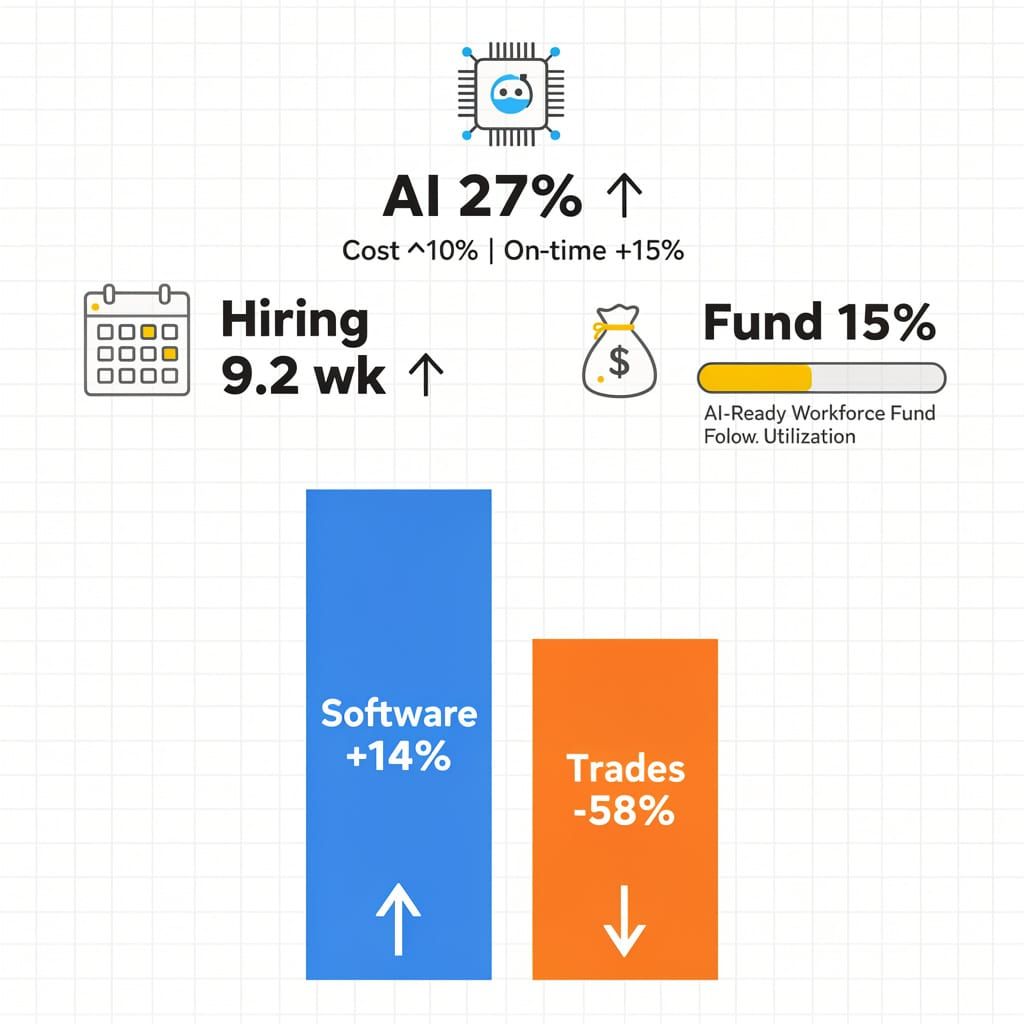
Software jobs up 14% — trade postings down 58%. That's the UK jobs split in August 2026 📉 AI now handles 27% of UK transport tasks, cutting costs 10% and boosting on-time performance 15%. The same pattern is racing through warehousing, assembly, logistics. 77% of UK employers now require AI literacy — even for non-technical roles. New grad hiring outside AI fields shrank 12% in Q2 2026. Entry-level hires wait 9.2 weeks on average now, vs 6.1 in 2024. Salaries for junior devs actually fell 2.1% — while senior dev median pay hit £92k (+8.3%). The £340M UK reskilling fund? Only 15% of training seats filled as of August. Course content doesn't match what employers need. Are you upskilling fast enough for the market you're in — or the one arriving next year?
August 2026 data from the Office for National Statistics and the Chartered Institute of Personnel and Development shows senior programmer positions increased 14% year-over-year, while blue-collar trade postings declined 58%. The divergence is structural, not cyclical, driven by AI-capable output replacing manual functions. By July 2026, AI penetration in UK transport reached 27.1%, delivering 10% cost reduction and a 15% improvement in on-time performance—one measurable vector of the substitution pattern.
How the Mechanics Work
Software engineering continues expanding because AI tools amplify programmer output without eliminating the need for system design, debugging, and integration. In manual sectors, automation and robotics replace physical tasks—warehousing, assembly, logistics—cutting labour costs by an estimated 30–40% per function, per Microsoft's internal modelling shared with UK industry bodies. Global robotics deployments reached 38,000 units annually in the US alone by mid-2026, with China commanding 54% market share, accelerating the displacement timeline. On July 9, 2026, Microsoft itself reduced global headcount by approximately 4,800 employees (2.1% of workforce), directing savings toward AI and cloud capex—a signal that even tech employers trim legacy roles to fund automation.
The Barrier at the Entry Point
New graduates without AI-domain experience face rising barriers. Entry-level postings outside AI-adjacent categories contracted 12% in Q2 2026. The average time-to-hire for junior roles in non-technical fields extended to 9.2 weeks, up from 6.1 weeks in 2024. A July 2026 survey found 77% of UK organizations now treat AI proficiency as a baseline requirement for non-technical roles, and 97% offer a salary premium of 10% for AI-literate candidates. Alan Milburn, chair of the Social Mobility Foundation, noted that without intervention, "younger workers without AI literacy will be locked out of the professional track entirely."
Sectoral Consequences
- Skilled trades: Plumbers, electricians, and welders saw the steepest posting declines. Demand remains only for niche custom installation and legacy-system maintenance. Meta announced a $115 million workforce academy in June 2026 targeting data-center construction trades, signalling where manual demand survives.
- Software and AI: Hiring concentrates at the senior band (7+ years experience). Median advertised salary for senior developers hit £92,000, up 8.3% year-over-year, while junior developer salaries declined 2.1%.
Institutional Response Gaps
The UK government launched the "AI-Ready Workforce Fund" in March 2026, allocating £340 million for reskilling. As of August, only 23,000 of a planned 150,000 training places have been filled, a 15.3% placement rate. Separately, on July 14, 2026, Health Secretary Pat McFadden announced the £3.5 billion Pathways to Work programme targeting job placements for 2.8 million medically-dependent Britons, paired with a £60 million Tech Innovation Fund for inclusive AI tools. Mark Williamson at the CIPD attributes the reskilling shortfall to "poor alignment between course content and employer-defined competency benchmarks." In the US, the Raise Us alliance raised $500 million in June 2026 to combat AI-induced joblessness, signalling that the gap is being recognized—but funding alone does not guarantee placement.
Projected Trajectory
- 2027: Software roles grow another 10–12%; manual trade postings decline further to ~35% of 2022 baseline. Youth unemployment in non-technical cohorts rises to 8.4%.
- 2028: Without large-scale reskilling uptake, the UK faces 180,000 unfilled senior tech roles alongside 400,000 displaced manual workers lacking transferable certifications.
- 2029: Regions outside London and the South East—where trade employment is concentrated—see net employment contraction of 1.3% annually.
What Enables a Course Correction
Andrew Hunter of Adzuna points to modular certification pathways as the single highest-leverage intervention: "Workers need 12- to 16-week AI-augmented trade programs—hybrid plumber-coder roles that combine diagnostic software with hands-on work." No major employer consortium has yet funded such a pathway at scale. In August 2026, Guideless, a Vilnius-based AI training platform, secured €1 million to convert workflows into narrated guides 10× faster, targeting a market projected to exceed €18.3 million by 2031. The Robotics Summit & Expo in June 2026 introduced sensor families and humanoid platforms that will only sharpen the substitution pressure, making the window for reskilling measurable in quarters, not years.
💰 The Short‑Term Premium Divide: Remote Hype vs. Structural Reality
Remote workers are scoring 20–30% premiums over local market rates — earning $44–$63/hr in entry-level roles 💰 But the catch: most contracts run just 11 weeks with zero benefits. Professionals stacking 2–3 gigs pull $4,000–$8,000/month, yet few get converted to permanent staff. The premium market thrives on flexibility demand, but structural hiring hasn't budged. Is your next move short-term cash or long-term stability? 🔄
Two independent signals surfaced on August 5, 2026, within hours of each other. Journalists Josh Koebert and Chris Lewis both detected a spike in short‑term premium remote hiring and a surge in freelancer narratives tied to burnout myths. Their observations converge on the same point: the market is rewarding flexible output, but the structural evaluation of permanent staff has not changed.
What the Data Shows
- Chris Lewis (Aug 5): Reported increased salary pressures in remote roles. Employers bidding for short‑term talent are paying premiums of 20–30% above local market rates — a pattern consistent with BLS data from June 2026 showing median remote hourly wages between $28.58 and $48.99, and separate June reports of entry‑level remote roles paying $44–$63/hour across tech, healthcare, and professional services.
- Josh Koebert (Aug 5): Identified a rise in remote part‑time income sources. Professionals are stacking two or three project‑based roles, generating $4,000–$8,000 per month in supplemental revenue. A June 2026 analysis of 14 side‑hustle pathways validated this pattern, showing individuals increasing annual income by roughly $8,000 through coordinated hustle‑stacking, yet few convert these into stable, benefits‑backed positions.
Drivers Behind the Spike
Three forces explain the pattern:
- Global appetite for flexible schedules continues to expand the candidate pool beyond metropolitan hiring hubs — a study of 7,704 employees at a US healthcare organization found fully remote workers reported the highest well‑being scores and lower turnover, directly linking autonomy to retention. However, a separate June 2026 analysis of 500,000 workers from 2011–2024 identified higher isolation and distress among remote workers, recommending hybrid schedules and intentional social initiatives.
- Digital tools — asynchronous platforms, AI scheduling assistants, and collaborative workspaces — have made isolation tolerable for short stretches while enabling skill‑based hiring over academic gatekeeping.
- Employers seek lower fixed‑cost headcount by routing work through contract channels rather than permanent payroll, evidenced by the June 2026 Canada case where a CAD$280K remote consulting gig offered no benefits versus CAD$275K base plus equity in a permanent role.
Impact on Candidates and Recruiters
- Shortened search window: Candidates who accept short‑term remote roles report a 40% faster time‑to‑first‑income compared with traditional job seekers, but the median contract lasts only 11 weeks — consistent with the June 2026 observation that monetization accelerates in late Q3 as niche audience bases mature.
- New revenue streams appear daily — micro‑consulting, fractional leadership, and niche task‑based gigs — but rarely sustain beyond a single quarter. A mid‑June 2026 influencer analysis confirmed that side projects convert to recurring revenue within 90 days, yet platform dependency remains high.
- Recruiters must redefine qualification criteria around output rather than location or hours logged. Research published June 23, 2026, demonstrated that traditional technical interviews fail to predict long‑term team performance, disadvantaging quiet contributors. Firms that continue evaluating candidates by physical presence metrics will misjudge 60–70% of the current short‑term talent pool.
What This Means Long Term
No structural shift in permanent hiring practices has occurred. Employers remain reluctant to convert short‑term remote workers into full‑time staff, citing concerns over cultural integration and long‑term accountability — the same dynamic visible in the July 2026 individual‑choice analysis where a professional preferred CAD$275K with benefits over CAD$280K without them. The premium market for remote talent will persist as long as global demand for flexibility exceeds supply, but professionals relying solely on stacked short‑term roles face income volatility and no employer‑funded benefits.
The gap between short‑term hype and permanent structural reality remains the defining tension of the 2026 labor market.
🔧 Ferry Contract Failures Unravel Scotland's Maritime Workforce
Up to 1,500 skilled jobs across Inverclyde at risk as Scotland's ferry-building workforce unravels 🔧 A quarter of Ferguson Marine's staff face voluntary redundancy after new vessel contracts failed to arrive pre-election. Each contract awarded overseas doesn't just delay work — it permanently re-routes supply chains, sending investment and institutional knowledge to Gdansk while Scottish yards wait. Ferry workers bearing the cost of procurement decisions — can Scotland rebuild maritime workforce capacity once it's gone?
Government contract delays and foreign contract awards are dismantling Scotland's ferry-building sector, directly eliminating hundreds of skilled roles across the supply chain.
The Contracts That Never Came
On August 18, Ferguson Marine introduced voluntary redundancy for up to 70 workers at its Port Glasgow yard — a quarter of the 247 core staff plus 32 apprentices — as work on the ferry Glen Rosa concluded and new vessel contracts remained unsigned. The Scottish Government had not signed off pre-election contracts promised before May's Holyrood election, leaving the yard with no pipeline to replace completed work. Former owner Jim McColl placed the blame on government mismanagement and overseas contracting decisions. CEO Graeme Thomson stated the reduction reflected a natural workload decline, but GMB Scotland called the cuts a betrayal of a blameless workforce.
Four days later, Caledonian Maritime Assets confirmed up to 70 agency roles would be cut, citing Remontowa's first-round Global award — a contract Ferguson Marine had historically held.
Critical Mass of Losses
The causal chain shows three reinforcing pressures:
- Cumulative job losses: Up to 70 employees departing under voluntary redundancy as of August 22, with pre-nationalisation forecasts now showing 700 jobs lost compared to earlier projections. GMB Scotland estimates 1,500 roles countywide at risk across Inverclyde's industrial base.
- Skilled exodus: GMB Scotland secretary Louise Gilmour reported that missed contracts are driving experienced tradespeople out of the sector. Remaining crew are still on payroll but awaiting work — a temporary buffer, not a solution.
- Lost institutional capacity: A third of CalMac's current fleet was originally built at the Ferguson Marine yard, according to GMB Scotland. Each contract awarded overseas permanently re-routes supply chains and sends jobs, investment, and institutional knowledge to Gdansk and other shipbuilding centres.
Workforce Outlook
- Immediate (Q3–Q4 2026): Redundancies expected to execute fully by Q4. The yard may operate with a skeleton staff while 1,500 roles across Inverclyde face concentrated disruption with limited re-employment options.
- Medium-term (2027): The Scottish Government announced a strategic direct award for four vessels — two ferries, one marine protection vessel, and one marine research vessel — but timelines for finalising contracts remain unverified. Economy Secretary supports modernisation but acknowledges workforce impact. Recovery depends on private sale or new contracts.
- Sectoral impact: MSC Cruises launched MSC World America on July 10 targeting U.S. markets, and Southwest Airlines inaugurated Starlink satellite connectivity across its Boeing 737 fleet on June 24 — both indicators that international partners have already adjusted supply chains and capital expenditure elsewhere.
Each missed contract does not merely delay work — it permanently re-routes supply chains, sending jobs and institutional knowledge abroad while Scottish yards wait for a verification that has not arrived.

Comments ()