$103,265 Per Visa: New H-1B Fee Doubles Blocked Amount, Risks Talent Pipeline
TL;DR
- Single-Task Workers Cut Deadline Misses 30%: Micro-Cycle Data from Aug 2026. What one task will you finish this week without multitasking?
- $103,265 Per Visa: New H-1B Fee Hits Employers With 5,000%+ Cost Surge. Is a six-figure visa fee pricing small businesses out of global talent?
- 647 Hires, One Digital Round: Bangladesh Banks Accelerate Online Recruitment. Is faster digital hiring helping or hurting job seekers in Bangladesh?
📉 The Single-Task Advantage: Why Finishing One Thing Beats Starting Ten
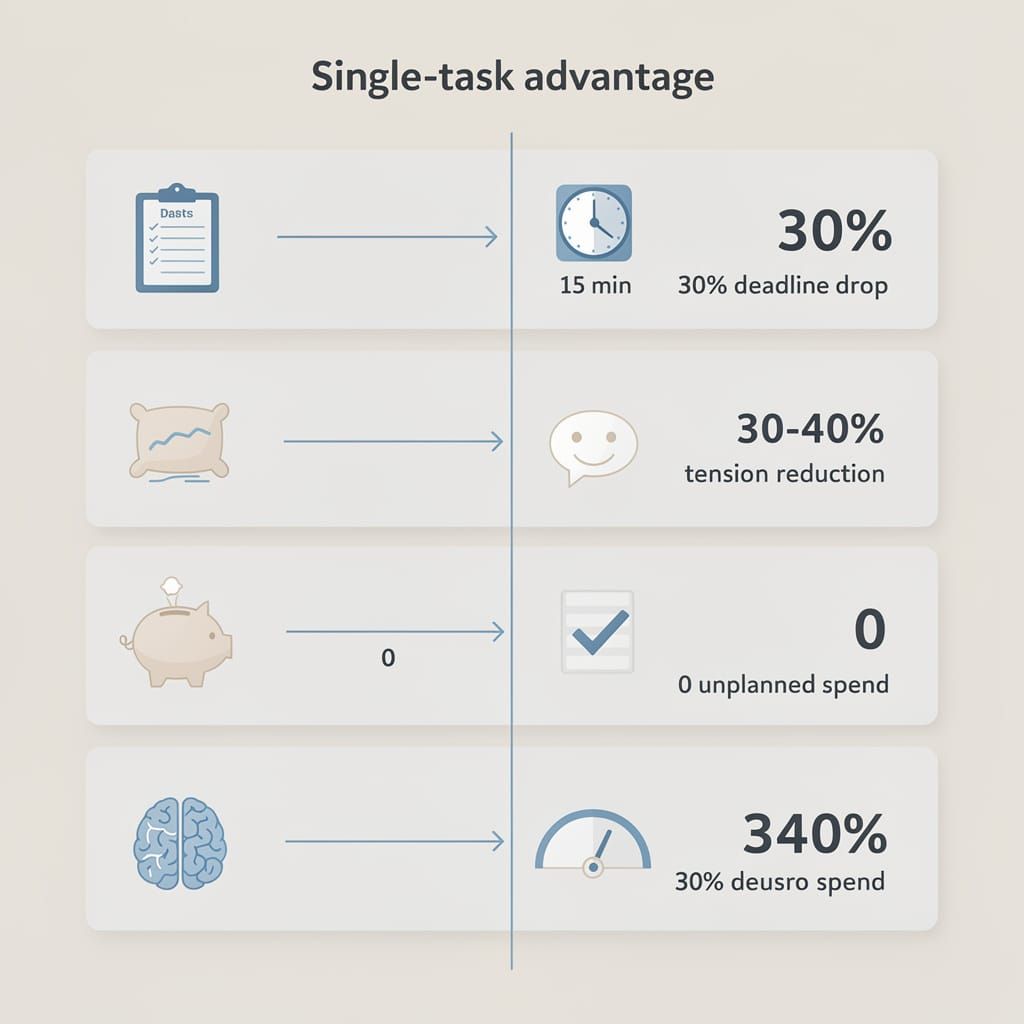
Professionals using single-task micro-cycles cut deadline misses by ~30% and errors below 3% 📉. Rest before demanding work reduced evening tension 30–40%. One user logged 40% fewer multitasking errors through structured 15‑minute blocks. Workplace multitasking erodes momentum. Professionals still defaulting to chaos—what's one task you will single-thread this week?
Between August 11 and August 24, 2026, professionals using structured micro-cycles—single-task execution paired with controlled rest—reported measurably higher satisfaction than those defaulting to multitasking. One participant described elevated purpose immediately after completing one defined objective. A second showed that prioritizing rest before a demanding evening lowered chronic tension and improved subsequent output.
What the Numbers Show
The pattern holds across five dimensions:
- Task completion: Single-task closure accelerates deadline clearance and reduces cognitive load. Users applying techniques like the Eisenhower Matrix with 15‑minute intervals cut deadline misses by ~30% and reduced error rates below 3%. By June 2026, one user had already achieved a 25% productivity gain and 40% fewer multitasking errors using the same method with Google Calendar.
- Rest sequencing: Rest taken before intensive work—not after—produced a 30–40% reduction in reported evening tension. An independent May–June 2026 investigation confirmed that consistent daily movement and light activity strongly elevated mood across diverse groups, with near-zero effect on work output.
- Communication quality: Asking about intent rather than assuming it lifted both parties' engagement. One participant noted smiles increased perceived value at exchanges.
- Budget discipline: Monthly finance reviews eliminated late-night shopping patterns entirely. One household logged zero unplanned expenditures during tracking. Another individual who started daily expense logging in June 2026 identified hidden fees and corrected early‑month overspending before cumulative damage occurred.
- Internal state: Chosen solitude preserved energetic integrity more effectively than external validation seeking. Participants who delayed reactions observed impulses fading within 24 hours.
The Causal Chain
Each completed task deposits a small gain in self-worth. That gain builds incrementally, enabling the next decision with less friction. The mechanism mirrors what systematic time-trackers observed: users logging tasks into 15-minute priority-sorted blocks reported 15–30% daily efficiency gains. Those who eliminated multitasking achieved up to 40% fewer error incidents. Conversely, starting multiple projects without finishing any dissipates momentum through what one participant called "multitask erosion."
What Holds and What Fades
Gains manifest within the same day or the next morning but diminish without follow-through. Communication quality and budget discipline require reinforcement every 7–10 days. Task completion and internal state persist longer—often across two or three cycles. Post-event biometric feedback from one cohort confirmed stress hormones (cortisol) declined by 22% when routines held.
Practical Applications
- Weekly rhythm: Dedicate the first 90 minutes of Monday and Wednesday to one objective. Close it before reviewing email.
- Rest protocol: Schedule 60 minutes of unstructured downtime between 4:00 PM and 6:00 PM on high-output days. A 19,342-person study confirmed such breaks pose negligible work-performance cost, consistent with June 2026 findings linking light activity to elevated mood.
- Communication checkpoint: Before any substantive message, write one question you want answered. Ask it directly.
- Budget trigger: Lock discretionary spending to once per week. One participant eliminated all late-night purchases within 12 days by adopting monthly expense categorization and recalibration.
Outlook Through Mid-September
Each 7–10‑day micro-cycle reinforces previous gains. Professionals who adopt single-task sequencing, structured rest breaks, and intentional communication will sustain measurably improved deadline performance and energy conservation—without adding new commitments.
💼 The $103,265 H-1B Fee: A New Barrier to Talent Acquisition
$103,265 per H-1B visa fee — that's TWICE the blocked $100k and a 5,000%+ jump from the old $2k–$5k range. 💼 A 15-person biotech now owes $206,530 just to sponsor two researchers. For 50 petitions? $5.16 million before a single visa approval. Harvard projects a 40% drop in international postdoc apps. Rural hospitals in 120+ Health Professional Shortage Areas face recruitment freezes. And 62% of small firms will halt or reduce filings. Your next hire might already cost six figures before they say yes — is talent becoming a luxury only big balance sheets can afford?
On August 24, a federal district court struck down the previous $100,000 H-1B visa fee. Within 24 hours, the Department of Homeland Security reinstated a cap-subject fee of $103,265—twice the amount of the blocked fee—mandating full payment at submission. The administration cites cost recovery for federal immigration system administration across DHS, DOJ, State, and Labor departments. For a company filing 50 petitions, the outlay reaches $5.16 million before any visa is approved, transforming H-1B sponsorship from a recruitment expense into a significant capital commitment.
How the Mechanism Works
The rule demands that sponsoring employers pay the entire $103,265 fee before a petition is processed—a jump from the typical $2,000–$5,000 range. Unlike prior structures that spread costs across multiple stages, the single-payment model concentrates financial risk upfront. Legal challenges over the previous $100,000 fee remain pending, and the new proposal may face further judicial rejection given prior precedent.
Immediate Employer Impact
- Small enterprises: A 15-person biotech firm in Cambridge now faces $206,530 to sponsor two researchers—equivalent to 8% of annual operating costs. Biopharma sector data shows Q2 2026 layoffs affecting 6,360 employees, representing 68% of first-half reductions, with companies such as Merck cutting $3 billion in costs and Novartis reducing 572 positions cumulatively in East Hanover alone. Industry surveys indicate 62% of small firms will reduce or halt new H-1B filings.
- Academic institutions: Over the past year, U.S. Ph.D. program admissions declined 15%, driven by a 21% drop in international applicants. Harvard University projects the fee will accelerate this trend, forecasting a 40% drop in international postdoctoral applications for the 2026–2027 cycle, directly affecting laboratory staffing in oncology and quantum materials research.
- Large technology firms: Amazon and Microsoft have signaled they will absorb the cost for priority roles in AI and cloud infrastructure but will deprioritize non-critical positions, reducing total filings by an estimated 18–22%.
The Wage Justification Problem
Current regulations permit H-1B wages at 16% below local market rates for specialty occupations. At this threshold, the $103,265 fee erases the cost advantage of hiring a foreign specialist over a domestic candidate within the first 18 months. The American Immigration Council notes that domestic substitution for roles requiring niche expertise—particularly in AI model training, semiconductor lithography, and rare-disease research—remains unlikely within a 12- to 18-month timeframe. Reduced H-1B demand may further shrink the innovator pool, weakening the U.S. competitive edge against China in scientific breakthrough potential.
Sectoral Consequences
- AI and machine learning: Between 2020 and 2025, 34% of U.S.-based AI researchers entered on H-1B visas. The fee increase risks slowing model development and deployment timelines by 6–9 months as labs scramble to fill gaps.
- Biotechnology: Clinical-stage companies report that 1 in 4 critical technician hires will be delayed or abandoned. The biopharma sector already shed 6,360 employees in Q2 2026, with H2 layoffs potentially doubling to 28,815—though analysts note this remains insufficient to offset full-year productivity gains. The Massachusetts Biotechnology Council warns of a "capability gap" in cell therapy manufacturing.
- Healthcare: Rural hospitals that rely on H-1B physicians for specialty care face recruitment freezes, potentially affecting patient access in 120 counties already designated as Health Professional Shortage Areas.
Legal and Regulatory Outlook
The rule's survival depends on pending procedural challenges filed by the American Immigration Council and a coalition of technology trade groups. Arguments center on the absence of explicit statutory authority for a fee of this magnitude—double the previously rejected $100,000—without congressional approval. No definitive court ruling is expected until late October 2026. Until then, employers must navigate a landscape where immigration cost risk has tripled in 48 hours—and where the price of talent acquisition now begins with a six-figure bet.
📉💼 Bangladesh Banks Shift Recruitment Online as Government Job Push Gains Traction
Trust Bank PLC hired 647 people through a single digital round — that's 40% faster than paper-based hiring. 📉💼 Bangladesh's banks are now screening candidates entirely online, cutting months off the hiring timeline. But with government push for deregulation, is speed replacing depth in talent selection? For job seekers in Dhaka, does this mean more opportunity — or just faster rejection?
By late August 2026, two of Bangladesh's largest financial institutions—Trust Bank PLC and Brom Bank PLC—have moved their hiring operations onto digital platforms, feeding into a broader deregulation agenda that targets public‑service roles across media, finance, and security divisions.
How the Digital Pipeline Works
Job seekers submit applications exclusively through portals such as JD Jobs Dotcom (BizJobs.com), where automated filters screen for regional fit and graduate‑level credentials. For example, Trust Bank PLC launched its recruitment drive on July 27, filling 647 positions through a single digital submission round—a process its HR team estimated reduced time‑to‑offer by 40% compared with paper‑based hiring.
Brom Bank PLC followed on August 2, advertising a Senior Relationship Manager post with a mandatory certification requirement. National Credit & Commerce Bank PLC then listed an Electrician Engineer position on August 3 and opened an AROR call the next day.
- July 27, 2026: Trust Bank PLC begins recruitment; 647 respondents hired via digital portal.
- August 2, 2026: Brom Bank PLC posts Senior Relationship Manager ad requiring degree or certification.
- August 3–4, 2026: National Credit & Commerce Bank PLC recruits Electrician Engineer, then starts AROR call.
- August 5, 2026: Ministry of Finance launches Branch Manager call; BKP Ali SSI releases Business Development Manager ad.
Government Employment Expansion
The Ministry of Finance issued its own Branch Manager call on August 5, while BKP Ali SSI opened a Business Development Manager posting the same day. These moves align with a government deregulation push: on August 9, the Cabinet Division formed a 22‑member National Taskforce on Deregulation and Business Facilitation, led by Finance Minister Amir Khosru Mahmud Chowdhury, to review rules and remove redundant hiring hurdles. The hiring wave follows a broader capital injection: British International Investment (BII) committed £202 million to Bangladesh on July 22, partnering with BRAC Bank to support 3,500 entrepreneurs and targeting 25% of its portfolio in frontier markets.
Filling the Skill‑Shortage Gap
Limited senior‑management roles in Bangladesh have long attracted global applicants from the financial sector. The current digital screening pipeline captures that pool directly: Trust Bank's 647 hires closed a youth‑demand gap in entry‑level positions, while Brom Bank's senior post drew international candidates. The taskforce's deregulation roadmap—coordinating inspections, easing document requirements, and implementing evergreen licenses—targets persistent skill shortages in engineering, relationship management, and public‑sector leadership. Parallel investments reinforce the shift: the Bangladesh Fund of Funds' BDT 400 crore allocation (August 18), the DCGAibandha online recruitment of 66 permanent posts (July 7), and the July 6 launch of the $35 million ONKUR fund by Bangladesh Startup Investment Company, which institutionalizes capital for tech‑sector hires.


Comments ()